Thursday, October 5, 2017

A 2017 Corn Report: Mother Nature Won

Mother Nature won. In the epic battle of Farmer vs. Mother Nature, she denied access to timely rain. She opted for 100-degree temperatures during critical growing times. She would tease us with rain clouds we could see on the horizon but kept the raindrops from falling on our parched fields.

So, it's a bit anticlimactic to report on Corn Harvest 2017. On second thought, let's just keep it lower case ... corn harvest 2017 doesn't deserve the capital letters. It was not a bumper crop. In fact, it was the worst corn crop we've had in the five years since adding it to the crop rotation on the County Line.
 
 Our 320 acres planted to corn yielded an average of 43.6 bushels per acre.
 

Since we are a totally dryland farming operation, we are dependent upon Mother Nature's rains and her heat index during critical times like pollination. She seems to be like the playground bully when it comes to County Line corn.
To compare with previous years, 2016's overall average was 71 bushels per acre. Our first year of corn production was 2013, and we had an average yield of 57 bushels per acre. In 2014, we had our best year to date, with an average of 108 bushels per acre. Overall yield average for 2015 was 43.88 bushels per acre.
The journey toward Corn Harvest 2017 began in April, when Randy planted the crop. (For a look back along the way, click on this link.)
April 2017:  The corn seed in the middle of the photo was at the end of the row, where Randy turned. Most of the seeds end up underground, where they are supposed to be, but I still liked the photo.
May 2017
We finished corn harvest September 25, but it would have been sooner had we not had some combine problems.

Our 320 acres of corn likely sounds like small potatoes - or small sprouts - to anybody who has circles of corn.
But we are primarily wheat farmers, and we were thankful for our second-best wheat crop ever here on the County Line.

After a nice, gentle 3.40" rain the week before, we started planting wheat on October 2. However, we've gotten 0.50" in the past couple of days, so we are at a standstill in that process. No complaining about moisture is allowed! We'd like to keep on Mother Nature's good side for this crop.

More on wheat planting to come ...

Tuesday, October 3, 2017

Hills and Valleys

A song has played in an intermittent loop on my mental soundtrack for the past couple of weeks. It momentarily gets bumped to the background by a hymn we sing at church or a song on the actual radio dial.

But, if there's no music playing, it's a song that keeps resurfacing on my internal radio feed. It started on a trip to South Dakota.  Randy had gotten a phone call that his brother, Lyle, was in the hospital in Rapid City, so we hurriedly finished some obligations, then got in the car a couple of days later for the 12-hour trip.

We traveled across our Kansas plains, skirted the Nebraska sand hills and arrived on the plains of South Dakota. But as we got closer to Rapid City, the plains gave way to the Black Hills. It was dark by the time we arrived that first day, but I could still see the faint outline of hills as we drove west. And I first began thinking of Tauren Well's song, "Hills and Valleys," a song that I've heard quite a bit on K-LOVE, a contemporary Christian radio station.

Hills and Valleys
(Find all the lyrics at this link)
Find the story behind the song at this link
Sung by Tauren Wells

On the mountains I will bow my life to the One who set me there
In the valley I will lift my eyes to the One who sees me there
When I'm standing on the mountain I didn't get there on my own
When I'm walking through the valley I know I am not alone
You're God of the hills and valleys, hills and valleys
God of the hills and valleys
And I am not alone

The next few days, we spent most of our time in the hospital ICU, but we also went to Deadwood to retrieve a few things from Lyle's apartment.
  
Painted Lady butterflies danced and swirled in the flower gardens in front of his apartment building, reminding me of their "cousins" I'd left behind in Kansas.
There's beauty everywhere, even when your mind is swirling with other concerns. On the way back from Deadwood, we made a wrong turn and ended up in Wyoming.

But our "wrong" way transported us to the "right" place all along. We saw glimpses of a small stream as we drove. Finally, there was an extra-wide shoulder and we pulled off to explore.
Before I ever reached the clearing, there were more butterflies.
 
And then we stepped into the stillness of the pine trees. It was quiet. Just the rush of water flowing over a small waterfall hidden in the trees marred the silence. The water was enough to mask any sounds from the highway, though it wasn't busy anyway.
The tall pines and their shorter neighbors provided a maze of light and shadows.
Light and shadow ... our little oasis of beauty and pleasure in a sea of illness and shadow and uncertainty. And I remembered more of those lyrics ...
I've walked among the shadows
You wiped my tears away
And I've felt the pain of heartbreak
And I've seen the brighter days

And I've prayed prayers to Heaven
From my lowest place
And I have held Your blessings
God, You give and take away


No matter what I have, Your grace is enough
No matter where I am, I'm standing in Your love

Later, after Lyle was transferred by ambulance to a hospital in Montana, we drove to Mount Rushmore.
It was overcast, and the rain clouds blew in, causing pine needles to pummel us as they fell from the trees surrounding the monument.
And, again, the words from "Hills and Valleys" came to mind:

Father, You give and take away
Every joy and every pain
Through it all, You will remain
Over it all ...

And I will choose to say
Blessed be Your name
And I am not alone


Yesterday, we started planting wheat. My trip to Zenith to get a load of fertilizer was on the flat landscape of our Central Kansas home. There were no literal hills and valleys to traverse. But as tragedy unfolded on television screens and on radio stations yesterday from Las Vegas - and in real life for way too many people - those words again resonated.

And I am not alone.


Thursday, September 28, 2017

Les mauvaises terres a traverser (The Badlands)


The "flowers" bloomed from earth that looked more like gravel than quality soil. The wispy yellow blooms seemed out of place when set against a jagged and unforgiving landscape. It was a little like pinning a boutonniere on a grungy work shirt. It made you look twice to make sure it wasn't a mirage. 
Our unplanned trip to South Dakota wasn't a tourist trek. We had made the 12-hour drive to be with Randy's brother, Lyle, in the hospital. But on our way back to Kansas, we drove through Badlands National Park.
Closeup, the unyielding land seems anything but beautiful or productive. But the sweeping landscapes of peaks, gullies, buttes and prairies help you overlook the unforgiving soil.
It's another one of those "you've-got-to-see-it-to-believe-it" places. It's also a place where amateur photos just don't capture how beautiful it truly is (kind of like Grand Canyon photos).
But, of course, that didn't keep me from attempt after attempt!

In some places, it looks like I imagine the surface of the moon to be - full of craters and crevices.  But instead of the totally "black hole" of space, a blue fall sky provided the backdrop for the stark environment.
In other places, it was almost as if the rocks formed cathedral spires, like architecture from the natural world.
 
In fact, architect Frank Lloyd Wright wrote in 1935: "I've been about the world a lot and pretty much over our own country, but I was totally unprepared for that revelation called the Dakota Badlands. What I saw gave me an indescribable sense of mysterious elsewhere - a distant architecture, ethereal ... and an endless supernatural world more spiritual than earth but created out of it."
It's amazing how much the landscape changes from one overlook to the next - from browns, to reds to yellows and tints in between. The Lakota Indians knew the place as mako sica. Early French trappers called the area les mauvaises terres a traverser. Both mean "bad lands."
By mid-September, children are back in school and families aren't on a summer road trip. But there were still plenty of people exploring the terrain - from those on motorcycles to private cars to buses to campers - all of us in awe of God's creation. 

“The Bad Lands grade all the way from those that are almost rolling in character
 to those that are so fantastically broken in form and so bizarre in color
 as to seem hardly properly to belong to this earth.”
— President Theodore Roosevelt

Authorized as Badlands National Monument on March 4, 1929, President Franklin Roosevelt issued a proclamation on January 25, 1939, that established Badlands National Monument. In the late 1960s, Congress passed legislation adding more than 130,000 acres of Oglala Sioux tribal land (used since World War II as a U.S. Air Force bombing and gunnery range) to the Badlands to be managed by the National Park Service. 
 
An agreement between the Oglala Sioux Tribe and the National Park Service governing the management of these lands was signed in 1976. The new Stronghold and Palmer Creek units added lands having significant scenic, scientific and cultural resources, according to the National Park Service. The park consists of nearly 244,000 acres of sharply eroded buttes, pinnacles and spires blended with the largest, protected mixed grass prairie in the United States.

More than 11,000 years of human history pales to the eons old paleontological resources. Badlands National Park contains the world’s richest Oligocene epoch fossil beds, dating 23 to 35 million years old. The evolution of mammal species such as the horse, sheep, rhinoceros and pig are studied in the Badlands formations by scientists.
The only animals we saw were big horn sheep, some of which grazed near the roadways. Well, I take that back. We also saw prairie dog towns, and several photographers flocked to those areas to play hide-and-seek with the rodents. However, I can see prairie dogs as I drive toward WalMart in Hutchinson, so we skipped that stop.
I also imagined a bird perched on top of the rock when I saw this formation.
And I thought an animal could have been crouched inside this "cave."(On the lefthand side of the shot.)
 
 The Badlands wasn't all massive rock formations. There were also some areas of plains.
But it was time to return to our own home on the Kansas plains. So we left the Badlands behind and hit the road.
Our only tourist stop in Nebraska was a quick gaze from the overlook of the Valentine National Wildlife Refuge. And then we headed the car south to our home near the Quivira National Wildlife Refuge.


Tuesday, September 26, 2017

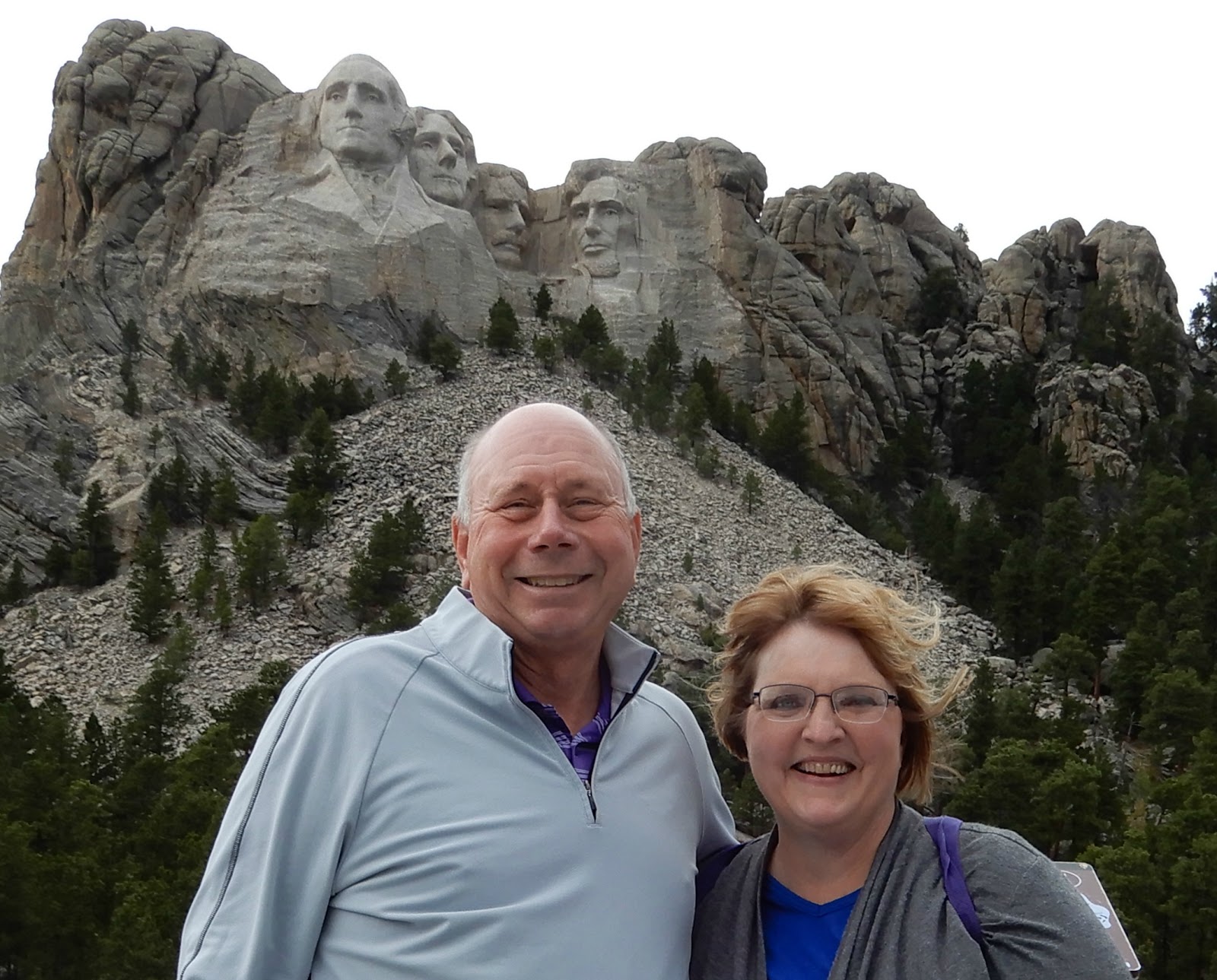
Our Mugs Visit Their Mugs


"... let us place there, carved high, as close to heaven as we can, the words of our leaders, their faces, to show posterity what manner of men they were. Then breathe a prayer that these records will endure until the wind and rain alone shall wear them away."
Gutzon Borglum, Mount Rushmore sculptor, 1930


Taken September 19, 2017. Why does my hair always look like the "before" picture?

As a former newspaper Focus editor, I often had to incorporate "mug shots" into the pages I designed. There were people celebrating milestone birthdays, others marking 50 years or more of marriage and young couples just starting on their matrimonial journey.

Mug shots - or the dreaded "grip and grin" shots from a ribbon cutting or awards banquet - weren't the preferred illustration for newspaper editors. We much preferred action shots or unusual angles ... the photos that made the reader stop for a second look. (Of course, those head shots with anniversaries and weddings and such were probably the best read of the section, if I'm honest. People like seeing their friends and family in newsprint.)

But I couldn't resist having a stranger take our "mugs" visiting the "mugs" of a rather famous four guys in American history.  I returned the favor for several fellow tourists.

A trip to Mount Rushmore was not on the docket this September. However, Randy's brother was in the hospital in Rapid City, and Randy wanted to make the trip to South Dakota. After his brother was transferred to Montana for additional rehabilitation, we became tourists for the afternoon.

The day was gray, but the rain held off until after we'd been up and down the steps and trails that gave us different angles to view the monument.
 
As I looked at this monument carved out of the Black Hills of South Dakota, I kept thinking about what a genius sculptor and artist Gutzon Borglum had to have been. He didn't have any computer models. He didn't have modern equipment. He didn't have state-of-the-art blasting tools. He used a protractor ... yes, a protractor ... to figure out the measurements and dimensions.

And I realized that while Borglum didn't have modern contraptions, he had something much more valuable: He had vision. He could "see" through the layers of rock. And he had the skill and determination and intestinal fortitude to make it happen.
More than 450,000 tons of rock were removed from Mount Rushmore to bring out the four presidential faces. Although about 90 percent of the rock was removed with dynamite, the remaining rock was removed by drilling with jackhammers and wedging the rock off the mountain. The final finishing work on the faces was completed using small jackhammers and facing bits.

As with many monumental projects, not everybody was on the same page at first. In 1923, Doane Robinson, the superintendent of the South Dakota State Historical Society, had envisioned a massive mountain memorial carved from stone so large it would put South Dakota on the map and bring tourists by the carload. Robinson was dreaming of Western figures such as Chief Red Cloud, Buffalo Bill Cody, Lewis and Clark and other Western heroes.

 
But Borglum didn't share that vision. The outspoken sculptor told Robinson that his life's work would not be spent immortalizing regional heroes. Instead, he insisted the work demanded a subject national in nature and timeless in its history.

By selecting four presidential figures for the carving, Borglum wanted to create a reminder of the birth, growth, preservation and development of a nation dedicated to democracy and the pursuit of individual liberty.

In these days when the nation seems so divided, those ideals are worth remembering, don't you think? 
While we were in South Dakota, Randy read an article that said peak beauty for fall foliage was still a week or two away. We did find a little bit of fall color decorating our way.

Thursday, September 21, 2017

Painted Ladies Come to the Neighborhood


A bunch of Painted Ladies have come to Stafford County. It may sound like a Red Light District is infiltrating the countryside. But these Painted Ladies are much more genteel.
Painted Lady butterflies – which look similar to monarchs – are flourishing in Central Kansas “exponentially more” than usual, according to Jim Mason, director of Wichita’s Great Plains Nature Center, in a Wichita Eagle interview. Favorable weather conditions in Oklahoma and Texas earlier this year allowed multiple generations of painted ladies to thrive, Mason said. Now they've arrived in Kansas.

Enjoy them while you can, Mason said, because they won’t last long. Unlike monarchs, which have a north-south migration pattern, painted ladies – which have a lifespan of anywhere between two weeks and a month – don’t migrate away from cold temperatures.

“They will just generally go north and breed, lay eggs and die,” Mason said. “Come winter time, whichever ones are left here will perish – then the whole thing starts over again next year.”

It may look like I just waltzed out to the road and quickly got a photo of a Painted Lady in full regalia, spreading her wings and showing off the goods. But it took a whole lot of frames with her wrapped up like a modest lady in her robe - keeping her wings tucked together.
Admittedly, they are pretty with just their "underwear" showing, too. But between their quick movements as they collected nectar and the sunflowers swaying in a warm Kansas breeze, it was not an easy photo shoot.
I also had tried the day before at the Rose of Sharon shrubs we have at our north driveway.
They were modest then, too, though one was willing to share the spotlight with a clouded sulfur "cousin."
I didn't realize I'd gotten a second Painted Lady with her wings spread until I got back to the computer. (See the arrow pointing at the other butterfly.)
It was a Where's Waldo moment, kind of like seeing a yellow clouded sulfur butterfly on a yellow sunflower.
They were equal opportunity nectar gatherers: They liked the flowers in their own color and those in other hues. There could be a lesson there, I suppose.

A Time to Pray

Dear Lord, today I will notice Your hand in the details
that magnify Your love here on earth.
(From my email Guideposts devotional)


Read more here: http://www.kansas.com/entertainment/ent-columns-blogs/keeper-of-the-plans/article173023761.html#storylink=cpy