Thursday, May 9, 2019

Morning Drive Time: Country Style

The big-town radio stations talk about morning drive time. They'll play a mix of music to get commuters from suburbia to their downtown office jobs. It's where the stations sell their best advertising space, since it's when the drivers are held captive by bumper-to-bumper traffic. Or so I've been told.

I don't know about that kind of morning drive time. Even when I was commuting back and forth from our farm to Hutchinson to work every day, the traffic was never bumper to bumper.

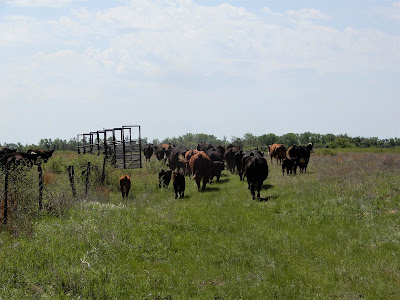
But our current kind of "drive time" has less to do with traffic and more to do with "driving" cattle. And it involves a 4-wheeler. There are potholes, to be sure. But they are more likely old buffalo wallows than asphalt broken down by winter de-icing.
Randy says we use "Japanese horses" for our drive time. In other words, we don't have horses. But a neighbor used the real thing on a Saturday morning cattle drive a couple of weeks ago.
We got a front-row seat from our porch.
One little calf was lagging behind. He got roped and then got a chauffeured ride in the trailer.

All our cows and calves are transported by trailer, since there's too much distance between the corrals and our summer pastures.

Our morning drive time isn't without headaches though. Big-city commutes may be marred by accidents, timing and weather. Our country version is at the mercy of the weather, too. Rain slowed our annual drive from our cattle's wintertime accommodations to their summer vacation spots.

Thankfully, Monday was the final day for this annual exodus, which we usually try to accomplish by May 1. We missed the rains on Sunday night, which allowed the road to the Big Pasture to dry out enough from the 1.70 inches of rain we got last week. We had to have the vehicles in four-wheel drive and gun them a bit to get through one low-lying place.

But we've since had an additional 3.40 inches of rain. If we hadn't gotten the final group moved on Monday, there would be no hope of doing it the rest of this week. The corn we planted where it was too wet to plant wheat last fall is definitely getting its "feet" wet. We'll see how much replanting we need to do.
Wednesday, May 8, 2019, a corn field after 5.20" of rain 
Corn is planted on both sides of the road ... under the "lake"
Because we couldn't move the pairs to the Big Pasture because of wet roads, we moved the bulls to their pasture last week. They had been romancing the heifers, but some of them now needed to turn their attention to the cows that would end up at the Big Pasture
After a little sorting, a couple of them made the ladies' acquaintance late last week, so they were also part of our Monday round-up.  
Randy points the way to the ladies: "Go east, young men!"
Back to the morning drive time: Monday was a beautiful day for our final cattle round-up. Randy and I were on 4-wheelers to get the cattle from the pasture south of our house into the lot where we could sort and load them. 

Driving cattle is a little like working with junior high girls. It's easier to get them to do what you want them to do if they are among friends. It's kind of like a trip to the girls' bathroom at a junior high dance. It's best accomplished en masse.
We herded them up toward the corrals.
It took a bit of encouraging to get them to go through the big mud puddle, but they eventually made it into the corrals where we sort. Separating mamas and babies is always part of the process. We haul the babies separately so they don't get stepped on in the trailers.

There are usually a few pairs in each group that we need to sort off as well. They may be older cows and their calves, since Randy plans to sell them at the end of the summer. Or they may be going to a different location because Randy wants an optimal number on each pasture.
Randy makes a handy-dandy written list that I can hold in my hand for that process. That always works better than me trying to remember numbers. Happy helpers make the process go more smoothly.

I may be happy, but the mamas aren't. We have our share of protesters, loudly lamenting their withdrawal from their offspring. I can relate. I remember that first day of kindergarten when the big yellow bus swallowed up my precious cargo. And I knew they were coming back!
The calves seemed to suffer less separation anxiety. Of course, they likely weren't hungry at the time.
 But they eventually got to reunite and took off to explore their summer time vacation home.
This group arrived at the Big Pasture, which has been in Randy's family for more than 100 years.

THE NINNESCAH
In the big cities, road construction may slow the morning commute. Thankfully, a little road construction in the last month or so helped our commute immensely.

Last fall, we did our form of mud-wrestling as we brought pairs home from the Ninnescah. After 14-plus inches of rain, our normal route was not passable, so we ended up driving an extra 12 miles each trip. We also wiped out a corner post because of muddy conditions.
 
Thankfully, the county repaired the road. And the guys repaired the entrance to the pasture. They added a new corner post and made the entrance much wider, which should help avoid problems in the future, even if we have to turn in from a different direction.
Randy came up with a farmer solution to hold the new gate open. It only took him a little while to find a sturdy stick with a helpful "y."
The cattle making the move to the Ninnescah arrived in late April, thanks to the repaired road.

PALMER PASTURE
The ladies who'll become mamas for the first time next January arrived at the Palmer Pasture last week.
Even though it was a cloudy, overcast day, I always think the setting with the old cottonwoods is picturesque.
Now, unless we get phone calls about escapees (fingers crossed that doesn't happen), everyone is in place and ready to spend the summer. When do I get a vacation?

Tuesday, May 7, 2019

Birds of a Feather

I went along for the ride on Randy's excursion to the Stafford golf course Saturday evening. It was too wet to move our last group of cows and calves. We'd been watching the Kentucky Derby coverage for hours, and it was still a hour away. So I set the DVR and decided I could watch it on tape.

Little did I know that everyone would be watching the tape. Over and over and over again. (Maximum Security, who crossed the line first, was ultimately disqualified and Country House became the declared winner.)
It was a beautiful evening at the golf course. Not too hot, not too cold, not too windy. I could hear the windmill in the pasture to the south creaking its usual song, accompanied by bird calls.

Randy pointed out a bluebird as we drove from one hole to the next, but I missed it. He has eagle eyes - pun intended.
A lot of golfers were also enjoying the Stafford course Saturday night. As we waited for Randy's turn to tee off at another hole, he saw another bluebird. And this one stayed posed while I surreptitiously grabbed my camera and got him in my sights.
When mother nature made the bluebird she wished to propitiate both the sky and the earth, so she gave him the color of the one on his back and the hue of the other on his breast.
John Burroughs
Naturalist and essayist
(I'm on a John Burroughs quote kick. I also used his words for my May basket and nest post.)
 
This was an Eastern bluebird. As Randy says, we've both seen more bluebirds this year than we have in our entire lifetimes. In February, a group of Mountain Bluebirds made a stop in the pasture to the south of our house.
The bluebird carries the sky on his back.
Henry David Thoreau

The bluebird wasn't our only bird encounter this weekend. Randy also found an injured baby hawk in one of our farm sheds.
 Randy thinks one of its wings was battered and broken.
This was the same shed where we'd had the nest of robin's eggs a couple of springs ago.
The big old trees that surround our house provide plenty of real estate for birds, but I'm usually not lucky enough to capture them with my camera. So I just enjoy the serenade. These close encounters were a bonus!

Another bonus: We were finally able to move the final group of cattle to the Rattlesnake Pasture on Monday. More on that later, but - spoiler alert - mission accomplished!

Wednesday, May 1, 2019

Lilacs, Bird Nests and May Day

 
To find the air and the water exhilarating
To be refreshed by a morning walk or an evening saunter
To be thrilled by the stars at night
To be elated over a bird's nest or a wildflower in spring.
These are some of the rewards of a simple life.
John Burroughs, American naturalist and essayist


May arrived on the coat-tails of April showers, causing the backyard lilacs to gleam with delicate dew. The lilacs' fragrance mingles with the aroma of raindrop-tinged earth on this May Day morning. It's as though the Earth is celebrating May Day with its basket overflowing.

Though it may not feel like spring with cooler-than-normal temperatures, the backyard flowers and shrubs are waking up from their winter's nap. American naturalist and essayist John Burroughs said it better than me:

Oh, spring is surely coming!
Her couriers fill the air. 
 
Each morn are new arrivals.
 Each night her ways prepare.
 
 I scent her fragrant garments. 
Her foot is on the stair.
John Burroughs, American naturalist and essayist

A bird's nest holds the promise of new life amid spring flowers.
A single robin's egg is a splash of blue in an old evergreen bordering our backyard fuel tanks.
And the bees buzz with excitement, gathering nectar from the lilac bushes.
The smell of moist earth and lilacs hung in the air
 like wisps of the past and hints of the future.
Margaret Miller
Today is May Day. When Jill and Brent were little, we made and delivered May baskets. They are traditionally filled with flowers and treats and left hanging on a friend's or neighbor's front doorknob. Once the basket is in place, the deliverer rings the doorbell and runs off to hide and watch the recipient's reaction.
Randy's folks lived just two miles north of us when Jill and Brent were small, and we often delivered a May basket to them. Their over-the-top reactions always thrilled my little cohorts. It wasn't long until Jill and Brent couldn't contain the "surprise" and burst out from the bushes to greet Grandma and Grandpa.

I suppose I have photos of these events ... somewhere in one of the tubs full of photos. But without a full-blown reconnaissance mission, I didn't locate one (though here's a cute one from that time period).
This year, the lilacs under the old windmill in our backyard are blooming in time for May Day. Some years, they are past their prime by May 1.
The lilacs are not the only nod to spring.
The spirea bush looks like miniature bridal bouquets in a sea of green.
Though we wouldn't have thought about needing rain after 15 inches fell in a month last fall, we are grateful for the 1.70 inches of moisture we've gotten this week. It should knock the dust down as we sort and move cows and calves this afternoon and tomorrow. And it's good on the corn that was just planted, too.

Happy May Day!

Tuesday, April 30, 2019

In Sync

Alfred Lord Tennyson once said, "In the spring, a young man's fancy lightly turns to thoughts of love."
Well, I don't know about love, exactly. But it's "birds and bees" time on our Kansas farm. Last week on Earth Day, we ran the heifers through the working chute in preparation for this season of "love," or, more accurately, lust.

Earlier, the bulls had their doctor's appointments with Veterinarian Bruce Figger to make sure they were ready to fulfill their job description here on the County Line. But the bulls aren't the only factor in the "birds and bees" of a Kansas cattleman. The heifers who will become first-time mothers next winter also have been getting some extra care.
Beginning in March, our 25 yearling heifers had their silage topped with MGA. MGA is melengestrol acetate, which suppresses the ovulation cycle for the heifers. For 14 days, Randy added the MGA to the silage and fed the equivalent of 1/2 a pound per head per day.
This was the first step in getting the heifers to come into estrus (or heat) at the same time. These young ladies were born in early 2018. In 2020, they will become mothers for the first time.
During their Earth Day "doctor's" appointment, the heifers each got a shot of Lutalyse, which makes them come into heat. We do this to synchronize the heifer's reproductive cycles.
N'Sync isn't just a singing group. We get the heifers' reproductive cycles "in sync" to shorten the calving season for the heifers, which saves labor at calving time. (Well, it saves some labor for the humans - not the mama cows.) Because heifers are first-time mamas, we check them frequently in case they are having trouble calving.
 
 Randy also gave each heifer a vaccination to prevent respiratory issues and diarrhea.
Then it was time to introduce the guys to the ladies. Some 283 days later, the babies are supposed to arrive. So we will expect to get our first 80-pound bundles of joy next January 28 or so. 

Later this week, we'll be moving the remainder of the older cows to summer pastures. Then, we'll "assign" bulls to their respective pastures. 
The bulls are ready. The cows are ready. And if all goes as planned,  the miracle of life begins yet again on the County Line.