
Beef in the deep freeze: That's what my Sunday Facebook post said, along with several photos showing snowy conditions during cattle feeding.
I called it my Farmer Joke of the Day.
But the prolonged wintry temperatures are no joke for cattle producers, especially those in the midst of calving.
However, in reality, the cattle are more comfortable than I am. Really.
Yes, they have snow on their backs.
Yes, I can see their breath as they stand at the bunks.
And, yes, they are more comfortable than I am even though I'm doing an impression of the Michelin tire man with my long-sleeved shirt, two sweaters and two insulated chore sweatshirts, along with long underwear under jeans, two pairs of socks, insulated work boots, insulated gloves and a stocking cap.
It's not a pretty look. But in a feed truck with a heater that's questionable at best, it's the attire of the week.
I posted a series of winter feeding photos on my Facebook page on both Saturday and Sunday.
More than one person commented about wishing all the cattle could be in a barn. One even said it was good she didn't have livestock because she'd want to bring them into her house. (I know she was joking, but I began thinking about just our 100 feeder calves stuffed into the main floor of our house and then pushing them up the stairs like you do in a livestock hauler's trailer. And then I'd still have to find room for the 125 mamas and the 35 or so babies who've already been born.)
I don't deny that it's cold. I don't deny that it adds additional work to care for cattle. And I added another sweatshirt to my morning chore attire this week since temperatures will struggle to get out of the single digits.
But before anyone calls HSUS, here are the facts:
Livestock are already well-equipped to tolerate seriously low temperatures, ice, snow and wind. Cows
are not people. When temperatures start to drop in the fall, livestock
begin growing a thicker coat to keep them warm and insulated against the
changing climate. Have you ever felt a cow hide? It's got more heft than one of those currently popular weighted blankets.
When it snows, the hair catches the snow and forms a layer over the cow.
This creates an air pocket between the snow and the cow’s skin, which
is then warmed by the cow’s natural body temperature of 102 degrees. 
At temperatures below 18 degrees, the animal begins to require additional feed in order to maintain body
temperature. As long as this additional energy supply is met by
additional feed intake, the animal will survive just fine.
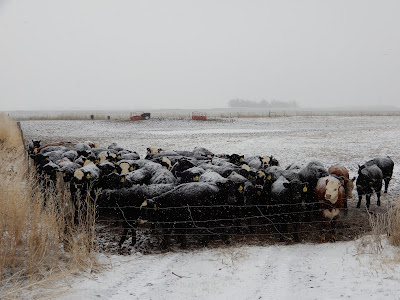
The feeding is where I come in. The feeder calves hear the feed truck and tractor coming and stand at the fence ready to greet us as they await their morning victuals.
(Here's the photo you get when you try to take pictures one-handed while driving toward to the bunks to feed silage. The feeder calves were the babies born on the County Line a year ago.)
Randy uses the tractor to feed silage in the Peace Creek pasture.
During snowy and cold weather, he also spreads out straw for bedding for the mamas and babies.
He repeatedly does this at all four locations that have expectant mothers and babies.

It looks like this mother was left on babysitting duty, doesn't it?
We feed the mamas well. And they, in turn, feed their babies nice warm milk.


We also haul plenty of water. Ice breaking is added to Randy's duties.
Brand new calves are a bigger issue during the extreme cold temperatures. Just like human babies, bovine babies have been floating in a nice warm, body-temperature bath during gestation. But, once they are birthed into the "cold, cruel world," it really is cold and cruel in these below-freezing temperatures.

A commenter on another cattle producer's page said, "Well, you should turn your bull out later. That's your problem."
For most of us having calves right now, this is the time frame that works within our diversified farming operations. This is the time of the year that farmers in our region can devote to more intensive cattle work. It's not during planting or harvest time for crops. (For a time, we had a fall calf crop, too, so there are farmers/ranchers who do avoid the winter or supplement their herd with two calf crops. It is a management decision - not stupidity - despite the commenter's views.)
Most mamas bond with their babies by licking them off. We always hope the mamas will be smart enough to birth their calves in the straw behind a windbreak, giving them some shelter.
 |
File photo - Read more about calves in pickups here.
|
However, if the baby needs a little extra help warming up, Randy gives it a "sauna" treatment in the pickup cab.
We also have calf blankets that we've used on occasion to provide a little extra protection for brand-new babies.

We also have windbreaks at each of the locations where we calve out mamas. The cattle instinctively go to the side of the windbreak that gives them the most protection from the wind.
Researchers say that animals which have been housed outdoors all fall and early winter have become
acclimated to the temperatures.They may even get sick if then put into an enclosed shelter. They
can get overheated, thereby producing moisture in the form of sweat and
respiration moisture. Without adequate ventilation to remove this
moisture, the environment is ideal for respiratory
infections.
Studies
in Montana indicated that during mild winters, beef cattle sheltered by
windbreaks gained an average of 34 to 35 pounds more than cattle in an
open feedlot. During severe winters, cattle in feedlots protected from
the wind, maintained 10.6 more pounds than cattle in unprotected lots.
I will need to continue my impression of the Michelin tire man, according to weather reports. Very cold, Arctic air will hang around for the remainder of the
week with chances for off and on snow showers. Dangerous wind chills
will be likely by the end of the week too. Low
temperatures will drop into the single digits for much of Kansas with
cloudy skies. Northeast winds will make it feel colder. Freezing
drizzle and some light snow will return to southern Kansas Tuesday
night and early Wednesday. More
chances for light snow are expected Friday and Saturday, but it’s too
early to say how much might fall in Kansas. Dangerous cold will hold on
throughout the weekend with wind chills falling 20 to 30 degrees
below
zero.
The weather forecast last night said the frigid temperatures could blanket the area through February 20.

When my farmer came into the house last evening, he said, "Man, I'm tired!" It probably won't be the last time I hear that if the weather forecast is right.


