Tuesday, May 23, 2023

Horse Racing in the Blood


I think my Great Grandpa Neelly would have fit right in during our day at the Keeneland Race Track at Lexington, Ky.

Charley Neelly had a fondness for horses and made money by trading them. He also liked good driving horses and owned 11 race horses during his lifetime. A little of that love of racing must have filtered into my mom's blood and then into mine. She's always liked watching horse racing. On Saturday afternoons in the spring, I remember gathering around the TV in the family room to watch the three races of the Triple Crown. That's still a favorite spring Saturday afternoon viewing choice.  


We had been to Keeneland once before in the dead of winter. Brent was working at Morehead (KY) State University's athletic department at the time, but we only had time to visit in the fall and winter. By chance, an employee there saw us looking around the grounds in January 2013 and gave us an impromptu tour. But Randy wanted to go back to Kentucky to see horse racing. The timing of this Kentucky trip was centered around the race schedule there. Keeneland hosts spring races in April and has a fall session through the month of October.

Even though Randy ordered the tickets shortly after sales opened, we were only able to get general admission. 

We weren't sure how much room there would be, so we arrived as the gates opened. We chose one of the scattered benches provided in general admission and took turns exploring. People in the know brought their own lawn chairs for seating, too.

I had taken a photo of the jockeys when we were there in January 2013. (For that blog post, click HERE.) I repeated that photo in 2023.  

I could have bought a hat there.


But I had brought my Walmart hat, which sufficed.

It may not have been as fancy, but it was more in my price range, and it still kept my face from getting sunburned.

There were certainly plenty of betting windows.


And, of course, there were plenty of concession stands. (The admission price of $7 each ended up being the least expensive part of the day.)

Grooms brought some of the horses into a central courtyard. 


Without their numbers and racing colors, I have no idea what their names were. Some seemed more spirited than others. The one below needed two grooms to keep him in line.

We didn't hear the bugle for the first race, but we did for the other nine races. We definitely had beginner's luck. The first horse we chose - PH Factor - was the winner! 

We were pretty excited! For the second race, we chose Rush Center, because of the town of the same name in Kansas. And he won in a photo finish ... or so we thought. 

Because he bumped another horse as they were turning for home, he got downgraded to second place.


Just like at a football game at K-State when the action is on the other end of the field, I ended up watching the big screen. Plus, lots of people that had been crowding around a bar or the betting windows, crowded around the rails during the races.  

There were statistics about prior races in the program. There were "Betologists" at kiosks to give people their two cents' worth of advice ... for a price greater than two cents, of course. But my strategy continued to be choosing the name I liked the best. That strategy paid off again in Race 7, when we chose Magical Lute. There was "magic" for Randy and "music" for me. He was the victor! In the photo below, he was cooling down after his win on the way to the winner's circle.

I thought this photo was cool - Magical Lute and jockey going by the big screen while their photo was flashed there!

 And below, he's in the winner's circle.

Here, he's being led away from the winner's circle for his victory meal, I suppose.


 In Race 8, we also chose the winner, Viareggio.

After watching the weather report, we also had "bet" that it was going to rain. It did. But we brought our K-State ponchos, which usually get pulled from the car trunk at wet football games. As is usual when we wear our purple as we travel, it generates conversation. Most of it was good. Several Cincinnati fans are anxious to be part of the new Big 12. However, one man's comment cannot be repeated on a family blog. I think he was still a little bitter about the University of Kentucky men basketball team's loss to K-State in the Big Dance.

We sat there in the rain to avoid losing our bench and to keep it dry. Plus, when you're in a drought at home, you just enjoy the rain - no matter the setting. Just like at football games, we lasted until the very end. There were a lot fewer people crowding the rails during the rain.

We actually came out ahead with our novice betting, even when you count the $4 bottles of water and the pricey hot dog Randy ate.

Keeneland was our favorite activity of the trip. 


***


Our favorite Lexington eatery was OBC - Old Bourbon County restaurant. Our server told us we were sitting at Coach John Calipari's table. At first, we thought maybe he just told us that because it was kind of tucked into a corner. But it actually had a metal nameplate on it. We texted Tye, who took over our farm ground. He's a big KU fan. Kentucky and KU aren't the best buddies on the basketball court, so we K-Staters had to give him a hard time. 

Randy had shrimp and grits. I had chicken in country biscuits. Both were delicious. 

Shrimp and Grits - OBC photo

I should have taken pictures. I took these off their website.

Chicken in Biscuits - OBC photo

More from Lexington is coming in the next blog.

Thursday, May 18, 2023

You Can Take the People Away from the Farm ...


You can take the people away from the farm. But you can't take the farm out of the people.


When we were looking for a place to eat supper in Bowling Green, Chaney's Dairy Barn caught my eye. It seemed to be fairly close to Bowling Green, and it gave us an opportunity to make a "Sunday drive" in the country on a Wednesday evening and get off the interstate. Plus, we'd be eating "local," something we try to do as we travel.

While we waited for our food to arrive, I wandered around the dining room to learn more about their history. Just like our Kansas ancestors, the Chaney family settled in Kentucky through the land grant program. The Chaney Dairy is on land that was granted in 1811 to Asa Kerby, an ancestor that dates back eight generations. A farm house stood on the property from 1850 until 1989, when it was destroyed by fire. 

In 2001, current owners Carl and Debra Chaney had a decision to make. They didn't want to give up the dairy business, which had been part of the farm since 1940. But with labor and economic challenges, they needed to make a change. They pivoted and now supplement their dairy operation with an agritourism attraction and informal restaurant. They've added a children's playground with a jumping pillow and playground. They offer both guided and self-guided farm tours to visitors, who can view the 60 Jersey cows and the robotic milkers which help the family produce milk, cheese, ice cream and other dairy staples. 

I had the Dairy-Aire, a pimento cheese sandwich made with Mema's recipe and fried pickles, another specialty, served with homemade ranch. (I'm always in search of pimento cheese that can rival the recipe made by a Stafford UMC church lady way back when. I'm still a bit bitter she went to her grave with that recipe. It wasn't because people didn't ask her for it!)

After supper, we walked down a dirt lane to the dairy facility to tour their barn. 

The cows are housed in a barn with fans and 24-hour access to food and water.

They use a Lely A4 robotic milking system. 

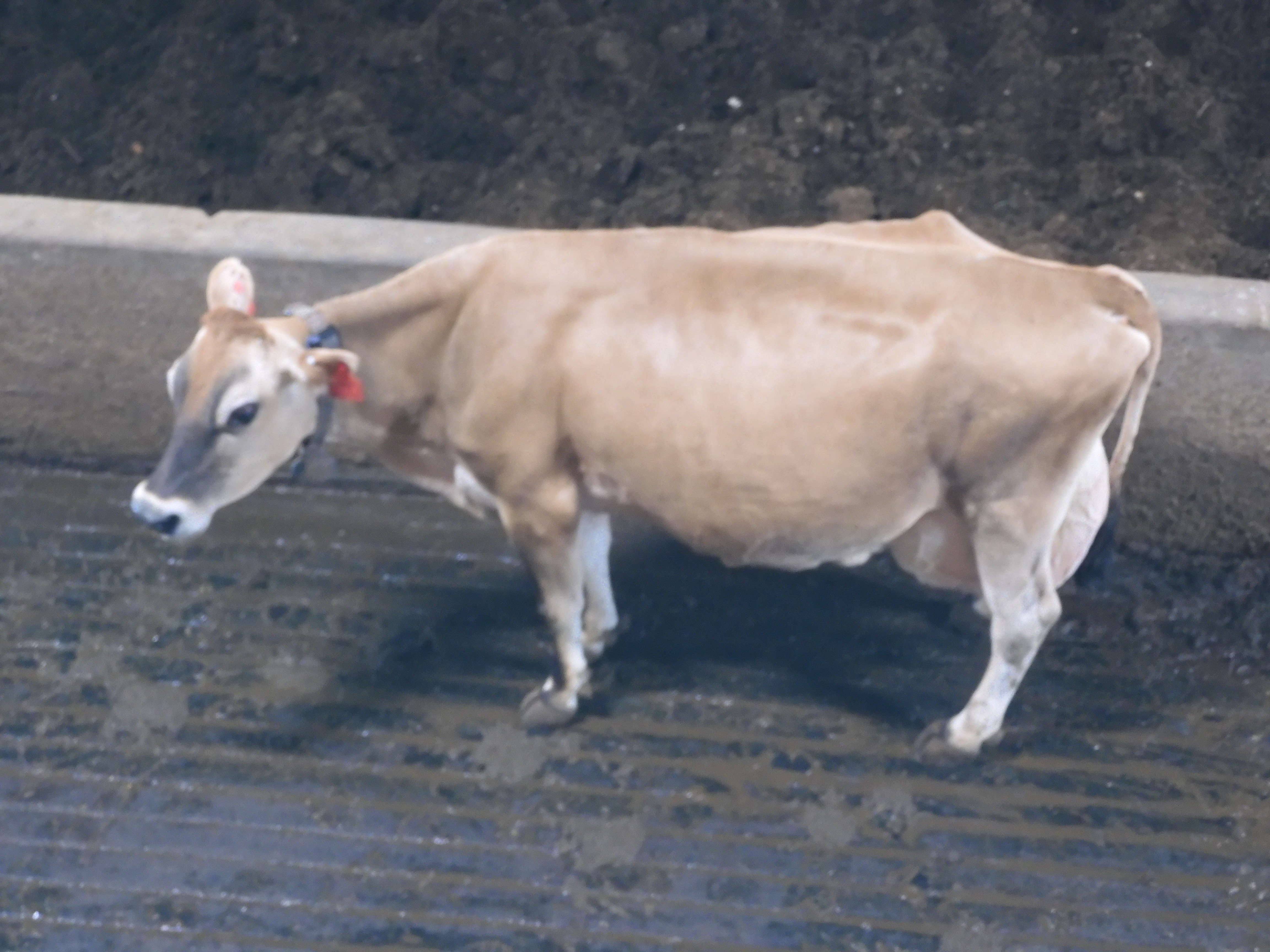
This cow was next in line to be milked. It reminded me of the photos I took of our cows and calves in the lane, waiting to be worked each spring.

Cows choose the time to get in line to be milked.  As full as this cow's udder was, it looked to us that she'd waited plenty long to get in line. But she did join her friends as we were standing there. Most cows go in for milking three times a day and produce 65 to 75 pounds of milk daily.


A robotic arm does everything from clean the cow's udder to hook up the milker. Data on how much milk the cow is producing goes into the computer. 

This cow data was from Abby, No. 1801, whose milking process we watched.

The milk is collected in the milk tank room.

In 2018, the Chaney family added the equipment needed to pasteurize the milk on their farm. 

This led to the Chaney's selling their own fluid milk and dairy products. '


 It's the only place in Kentucky making ice cream that comes from their own milk. 

This photo is blurry, but it shows one of the cows coming out of milker (and more cows in line to be milked in the background.) Another one appears just to be hanging out with her friends.

They even had a robotic manure scrapper.

Like all good farms, they had a barn cat. This one reminded us of a younger version of Big Cat.

The sun was setting, so we left the farmyard to return to the tourist part of Chaney's. 


Our tour gave us enough time for our supper to settle. So, of course, we had to partake in the Chaney's Ice Cream.

We also had Chaney's Ice Cream in a food trailer after our Mammoth Cave tour. Next time, we arrive in Lexington.


Tuesday, May 16, 2023

Well, It Was Mammoth


Mammoth Cave was ... well, Mammoth. But it was probably our least favorite stop on our trip.  And that was a surprise.

Randy, especially, was excited to add a check mark to another National Park after our trip last fall that included six national parks in Colorado, Utah and Arizona. I think both of us were expecting beautiful formations like those found in Carlsbad Caverns, which we visited B.C. (Before Children). Randy also took Jill & Brent to the Caverns when they were on a trip to visit relatives in New Mexico.

But it wasn't like that at all. Honestly, I was more concerned about staying upright on the uneven walkways. Before we ever descended the 200 stairs to get to our tour of the cave's Cleaveland Avenue, the park ranger put the fear of God into us. He cautioned that it would take hours for any rescue crews to respond to a medical emergency or an injury from a fall. Yikes! Way to welcome your guests!

Mammoth Cave National Park includes more than 400 miles of surveyed passages. These days, you have to have reservations to tour the different portions of the cave. Randy chose Cleaveland Avenue, which was rated "moderate" in difficulty. 

I had trouble getting good photos since it was so dimly lit.  And, again, I was trying to stay upright, so I didn't add pulling the camera from my pocket too frequently. (That kind of sounds like my excuses when there were limited photos from gathering and working cattle, doesn't it?)

According to the park, "it shelters a long and complex underground labyrinth.  The mysteries of this amazing natural laboratory have inspired and sustained human discovery for thousands of years."

The caves are karst landscapes, in which water moves rapidly underground by dissolving rock. Mammoth Cave's karst landscape is part of the U.S.'s largest regions of cavernous rocks. Caves and springs commonly occur in karst regions like Kentucky, southern Missouri and Florida. The karst landscape is why the Sky Dome at the National Corvette Museum in nearby Bowling Green collapsed in 2014. (See my earlier blog HERE.)

Karst is key to Mammoth Cave's origin because rock must be readily dissolved by mildly acidic water for cave passageways to form. What Mammoth Cave has that some other karst caves lack is an insoluble sandstone "roof." Sandstone protects the rocks below it. 

Cleaveland Avenue, where we toured, is tube shaped. It was formed as water flowed softly at the water table. Often such tubes are filled with water as they are formed.

A slightly different angle.

Mammoth Cave was formed by water sinking into the ground and flowing through underground streams to the Green River. As the Green River eroded a deeper course, the underground streams abandoned old beds and dissolved new, lower cave passageways.

Mammoth Cave was discovered in 1802. In 1926, Congress passed an Act to accept lands donated to the government to form a brand new national park at Mammoth Cave in Kentucky. At the time, the Mammoth Cave region was full of farmland and homesteads and needed to be prepared for its future park service status. Construction and improvements took place on both the surface and in the cave itself. This included destroying undesirable structures and reducing fire hazards, and building trails, a park amphitheater, as well as many other park structures to support the park’s mission.

The walkways we used were built during the Depression by the Civilian Conservation Corps (CCC). President Franklin Roosevelt created the CCC to put young men, aged 19 to 25, to work during the Depression. During the nine years CCC was in service, more than three million enrollees signed up to live and work in 4,500 camps that stretched across the U.S., including at Mammoth Cave. 

National Park Service photo of CCC workers at Mammoth Cave

For each day that a young man would work, he received $1 dollar. Within a month’s time, he earned $30, five of which he could keep, and the rest was sent to his family to help put food on the table and a keep a roof over their heads. This program addressed two distinct problems facing America; it provided employment for needy young men while also working to solve ecological challenges of conservation. They also planted many of the trees in the Mammoth Cave National Park. 

Four CCC camps were established in Mammoth Cave Park, with each of the camps housing 200 to 250 young men. The CCC often sent workers far from home to work on projects, yet several men from the local communities were part of the Mammoth Cave camps. 

Since those walkways were established some time ago, they are deteriorating and uneven.

Our park ranger asked the question, "Did this rock fall that way or was it placed by human hands?" He didn't really ever answer the question, but rather, told a joke.  
 

Early visitors to the cave often couldn't resist leaving behind a sort of "I was here" mark by writing their names on the cave walls. That will get you arrested these days.

My favorite moment was when the park ranger turned off the lights and the lantern and sang. Obviously, you can't see a thing in this video, but just turn it up and listen:

Thankfully, he turned on the lantern again before we continued on our tour.

Gypsum may also grow outwards in shapes that resemble flowers, like this one:


Flowers, like crusts, form as the gypsum extrudes from the rock (like toothpaste from a tube). In a crust, all the crystal grow at about the same speed, but to form a flower, some of the crystals grow faster than others.

Our tour ended in the Snowball Room. At least, that's what they called it.


They are globular white gypsum balls that cover the ceiling. 

Thankfully, the elevator to the surface worked. All the way through the cave, I had prayed for that outcome. I was not relishing reversing our route and then walking up all 200 steps. 

More from our trip to come.