Monday, March 14, 2011

Life Lessons

Death is one of life's lessons. Ironic, isn't it?

We would like to shield our kids from the difficult things in life. But if we didn't experience some of the hard things as kids - when we're in the midst of a family who loves us - wouldn't it be tougher in the long run?

A 4-Her named Katie came to the County Line last week and took home a bucket calf. It was a twin. Randy had been feeding it since it was born February 27.

The mom had claimed only one of the babies. Randy had carried it to the barn to get keep it dry and warmer.

Then he bottle fed it, twice a day for a week and a half.

It never seemed to thrive. He would have to rouse it from its bed of hay and encourage it to stand up and eat.

But it seemed to improve a little bit, so he called the 4-H family who had asked for a bucket calf. He told Katie's mom he wasn't sure how the calf would do, but they could try.

Unfortunately, the calf died. (We had already told them we didn't want to be paid for the calf until we knew for sure it would survive.)

When Katie's mom called, I told her to tell Katie that we were sorry about her calf. And it was her calf, even though she had only had it a couple of days. I told her that we knew the calf wasn't the strongest calf and that it wasn't Katie's fault that it died.

It's just another example of how 4-H teaches life lessons. Death is a part of life. Animals and plants and people die. Some are sick and some are old. Some are neither sick or old, but they still die. Sometimes it doesn't make sense.

But Katie has now experienced the death of someone she loves. And she'll know that she can get through it.

We often used death on the farm as a teaching moment. A dead kitten on the road in front of our house taught Jill and Brent that there were consequences for crossing the road in front of traffic. It made them aware.

Brent had a 4-H steer die at the fairgrounds one year. Thankfully, he had two steers at the fair that year, so he was still able to sell one in the premium auction. But losing a market steer probably knocked $1,000 from his college fund. He had fed and watered that steer every day. He had spent time working with it so it would lead during the fair. It was a lesson that no matter how hard you try, things don't always work out. You have to pick yourself up and try again the next time.

Life goes on ... even in the face of death.

Friday, March 11, 2011

Change the World

(Stained glass window at Youthville Chapel, Newton, KS)

Kansas has had its share of tourism slogans through the years. "Kansas: It's as big as you think" is the current motto. Its precursors included "The Secret's Out," "Linger Longer," "Land of Ahhs" and "Simply Wonderful."

If Gov. Sam Brownback gets his way and chops funding for the Kansas Arts Commission, it will be no secret that our state's simply wonderful arts groups will have to linger longer at the mercy of private donors. My "Ahhs" are quickly turning to "Oh no's!"

If Brownback's budget passes, Kansas would become the first state in the nation to no longer fund arts. I don't think that's what the Sunflower State wants to hang its hat on.

I wouldn't want to be the governor. I wouldn't want to be a state legislator, looking for ways to scrimp and save and bring down the budget deficit.

But I'm afraid that if public funding for the arts is on the chopping block, it won't be long until school districts follow suit and whittle school music programs from their class schedules.

And that would be a shame. A week ago, I spent the day at the Heart of the Plains Music Festival hosted by Stafford Schools. I got a chance to support my local high school musicians and also those from my alma mater, Skyline High. Most importantly, I got the chance to hear my talented niece, Madison, perform individually and with Skyline groups.

A basketball team doesn't have the market on teamwork. Just spend a day listening to choral music or band performances and you'll figure that out pretty quickly.

I have to admire a group of high school students from Lawrence, who took their convictions to the Kansas statehouse last week.

“Art is an essential part of life,” said Hazlett Henderson, a sophomore at Lawrence High School. “I don’t know if private funding will be there.”

A Senate committee last Thursday rejected Gov. Brownback’s attempt to abolish the Kansas Arts Commission. The Federal and State Affairs Committee voted against Brownback’s order before a packed hearing room that included about 20 high school students from Lawrence.

Keil Eggers, a senior at Free State High School, said he made the trip to the Capitol because he wanted the Arts Commission funded so that “kids behind me would have the same opportunities” in arts programs that he had.

Brownback’s order will take effect July 1 unless the Legislature rejects it. The committee’s recommendation to keep the Arts Commission will next go to the full Senate. After the hearing, the Lawrence students said they were pleased with the decision by the committee.

They aren't alone in recognizing a strong correlation between quality music education in schools and academic achievement.

Madi was selected for the Kansas Music Educators Association honor choir, which was directed last month by Dr. Craig Jessop of Utah State. This guy is no slacker: He is a former director of the Mormon Tabernacle Choir.

At the choir performance, he shared an interesting statistic with the musicians, their families and the audience.

The average ACT score of the choir kids who had taken the test was a 27. The 2010 average composite score for all Kansas students was 22, above the national average of 21.

The Kansas musicians' ACT score was 5 points higher. That's significant.

A 2007 Harris Interactive Poll of working adults indicated that music education impacted five skill areas: ability to work toward common goals, striving for excellence in group settings, disciplined approach to solving problems, creative problem solving and flexibility in work situations.

Harris Interactive Poll, 2007

I know that no one wants their great love on the chopping block. I freely admit that music is one of the cornerstones in my life. But I think cutting funding to the arts is a big mistake.

Gov. Brownback may want to reconsider. I know that Bono is no great philosopher, but I do think this particular "slogan" has some merit for the Land of Ahhs:


Music can change the world because it can change people.
Bono

Thursday, March 10, 2011

Hot Wire Broke

"These beauties are hot wire broke."

It sounded to me like they had a future in stealing cars.

When you go to a foreign country, it's always good to have a translator. You wouldn't think you'd need a translator at a cattle sale just a county away. But I did.

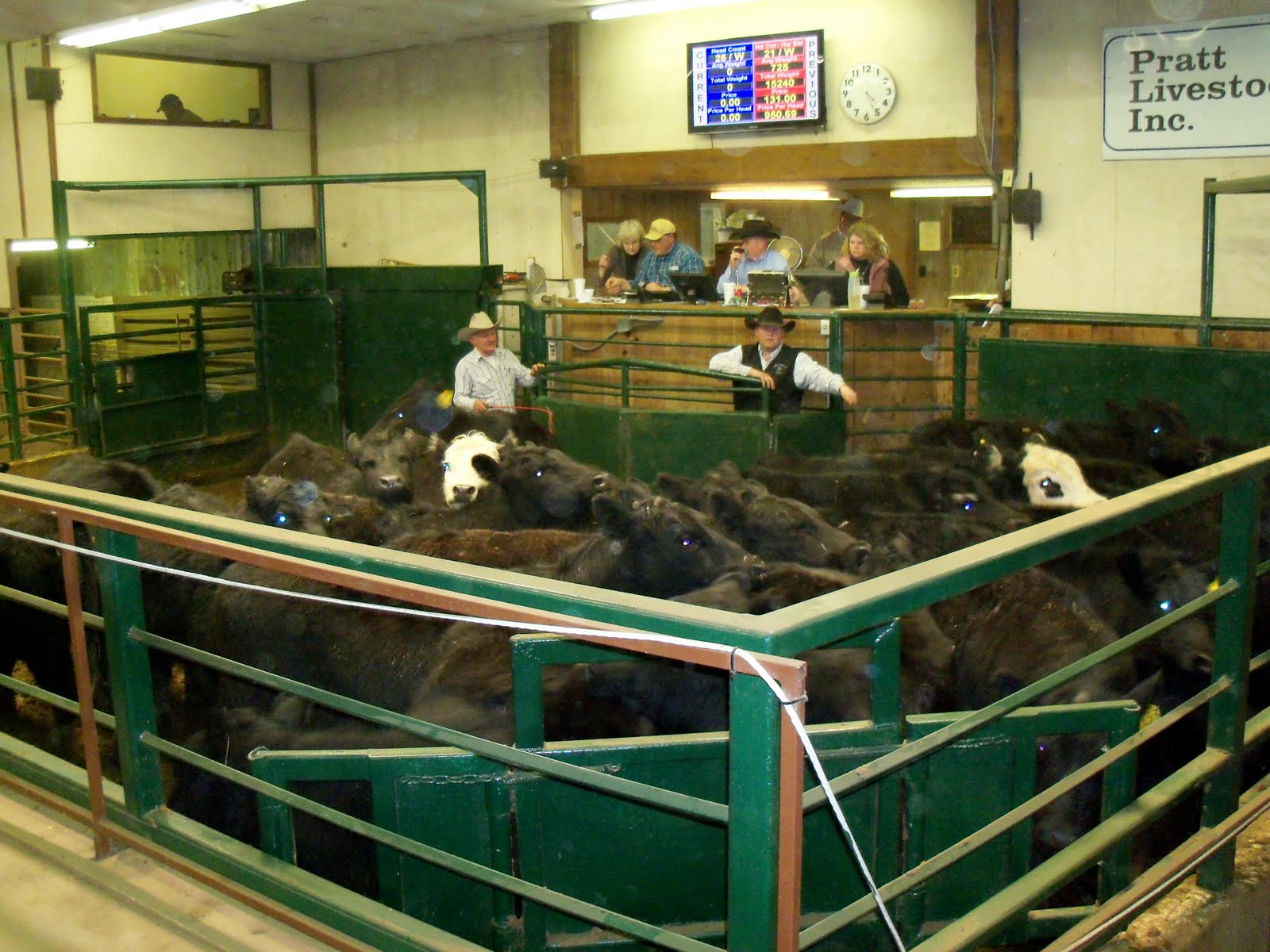
Randy provided translation services free of charge at Pratt Livestock Inc. I provided his free comic relief since I asked question after silly question. (Yes, I know it's been said that there are no silly questions: Randy might beg to differ after a day at the sale barn with me!)

By the way, "hot wire broke" means the cattle have been on wheat or rye pasture and are used to the electric fence. In farm wife terms, it means that there's a possibility you won't be called into cattle chasing mode on a daily basis.

There's definitely a lingo and a rhythm to the proceedings at the sale barn. There's a kind of dance between the auction ring and the cattle buyers in the stands.

The guy on the left, Jake Lewis, is the sale manager. He sets the floor price for each pen of cattle. The cattle entered to his right and came into the ring, which has a scale under the floor. He sets the price based on the quality of the cattle, their size and their sex.

The guy in the middle and the guy behind him took turns as auctioneers. It's a music all its own as they urge the buyers to raise the price they're willing to pay in dime or quarter or dollar increments. And my friend Anita DeWeese, on the right, is typing frantically into the computer, trying to keep the amount per pound up to date as the auctioneer continues his spiel. As the cattle left the ring, she was kind of like an air traffic controller, speaking into her microphone to tell the guys in the back where to put the animals until it was time to load them into semis for their next destination.

Besides a translator, I guess I needed a sign language interpreter, too. I really wanted to take a photo of a young cattle buyer in his black cowboy hat, Wranglers and big belt buckle. But I was old enough to be his mother, and I didn't figure it was appropriate.

But during a long day, he did provide some people-watching moments. I truly couldn't figure out his method. Sometimes he'd tap his cards once against his other cards to indicate a bid. Other times he hit them hard against his open palm. Sometimes he'd wiggle a finger to let the auctioneer know he was interested. Other times he'd nod his head as the price escalated upwards and then gave a no-nonsense cut off with both arms when it got a little too rich for his blood.

My cowboy-hatted friend pumped his fist repeatedly. Let's just say he wasn't excited about the good cattle run. He was wanting most of the heifers he'd bought tested for pregnancy. I'll let you use your imagination about how the fist pumping went.

He was kind of like a poker player, fanning out his cards, and contemplating his next move. Randy had one card to write down our cattle and the prices they brought.

The black-hatted cowboy had at least half a dozen. We surmised that he was buying cattle for several different customers. The different cards represented different customers and the semis needed to haul them.

But you don't even have to be in Pratt to bid on the cattle. Technology has come to the sale barn: A series of cameras lets off-site bidders in on the action, too. When I was a little girl, I remember lines of phones around the upper perimeter of the auditorium. These days, the buyers use their own cell phones to keep in touch with the people who are ultimately paying the bills - whether that's a feedlot or a private buyer who is looking to add to his own cow herd.

It was definitely a male-dominated room, though there were "21 ladies done like you want things done and brought to town for the first time."

Translation: The 21 heifers looked like quality cattle and were raised at a family farm.

"These heifers are green."

Translation: Well, they looked brown to me, but Randy explained that the auctioneer meant they'd been on wheat or rye and were ready to gain bulk at the feed bunk.

There were a few gentlemen, too, though these particular gentlemen didn't wear cowboy hats and seed caps. These "gentlemen" were bulls, not to be confused with steers.

All in all, 6,000 head of cattle moved through the ring last Thursday. Today's another sale day at Pratt Livestock. But they'll have to do it without me this week.

Wednesday, March 9, 2011

Bloom Where You're Planted


Today is Ash Wednesday. It signals a time of prayer and preparation as we make the 40-day Lenten journey toward Easter. It should signal a time of cultivating our relationship with Christ through prayer and study so that we can bloom where we are planted.

We are sometimes called to bloom through difficult circumstances, just like this plant we'd left for dead. In a freezing wash house, it somehow found new life.

Today, head on over to the Lovely Branches Ministries website for my March blog posting. And while you're there, check out the other blog writers and features on the Lovely Branches website.

You'll want the recipe for Chocolate Trifle, too, also found on my March posting. It was served for the first Lovely Branches Friendship Friday. A delicious dessert is always part of the meal. The Trifle recipe reminds me of a more elegant version of "Dirt" Cups, little individual servings of pudding and whipped cream and crushed chocolate sandwich cookies with a gummy worm hidden inside, one of my kids' favorite treats when they were little.

There were no gummy worms hidden in this dessert. The surprise ingredient? Coffee.
(It seems to be a theme for me lately - coffee and chocolate!)

Tuesday, March 8, 2011

No Two Are Alike

There is nothing like soup. It is by nature eccentric: No two are ever alike, unless of course, you get your soup from a can.
Laurie Colwin, Author of "Home Cooking"

I'm not going to lie. Every once in awhile, I get my soup from a can. I prefer homemade tomato soup, but I have been known to open a can of Campbell's, add some milk and call it good. And it is good. You don't stay in business for 130 years otherwise.

But when the weather turns cold and dreary, it's my natural inclination to turn to homemade soup.

I'm not sure whether this latest round of winter weather today will include snow on the County Line. We seem to be on that nebulous line between a trace of snow and sleet on the weather forecasters' maps. But I hear the pitter patter of raindrops on the roof, and it's a good excuse to think soup.

During the last round of cold weather, we tried Southwestern Chicken Corn Chowder. I had printed it off earlier this winter, but I hadn't yet tried. After its trial run, I think it will be making other appearances on our table.

Hope you enjoy it too!

Southwestern Chicken Corn Chowder
2 tbsp. butter
1 small onion, chopped
3 cups fat-free chicken broth
2 cups frozen corn
2 potatoes, peeled and cut into 1/2-inch dice
1 small red pepper, diced
1/2 cup carrot, diced
1 rib celery, diced
2 cups low fat milk
1 cup shredded cheese
13 oz. can chicken breast, drained
1/2 tsp. cumin
1/2 tsp. salt
1/2 tsp. cayenne pepper

Melt butter in stockpot. Add onion and cook until tender, about 5 minutes. Stir in chicken broth and all vegetables. Bring mixture to boil; reduce heat. Simmer, covered, for 5 minutes or until vegetables are tender. remove 2 cups of soup and puree in blender or food processor. Return to saucepan with remaining soup.

Stir in milk, cheese, chicken and seasonings. Simmer 10 minutes until desired serving temperature.

Notes:
  • I only used 1/4 teaspoon of cayenne. If Jill were making it, she'd use the whole amount.
  • The original recipe didn't call for carrots. That's my addition. That may have been why the soup was more yellow than a traditional chowder.
  • We like thick soup. At the end of the cooking time, I combined about a tablespoon of cornstarch with about 2 tablespoons of water and mixed well. I then stirred it into the soup to thicken it a little more.
  • Instead of using canned chicken, you can reduce the cost of this recipe by microwaving chicken breasts and cutting them up yourself.
I think that women just have a primeval instinct to make soup, which they will try to foist on anybody who looks like a likely candidate.
Dylan Moran

Monday, March 7, 2011

Performance Anxiety

Performance anxiety: It's that flutter in the pit of your stomach, the dry mouth and the rapid heartbeat as the time ticks closer to that big event.

I've felt it plenty of times before I've sung a solo or accompanied a middle school instrumentalist. I've experienced it as a parent when all the practicing was over and I had to sit there and watch Jill or Brent give a 4-H talk or play their piano solos during a recital.

When I've sat in stadium seating as a parent, I've held my breath as Brent hiked the football or Jill ran the third leg of a relay.

But I wasn't expecting to feel it at the Pratt Livestock sale barn last Thursday - even if there was stadium seating.

Maybe it was less performance anxiety than checkbook anxiety. You sit there and watch other people's cattle sell and do well. You don't want to be that wallflower that nobody wants.

But I didn't need to worry.

We sold 68 head of cattle. The average weight of the steers was 748 pounds.

The average price per head was $932.00 or $1.30 per pound. It's the most dollars per head that we've ever received for our cattle. A group of 26 steers brought $1,031.34 per head. Randy said he'd never had cattle bring more than $1,000 a head before.

It appears Randy chose the right week to sell feeder calves. (Of course, time will tell on that. Maybe next Thursday will be even higher.)

So why the good price? Beef cattle prices are up right now. Randy is pleased with the rate of gain for our cattle through the winter months.

Their journey from the County Line corral to Pratt Livestock started last Tuesday, when we sorted the cattle. Then on Wednesday, trucker Donald Harner brought his semi to haul the cattle to Pratt. The semi is divided into different compartments, which can hold anywhere from six head to 25 head of cattle. Each semi can haul about 50,000 pounds of cattle.

Our 49,820 pounds of beef cattle were then offloaded and put into pens at Pratt Livestock, where they were sorted by sex and size. The cattle are put into different pens where they have water and feed until sale time.

After the sale, the buyers arrange for other semis to come and pick up the cattle. They are loaded back onto the semis and taken to feedlots, where they will fattened for five or six months. Then they will be harvested for beef on American consumers' tables.

From pasture to plate ... We're proud to be part of the process bringing quality beef to the dinner table.

Friday, March 4, 2011

Marvelous Mocha

Gooey chocolate ... What could be better? Well, a little coffee to go with that chocolate never hurts.

I saw the recipe for Mystery Mocha on the Pioneer Woman's website. It caught my eye when I clicked on another blogger's link to the website's Tasty Kitchen and Nutella Ooey Gooey Brownies.

It was one of those recipes I printed and stuck in a pile to try "sometime." Do any of you have a pile like that? I'll never get them all made, but I keep collecting them.

I think my Nu Lambda sisters were glad this one made it off the pile and onto serving bowls. Yum! If I do say so myself.

Actually, I don't have to say so myself. My friends liked it. And Randy was glad to see the leftovers after he'd devoured my trial run last weekend.

Enjoy!


Mystery Mocha
3/4 cup granulated sugar
1 cup all-purpose flour
2 tsp. baking powder
1/8 tsp. salt
1 piece unsweetened chocolate (1 square)
2 tbsp. butter
1/2 cup milk
1 tsp. vanilla extract
1/2 cup brown sugar
1/2 cup sugar
1/4 cup powdered cocoa
1 cup cold strong coffee

Sift together 3/4 cup sugar, flour, baking powder and salt. Set aside.

Melt square of unsweetened chocolate and butter in the microwave. Add to dry ingredients alternately with the milk and vanilla. Blend. Pour into a greased 8- by 8-inch or 9- by 9-inch pan.

Combine brown sugar, 1/2 cup sugar and cocoa powder. Sprinkle over the cake batter. Pour the 1 cup cold coffee on top. Don't stir!

Bake at 350 degrees for 40 minutes.

Serve warm with ice cream or sweetened whipped cream or whipped topping. This will serve 8 or 9 and is best served warm.