When we first welcomed Flat Aggie to our South Central Kansas farm, I asked a question about how truthful to be with Aggie and a classroom of fourth graders from Walden Academy in Willows, Calif.
Aggie arrived amidst sub-zero wind chills, and we promptly lost two calves, despite our best efforts. I want to clarify: I never intended to lie to the students and tell them that the calf we had worked so hard to save had survived. I just thought about not telling the story at all.
But, on the advice of both blog readers and Facebook followers, I decided to share the story in its entirety. Yes, we had a few calves die in bad weather, even though we worked really hard to help them and their mothers. (We had seven calves die this winter, two from birth defects and the others due to extreme cold. This was more than most years.)
As most people pointed out, many fourth graders may have already experienced the death of a pet or even a grandparent. Sometimes, we lose people and creatures that are important to us. In this case, these animals aren't our pets, but we are entrusted to care for them to the best of our ability. We don't like to have animals suffer or die. But death is a part of the life cycle. Fourth graders are old enough to know that.
For farmers and ranchers, there's an added consideration. The loss of a baby calf is also the loss of some income. When we sold feeder calves at the Pratt Livestock sale barn, new baby calves were selling for as much as $400. That is an unusually high price. So, besides it being emotionally hard to lose a creature in our care, it's also a loss to our farm income.
But I also don't want Aggie to leave Kansas without telling the fourth graders there were many more success stories than sad stories as we approach the end of our calving season.
Sometimes, the jackets - plus some straw - helped the babies warm up and thrive.
Aggie also got another experience when he helped put an ear tag in a baby calf's ear. The calf was born to a heifer, a first-time Mama. Randy puts the ear tag in so that we can match the baby calf to the heifer.
The ear tagger is kind of like a giant ear piercer. Probably some of the fourth grade girls already have pierced ears. Aggie watched as Randy gave that particular calf the 421 tag number. The "4" tells us that the calf was born in 2014 (the last digit of the year). That's how we number our calves. Last year's calves have numbers beginning with "3" and next year's calves will have numbers starting with "5." The "21" meant it was the 21st calf born to a heifer this year.
After the baby got its tag, the mama checked it out and realized it was just fine, despite some interference from those humans who came to the cattle corral.
Aggie also helped Randy and I as we checked cattle in pastures and corrals. One cold day, he found a baby calf taking a nap in the grasses at the pasture, which sheltered the calf from the cold.
We hope Aggie liked seeing the cute babies just as much as we do.
As Aggie prepares to leave, we are close to being done with our 2014 calf crop. Now, we only have 14 out of 114 heifers and cows left to calve. Don't know how we'll do it without you, Aggie!
Wednesday, March 19, 2014
Tuesday, March 18, 2014
Aggie Visits an Ethanol Plant
It's not every day that Randy and I tour an ethanol plant. So we were glad to share that experience with Flat Aggie.
After being shut down and idle for more than five years, the ethanol plant in Pratt is back in business under the ownership of Pratt Energy, a partnership between The Scoular Company and Pratt Biofuel Investors (PBI). Pratt Energy is operating the plant and marketing the ethanol, while Scoular is buying the milo and corn to produce the ethanol and marketing the wet and dry distillers grains, a co-product of ethanol production.
Scoular purchased the 55-million gallon plant and adjoining 1.8-million bushel grain facility in 2011 from Gateway Plant LLC. The Gateway ethanol plant had originally opened in 2007, but an ice storm in December 2007 and other management difficulties caused the plant to go bankrupt and close.
In December 2012, Scoular sold a portion of its interest in Pratt Energy to Pratt Biofuels, which has related ownership to Calgren Renewable Fuels. Renovations were completed by late summer 2013, and the plant began grinding grain and producing ethanol in early September 2013.
Lyle Schlyer, president of both Pratt Energy and Calgren Renewable Fuels, gave us our tour at the Pratt plant. Schlyer said the Pratt plant is patterned after a nearly identical plant in Pixley, Calif. Calgren successfully renovated the Pixley plant in 2009 and continues to operate it today.
Area farmers and cooperatives are hauling milo and corn to the plant to be converted to ethanol. When they arrive, the grain is tested for quality using probes.
The truckers then take their trucks to be unloaded in the elevator.
Two trucks can unload at one time, which we saw during our tour of the plant.The plant buys most of its corn and milo from nearby counties, with 70 to 80 trucks delivering around 55,000 bushels of grain a day. The plant plans to use about 20 million bushels of feedstock (corn and milo) per year, with most of it being sourced by truck within 30 to 75 miles of Pratt. However, if needed, Scoular can bring in grain via unit trains. The facility is located on the Union Pacific Railroad and can ship or receive 100-car trains of grain, as well as load out the same size trains of dried distiller grains or ethanol.
Right now, the ethanol blend ratio is about 60 percent corn and 40 percent milo, but the plant tries to use the grain that is most economically feasible, said TJ Mandl, Scoular’s local manager who oversees the company’s Pratt business.
Scoular also markets wet and dry distillers grains, a co-product produced during the processing. Scoular supplies the distillers grains to small and large cattle feeders, as well as feed mills. Each day, about 20 loads of ethanol and 45 loads of distillers grains go out of the plant.
We got to see inside the ethanol plant, but Aggie and I can't reveal any trade secrets for the process. (We didn't understand them anyway!)
Aggie and I thought that the office looked like Mission Control. Two workers were sitting at computer terminals with several monitors. They were watching to make sure all the processes were going smoothly and watching for the correct temperatures as the grain ferments and is transformed into fuel.
Pratt Energy sells the ethanol largely in the Wichita, Oklahoma City, Tulsa and surrounding markets. Before the Pratt ethanol plant went online, most of the ethanol sold in southern Kansas and Oklahoma came from outside the region.
While it may look like the plant is polluting the air, it's not. That is just steam - or water vapor - from the plant.
Pratt Energy employs 34, and the Scoular Co. has a workforce of eight to 10, so having the plant operational has been good for the regional economy. It has also given local and area farmers and farm cooperatives another source to sell their grain.
** Some of the information for this blog post came from a newsletter produced by The Scoular Company. It was tough to hear during the tour, so the information found in the online newsletter helped supplement the information Aggie and I learned while on the tour.
Monday, March 17, 2014
Aggie Visits The Wheat State
Wheat is the major crop here on our farm in South Central Kansas. So, you'd think that Aggie would have had lots to do to help us with this important crop.
It's not only important to us, but it's important to Kansas agriculture. On average, Kansas is the largest wheat producing state, with nearly 1/5 of the nation's wheat grown here. All the wheat grown in Kansas in a single year would fit in a train stretching from western Kansas to the Atlantic Ocean.
However, at this time of year, about the only thing to do with wheat is to watch it grow. Since Aggie arrived when we were experiencing sub-zero wind chills, the wheat was still in the dormant stage. But, as the weather warms a bit, the wheat is starting to green up and grow.
We planted a little more than 1,400 acres to wheat last fall during a time frame from September 23 to October 9.
Here in Central Kansas, we plant what is called hard red winter wheat. It's planted in the fall and then goes dormant during the cold months of winter before coming out of its "hibernation" and growing again in the spring. It is then usually harvested in June.
Here's what the wheat looks like as it emerges in the fields.

This month, the co-op sprayed our wheat field with nitrogen fertilizer. (I missed the actual spraying because I was at school during that time, so this is a photo from 2010. I didn't show Aggie in person, but we still thought it was important to show you Walden Academy students!
Snow during the winter months doesn't hurt the wheat at all. In fact, the moisture helps it.
However, last spring, we had several late season ice and snow storms in April and even in May. A freeze on wheat can impact the yield, or the amount of wheat we raise. At the time, I said it looked like a slushy machine had exploded on our wheat fields. Thankfully and miraculously, it didn't ultimately affect the size or quality of the crop.
As the weather gets warmer, the wheat plant begins growing and gets taller.

A little later, the wheat head emerges from the plant.
We usually harvest in mid to late June and sometimes into early July. We can begin harvest when the wheat fields turn golden in color and the wheat kernels dry out.
The combine separates the wheat kernels from the straw. We then use the combine auger to put it into the trucks.
Once the truck is full, we haul the grain to a co-op elevator. When we arrive at the co-op, we pull on the scales so both we and the co-op know how much grain we have delivered. They use a probe to get a sample of the wheat to test it for moisture and test weight, a mark of quality. (You can see the probe on the orange arm hovering over the truck in the photo below.)
Then we dump the grain out of the truck with a hydraulic bed lift.
Here's a close-up of the wheat kernels and a copy of the postcards that Aggie and I packed and sent to my fourth grade friends.
A farmer doesn't have an 8 to 5 job. During wheat harvest, we often cut long after the sun has set.
Want to keep up with the Flat Aggies who are visiting farms and ranches across the U.S.? Like Flat Aggie on Facebook. Thanks again to Nicole of Tales of a Kansas Farm Mom who arranges these visits.
It's not only important to us, but it's important to Kansas agriculture. On average, Kansas is the largest wheat producing state, with nearly 1/5 of the nation's wheat grown here. All the wheat grown in Kansas in a single year would fit in a train stretching from western Kansas to the Atlantic Ocean.
However, at this time of year, about the only thing to do with wheat is to watch it grow. Since Aggie arrived when we were experiencing sub-zero wind chills, the wheat was still in the dormant stage. But, as the weather warms a bit, the wheat is starting to green up and grow.
We planted a little more than 1,400 acres to wheat last fall during a time frame from September 23 to October 9.
![]() |
| Here is Randy drilling wheat last fall. |
Here's what the wheat looks like as it emerges in the fields.

This month, the co-op sprayed our wheat field with nitrogen fertilizer. (I missed the actual spraying because I was at school during that time, so this is a photo from 2010. I didn't show Aggie in person, but we still thought it was important to show you Walden Academy students!
Snow during the winter months doesn't hurt the wheat at all. In fact, the moisture helps it.However, last spring, we had several late season ice and snow storms in April and even in May. A freeze on wheat can impact the yield, or the amount of wheat we raise. At the time, I said it looked like a slushy machine had exploded on our wheat fields. Thankfully and miraculously, it didn't ultimately affect the size or quality of the crop.
As the weather gets warmer, the wheat plant begins growing and gets taller.

A little later, the wheat head emerges from the plant.
![]() |
| Morning dew on a wheat head |
Then, later, the wheat plant pollinates. The little yellow "flecks" on the wheat head are pollen. The pollination helps make more kernels in the wheat head.
We usually harvest in mid to late June and sometimes into early July. We can begin harvest when the wheat fields turn golden in color and the wheat kernels dry out. Once the truck is full, we haul the grain to a co-op elevator. When we arrive at the co-op, we pull on the scales so both we and the co-op know how much grain we have delivered. They use a probe to get a sample of the wheat to test it for moisture and test weight, a mark of quality. (You can see the probe on the orange arm hovering over the truck in the photo below.)
Then we dump the grain out of the truck with a hydraulic bed lift.
Here's a close-up of the wheat kernels and a copy of the postcards that Aggie and I packed and sent to my fourth grade friends.
A farmer doesn't have an 8 to 5 job. During wheat harvest, we often cut long after the sun has set.
Want to keep up with the Flat Aggies who are visiting farms and ranches across the U.S.? Like Flat Aggie on Facebook. Thanks again to Nicole of Tales of a Kansas Farm Mom who arranges these visits.
***
In case you've missed the introduction to Flat Aggie
Our buddy, Flat Aggie, is from Miss Holbrook's fourth grade classroom at Walden Academy in Willows, California. Flat Aggie is a project
of my southeast Kansas blog friend, Nicole, and her Tales of a Kansas Farm Mom blog.
Flat Aggie goes to farms all across the country to learn about
agriculture. Aggie then reports back to the class with a letter (or
blog posts) from
the farm. Randy and I have been taking Aggie with us when we check
cattle and do other things on the farm. We have enjoyed hosting him and
helping him learn about life on a South Central Kansas farm.
***
Today, I'm linked to Tales of a Kansas Farm Mom's Country Fair Blog Party. Click on the link to read other blog posts from the country.
Friday, March 14, 2014
Aggie at the Auction
Since Aggie enjoyed himself so much at the cattle auction, we decided he should go along when a neighbor's family had a farm sale this week. Our neighbor died last year, and his girls have rented out the farm ground to another neighbor. So, they don't have a need for the equipment he used on their farm.
When we got to the auction, Aggie and Randy got an auction number, 52. That is the number Randy used to make his bids.
The auctioneers usually start with the "small stuff," which is typically put on trailers. Randy wasn't interested in any of those items. But a farm sale is also a good time to visit with your neighbors, so we did some of that while the auctioneers sold tools, fencing gear and other smaller items. Aggie checked it out, but he wasn't interested either.
The auctioneer rides in the bed of a pickup truck. The bidders gather around the trailers or the equipment that's being sold.
The auctioneer uses a microphone and does his auctioneering chant to try and get people to pay the most money possible for each item.
While they were still selling the items on the trailers, Aggie and I went with Randy to check out two pieces of equipment.
Randy wanted to bid on this chisel. If Aggie looked closely, he could see the points, the part that goes into the soil. A farmer would hook it up to a tractor and pull the chisel to break up and loosen the soil. The points also disrupt the roots of weeds in the field and kill the weeds.
Randy also wanted to bid on a fallow master, which is used as a conservation tool. It doesn't dig as deeply as a chisel, and it leaves some residue on top of the soil which helps prevent wind erosion and conserves moisture in the field. Still, the sweeps will cut off the weeds.
Below, Aggie checked out the pluckers, the round teeth-like wheels that pull up the weeds and also help level the ground.
Randy quit bidding on the chisel because it went for more money than he wanted to spend. However, he got the fallow master for $22,000. That sounded like a lot of money to Aggie. It did to me, too. But a new fallow master would cost around $50,000. We purchase a few things new here on our farm, but much of the equipment we use on our farm is used, mainly because it's so much less money.
After the sale, Randy went to the auctioneer's portable office in a trailer. He told the auction clerk that his sale number was No. 52. She knew how much he had bid for the fallow master based on his auction number. So, he wrote the check and we were free to take it home.
Aggie and I didn't bid on anything, but we enjoyed watching and visiting!
***
In case you've missed the introduction to Flat Aggie
Our buddy, Flat Aggie, is from Miss Holbrook's fourth grade classroom at Walden Academy in Willows, California. Flat Aggie is a project
of my southeast Kansas blog friend, Nicole, and her Tales of a Kansas Farm Mom blog. Flat Aggie goes to farms all across the country to learn about
agriculture. Aggie then reports back to the class with a letter (or blog posts) from
the farm. Randy and I have been taking Aggie with us when we check
cattle and do other things on the farm. We have enjoyed hosting him and helping him learn about life on a South Central Kansas farm.
Thursday, March 13, 2014
Sold! Aggie Goes to the Cattle Sale
I'm not usually a fan of fast-talking men. But I make an exception when it's a cattle sale. Our buddy, Flat Aggie from Walden Academy in Willows, California, doesn't say a whole lot, but we hope he's learning a bunch about what life is like on a farm in South Central Kansas. Flat Aggie is a project of my southeast Kansas blog friend, Nicole, and her Tales of a Kansas Farm Mom blog. Flat Aggie goes to farms all across the country to learn about
agriculture. Aggie then reports back to the class with a letter (or blog posts) from
the farm. Randy and I have been taking Aggie with us when we check
cattle and do other things on the farm.
Two weeks ago, Aggie went with us to Pratt Livestock when we sold feeder cattle. These are cattle that were born on our farm a year ago. It was a two-day process to get the cattle ready to come to the sale. (Check out Aggie's adventures with sorting and loading here.)
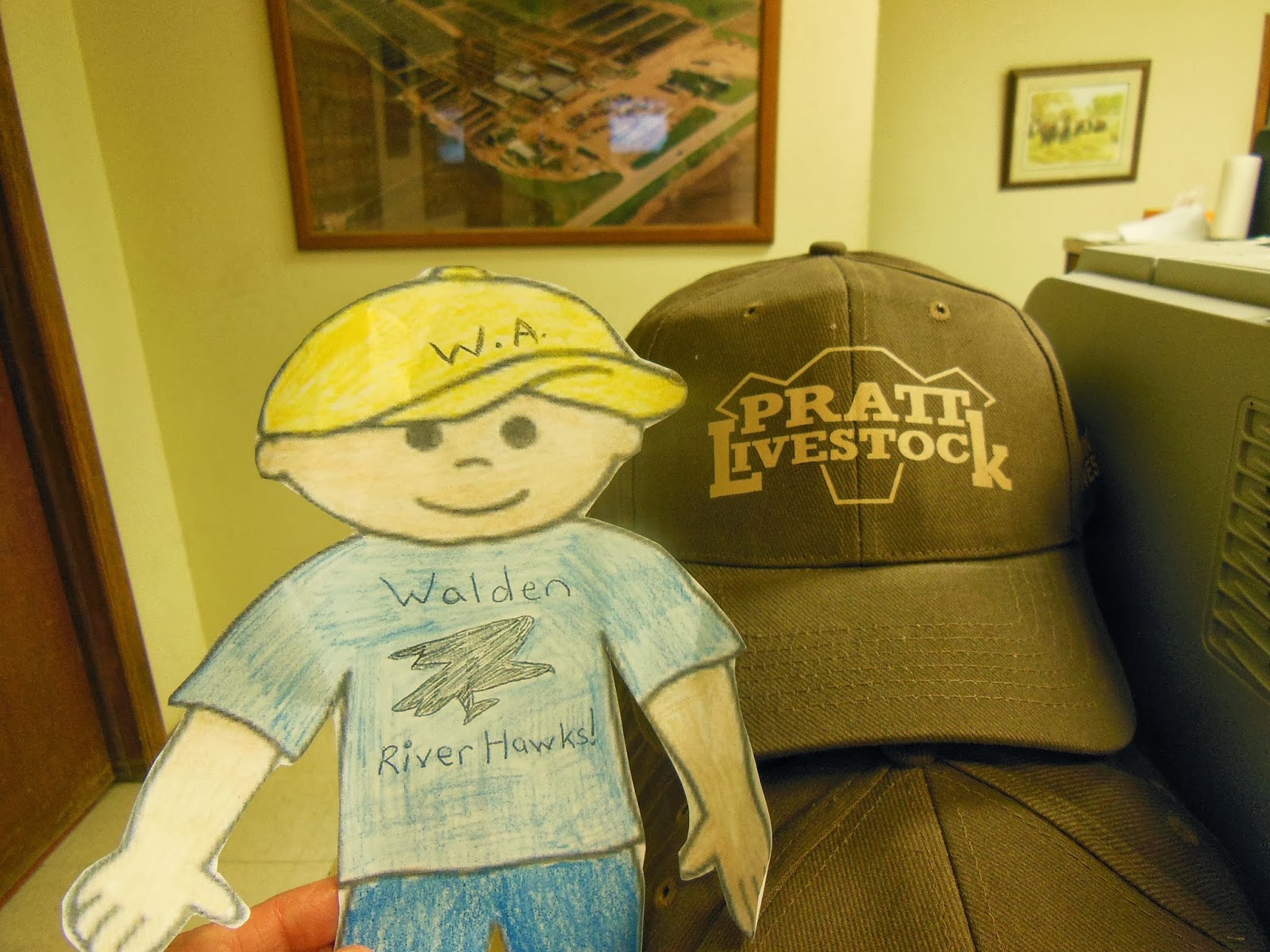
When we arrived at the sale barn, we went into the office to find out when our cattle would go through the sale ring. Since Aggie likes his cap, he was impressed with the Pratt Livestock hats. Too bad they were a little big for him!
Next, we headed into the sale barn. On the day we sold feeder calves, our 98 calves were among 5,000 head going up for auction. The auction started at 9 AM, but our first cattle didn't come through the ring until 11 AM.
As the cattle came into the ring, the auctioneer started his chanting. (He's the one in the middle with the microphone). The guy on the left also watches for bids. To bid, the buyers may nod their heads or raise their hand or say something like "yep." I told Aggie that I have to remember not to wave to anyone I know across the room. They might think I'm bidding!
The lady on the right (my friend, Anita) keeps track of who buys which cattle and uses a microphone to tell the workers in the back so they know which pens to put the cattle in after they leave the sale ring.
The ring has a scale so that buyers know how much the cattle weigh. In this particular pen of 16 heifers, they averaged 798 pounds each. The whole pen weighed 12,770 pounds. (See, Aggie? We do use math in farming!) For this group, the buyer paid $1.54 per pound. (The price shows per hundred weight.)
Below, Aggie checks out the sale sheet. You can also see all the people who came to the sale. Some of the people were others like us who were selling cattle. Some were cattle buyers. Some of them were taking cattle back to their own farms to feed until they are big enough to harvest for beef. Most were buying to take to feedlots for "finishing," which also means that they are feeding them until they reach the optimal weight for harvest.
Aggie was there in person, but there were a few buyers who "came" to the sale via the internet. Even after Aggie goes back to California, he could still watch the Thursday auction at Pratt Livestock.
In addition to the buyers and sellers, Aggie also noticed a stand with the initials, USDA. That stands for United States Department of Agriculture. A USDA representative is there to report market results of the sale to publications, to provide government statistics and to provide public information so all buyers and sellers have access to it.
Randy was pleased with how much the calves have gained, even during a cold winter. The heifers averaged 797 pounds each, while the steers averaged 914 pounds each. He was also pleased with the price we received. The cattle market is up, which is a good thing when you are selling. However, we also have to buy six new bulls this spring, so we will also have to pay more for those replacement bulls.
After the sale, the buyers arrange for other semis to come and pick up the cattle. They are loaded back onto the semis and taken to feedlots or to another rancher's location, where they will fattened for five or six months. Then they will be harvested for beef on American consumers' tables.
Subscribe to:
Posts (Atom)