Showing posts with label Pratt Livestock. Show all posts

Tuesday, March 2, 2021

Orange "Earrings" and Vision Tests

I had one of those peripheral vision tests at the eye doctor a week ago. As a firstborn with test anxiety, I absolutely hate those blinking lights and the pressure to click my little signaling button at the correct times. 

"Did I miss one?" "Why is there so much time between blinks?" "Am I going BLIND?"

I have horrible eyesight: It's -6 in the right eye and -7.5 in the left - whatever that means. In real life, it means that my glasses are the first thing I put on in the morning and the last thing that hit the bedside table at night.


I had a vision test of another kind last week, too. It was just as difficult. It involved trying to pick out little orange "earrings" on feeder calves while they were moving. I didn't take any photos of the sorting process that day. As Randy says, I was a little busy at the time. But I found a photo I took from the feed truck which demonstrates what a challenge this eye test can be. 

Here' a better look at the tag from a different sorting event several years ago. 

Last week, we gathered the feeder calves so we could sort the heifers (girls) from the steers.


We've been feeding them silage and hay since we weaned them from their mothers last fall.

Once we had the 95 calves up in the sorting pen, our mission was to sort the heifers with the calfhood vaccination tags from the steers and the unbanded heifers.

Easier said than done. It's not easy for people with good vision to see the orange tag on the right ear. It definitely raises the level of difficulty for someone with poor vision like me!

We retain 25 heifers which were calfhood vaccinated last fall as replacement heifers for our herd. The heifers will have their first babies next January/February 2022. The heifers without the calfhood vaccinations and the steers made a trip to the Pratt Livestock sale barn last week.

To sort, we keep running the calves into smaller corrals. Randy and I were the sorters. Our neighbor, Todd, ran the gate in case one - or more - got past us. Besides the fact that the orange tags are pretty tiny on a 650-pound animal, it seems they further complicate the task by turning their rear ends toward us instead of facing forward. They also have their winter hair, which sometimes makes it hard to see their orange vaccination band on hairy ears, especially at a glance.

Last November, Dr. Bruce Figger came to the County Line to help us work calves that had been born last winter. As heifers came through the chute, Randy would decide whether or not it was one he would potentially want to add to our herd. If she was in good body condition and had good confirmation. Dr. Bruce would give her a calfhood vaccination.

The vaccination  prevents brucellosis, also known as "bangs." This disease causes abortion or premature calving. The vaccination must be performed by an accredited veterinarian, in compliance with state and national regulations.
Dr. Bruce uses a device to "tattoo" the animal to show it had received the brucellosis vaccination. Then he used green ink to mark the tattoo.

The orange "bands" help identify the calves who've been calfhood vaccinated. Most of these heifers become part of our cow-calf herd and will have their first calves in 2022 as 2 year olds. 

After sorting, the 25 heifers were sent into a separate lot, and the remainder went back to the pasture until Wednesday morning, when the semi truck arrived to take them to the sale barn. 

Selling cattle always puts a smile on the farmer's face.


 (I was smiling for a different reason. We didn't have to complete this task the previous week - when it was -14F. And I wasn't the one having to back the semi up!)


Though we have two farm-sized cattle trailers, it would take several trips to get all the cattle to the sale barn. So we hired Darrel Harner Trucking to do our hauling to market.

The semi is divided into different compartments, which can hold anywhere from two head to 25 head of cattle. Darrel told us how many calves he wanted at a time to load the semi, and we sent them on their way.

We met Darrel and the cattle at the Pratt Livestock sale barn for the unloading.

With semis and small trailers coming into the sale barn yards, it was like a traffic jam - country style.
 
The sale barn personnel count the cattle as they come off the truck.

After they're unloaded, the cattle are put into different lots to await sale day.

Last Thursday, the Pratt sale barn had some 4,200 cattle go through the auction ring. Ours were among them.

The price on feeder calves is down some. But it's still a good feeling to get a paycheck for all the work.


We sold 27 heifers (average weight of 614 pounds each) and 43 steers (average weight 734 pounds each.) 

January 2020 - 2nd calf born in 2020.

It's an end to a year-long journey, which began with their birth last winter. There were plenty of chapters to the story between then and now ...


... from working calves on our 39th wedding anniversary (note the ear tag number) ...


 ... to sorting, loading and transporting the calves and their moms to summer pasture ...

 ... to gathering and bringing them back home again in the fall ....

... working them again ... (missed photos of that this year) ...

 
... and feeding them every day since then - rain, snow or shine.
 

Au revoir to much of the Class of 2020! (We're still feeding and watering the replacement heifers and all the other cows until we move them to summer pasture in May.)

Thursday, March 12, 2020

Free Lunch? That's a Bunch of Bull

There's no such thing as a free lunch.

Oh, we didn't shell out any money as we went through the line and picked up our BBQ beef sandwich, chips and cookie at the Poland Angus Farm bull sale. (It was very tasty, by the way.)

And they wouldn't have made us pay if we hadn't purchased a bull at the sale.

But we did. So it was not a free lunch.

In these days of Google, I wondered where the idiom "free lunch" had originated. Who knew TANSTAAFL was an actual acronym.
The concept of TANSTAAFL is thought to have originated in 19th-century American saloons where customers were given free lunches with the purchase of drinks. ... So the saloons purposely offered free lunches with the expectation that they would generate enough revenue in additional drinks to offset the cost of the lunch. 
From www.CulinaryLore.com
I think the concept works out OK for bull sales, too.
 
No. 45 came home with us.

Here's what the sale book said about No. 45:
Another Peyton son that will work on heifers that hits all the numbers.
The verbiage wasn't as effusive as some of the other descriptions, so I guess that's why we didn't pay top dollar. (If our notes are right, the top amount paid that day was $10,000.)
The free lunch wasn't the only fringe benefit. There was an awfully cute greeter as we pulled into the Barber County farmstead.
There were no parking valets, but there was plenty of room in the "parking lot."
When we arrived, we took a sashay through the honored guests.
Based on numbers listed in the sale book, Randy had marked several bulls he was interested in.
He was not alone in his perusal of his sale book or in looking at them in person. It's not just a beauty contest, though looking for correct conformation for each breed is one factor in the decision-making process. While Randy looks for bulls that produce smaller birth weight calves, he's also looking for those whose progeny have higher 205-day weaning weights and yearling weights. He will use this new bull with heifers, so the birth weight is important for first-time mothers.

The weaning weight EPD - or expected progeny difference - on this bull is 72 pounds above the breed's average weight. The yearling weight EPD is 122 pounds above the breed's average weight. So, theoretically, the bull produces offspring that gain well in the first year. He had good milk EPDs, which should make the females he sires good replacement mamas who will make plenty of milk for their calves.

I always take several photos in the bull pens, hoping that I'll end up with a photo of the guy we end up with. But Randy had quite a few marked this time, so my pen photos of No. 45 were not glamour shots, though I did catch his profile in a frame or two.
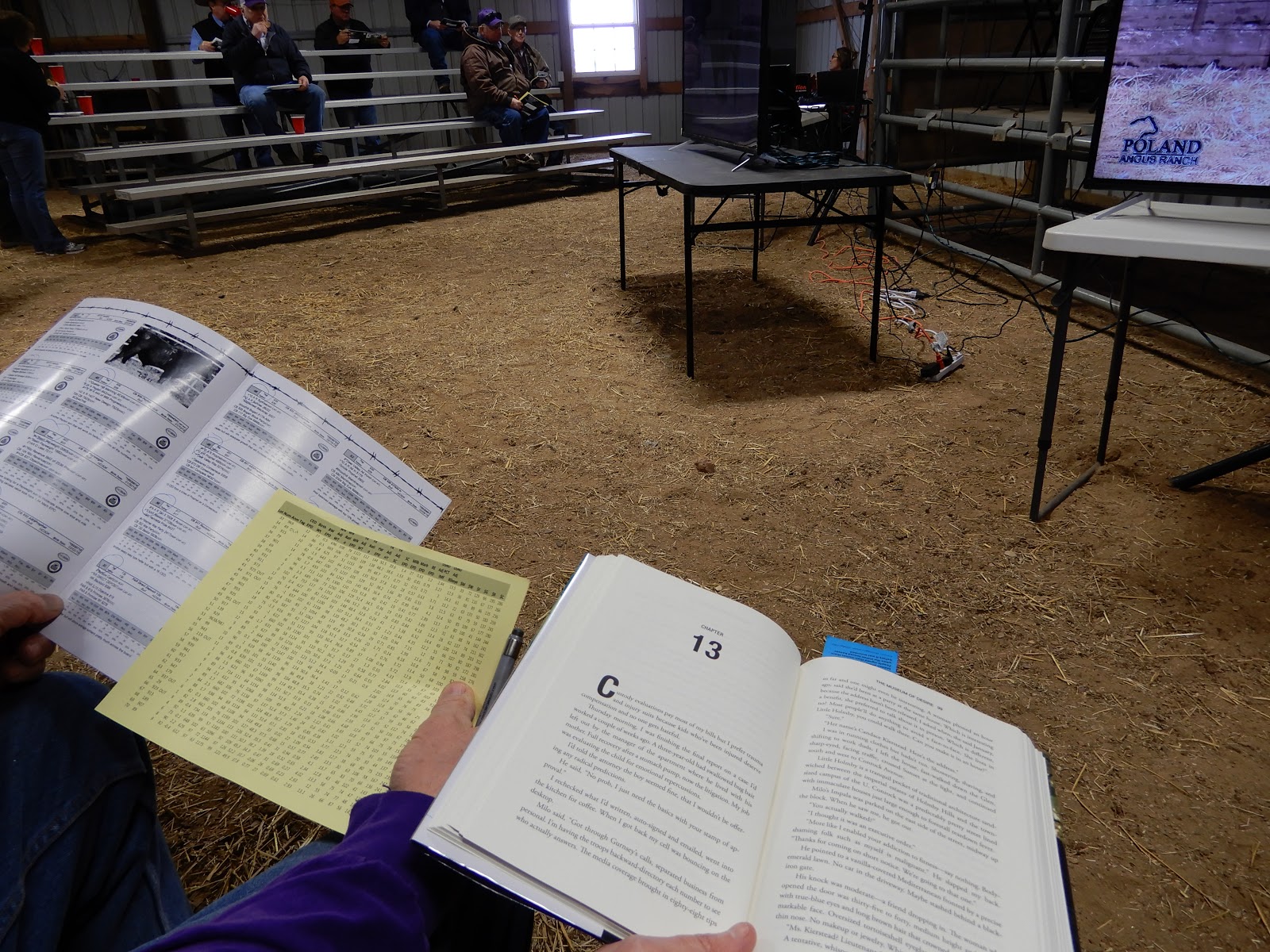
After our "free lunch," Randy continued to look at the updates and read the sales book. I read my mystery.

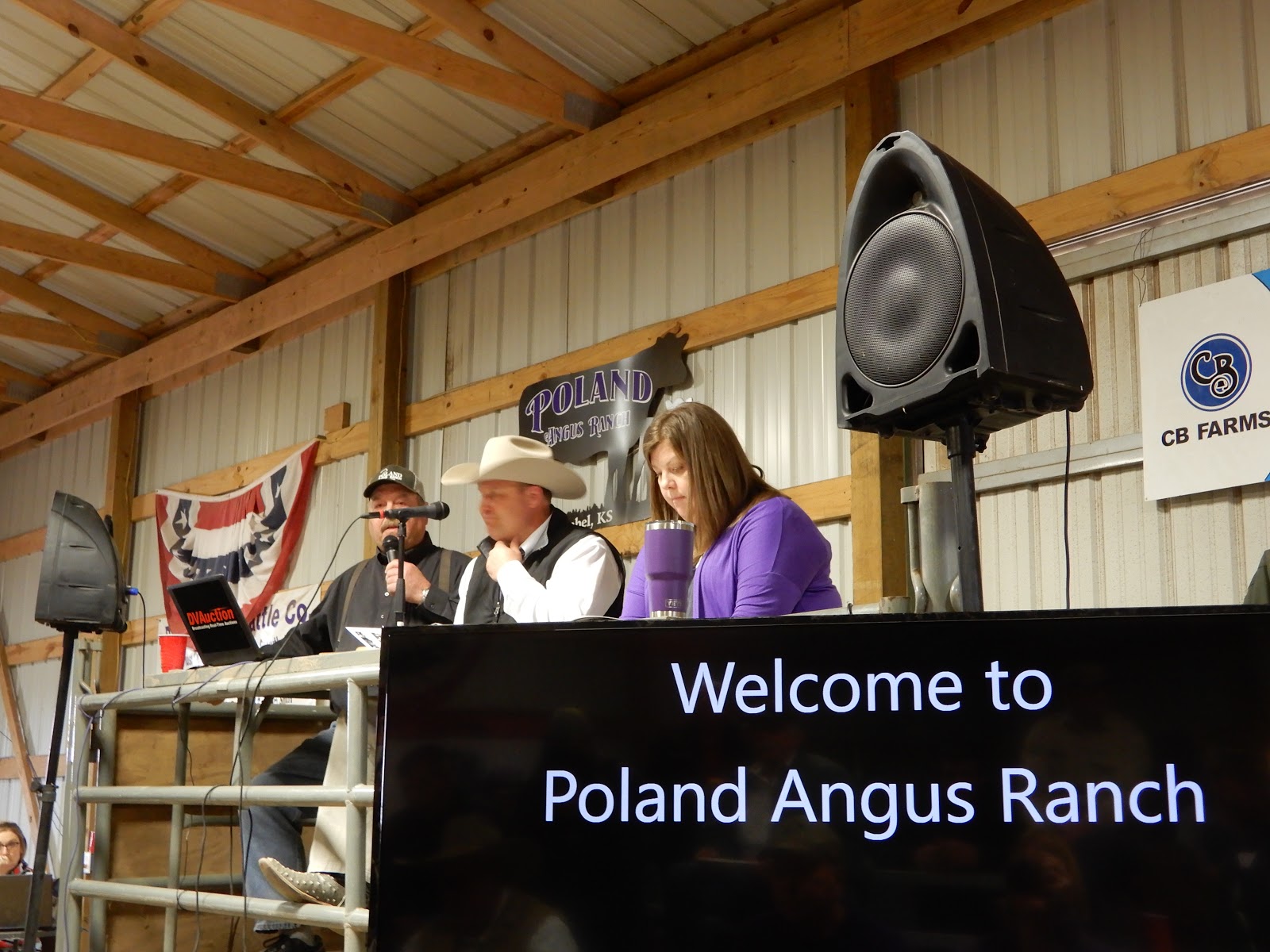
And then it was time. At this sale, the bulls don't come into the arena. Instead, they are shown on a video screen. Three bid takers gave attention to the crowd while the auctioneer chanted his spiel. 
Here was No. 45's brief appearance as a TV star. 
After the auction, we were first in line to retrieve our purchase. If you haul it yourself, there's a small discount. Buyers also got a discount if they were repeat customers. We were.
Once home, the other bulls checked out their new pen mate. Since there are no ladies to impress at the moment, there were no fights - just curiosity.
We don't plan to sell any bulls this year unless they don't pass their "job interview" with Dr. Bruce, our veterinarian, later this spring.

On our way to the bull sale, we made a slight detour and took four heifers who'd lost calves to the Pratt sale barn. 
That required sorting them from the mamas and babies. Randy insists we don't have a Mickey Mouse operation, even though he used stationary that might dispute that. (He knows that I have no memory for numbers, so he makes me a list before we ever start. It keeps everyone happier.)
As we waited to unload, Randy queried, "I wonder if we'll make enough money selling the heifers to pay for the bull?"
I told him there was a flaw in his theory, since we had been raising and feeding those heifers since they were born in the winter of 2018.
We bid $3,750 for the bull, but ended up paying closer to $3,512 after the discounts for hauling and as repeat customers. The heifers ended up bringing $3,585 at the sale barn the next day - $930/head.
Now, if you don't figure pesky things like feed costs, transportation, labor, etc., Randy can feel good. Shhh! Don't burst his bubble.

Thursday, January 9, 2020

Sold! Home-Raised, Home-Grown, Homespun

"Look at these here, boys: They are home-raised, home-grown, homespun."

We collected a paycheck for our "home-raised, home-grown, homespun" feeder calves a little earlier than usual when we sold 73 of them at Pratt Livestock on December 19.

Because our supply of silage was dwindling, Randy decided to sell the calves in December, rather than our usual January or February. (We sold February 7 last year.) Just what I needed: More to do in December, along with the Christmas rush. But ... such is life.

That move to the auction block is only a small portion of the journey that epitomizes that "home-raised, home-grown, homespun" slogan.
 
The first one born was this little guy, who got the first ear tag of the year - 900. (The first number on the eartag tells us when the baby was born - in this case, 2019.)
 
He wasn't the only cutie, of course.
 
 They warmed up on cold winter days with their own personal milk machines - aka their moms.
On our wedding anniversary in March 2019, we worked baby calves for the third day in a row, giving them vaccinations and eartags. The boy calves were also transitioned from bulls to steers.
This eartag caught my eye, since it was our 38th anniversary.
 
 In May, the calves traveled via trailer with their mamas to summer pastures.
This group arrived at the Big Pasture, which has been in Randy's family for more than 100 years. While there is definitely less work with cattle when they are on pasture, this year provided its own set of challenges with five pair that would not stay in, no matter what we did.
We lost track of the number of trips we made on 4-wheelers to bring them back to the pasture. As Randy says, we toured some shelterbelts and back roads that we'd never experienced before.
In early November, on a frosty morning, we gathered the cattle from the the Ninnescah pasture and brought them back home.
On another day, Randy and his cousin Don (along with some other excellent help, if I do say so myself), gathered cattle from the Big Pasture and we transported them home.

After they arrived home from the pastures, they were weaned from their moms. Like wellness checks for humans, the calves had a doctor's appointment, too. Dr. Figger gave them another round of vaccinations. 
My stint with the feed truck began in earnest.
In December, with feed supplies dwindling, Randy was ready to sell.
After getting them in the corrals, we sorted out the 25 heifers we planned to keep. They will become mothers in our herd for the first time in 2021.
There are no pictures from sorting because I had plenty of other things to do. The following day, the semi arrived to transport the 73 calves to the sale barn.
Though we have two farm-sized cattle trailers, it would take several trips to get all the cattle to the sale barn. So we hired Darrel Harner Trucking to do our hauling to market.
The semi is divided into different compartments, which can hold anywhere from six head to 25 head of cattle. Darrel told us how many calves he wanted at a time to load the semi, and we sent them on their way.
It's always a good feeling to watch the semi leave the farmstead ...
... and then watch it arrive in Pratt at the sale barn.
As we watched the calves unload, I noticed our shadows. This journey requires a lot of teamwork from start to finish.
The calves stayed overnight so they were ready for the sale the next day.
Randy says sale day is always a highlight for him, a culmination of a season of work. He had hoped the calves would weigh 600 pounds apiece, but they weren't quite that big. While the price wasn't quite as good as last year, he was pleased enough with the paycheck.
The cattle work didn't end. We are still feeding the 25 sisters left behind at home. Randy is hauling hay and water to the expectant mothers. Today, with the cow's due dates fast approaching, we are driving one group of cattle off stalks and into a pasture. We are sorting another group that got mingled together earlier this winter.

The 2020 maternity ward is only a couple of weeks away. And the whole process will begin again. (I'm hoping for no repeat of the summertime escapees in 2020.)