Thursday, January 13, 2022

Tropical Getaway


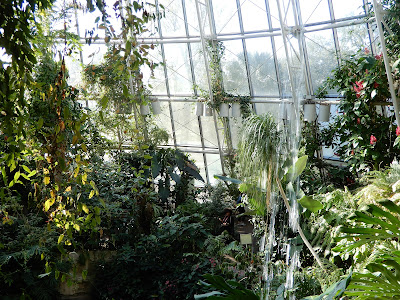
There's a certain satisfaction in realizing that you're in the middle of a tropical rain forest (or - at least the citified version) and missing the polar express temperatures at home.


For the past two winters, Randy & I would have been in Kansas, trying to stay warm as we fed and watered cattle. My January photo on the family calendar has a snowy scene of a water delivery last winter. We didn't have hired help the past two years, so we had to stay fairly close to home since cattle seem to want to eat every day. Our cattle herd's Uber Eats was powered by Kim & Randy.

It's probably no surprise to anyone who knows me that the Butterfly House at the Museum of Natural Science in Houston was my favorite exhibit. And that's where we found the "rain forest." 


Because we aren't caring for our cattle ourselves this winter, we took advantage of a few extra days away after K-State's game.  One of those days, we visited the museum.
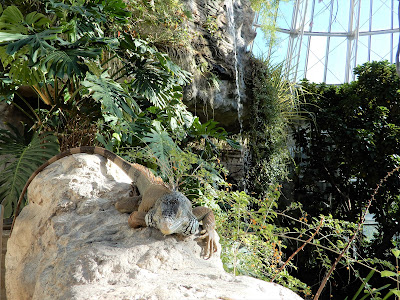
It was a lot easier to take a photo of our "tour guide" than it was the flittering and fluttering guests of honor. He didn't move the whole time we were in the exhibit. But he doesn't have quite the visual appeal as his flighty neighbors.


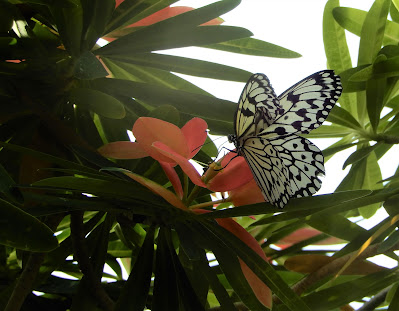
These rice paper butterflies were abundant. With their wafer-paper thin wings, it was easy to see where they get their name.
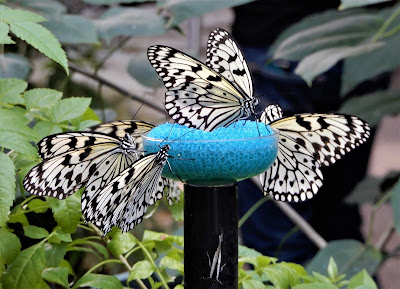
Rice paper butterflies


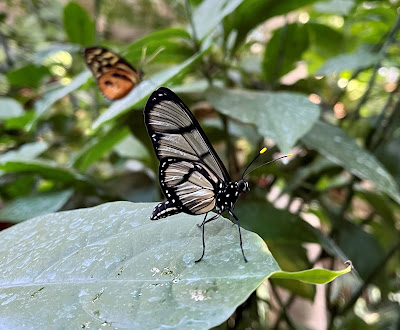
The blue butterflies were much more elusive and much less cooperative. I never saw them away from the windows of the solarium.

Their inelegant perch didn't make for beauty shots.
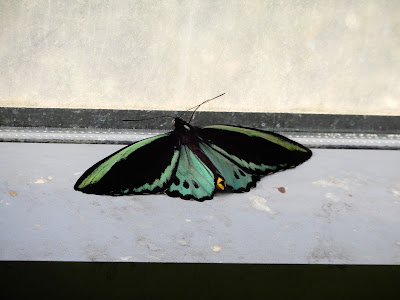
Cornflower blue is probably my favorite color. I would have loved to get a better shot of this blue beauty.

While the colors on the other butterflies were more reminiscent of the Monarch butterflies who travel through our area each fall, there were many more varieties.

The museum estimates there are 1,500 to 2,000 individual butterflies in the exhibit at any given time. There are 60 or so species of butterflies from tropical regions such as Southeast Asia, Africa, and Central and South America.
Leopard lacewing

A sign told us to watch for numbered butterflies. A couple of butterflies photobombed the sign as I was taking the photo!


Randy's sharp eyesight spotted one. It wasn't the prettiest photo, but we saw No. 23, nonetheless.


Advice from a Butterfly:

Let go of the past
Trust the future
Embrace change
Come out of the cocoon
Unfurl your wings
Dare to get off the ground
Ride the breezes
Savor the flowers
Put on your brightest colors
Let your beauty show.

-Unknown
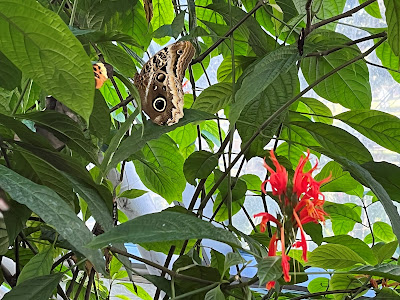
 

That seems like good advice on this first month of the new year!

While it wasn't as warm as the rain forest, the moderate Houston temperatures also led to an expedition on the Hermann Park Golf Course. We don't have skyscrapers visible on the Stafford golf course - unless you count our prairie skyscrapers - grain elevators.

We'd been to another part of Hermann Park for K-State's pep rally before the Texas Bowl. 
 

 We won the game vs. LSU, 42-20. (I had more Texas Bowl photos on my Facebook page.)
But the next day, we were back in Hermann Park for golf.

I rode along. Randy's golfing companions were a trio of guys who regularly play the course. They provided lots of free advice.
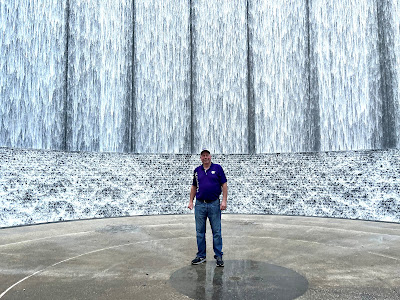
It was still shirt-sleeve weather when we checked out another Houston attraction, the Waterwall, later that day.
 
Designed by SWA Group and completed in 1985, the 2.77-acre park in the Uptown District features a 64-foot-high, sculptural fountain popularly known as the Waterwall.
The Water Wall pumps 78,500 gallons of recycled water every 3 hours and 20 minutes.
 
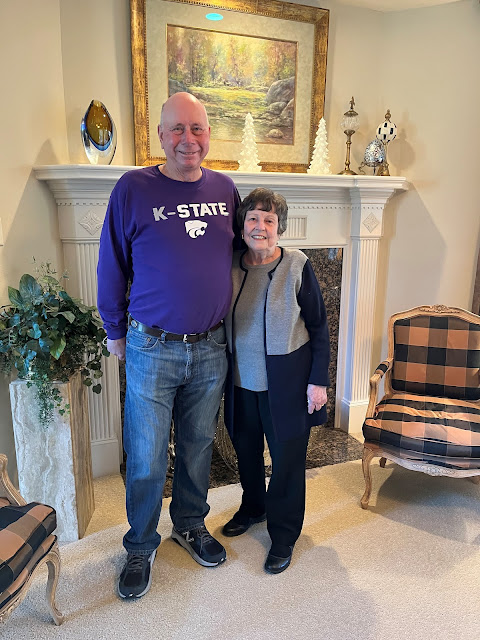
Another stop that warmed our hearts was a visit with Randy's Aunt Lorene, Uncle Gary and cousin Garrick. It had been awhile since we'd seen them.


The whole getaway was fun - with the exception of the Houston traffic. Randy only got honked at three times. We'll call that a success!

More from the museum in an upcoming blog!

Tuesday, January 11, 2022

Ripples of Beauty


When you see beauty all around you, beauty will seek and find you, even in the most unexpected places.
Alberto Villoldo


Sunset is usually pretty in some way. But it was a happy accident that sunset during a trip to Quivira National Wildlife Refuge was so spectacular. Even though the Little Salt Marsh is only a few miles from our house, you have to make the decision to venture out before you know whether the setting sun will provide a Broadway-worthy finale ... or maybe only a one-star review.


But, on that December evening, the view was worthy of all the good reviews and accolades - though at our location, it was only Randy and me, joined by a chorus of pelicans, ducks and geese bidding each other a good evening.

Cloudy summer skies can provide their share of drama. But NOAA meteorologist Stephen Corfidi.says it's scientific fact that the crisp, cool temperatures yield even more vibrant hues. No matter the time of year, sunset colors are created by a phenomenon called Rayleigh scattering. It’s the same phenomenon that makes the sky appear blue during the day.

Sunlight contains all the colors of the rainbow. But not all the colors reach the ground in the same concentration. Nitrogen and oxygen molecules in our atmosphere act as little mirrors for blue and violet light, in particular. That means not as much blue or violet light reaches the ground. Instead, it bounces around in our atmosphere, creating the blue dome of sky we’re all so familiar with. 


At sunset, light has to travel through a greater distance of atmosphere to reach our eyes — so even more blue light, and even some green and yellow light, gets filtered out. That leaves us with the warmer hues of the visible light, the reds and oranges, and it’s why many sunsets look like fire. 


Crisp, dryer air allows more pure colors to reach our eyes. That night, the shifting sky painting lasted for about an hour. On that unseasonably warm night, the sunset was a balm to my soul. 

 A pebble cast into a pond causes ripples that spread in all directions. Each one of our thoughts, words and deeds is like that. 
Dorothy Day

Sometimes those ripples are positive.


Sometimes they aren't. And I supposed we're called to make the best of any ripples that come our way.
 
In this scene, we could see something disturbing the surface of the water. 
 
The critter didn't seem to care that we were interrupting its evening dip in the Little Salt Marsh.
 

Randy thinks it was a muskrat, though it was hard to see in the vanishing light.
 

Final shot before heading for home ... Thank you, God, for beauty to calm the soul.

From an email devotional in this new year:

O Great Spirit, whose breath gives life to the world, and whose voice is heard in the soft breeze; We need your strength and wisdom. Cause us to walk in beauty. Give us the eyes ever to behold the red and purple sunset. Make us wise so that we may understand what you have taught us.  Help us learn the lessons you have hidden in every leaf and rock. Make us always ready to come to you with clean hands and steady eyes, so when life fades, like the fading sunset, our hearts come to you without shame. Amen.

Traditional Native American Prayer, UMCH #329 


Thursday, December 30, 2021

The March Toward Harvest: December Update

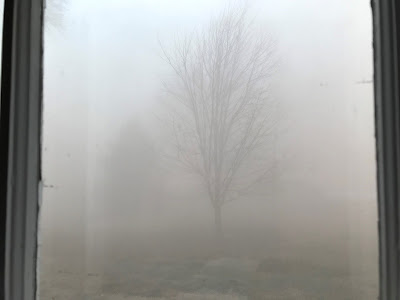
Taken from my dining room window, December 15, 2021. You couldn't see our north driveway.

 This is not a December photo of the wheat field. But it does illustrate some of what happened to our wheat crop this month.

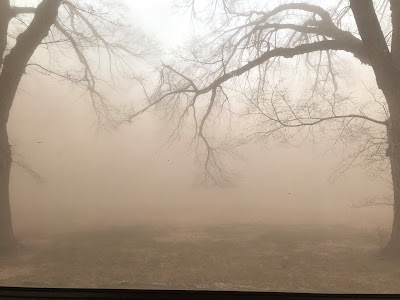
From my front door, December 15, 2021. You couldn't even see the road.

On December 15, we had a terrible windstorm. It turned the landscape into a reenactment of the Dust Bowl Days here on the Central Plains.


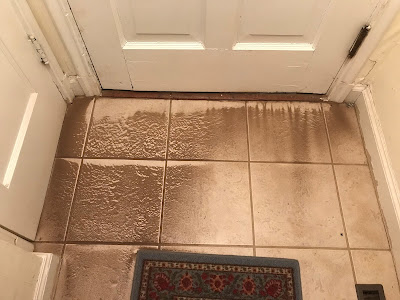
This was the dirt that swirled in through my front door. It was everywhere.

Though it was a mess and likely did some damage to the some of the wheat crop, we feel fortunate. Some farmers and ranchers in northwest and north central Kansas had a wind-whipped wildfire. Two people lost their lives. It's estimated that 1,000 head of livestock were lost in the fire. And dozens of homes and outbuildings were lost, along with miles and miles of fencing. 

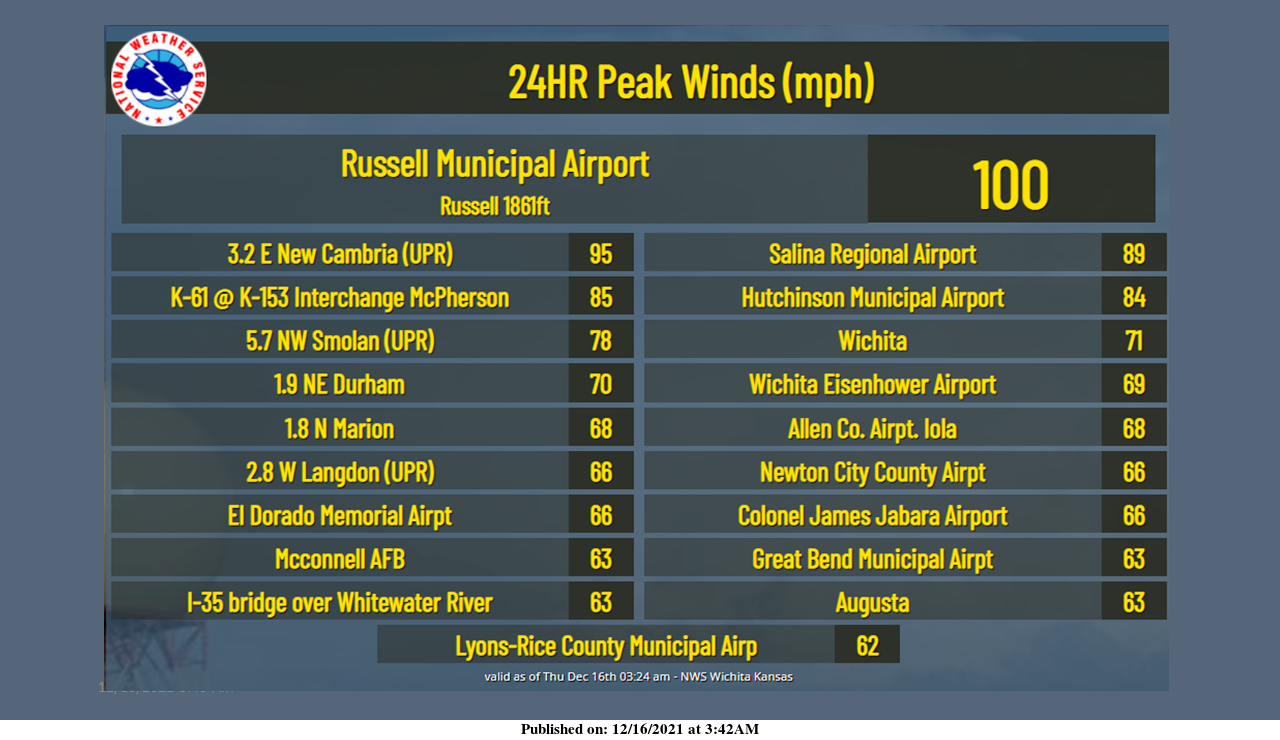
Wind records were smashed for the month of December since 1996 for central and south-central Kansas, according to the National Weather Service. This includes Wichita, Hutchinson, Salina, and Russell. Russell saw winds peak to 100 mph, shattering their old record of 67 mph.

We live in a house surrounded by old trees. As the wind was roaring, I was concerned that a tree or a big branch would topple onto the house. Thankfully, the trees stayed together. 

December 21, 2021

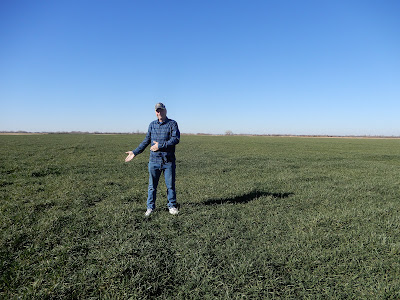
 Our wheat that was better established seems OK.

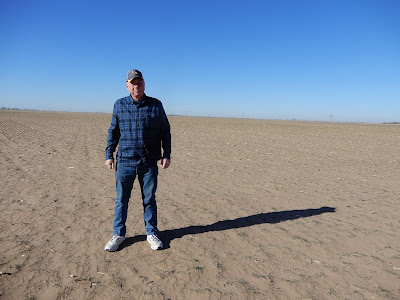
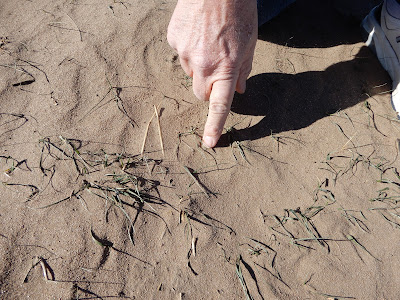
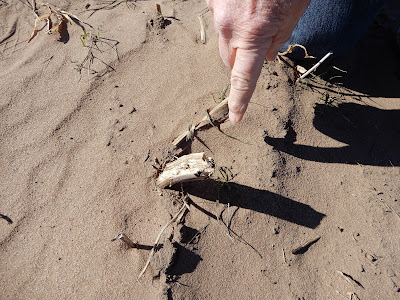
However, we had some later planted wheat (that was also replanted in late October) that blew badly during the windstorm. 

December 21, 2021

It was planted in corn stubble, so there was some residue left in the field, though it's a little hard to tell at the moment.

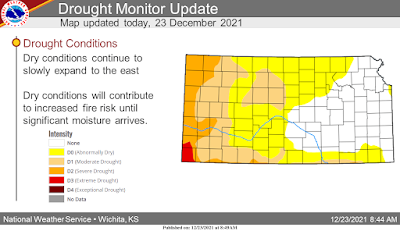
The drought conditions across the state continue to slowly expand as the long stretch of dry weather continues. 


Most areas of western Kansas are in experiences drought conditions, and this area is expected to continue to slowly expand eastward as long and the dry weather continues.Right now, we are in the "abnormally dry" designation. The dry weather will also increase the inherent fire risk until significant moisture arrives in the region.

There is a little glimmer of hope on the horizon. We may get measurable snow on New Year's Day. Time will tell. We haven't had measurable moisture since October when we were trying to plant wheat.

Here's a look back at my monthly wheat updates so far:

October

November

Here's hoping I'll have moisture to report in January!