
"Do you have questions?" That's a dangerous thing to ask a group of farmers.
Let me clarify: It may not be dangerous for the questioner. It may not be dangerous for the presenter. But it definitely is dangerous for an amateur tour guide trying to keep a group on schedule.

For a place that many people consider "flyover country," we had plenty to offer. In fact, I couldn't cram all the ideas I had into one day.

But, when I began the planning process back in August of last year, I knew that a tour of Stafford County Flour Mills was my first call. Hudson may not be the biggest town in the county - population 125 - but it's the home of Hudson Cream Flour. Due to regulations and nondisclosure agreements with companies, the mill does fewer tours than it did back in the day when I sponsored a group of Stafford County 4-Hers. Thankfully, they were gracious enough to host our group, and we began our day at the mill - one of the last independent flour mills remaining in the U.S.
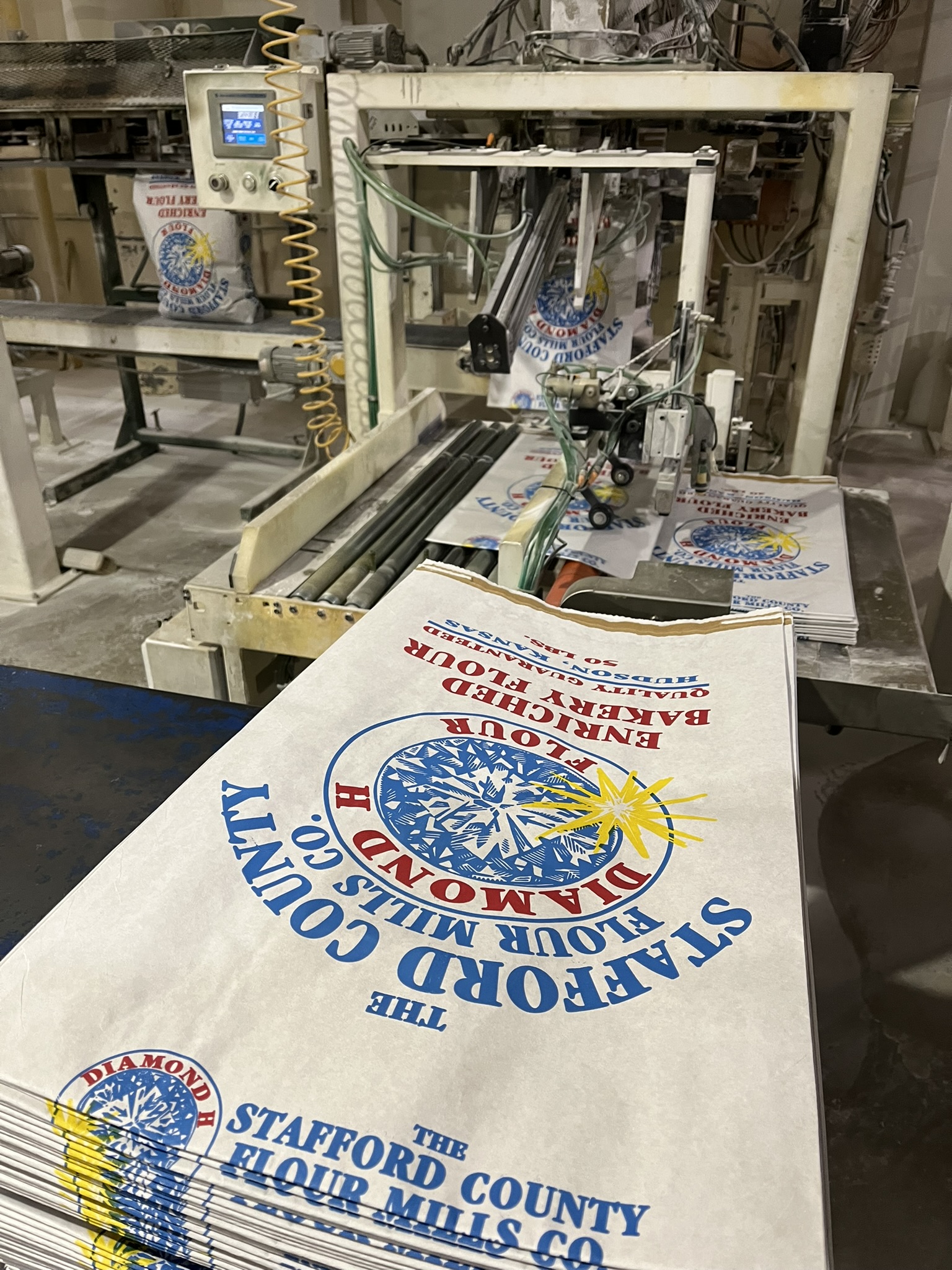

Hudson Cream Flour is made using a "short patent" milling process, a method that was much more common a century ago than today. In short patent milling, the wheat is ground more times and sifted with finer-meshed sieves than in standard milling. Also, the short patent process sifts away more by-product, leaving only the heart of the wheat kernel to make Hudson Cream flour. That Jersey cow on the label (and on the side of the elevator): It's used to symbolize how creamy, rich and smooth the flour is - hence, Hudson Cream Flour.

The mill's story began in 1882, when Gustav Krug migrated from Saxony, Germany and settled on a farm north of Hudson. His father, Karl, was in the milling business in Germany. Gustav decided he preferred milling over farming, so he formed the Hudson Milling Company with his brother-in-law Otto Sondregger in 1904.
When production began in 1905, there was a capacity of 75 barrels of flour produced daily. In 1909, financial difficulties forced the brothers-in-law to reorganize with a group of investors as the “Stafford County Flour Mills Company."
After the original wooden mill burned to the ground in 1913, Krug borrowed $50,000 to build a
new mill and erect the first four concrete storage tanks. Krug repaid
investors before his death seven years later. In 1914, milling
began at the new mill, with a capacity of 300 barrels per day.
In 1986, the Krug family was ready to retire. Without a family member of the next generation to take over, several members of the Hudson community were concerned that selling to a large company would mean a loss of jobs, and perhaps the mill itself. A holding company was formed to pool the resources of many members of the community, and the holding company purchased controlling interest of the mill from the Krug family, keeping Stafford County Flour Mills a locally-owned company.
Today - after nearly 120 years and mill renovations along the way - the milling capacity has increased to 4,000 hundred weight per day. More than 95 percent of the wheat milled at Stafford County Flour Mills comes from 75 to 80 farm families in Stafford County. When weather conditions mean that local farmers don't produce enough wheat or the quality is below par, the mill will truck in high-protein wheat from western Kansas.
 |
| Whole wheat flour being packaged. |
CAROL LONG POTTERY STUDIO

Our next stop was the Carol Long Pottery Studio. Carol creates internationally-recognized pottery from her farm home just a few miles from Hudson. She grew up on a farm south of St. John. She says she is inspired by the beauty and nature around her.

I am inspired by botanical life and hidden aspects of nature. I emulate my inspirations with an elaborate flow of shape, line, and texture. My work begins with shape and form. Depth is added through texture. Intricate slip application and glazing brings organic unity to the finished piece.
 |
| Works in progress |


DUNN SWINE FARM, St. John
As I've looked over photos from a full day in Stafford County, I realized that I missed some photos I wish I'd taken. The first omissions were during our lunch presentation by Leon and Jan Dunn, who are fellow Master Farmers from Stafford County. They were joined by their son-in-law and daughter, Scott and Jennifer Pfortmiller. I didn't get a single photo of them. However, I've linked Leon's presentation the family gave at the 2022 K-State Swine Profitability Conference. It gives a great overview.
Swine facilities have strict regulations for visitors in an attempt to prevent animal disease. Their video "took" us to their facilities virtually.
GRAY PHOTO STUDIO, St. John

Originally built in 1898, the building was home to Willam Rossetter (W.R.) Gray and his family. Gray was a well-known photographer throughout Central Kansas and photographed most of the families in the Stafford County area. Gray used wet glass plate photography and more 30,000 of his glass plate negatives were saved and are stored at the Stafford County Museum in Stafford.
 |
| This is a print from one of the glass plate negatives. It features Jessie Gray and friends having a tea party. Dated 1910. |
Restored glass negatives images from the Stafford County Historical and Geneaological Society can be seen at the Fort Hays State Scholars Repository's website HERE. They truly are a reflection of that period in time.
For more than 10 years, Carol Long and the Gray Photo Studio Board have had a dream of transforming it into an Art Center. The building is getting a makeover as construction has started to finish the insides of the building. The 100-plus-year-old building will soon once again be a place of inspiration: A place for resident artists to come work on their craft and offer trainings. A place for the community to come together for events and art shows.
 |
| Carol Long and Stafford County Economic Development director Ryan Russell talk about plans to restore the studio and make it an art center. |
 |
| From the Gray Photography Studio Facebook page. Note the large windows that Mr. Gray had installed to let in natural light. |
Funding from a Kansas HEAL grant is moving the renovations along. We briefly interrupted carpenters as we walked through the space during our tour.
 |
| From Gray Studio Facebook page |
SOLAR ECLIPSE

This is another one of those photos that I'm sad I didn't take. In my instructions to participants before the Discover Kansas tour, I encouraged them to bring solar-safe glasses so we could view the partial eclipse on April 8.
Many of them did, and we included craning our necks up to look at the eclipse's progress as we got on and off the bus in the afternoon. But, alas, I did not take a photo of people in their glasses. I really wish I would have. Evidently, no one in our group thought to do that - at least, among the people I've asked. But it was an added bonus for the day to have the 89 percent eclipse as part of our tour. We aim to deliver memorable experiences in Stafford County!
COMMERCIAL KITCHEN, St. John

Our group also toured the newly-licensed commercial kitchen in Stafford County. It is located in the Stafford County Annex, right off the 21
Central District Extension office. Jennifer Gleason, county agent, and
Ryan Russell, spoke about joint efforts to make the kitchen available
for people who wish to produce food products for sale. Several small businesses in Stafford County already make value-added
food products they can sell themselves. Making those items in a
commercially-licensed kitchen could open the door for sales in stores,
online, or out-of-state. The new kitchen in Stafford County is one
of fewer than two dozen such facilities around the state. It can also be rented for family and community gatherings.

4 STAR HYDROPONICS, St. John
Our next stop took us to 4 Star Hydroponics. It's operated by Alisha Mawhirter, who grew up on a traditional farm in Stafford County but now grows produce hydroponically. In her spare time (ha, ha!), she and her husband are raising five little girls. (Two of them were helpers during our tour.)


This tour stop was new to me, too. It may have been a little cool outside the greenhouse, but it was toasty inside with the sun streaming through.


Much of the produce 4 Star grows goes to Whole Foods stores halfway across the state.
 |
| Living lettuce |

Alisha primarily raises heirloom tomatoes, since that crop provides a higher profit margin.
SPARE PRODUCE, St. John
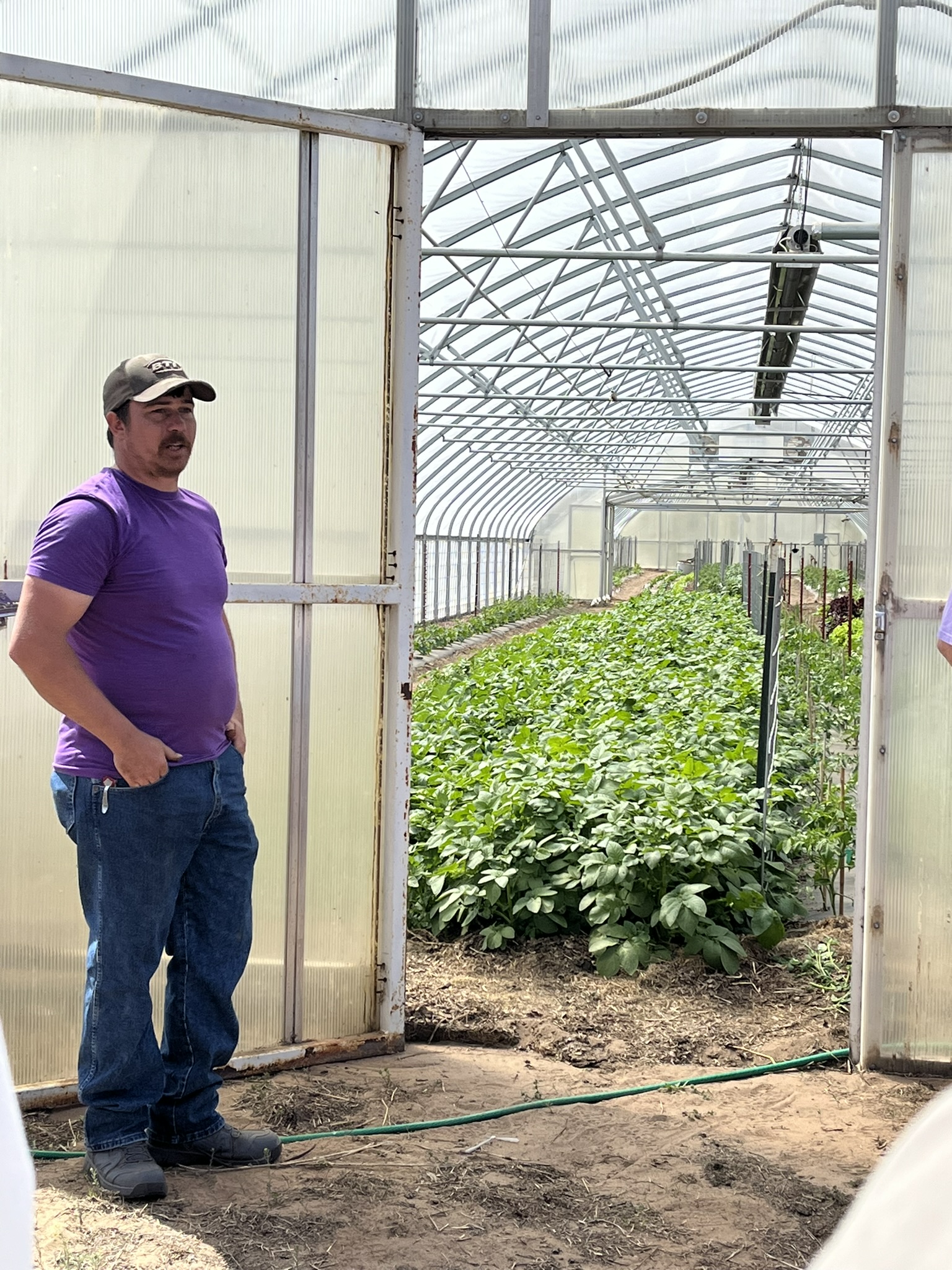
The produce grown at Spare Produce is grown traditionally. It's a business that current operator Timothy Spare comes by naturally. His grandfather, Richard Spare, began the business. Today, Timothy, and his wife, Felicia, with help from his parents Merlyn and Melody Spare, sell their produce through farmers' markets in Hutchinson, Pratt, Great Bend and St. John, along with some on-farm sales.


High tunnels give the Spares a head start on getting ready for market season. While the potatoes Timothy planted outside are still hidden from view, the ones in the high tunnel are coming along well.

They've already started selling some lettuces and spinach locally this spring.

They also have a produce grower in training at their house.

Felicia has added fresh flower bouquets to their farmer's market sales during the summer.

Timothy also took the group to their sorting and prep room. They have some plants under grow lights which they'll transplant into gardens as the weather improves.

NORA LARABEE MEMORIAL LIBRARY, Stafford
I've written a lot about the Stafford library on Kim's County Line including HERE and HERE. But it was definitely a stop I wanted to include on our Stafford County tour.

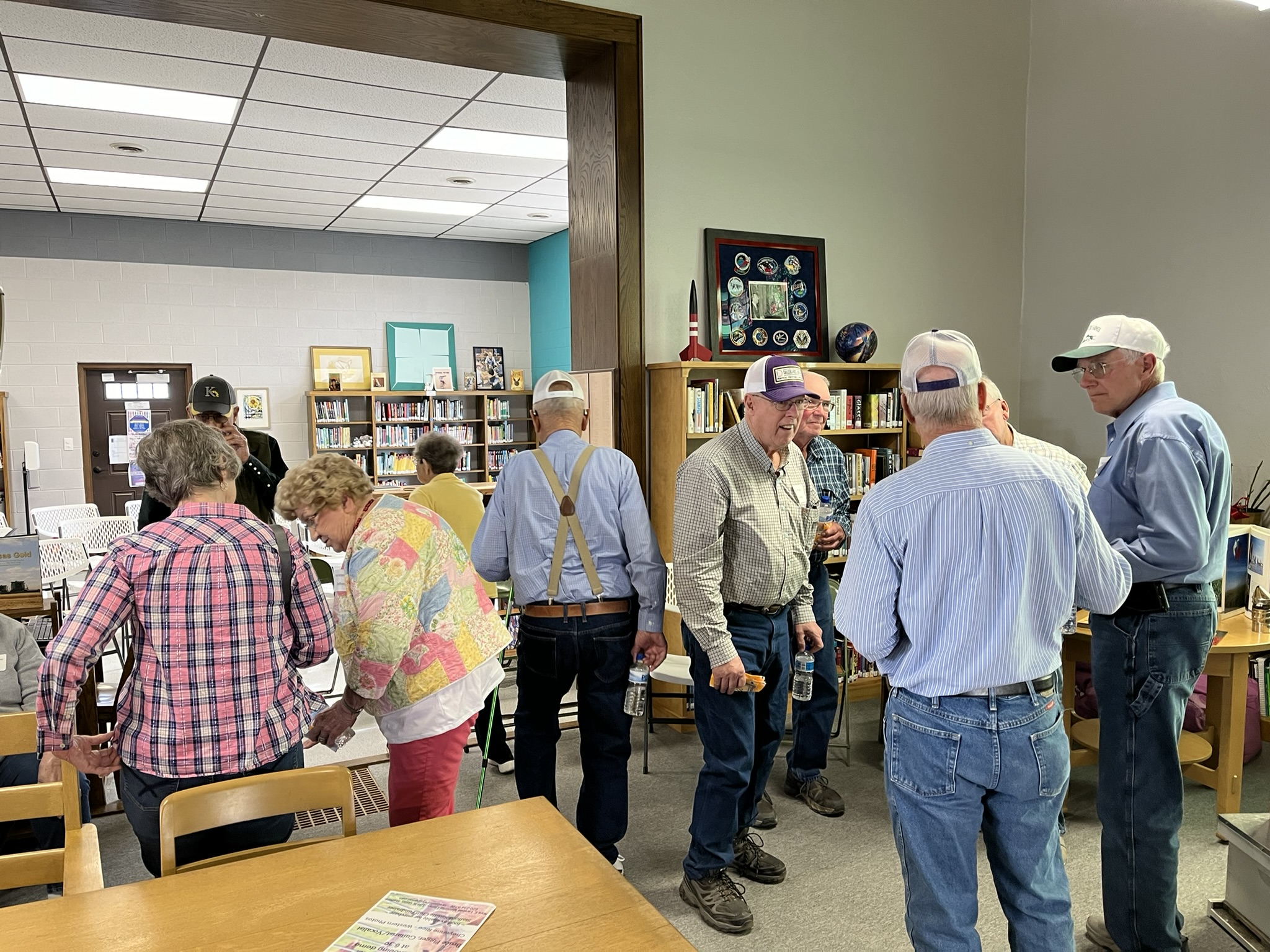
Librarian Gerry Ann Hildebrand talked about the history of Stafford and of the library, which was opened in 1905.

In recent years, the library has undergone a renaissance with extensive remodeling and new programming, including First Fridays, an evening of information, music, crafts, food and fellowship. Since the inaugural First Friday of the 2024 season had just happened the past weekend, I asked the presenter to come speak to our group, too. Tom Turner shared information about his Wild At Heart bees.
He didn't bring his helpers to the Discover Kansas presentation, but they were a lively and fun addition to the Friday night event.


Local photographer Adrienne Minnis had photos of Kansas flowers compiled for a slide show to tie into the nature and bee theme. They were projected onto computer screens at the library for First Friday and again for our Discover Kansas group.
QUIVIRA NATIONAL WILDLIFE REFUGE
As with the library, I've posted plenty of photos from Quivira National Wildlife Refuge on my blog. There's still a lot of winter brown at the refuge, but we still took a bus trip through the southern portion of the refuge.


One added highlight to the day was that our bus driver was a fraternity brother of Randy's. After Don DeWerff retired, he began driving for Village Travel Tours. When Randy arranged for the bus, he requested Don. We weren't sure whether he would be assigned, but he was. Bonus! It was like old home week because Don seemed to know a lot of people on the tour and presenters at our tour stops.
STAFFORD HIGH SCHOOL CULINARY ARTS PROGRAM

Culinary arts teacher Kim Unruh presented information about the Stafford High program. About 11 years ago, SHS’s traditional Home Ec/FACS program got a revamp. SHS applied for and received a Rigorous Program of Study grant from the State of Kansas. It then took a two-year effort by the USD 349 Board of Education and staff to develop curriculum and revamp kitchen space to add a Hospitality, Tourism, Restaurant and Event Management curriculum pathway to the district.
She also brought along three young men from her classes, who demonstrated making arancini balls.

SHS's Pro Start team - which recently competed in a state contest - made arancini balls for the appetizer of their competition meal. Arancini are Sicilian street food made of risotto that's rolled into a ball, stuffed with cheese, breaded and gently fried. I wish I'd taken a photo of the finished product. I guarantee they tasted wonderful!
The
Kansas Restaurant and Hospitality Association holds the ProStart
Culinary and Restaurant Management State Competition each year in March. The event brings schools from across the state to Wichita to
compete by developing, preparing and presenting a gourmet three-course
meal in 60 minutes, using only two butane burners. no electricity, and
no running water. SHS is the smallest school to compete in Pro Start.

They also served a delicious honey cake with strawberry topping and fresh vanilla bean whipped cream for our dessert. They used honey from Wild At Heart for the cake. (Ugh! No photo.)
OTHER PHOTO REGRETS
I didn't take any photos of the delicious food prepared by Wheatland Cafe of Hudson - from the cinnamon rolls in the morning to the bierock lunch to the smothered steam and fixings supper. I also missed getting photos of the cookies fellow Master Farm Homemaker Alda Hildebrand and I made for the lunch dessert and afternoon snacks. All the bread products and the cookies were prepared using our homegrown Hudson Cream Flour.
Alda also decorated the space with her handmade quilts and Arnold's woodworking. Again - no photos. Oh well! Those missing photos were the only regrets from a great day.

