Showing posts with label KS. Show all posts

Tuesday, December 17, 2024

Bookends of Our Trip


BOOKENDS: Every trip has a start point and an end point. Of course, if you have stronger "constitutions" than we old people do these days, there don't have to be as many way-stations along the way. But our trip to and from Eureka Springs had some tourist stops on both ends of the journey. 

BEGINNING BOOKEND

When I was a little girl, one of my favorite TV shows was "Bewitched." I often daydreamed about how convenient it would be to "wiggle my nose" like Samantha and instantaneously get the result I wanted. 

Alas, it doesn't work any better now than it did when I was a kid. So, when you depart for a trip, you know it's going to take you a certain amount of time to get there. When you live with a map aficionado like Randy, he definitely develops a time table and plan. 

Randy figured our departure time would have us arrive in southeast Kansas around noon.When it's nice weather, we often take a sandwich lunch in a cooler for our noon meal, rather than stopping at a fast food place along the way.He proposed stopping again at Big Brutus, where we'd had a picnic lunch on our spring 2023 trip through Missouri, Illinois, Kentucky, Indiana and back home again.

On one of our excursions through that part of the state, I'd seen that there was a Little House on the Prairie Museum. So I suggested a new stop instead. The museum near Independence, KS, celebrates the setting for Wilder's "Little House on the Prairie" book. 

My mom read the "Little House" books to we three girls, and I re-read them myself later in elementary school - twice, if I recall. Both Jill and Kinley read some of them, too. During the earlier 2023 trip, we'd stopped at Mansfield, Mo., when I happened to see a billboard advertising a Laura Ingalls Wilder museum there. While the Kansas version wasn't as extensive as the Mansfield site, I still enjoyed it, and there were even picnic tables there to enjoy our lunch. 

The log cabin resembles one described as the Ingalls' home in "Little House on the Prairie," though this is a reproduction. The Osage signed the treaty selling the land to the government on September 10, 1870. The family home was listed as the 89th residence of Rutland township in the 1870 U.S. Census, and the family lived there about one year. In her book, Laura told of building the cabin, of encounters with Indians, of going to Independence for supplies and of Dr. Tann's treating the family members for "fever'n'ague." Dr. Tann's grave is in Mount Hope Cemetery in Independence. The family Bible reveals that Caroline "Carrie" Ingalls was born in Rutland township in Montgomery County, Kansas, in August 1870.
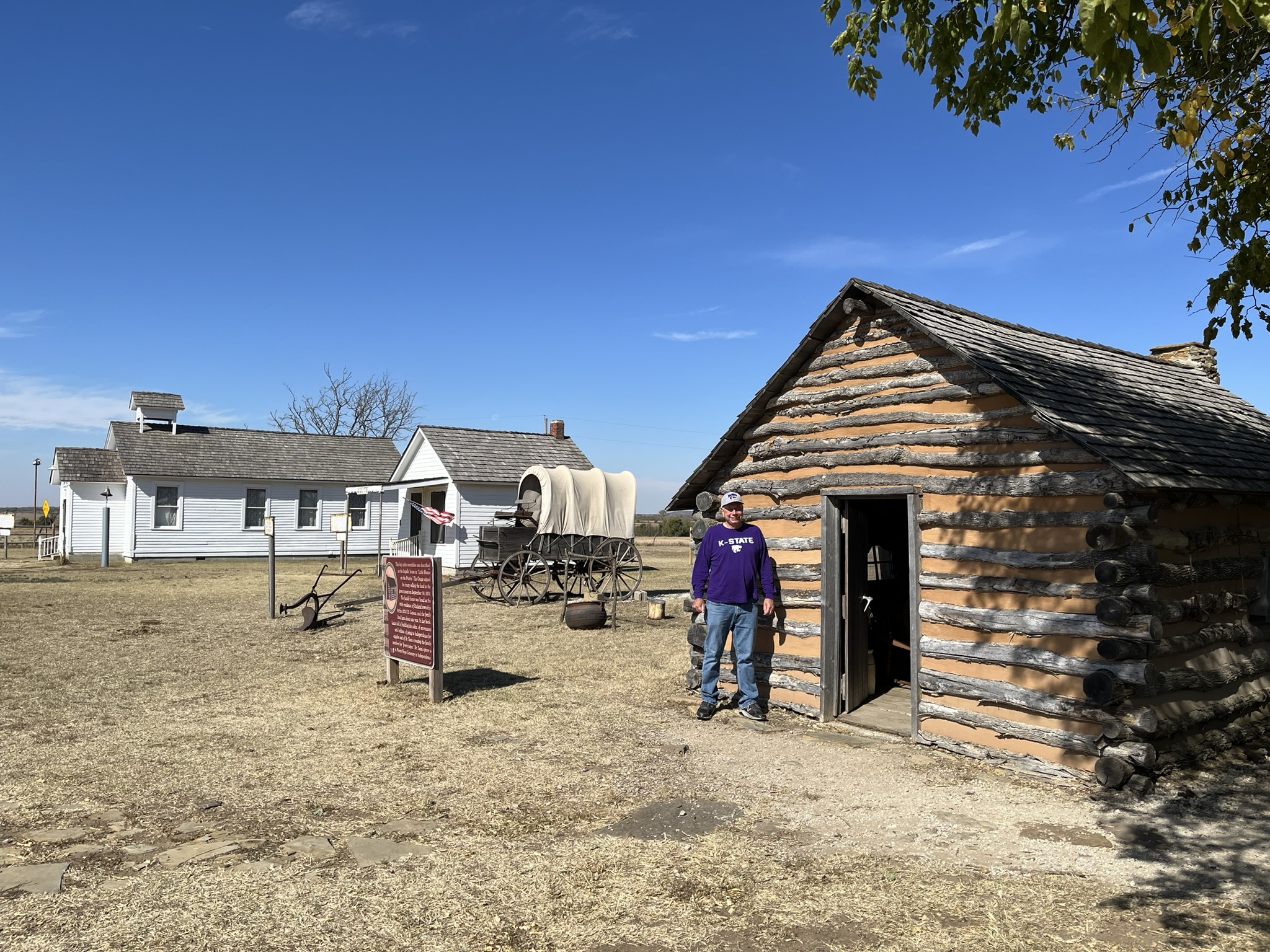

There is an old farmhouse on the site, but the Ingalls family never lived in the house. It's just a representation of how people who settled in the region may have built more permanent housing if they were in Kansas to stay. The Ingalls family only lived in the area about a year before returning to Wisconsin.


A gift shop is now in the farmhouse.


The hand-dug well on site, dug by Charles Ingalls, is mentioned in Laura's book.

Also on site are the Wayside, Kansas, post office ...


... and the Wayside School.

It was a nice stop along the way ... even Randy enjoyed it (though probably not as much as I did).

ENDING BOOKEND


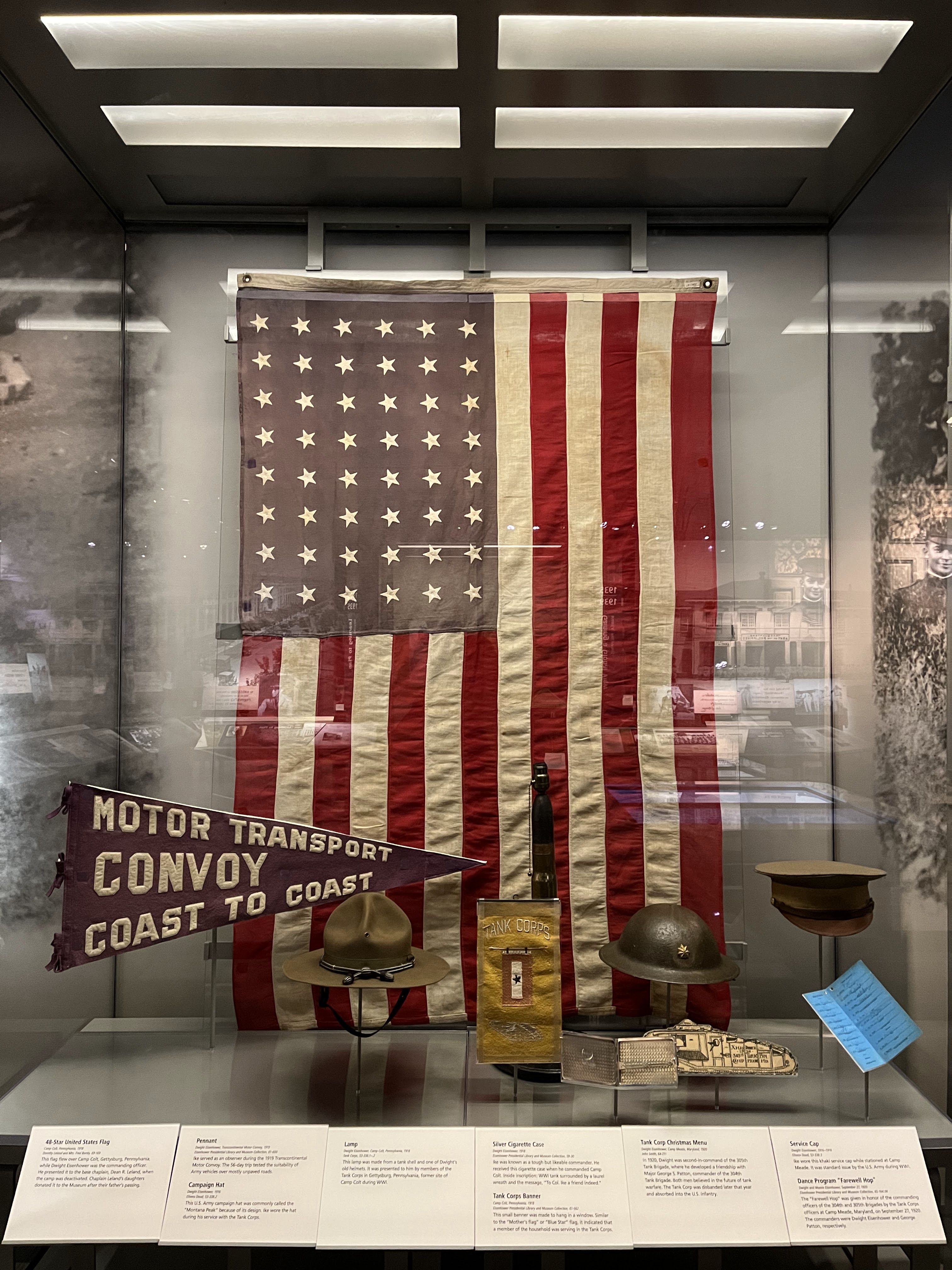
We stopped to see Brent and Susan in Kansas City on our way home. While they finished up their day of work, we did a "tourist-y" thing and went to the Kansas City World War I museum. We'd been to a concert on the grounds, and we'd seen the museum from the outside. For this trip, we took the time to tour it.

The displays were excellent. At the time we were there, they were working on a display that would feature tanks used in warfare. We'll have to go back another time, since Randy's dad drove a tank during the Korean War. (It was scheduled to reopen on Veteran's Day, so if you're planning a trip to Kansas City during Christmas break, it should be open.)


However, there was a bit of nostalgia with another of the displays. Randy remembers a tent similar to the one above that they unearthed at his Grandma Ritts' house. It had probably belonged to her brother, Ray, whom she'd cared for. Randy and Lyle took it home and had a grand time setting up the tent and playing Army at the farmstead.

Soon after World War I ended, Kansas City leaders formed the Liberty Memorial Association (LMA) to create a lasting monument to the men and women who had served in the war. In 1919, the LMA and citizens of Kansas City raised more than $2.5 million in just 10 days. The equivalent of more than $40 million today, this accomplishment reflected the passion of public sentiment for the Great War that had dramatically changed the world.

“It [The Liberty Memorial] has not been raised to commemorate war and victory, but rather the results of war and victory which are embodied in peace and liberty…. Today I return in order that I may place the official sanction of the national government upon one of the most elaborate and impressive memorials that adorn our country. The magnitude of this memorial, and the broad base of popular support on which it rests, can scarcely fail to excite national wonder and admiration.”

— Liberty Memorial Dedication Speech, President Calvin Coolidge, November 11, 1926


All the displays were well-done and gave plenty of opportunities to read as much or as little as you wanted. Plus, there were films interspersed throughout, giving ample chances to sit, rest and learn something at the same time.


Over time, the physical structure of the original Liberty Memorial deteriorated, and it was closed in 1994 due to safety concerns. However, in 1998, Kansas City citizens passed a limited-run sales tax to support the restoration to better showcase the WWI-related objects and documents the LMA had been collecting since 1920. In 2004, the Museum and Memorial was designated by Congress as the nation's official World War I Museum, and construction started on a new 80,000-square-foot, state-of-the-art museum and the Edward Jones Research Center underneath the Liberty Memorial.The Liberty Memorial was designated a National Historic Landmark on Sept. 20, 2006, recognizing the monument as a nationally significant historic property. 

JUST ONE MORE STOP


Final stop on our travel itinerary was a home football game at K-State. Susan and Brent joined us.


The late start time made for a beautiful sky to begin the evening.

There were fireworks after beating KU, 29-27. Unfortunately, the late start meant a middle-of-the-night return home. A victory always makes the drive a little more pleasant.

Tuesday, October 17, 2023

We Like Ike


I might have my native Kansan card revoked. I've lived in Kansas my entire life, but I'd never been to the Dwight D. Eisenhower Presidential Library and Museum in Abilene. I must have passed the billboards advertising it hundreds of time as we've traveled down I-70 to go to Manhattan and beyond for school, ballgames and family time.

We finally changed that on a recent trip to Topeka. Randy had visited as a child with his parents. That's been a year or two ago - give or take a few decades. 

Randy & me in front of Eisenhower's boyhood home.

Like Randy and me, Ike was proud to "come from the very heart of America." But this Kansas boy became the 34th president of the United States, serving from January 20, 1953, to January 20, 1961. He was the only 5-star General to become president. The Eisenhower Presidential Library and Museum is one of 15 Presidential Libraries operated by the National Archives and Records Administration.

Ike grew up on the "south side" of the tracks in Abilene. However, his humble beginnings served him well. He was born October 14, 1890, to David and Ida Stover Eisenhower. As one of the displays says, the Eisenhower parents "lived in piety and Christian service, brought sons into the world, and taught them the ways of righteousness, of charity to all men and reverence to God."

Ike was the third of six surviving brothers  - Arthur, Edgar, Roy, Earl & Milton. (Another brother, Paul, died as a child.) All the brothers were successful adults. The youngest, Milton, served as president of his (and our) alma mater, Kansas State University. He later went on to serve as president of both Pennsylvania State University and Johns Hopkins University. Milton was Ike's closest confidant during his presidency. Milton also served Presidents Kennedy and Johnson. 

This photo of Ida reading a letter from Ike is in the front entryway of the home.
 

The boys credited their mother, who they called "the greatest personal influence" in their lives. She filled them with ambition and raised them to value learning, discipline, service and hard work.

The boys didn't get to spend much time in the parlor.

His boyhood home and the furnishings are just like when the Eisenhower's lived there.

With six growing boys, I'm sure this bread box for mixing and proofing dough got plenty of use from their mother.

Next stop was the museum.


Dwight D. Eisenhower from a small town in the middle of the country was selected as a West Point cadet. As one of the displays said:

Eisenhower's intelligence and determination placed him on a path that led to the center of world events. He helped save the world from tyranny and set it on a course of peace and prosperity that endured for decades. Eisenhower not only came from the heart of America - he defined it.

This table was where Ike and other Allied leaders planned Operation Overlord, the invasion of Normandy. The success of the operation ultimately shortened the war against Nazi Germany. Ike worked tirelessly revising invasion plans and preparing the millions of troops for the liberation of Europe.


When Randy was a boy, he had a couple of favorite displays at the museum. One of them was Eisenhower's staff car.

General Eisenhower used several different cars over the course of World War II. The 1942 Cadillac Fleetwood was used by Ike during and after the war. Although there are many pictures of Ike visiting troops, there are few of him with his staff car for personal security reasons. It was refurbished and presented to him as a gift in 1957. 


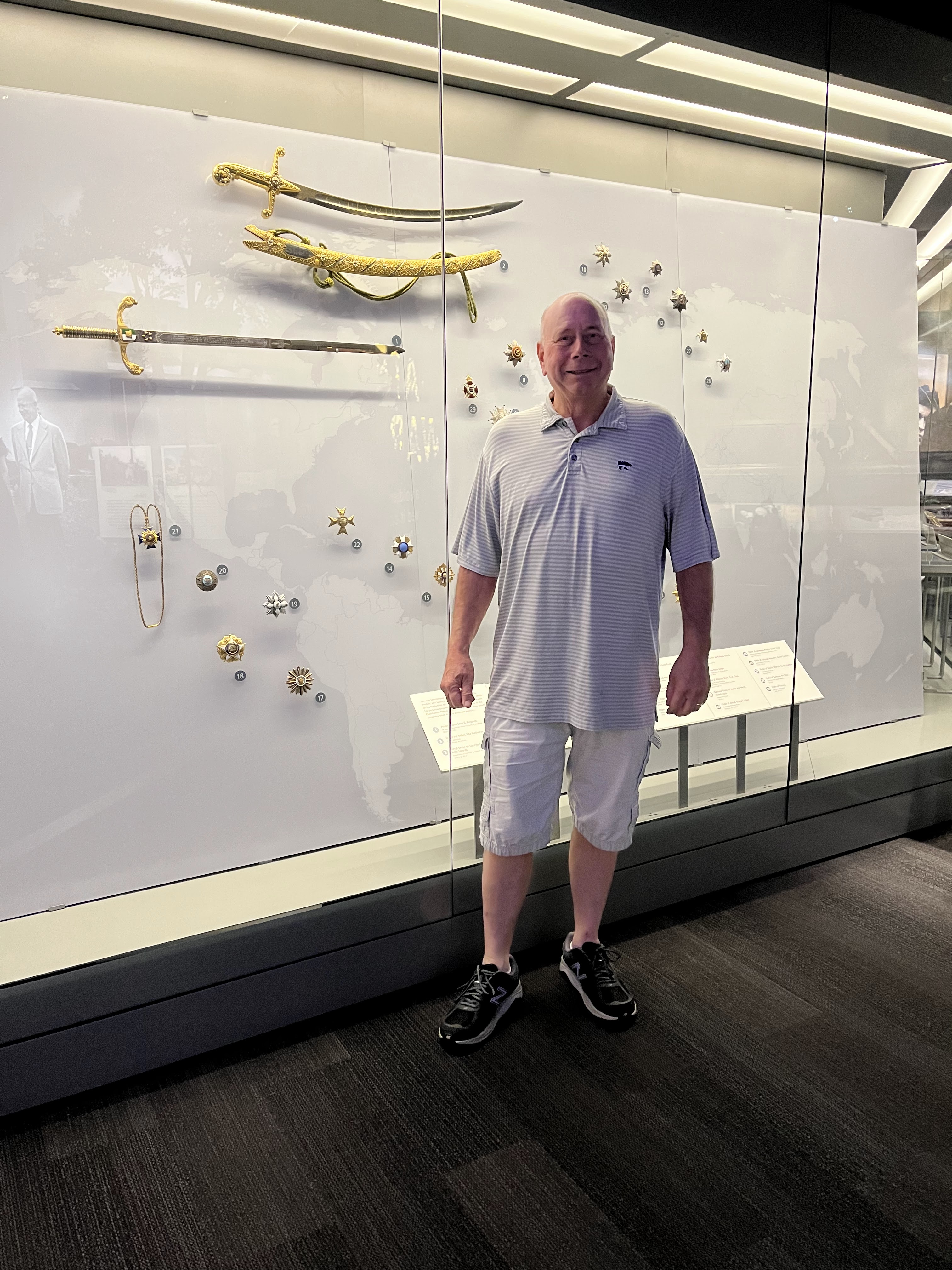
Before we even got to Abilene, Randy said he remembered a display of jeweled swords. We found these. (In Randy's "little boy" mind, he remembered more swords and more heavily bejeweled.)

Eisenhower's success on the battlefield introduced him to the world stage and ultimately gave him the name recognition and popular standing that helped him win the election as President of the United States.


President & Mamie Eisenhower

Though that name recognition and reputation may have been forged in war, Eisenhower was an advocate for peace.


After 40 years of military service, Eisenhower devoted his presidency to waging peace. He strengthened the nation through alliances, promoting prosperity and demonstration moral leadership. He consistently sought peaceful positive alternatives to military action. In doing so, Eisenhower helped to established the post-war order that guided American policy for more than 60 years. The Eisenhower Administration become known for its eight years of peace and prosperity. (From a museum display)

He promoted the nation's economic well-being by improving the movement of goods (national highway system), the social safety net, funding research and development, balancing the federal budget and creating new opportunities for all Americans. 

During his presidency, the percentage of American households with cars increased - from 40.3 million cars in 1950 to 61.7 million in 1960.  In 1950, only 8 percent of American households had a television, while that number increased to 87 percent in 1960. With the GI Bill, many more Americans were able to afford family homes. 

Eisenhower left the presidency in 1961 at the age of 70. From Eisenhower's farewell speech:

The world will soon be yours ... Approach your task with boldness and hope and the joy of challenge in your hearts and with the dedication to freedom and human dignity, for this is the only route to peace with justice. Good luck then ... I, for one, believe in you.
Dwight D. Eisenhower

In addition to the regular museum displays, there were some temporary exhibits. Randy and I especially enjoyed a display featuring Paint By Numbers creations. I suppose it's because we remember the kits from our childhood.


Even the White House was involved in the fad. Eisenhower's appointment secretary, Thomas Edwin Stephens, secretly handed out kits to Cabinet members, government leaders and visitors. He collected the resulting paintings and created a gallery of them in his office and around the West Wing. Aware of Ike's fondness for painting, the exhibit was a surprise gift.

Randy thinks this dog paint by number painting was in his childhood home growing up. 

By his brother, Milton

By J. Edgar Hoover

In addition to the paint by numbers, a few colleagues and friends did their own freehand paintings.


I think the paint-by-numbers display is only available through December. 


Our final stop was the chapel where Eisenhower is buried.  Eisenhower hoped that visitors would reflect upon the ideals that made this a great nation and pledge themselves again to continued loyalty to those ideals.


I loved the reflection of the stained glass windows on the wall as we departed from the chapel.

It seems the world could use a dose of Eisenhower's ideals these days. We could have spent more time there, but we had an important volleyball game to get to in Topeka. Perhaps we will make another stop. We would recommend it.