Showing posts with label Memorial Day. Show all posts

Thursday, May 27, 2021

In Flanders Fields

Jill - Memorial Day cemetery visit - May 1988
 
Most of the year, cemeteries are quiet places. They may provide an off-the-beaten-track place for a solitary evening walk, accompanied only by singing birds and a gentle breeze. 
 
My sister, Lisa, is a cemetery walker. She posted the photo below to Snapchat last Friday:
 
Photo by Lisa Bauer, Clay Center


Ideally, those peonies would be blooming this coming weekend as families make their annual pilgrimages, dotting the rigid pillars of stone with delicate fresh plants, silk arrangements or colorful plastic displays. The cemetery becomes a place to gather around great-grandmother's grave and tell a story or two. Visitors wave at neighbors across the narrow lanes. They may take time to visit for a minute or two before moving on to the next grave. American flags blow in the breeze between tombstones and wave a tribute to fallen heroes. 

Most flowers are toted in by visitors, like in the long-ago photo of Jill, who carried a mum about half as big as she was on our yearly cemetery tour.
 
But a few of the flowers are already in place - like the peonies in Lisa's photo. A few years ago, our  neighbor, Shirley, gave a program to my PEO group about the poem, In Flanders Fields, after she and her family visited the World War I Museum in Kansas City. It's the most famous poem to emerge from World War I. It was penned by Lt. Col. John McCrae, MD, who served at a field hospital in Belgium within sight of poppies blooming across the old battlefields and fresh graves. Since it was written, it's been memorized by schoolchildren in the U.S., Canada and Great Britain. The poem is the impetus behind the little paper poppies long sold by American Legion and VFW posts during the Memorial Day weekend.

In Flanders Fields
by Lt. Col. John McCrae, MD (1972-1918) 
Canadian Army

In Flanders field, the poppies blow
Between the crosses, row on row,
That make our place; and in the sky
The larks, still bravely singing, fly
Scarce heard amid the guns below.

We are the Dead. Short days ago
We lived, felt dawn, saw sunset glow,
Loved and were loved, and now we lie
in Flanders fields.

On the other side of the museum commemorative card, there's a verse by another unidentified wartime poet, who was inspired by the McCrae poem.

We cherish, too, the poppy red
That grows on fields where valor led.
It seems to signal to the skies
That blood of heroes never dies. 

Iuka Cemetery
Though I've not seen poppies blooming during my annual cemetery jaunts, at some cemeteries - like the Clay Center one - the peony bushes offer their pink, red or white blossoms, adding fragrance to the setting as families arrive for Decoration Day. In the cemeteries we annually visit, it does seem that peonies are the perennial flowers in permanent plantings. But, on occasion, I've seen stately irises decorate a family's plot.
 
"My" irises aren't found at a cemetery, though they are at a similarly solitary place. These irises I've claimed are just north of Zenith along a road we travel frequently to get to where we're going.

In late June, the roadway will be littered with wheat kernels that have blown out of rumbling trucks as they make their way to dump their grain at the Zenith branch of the Kanza Co-op. 
 
 
But, in May, both Randy and I look slow down as we reach the grove of cottonwood trees and look for the purple blooms playing hide-and-seek in the light and shadows.

The irises don't mark a grave. Instead, we imagine that they provided a splash of color by a long-ago farmstead. 

No one still living remembers a farmstead at that location. But one lone post from a fence or gate still stands among the blooms. 

These days, the irises are flanked by a CRP field, and the dry, brown grasses of winter offer a sharp contrast to the brilliant colors that form the old-fashioned spring flowers.  

The fragile blossoms are such a contrast to the rough bark of the towering old cottonwoods or the bristly branches of the evergreen tree.


Irises remind me of my Grandma Neelly, who had them in her backyard. You could see them from her kitchen window, where she cleaned up the dishes after poaching eggs for breakfast or serving Sunday's homemade chicken and noodles after church, followed by her light-as-air angel food cake. Seeing irises stirs up those memories as deftly as Grandma stirred up her rhubarb pies each spring.
 

Randy knows my affinity for irises. When our cottonwood was felled by wind last year, Randy planted irises, along with tulips, by our mailbox. 
 
 Whether your Memorial Day weekend includes your first trip to the lake or an annual pilgrimage to cemeteries, remember the message of the irises:
 
 
What in your life is calling you? When all the noise is silenced, the meetings adjourned, the lists laid aside. And the wild iris blooms by itself in the dark forest. What still pulls on your soul?
Rumi 
 

Friday, May 20, 2016

Meringue-Topped Chocolate Chip Bars


Where has May gone? For teachers and their students who are counting down the hours until the end of school, perhaps it's moved less swiftly. But, I look at the calendar and I see that June is barreling its way toward me. With June, comes a four-day church meeting in Topeka, which I hope gets finished up before harvest starts.

While television weatherpeople have started complaining about the rain and cooler temperatures, I'm thankful that the more moderate weather may have helped me avoid a head-on collision of church obligation and farm duty.

But, before we say goodbye to May, we have Memorial Day coming in little more than a week.
Memorial Day weekend just isn't the same as it was back when I was a kid. We still do the annual cemetery tour with my parents, putting flowers on loved ones' graves. We also try to meet Randy's sister and family to decorate graves for their family.

Look closely to see the rainbow in the clouds!
But back when I was grade school age, we sometimes had a picnic in Lemon Park in Pratt with Grandma and Grandpa Leonard and often with my Great Aunt Helen and Great Uncle Mike Stauth before we'd make the cemetery rounds.

As a kid, I didn't think about the preparation that went into toting a meal to the picnic shelter. I just looked forward to playing on the playground equipment and the novelty of eating a meal outdoors.

These days, we usually let a local pizza parlor do the cooking for us. And, as the chief cook around here, that's fine with me, too.

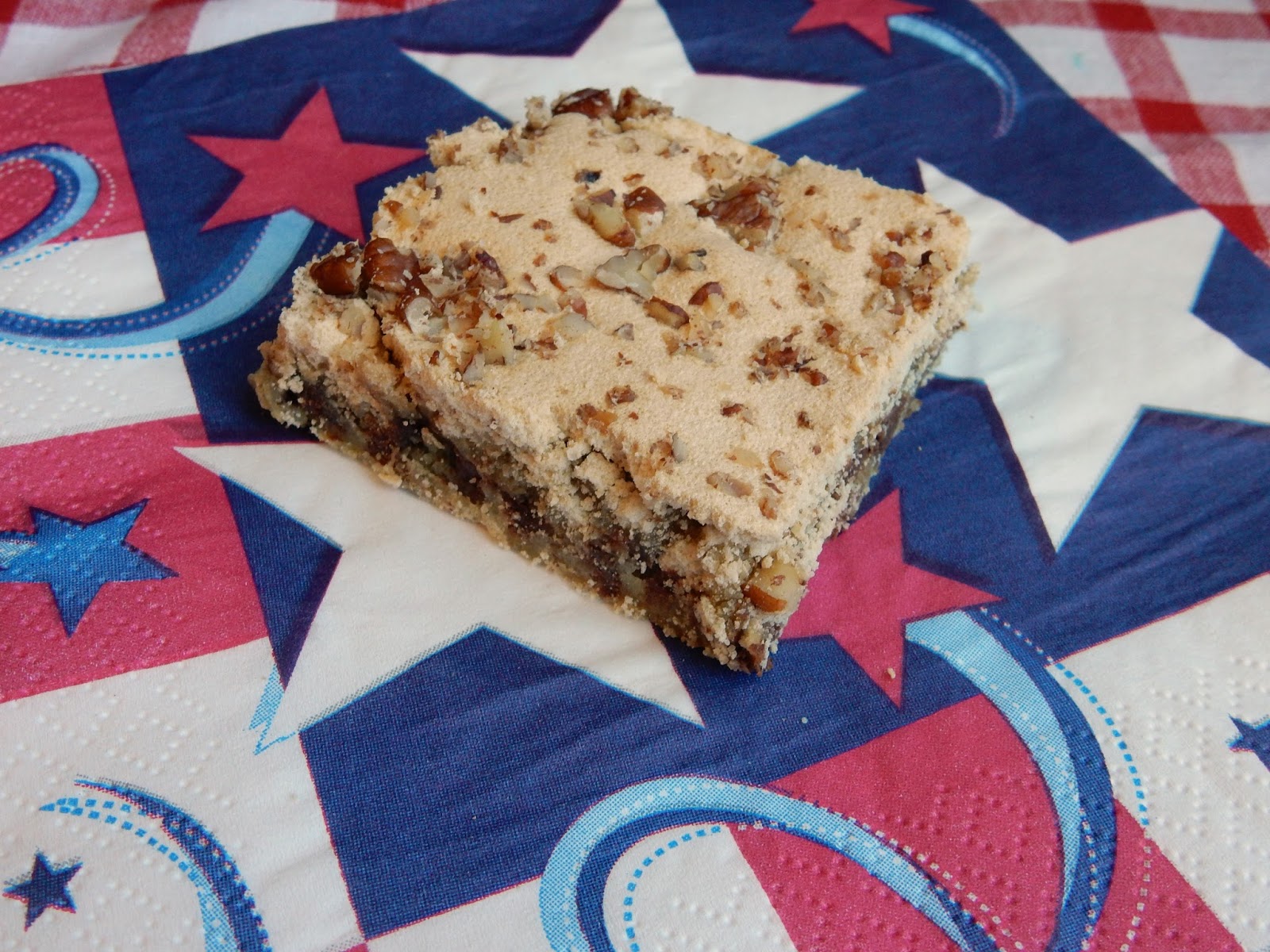
This recipe for Meringue-Topped Chocolate Chip Bars would be good at a picnic or for an after-the-cemetery-tour snack. They 'd be a fun treat at a camp-out with family or friends. They'd even be a little fancier chocolate chip bar to include on a cookie platter for a special gathering.

I found it in Calvary Baptist Church's most recent cookbook. It's a recipe from Alda Hildebrand, who always brings home her fair share of the ribbons in the open class division at the Stafford County Fair. The crunchy meringue top is the perfect way to offset the chewy cookie layer underneath.
Meringue-Topped Chocolate Chip Bars
Recipe adapted from Alda Hildebrand
Calvary Baptist Cookbook: Celebrating Our Heritage
Bar Cookie:
1/2 cup butter
1/2 cup brown sugar
1/2 cup sugar
2 egg yolks
3 tbsp. water
1 tsp. vanilla
2 cups flour
2 tsp. baking powder
1 tsp. soda
1/4 tsp. salt
1 cup miniature chocolate chips
Topping:
2 egg whites
1 cup brown sugar
Chopped nuts (optional)

Cream butter, brown sugar and sugar. Add egg yolks, water and vanilla, mixing well. Sift together flour, soda, baking powder and salt and add to creamed mixture. Stir in chocolate chips. Spread into a prepared 9- by 13-inch pan. Set aside.

Topping: Beat egg whites. Gradually add in brown sugar, beating well, until a meringue forms. Spread over cookie batter. Sprinkle with 1/4 cup chopped nuts, if desired. Bake in a 350-degree oven for 20 to 25 minutes.

***
Today, I'm linked to Weekend Potluck, hosted by these bloggers. Check out the tried-and-true recipes from them and other foodies!

Wednesday, May 27, 2015

Why Is the Sky Blue (and other unanswerable questions)

A persistent encyclopedia "hawker" at a long-ago Kansas State Fair asked me an important question: "How will you answer your child's question, 'Why is the sky blue?' "

At the time, I was a reporter and editor at The Hutchinson News. I was responsible for state fair coverage, so I was wandering the fair, looking for stories. Besides being a reporter, I was also a mom to a toddler. So the question did make me think - then and throughout the years as both Jill and Brent asked their share of difficult questions.

Thankfully, I resisted the urge to pony up the big bucks for an enormous set of encyclopedias, which would have become an expensive set of paperweights and flower pressers in this day of push-button technology and information.

But I again remembered that salesman's question about the blue sky when riding with our inquisitive 3-year-old granddaughter this weekend. We were on our way to a Topeka cemetery to put flowers on the graves of Randy's maternal grandparents, Laura and Alvin Ritts.
Alvin Ritts was a Methodist pastor. He died when my mother-in-law was in grade school.
Kinley hasn't had a lot of encounters with death - and that's a good thing. But she had plenty of questions:

"Did she die on a cross?" (Jesus' crucifixion is the death she's heard about the most.)
"Where is she?"
"Is she under the ground?"
"Is she under the grass?"
"Why is her soul in heaven?"
"Why? Why? Why? Why? WHY?"

A man who was decorating graves nearby was also the target of questions:

"Is he a grandpa?" (We were looking for a grandma, you know.)

We did the best we could with hard questions, and Jill finally diverted attention to another subject. (Kinley has lots of questions about everything. She reminds me of another little girl I knew long ago. Payback is a wonderful thing.) 

Kinley just couldn't grasp the concept of "visiting" grandparents who weren't actually there to see with her two eyes. It's kind of like trying to "see" the wind.
We probably were as inept at explaining that concept while at the Discovery Center in Topeka Friday afternoon, though there were a couple of experiments that helped.
Our encounters with Kinley and hard questions came back to both Randy and me during Sunday's worship service. We celebrated Pentecost, the "birthday" of the church. In Acts 2, it says:
When the day of Pentecost had come, they were all together in one place. And suddenly from heaven there came a sound like the rush of a violent wind, and it filled the entire house where they were sitting. Divided tongues, as of fire, appeared among them, and a tongue rested on each of them. All of them were filled with the Holy Spirit and began to speak in other languages, as the Spirit gave them ability.
Acts 2: 1-4
Our historic sanctuary is beautiful anyway, but thanks to Pastor Ben & Britt Bradley for their work in transforming it for Pentecost.
Just like Kinley's search for a grandma she couldn't see, I search for a Holy Spirit described as rushing wind and tongues of fire. Those aren't exactly stagnant images, are they? God's presence and the Holy Spirit should change me. It can happen slowly. Sometimes it's in an instant. But it's moving, not stagnant.

We Kansans know wind. It can be a pleasant breeze on a hot summer day or a howling gale that thunders through trees and brings down heavy branches during a storm.

Pentecost isn't just a "story" that happened long ago. God isn't finished "moving" us and doing new things even today. The Holy Spirit comes to open our eyes and show us how to be more connected, have mercy, offer forgiveness and transform the world with justice and love.

But it requires movement. I have to leave a beautifully appointed sanctuary and go out into a messy, noisy, complicated world. As Pastor Ben says, "We have inherited the work."
***
Sometimes, the work takes us out of our comfort zones. That was aptly illustrated by our choir song Sunday. Mac Knight is in his first year directing our little church choir. When he handed out "Baba Yetu" at a Wednesday night rehearsal several months ago, we had our doubts.

He knew it would take months to teach us the foreign words and help us figure out the rapid-fire rhythms. He had it scheduled for the choir's "swan song" before our summer hiatus. At the time, I don't think he realized the scheduled Sunday happened to coincide with Pentecost.

But how appropriate that the two converged! On a day when we read about the Holy Spirit coming and each person hearing the message in their native language (Acts 2: 5-21), our choir sang "The Lord's Prayer" in Swahili. God is still speaking today - no matter the language!
Photo by Arlene Lickiss
To hear "Baba Yetu," click on this link. (You can also "like" Stafford First United Methodist Church on Facebook to hear the anthem.)

Friday, May 22, 2015

In Honor of Memorial Day

C. Melvin Fritzemeier, 10th Infantry Division, U.S. Army
My father-in-law, C. Melvin Fritzemeier, served in the U.S. Army following the Korean War. He didn't talk about his service with me. But as we approach this Memorial Day weekend, I wanted to pay tribute to him and others who have faithfully served our country during wartime and times of peace.

Maybe I just needed to take him on a road trip by Fort Riley. As a kid, Randy remembers hearing "war stories" in the back seat as his Dad drove by the fort, where he had trained before being shipped out to Korea. 
C. Melvin Fritzemeier in uniform; upper right, Camp Casey, Korea, 11-Sept.-54, Saturday night was on the back of this photo; lower left photo was not captioned; lower right, caption says, "Ready to ship out to Korea from Fort Lewis, Washington."

Not long ago, I was digging for photos and came across several from Melvin's military service. After Randy's folks died, we cleaned out their farmhouse. By the end, we were all tired of sorting, so we ended up putting family photos in plastic tubs. We got elected to be the repository for all the tubs. 


Also in the box was this Indianhead insignia, the symbol for the Army's Second Division since October 1917 at Bourmont, Haute-Marne, France, from troops in World War II. The color markings (red, white, and blue) used to identify the division and their equipment in France were chosen  by the commander of the division as the colors for this insignia.  The star and Indian head signify the American origin of the division.

 Melvin was drafted three months after the Korean War officially ended. He served as a truck driver. Randy says he talked about sleeping outside in tents.

Melvin often told a story about Army food. He would never eat dried beef gravy after serving in the Army. He also never touched fruit cocktail. Randy says that he and a buddy each ate a gallon of fruit cocktail that they'd cooled in a nearby stream. He ate so much of it that he never wanted it again. 

As is the case today, servicemen and women leave behind their families as they go to serve their country. I found several little yellow books of photos, which Marie must have sent to Melvin overseas. Marie stayed with her mother in Stafford while Melvin served, and she worked at the Farmers National Bank until he returned and they moved to the farm.
Melvin served two years. By the time he returned to Stafford, he had traded his Private 2nd Class stripes for a Corporal designation.

On this Memorial Day, I'd like to thank all the veterans for their service. Our little community of Stafford has a number of young men and women who serve (or have served) in the Armed Forces. I thank them for keeping America strong, and I thank their families for the sacrifice of being apart from their loved ones, often in dangerous places. 

This nation will remain the land of the free 
only so long as it is the home of the brave.
  ~Elmer Davis
Happy Memorial Day! 

Note:  This was updated from a 2012 Veteran's Day post. 

Tuesday, May 27, 2014

At Rainbow's End

It rained from 4:30 to 8 Friday evening where we were. That was the good news.

The bad news? We were 4 hours from home in Oklahoma City.

The wedding we were attending was supposed to be outside in Coles Gardens. Brennan and Caitlin's Plan B inside the building was beautiful. It rained on Randy and my wedding day, too, which we always thought was a good omen for a couple of country kids. Brennan, our neighbors' son, and his new bride took it in stride, too.

After it quit raining, we wandered in the gardens at dusk. From looking at the radar, we knew we weren't getting the rain at home. It had been awhile since we'd smelled that unmistakable fragrance of rain-soaked earth.
Some fellow Staffordites were in front of the Coles Garden building and saw the remnants of a rainbow. We hurried around to get a glimpse, too.
It was a rainbow of another sort as the lights were reflected in the puddles on the garden patio. Raindrops glistened like diamonds on trees and flowers.
We finally got about 0.80" of rain Sunday morning here at our house. Our Rattlesnake Pasture that needs rain so badly got 0.50." We're thankful for every drop.
We did the "cemetery tour" after church with my family. As we were coming back home, we stopped at the Stafford Cemetery to decorate the graves of Randy's folks and other family members.

And we got our rainbow at home. It seemed fitting.

Friday, May 23, 2014

Dancing in the Graveyard

Maybe you don't think about a cemetery being a joyful place. But when I see the joy in these two little girls' faces, I can't help but think that the ancestors whose graves we were visiting had to be smiling.

Was their blonde hair from a distant grandparent? Were their blue eyes from a great-grandfather? If you compared their hands to those in an old photograph, would the shape of their fingers be echoed in the image?
Paige & Jill - 1988

For some families, Memorial Day may mean the first chance to get the boat out on the lake. It may mean a cookout with hamburgers and hotdogs and the summer's first s'mores.

For our family, Memorial Day has always included the annual cemetery tour.

For my Dad, Memorial Day holds special significance. Both his father and little brother died when he was still in elementary school. Memorial Day was a time to remember them, as well as others in the family who had passed on. It was a time to pay respects to the family members who homesteaded in South Central Kansas and established the farm where my Dad and brother still farm today.
Our annual trek has stops at cemeteries in Stafford and Pratt Counties, including Pratt's Greenlawn Cemetery, the Iuka Cemetery, Pleasant Plains Cemetery, Prattsburg Cemetery and  Macksville. On Sunday, we'll experience the 2014 version.
(New life in an old cemetery at Pleasant Plains: Brent's first Memorial Day, May 1988)

The trip involves a trunk load of fresh flowers - never silk.
My Grandma's flowers were usually from her own garden and carefully arranged in cans which my Grandpa had spray-painted a dark green.

(There she is in the background with my Grandpa in 1989. Brent, 1, is with my Dad, and the young-looking guy in the middle is Randy.)

Blake & Brent - 1989

When Jill was little, she noticed a marker with a little lamb in the Peace Creek Cemetery just a mile north of Randy's folks' house. There were never any flowers on this grave. So Randy's mom would always have an extra flower so Jill could decorate this little one's grave, a girl who was born and died in 1946.
The little girl's name was Jewell, so I know her parents wanted and cherished her. I always figured that her parents had already passed away or had moved away and that's why no flowers ever marked her grave. I think it made all of us glad that we could, in some small way, help remember her short life.

Families are a lot more transient these days. Unlike my Dad who lives on the same land where he was born, families are spread across the country.

Many don't live where they can drive down after church and make the cemetery rounds.
Will Memorial Day change as the older generations pass on? Even we die-hard cemetery visitors often don't go to all the out-of-the-way cemeteries our grandparents visited. As our children and our children's children move further from home, will there be anyone but flower shops visiting cemeteries on Memorial Day weekend?
We usually meet Kathy's family on the cemetery hill just west of Stafford during the Memorial Day weekend to decorate the graves of his Mom & Dad and Grandma & Grandpa. 
We even have purchased "real estate" nearby.
With life's fast pace and a world in which it seems we'd rather text than talk to our neighbor, will there still be flowers and flags and families dotting the cemeteries on a late May weekend in 30 years?
I hope so.
Note:  This is rewritten from a 2010 post on Kim's County Line. Happy Memorial Day to all!

Wednesday, May 29, 2013

Ties That Bind

As I nestled the pink geranium next to Gloria's gravestone, a red-headed girl and her brown-haired sister stood watching. Gloria was my late father-in-law's younger sister. On Monday, we gathered around the Fritzemeier stone at the Stafford Cemetery, carefully placing metal stakes in flower pots to batten them down in a stiff Kansas wind. No one in our little Memorial Day group knew Gloria. She died in 1954, a year before Randy was born.

But, as the unrelenting gale whipped Emily's red hair and pulled it from her ponytail, I thought about the threads that visibly and invisibly link us all together. Most of the photos I've seen of Gloria are black and white. I think her senior picture was probably tinted, as was the fashion in the 1950, but it shows her red hair and big smile.
My late father-in-law, Melvin, talked about Gloria's red hair. He, too, had red hair, but he often joked that it didn't stick around for long. He started going bald while still in high school. None of Melvin and Marie's children inherited the red hair. It wasn't until Emily was born that the family had a new generation of redheads.

But our visit to the cemetery was less about Gloria than it was about carrying on a tradition that was important to Melvin and Marie.

Later, Randy, Amanda and Emily (as well as Kathy, Dave & I) gathered at a soda fountain in downtown Stafford where Gloria and Melvin likely shared ice cream cones once upon a time. Not long ago, the marble bar and assorted fountain parts were dug out of storage and refurbished as a centerpiece for the new Stafford Mercantile. On Memorial Day, it was just another thread connecting past to present.
It was the same way at the Iuka Cemetery, as I laid flowers on the graves of my Dad's dad and his little brother, Gary.
It's been 70 years since my 79-year-old Dad had a father here on Earth and even longer since his brother died. I don't put the flowers on their graves to honor them as much as I do to honor my own Dad.
Those threads from the past inevitably stretch toward us. It's good to remember.

That seemed to be a theme everywhere I went last week. I was our church's lay delegate for the final Kansas West Annual Conference of the United Methodist Church. In January, Kansas West will join Kansas East and the Nebraska Conference of the UMC in one big Great Plains conference.

The conference in Hutchinson was the last of its kind. During one of the sessions, Mary Lou Reece, the wife of Bishop Scott J. Jones, showcased an 1892-era quilt. It had belonged to the Rev. Augustus P. George, who was a Methodist circuit-riding preacher from 1880 through 1892. The quilt was presented to Rev. George to commemorate the places in Southwest Kansas he served from 1883 through 1892. He eventually retired in 1908 and died in 1917.

It's a crazy quilt, as unique as the congregations who stitched it together with different fabrics and threads. Those pioneer woman likely used scraps from their own dresses and from the curtains that brightened their simple homes. After a long day of tending children, working in the garden, making meals and hauling water, they may have sat near a kerosene lantern or a glowing fireplace to piece together the fabrics and add embroidery stitches and lace. The quilt squares are from Dodge City, Spearville, Garden City, Johnson City, Bucklin, Ness City and 14 other towns, including those long faded from memory.

One of those towns was Nonchalanta, which was a post office and trading point in Ness County. It was located 15 miles southwest of Ness City on the Atchison Topeka and Santa Fe Railroad. In 1910, it had a population of 69, but it included a Methodist church. Nonchalanta's square caught my eye because of the yellow cross featured there and because of the name.
Click on the photo to see a bigger version of the collage
There's nothing "nonchalant" about this quilt. George's descendents treasured it for more than a hundred years and kept it carefully preserved in cedar chest and mothballs.

Now, it's getting new life. George's great-grandchildren presented the crazy quilt to the Kansas West Conference. It will now be on display at the Great Plains UMC Conference office in Wichita.

During one of the conference worship services, we sang one of my favorite "new" hymns, "Hymn of Promise." (New is relative. It was written in 1986.) It says, in part:

From the past will come the future
What it holds a mystery
Unrevealed until its season
Something God alone can see.

That's true ... whether you're talking about families or churches or communities. It's the ties from the past that bind us together ... the threads that connect us ... the bits and pieces that come together to make the whole. That's worth remembering.

***
I'm linked today to Jennifer Dukes Lee's Tell His Story. Click there to find out if you're smarter than a 5th grader and other important "stuff" about faith.