Showing posts with label Monarch butterflies. Show all posts

Friday, October 2, 2026

Orange & Black Flying Machines: The Monarchs


For the past week or so, the shelter belts at The County Line have been the fall equivalent of miniature runways as orange and black flying machines seemed to practice touchdowns and takeoffs like student pilots practicing their craft. 

You have to look closely. They are camouflaged in the leaves and branches.
  

Monarch butterflies used the protection of our trees to shelter during their migration journey. But they flit in and out of the leaves as people amble by. They move so quickly that it's hard to capture their swoops and dives.


Randy's attempt yielded a pretty photo of clouds and silo. 

I didn't even do that well.  I had to dig through some old blog posts to find a mediocre flight photo to post of our fall visitors. Today, it seems most of the butterflies have departed. 

Monarch butterflies are truly miraculous.

If nothing ever changed, there'd be no butterflies.
- Author Unknown

That's quite a reminder for this change-challenged person. They are the ultimate symbol of transformation. As George Carlin once quipped, "The caterpillar does all the work but the butterfly gets all the publicity."

I'm not sure that's true of monarch butterflies. It sounds like a lot of work to me to travel for two months, across thousands of miles, bucking wind and rain and predators. And it's all to get to a destination they've never visited before. 

The butterflies will only make this journey one time. So how do they know where to go? It is just another miracle of God's creation. Researchers say that it appears to be a combination of directional aids such as the magnetic pull of the earth, the position of the sun and the availability of milkweed, where the butterflies lay their eggs. No matter the reason, they are a beautiful signal of fall. 

File photo from Kim's County Line

They begin the journey in their summer home in Canada and the northern regions of the U.S. They are headed for a mountain range 70 miles west of Mexico City in central Mexico, where they find the perfect habitat to survive November through March in the Oyamel forests. 

File photo from Kim's County Line - Taken at Quivira National Wildlife Refuge

60 Minutes had a segment last year from Anderson Cooper about witnessing the Monarchs in Mexico. Click HERE to check it out, if you'd like. 


Wednesday, October 1, 2025

Lasting Message

Sunrise, October 1, 2025, over a hay field.

I finished a book last night. That is not unusual. But this book - Theo of Golden - will likely stay with me for quite some time.

I had seen glowing posts about the book on some Facebook book groups. The cover didn't immediately grab my attention. We've talked about the power of book covers at the Recently Read Book Club I attend monthly at my Stafford hometown library, the Nora E. Larabee Memorial Library. What is it that grabs our attention and makes us want to crack the book spine? 

Still, while not overly enthused by the cover, I did check with the Hutchinson Public Library, but it wasn't in their collection. 

However, I stumbled across it as I helped arrange books for our church's Oktoberfest book sale this coming Friday and Saturday. I immediately paid my 50 cents and took it home. 

I was surprised to discover it was self-published. Books that get their start that way rarely find much success. But, as I wiped tears from my eyes and closed the book last night, I understood why it defied the odds. (And, for the record, that wasn't the first time I'd had tears as I read this beautifully-written book with a timely message.) 

Here's a synopsis:  

Theo of Golden is the endearing story of a curious old man who quietly moves into a southern city and, for reasons unknown to anyone but himself, undertakes a campaign of anonymous generosity. Theo’s love for people, combined with his fondness for books, art, birds, and story, unite in a colorful expression of outreach and affection. Stories are shared, friendships are born, and lives, in response to his inexplicable kindness, are affirmed and transformed. The old man, no stranger to sadness and loss, quickly becomes a welcome presence in the community but his new friends and neighbors wonder, who is Theo? And why is he here? Theo of Golden is a beautifully crafted story about the power of creative generosity, the importance of wonder to a purposeful life and the far-reaching possibilities of anonymous kindness.

This morning, I woke up to news of a government shutdown ... more political finger pointing ... a caravan that brought a police officer killed in duty back home to rural Kansas ... more gun violence overnight ... and I despaired. But, as I walked by the window, I saw color in the sky and figured it was better for my mental health to drive down the road to watch the sunrise, rather than watch more of the newscast. 

Milo field sunrise panorama, October 1, 2025

I was probably a few minutes later than I should have been, but it was well worth the effort. And it again reminded me of the book. Besides Theo's generosity to his new neighbors, he was attuned to the natural world around him - the birds, the flowers, the trees, the sunset and even feathers.

Ironically, not long before I started reading the book - which features a single feather on its cover - I saw this blue feather lying in the grass as I got into the car to leave. And I couldn't resist taking a photo. Honestly, at the time, I was thinking about how I might be able to use the photo to illustrate the Emily Dickinson quote:

“Hope” is the thing with feathers -
That perches in the soul -
And sings the tune without the words -
And never stops - at all -

In the book, Theo meets new people at a bench by a fountain. At another bench near the river, he sits under a tree and watches at 7 o'clock each evening as the sun goes down. Maybe that thought about Dickinson's "hope" wasn't all that far off from Theo's philosophy of life either. 

Theo's bench - From the author's website

At one point of the book, Theo talks to one of his new friends about "good art." But his answer turns out to be about much more than just "art." It's about life.

It might not make a of of sense, but for anything to be good, truly good, there must be love in it. I'm not even sure I know fully what that means, but the older I get, the more I believe it. There must be love for the gift itself, love for the subject being depicted or the story being told and love for the audience. Whether the art is sculpture, farming, teaching, lawmaking, medicine, music or raising a child, if love is not in it - at the very heart of it - it might be skillful, marketable, or popular, but I doubt it is truly good. Nothing is what it's supposed to be if love is not at the core.
From Theo of Golden by Allen Levi 

For me, messages that I'm supposed to "get" often arrive unbidden from multiple directions. This morning after my return from the sunrise chase, I opened an email devotional from The Upper Room and again read the words of the Prayer of Saint Francis of Assisi:

Lord, make me an instrument of your peace:
Where there is hatred, let me sow love;
Where there is injury, pardon;
Where there is doubt, faith;
Where there is despair, hope;
Where there is darkness, light;
And where there is sadness, joy. 

Sometimes, it's hard to battle my way through those darker emotions - the hatred, the injury, the doubt, despair, darkness and sadness. But maybe we can find it as we pay attention to the small things around us. I spent some time this morning on the author's website, and read several of his essays, including "Taking the time to see" and "Learning Small Things Matter is Really No Small Thing." Those are themes I often talk about here at my little spot on the internet. 


And, thankfully, in the midst of all the other stuff, there's plenty of small "miracles" to open our eyes to see ... 

We've just experienced the Monarch butterflies' annual migration through our area.   


Even the search for butterflies can remind us that it may take some time and effort. I had trouble capturing photos of butterflies at rest. Most were flitting around high in the trees. But persistence paid off - a few times, at least.


The butterflies also share a message of perseverance and triumphing over obstacles as they make their way from northern climes to their wintering grounds in Mexico. 


But even through the rough days, we just have to look for the Light ...


 ... and the beauty around us.  


And give thanks - even when it's hard.

If you have read Theo of Golden or if  you read it in the future, I'd love to hear what you think.  


Tuesday, October 12, 2021

Late Arrivals

White Rabbit from Alice in Wonderland

I don't remember many songs from Alice in Wonderland ... with the exception of one. It's the one the White Rabbit sings as he's dashing across the meadow.

 
I'm late, I'm late,
For a very important date.
No time to say, "Hello," "Goodbye,"
I'm late, I'm late, I'm late, I'm late! ...

I run and then I hop, hop, hop
I wish that I could fly
There's danger if I dare to stop
And here's the reason why ...
 
You see I'm overdue
I'm in a rabbit stew
No time to say "Goodbye" "Hello,"
I'm late, I'm late. I'm late!


The White Rabbit was late for his appointment with the Queen of Hearts. But it's the "queens" of the fall - Monarch butterflies - that seem to have been late this year at my house. Unlike the White Rabbit, they aren't limited to "hop, hop, hopping." But their "air traffic" seems to have been delayed (kind of like those poor Southwest Airlines passengers over the weekend).

Usually, the Monarchs arrive in September around the shelterbelts near our home. And my unofficial nature consultant and friend, Pam, posted a spectacular photo of the butterflies roosting near Cheyenne Bottoms almost a month ago.
 
But I had only seen a few. However, on Saturday as Randy was planting wheat, he called and said he was stirring up butterflies as he drove along some tree rows. On my first attempt to find them, I saw a few, but they weren't landing for long enough to click the camera shutter. Later on Saturday, after the front moved in, I was able to "capture" a few in my camera lens.
 

Butterflies are truly miraculous.

If nothing ever changed, there'd be no butterflies.
- Author Unknown

That's quite a reminder for this change-challenged person. They are the ultimate symbol of transformation. As George Carlin once quipped, "The caterpillar does all the work but the butterfly gets all the publicity."

I'm not sure that's true of monarch butterflies. It sounds like a lot of work to me to travel for two months, across thousands of miles, bucking wind and rain and predators. And it's all to get to a destination they've never visited before.
County Line photo from 2019
 
They begin the journey in their summer home in Canada and the northern regions of the U.S. They are headed for a mountain range 70 miles west of Mexico City in central Mexico, where they find the perfect habitat to survive November through March in the Oyamel forests. As many as 300 million spend the winter there. Wouldn't that be a sight to see?


It's not like ducks and geese which migrate year after year. They will only make this journey one time. So how do they know where to go? It is just another miracle of God's creation. Researchers say that it appears to be a combination of directional aids such as the magnetic pull of the earth, the position of the sun and the availability of milkweed, where the butterflies lay their eggs.

No matter the reason, they are a beautiful signal of fall ... whether they are late or not.

Tuesday, September 29, 2020

Whispered Memories: A Monarch Butterfly's Flight


When we learn something, it becomes a memory that we can access to inform future decisions and behaviors. Repeated enough, that learning becomes instinct - the accumulation of memories passed down through the generations. Instinct is the dog biting a child who tries to take its food. It's the zip of adrenaline when someone follows us down a dark alley. It's the monarch butterfly, traveling tens of thousands of miles with nothing to guide it but a whispered memory embedded in its genes.
From The Ones We Choose, a novel by Julie Clark
 

I'm a fiction reader. Give me a good novel I can get lost in, and I'm happy to leave real life behind for a short time. And it's always a pleasant surprise when the book is written so beautifully that it's almost like poetry.

I finished The Ones We Choose by Julie Clark earlier this month. It was one I'd asked the Hutchinson Public Library to order, since I'd enjoyed Clark's other novel, The Last Flight, which was already in their collection. (I recommend both of Clark's novels.)

When I saw the description of the monarch butterfly, I took a photo of the page. I knew the majestic monarch butterflies would soon arrive in our backyard for the annual pilgrimage. I loved the idea that the butterfly knows where to go based on "a whispered memory embedded in its genes."

I suppose the phrase also resonated because I read it just before we left Kansas to travel to South Dakota to see Randy's brother at the hospice. The "whispered memories" are part of a human's life journey as well. No matter the disparate choices made by siblings in adulthood, there is a "whispered memory" of a shared history.


The butterflies typically take a "breather" on the north side of trees in our farmyard. 

As Randy was planting wheat last week, he found that the shelterbelts bordering the field also had the fall equivalent of miniature runways as the orange and black flying machines seemed to practice touchdowns and takeoffs like a student pilot practicing his/her craft. (It's not a good photo, but it sort of shows how we needed an air traffic controller for all the activity.)


I got one shot with multiple butterflies, but there definitely wasn't overcrowding in our annual Air bnb.


With the north wind, the butterflies seem to have departed for warmer climes after more than a week sheltering in our tree lines. I sure hope next year's monarchs will hear that "whispered memory" that brings them back to Central Kansas.

And I hope their ancestors stop by our pastures next spring to lay some eggs in the milkweed.

Ninnescah Pasture, June 2020

Dr. Orley “Chip” Taylor has been watching the populations of this large orange butterfly for years. He heads Monarch Watch at the University of Kansas, a group that coordinates the efforts of civilians and young students to tag monarch butterflies across the United States and Canada.

Monarch butterflies are not cold hardy and cannot survive our freezing winters. However, they are one of very few insect species that can feed on milkweed.

This milkweed bloomed in our pastures this summer.

Milkweed is cold hardy, with milkweed species growing all the way into Canada. Therefore the monarch butterflies fly north each year to take advantage of this milkweed food source.


Each spring, the adult butterflies that have overwintered begin flying north and laying eggs on milkweed. These generations of monarchs stair-step their way until some reach Canada.
With the approach of winter, they must fly south again.
On goldenrod - From Kim's County Line - September 2016
 
Unlike small rare butterflies that may depend on a single rare flower only found on a California mountaintop, the monarch butterfly is dependent on larger numbers of flowers during migration in order to sustain its migrating population, Taylor said.
 
The monarch butterfly is a “celebrity species” that attracts the attention of citizens concerned with preserving nature, Taylor said. This means that there are many online websites with information on the monarch butterfly—some of it accurate and some inaccurate. One accurate site is Monarch Watch. 
 
My friend, Pam, who I call my resident wildlife consultant, works for Kansas Wetlands Education Center. She discovered a roost of Monarchs in cottonwoods and willows along a channel at the nature center located near Great Bend. What a sight!

Pam produced this video of the "travelers." Check it out!


Yesterday, Quivira National Wildlife Refuge (which is only a few miles away from our house) posted a photo of monarchs from this past weekend near the Education Center there. If only I'd known ...

Tuesday, October 1, 2019

Air Traffic Control

We need air traffic control on the County Line these days.
A walk through trees stirs up butterflies swooping on air currents while they dodge darting dragon flies. With the wind blowing the past two days, the migrating Monarchs look for a respite in the shelterbelts and tree lines.
At a hay auction last week, I spotted a woolly bear caterpillar. A retired farmer saw me taking photos and told me I could start my own meme. (Who knew he'd know about memes!?) And I asked him, "Aren't they supposed to be a sign that winter is coming?"

He confirmed my recollection of folklore, and a Google search when I got home brought me a little more information. Here’s the legend: The woolly bear caterpillar has 13 distinct segments of either rusty brown or black. The wider the rusty brown sections (or the more brown segments there are), the milder the coming winter will be. The more black there is, the more severe the winter.

It appears we could be in trouble. But since it's been 80-degrees-plus the past two days, winter seems eons away. And who has time to worry about that when another sign of fall is moving through my backyard? With several of my friends posting congregations of Monarchs hanging out in their trees, I know I'm not alone in having an "air bnb" in the backyard.
Monarch butterflies are not cold hardy and cannot survive our freezing winters. However, they are one of very few insect species that can feed on milkweed.
This milkweed bloomed in our pastures this summer.
Milkweed is cold hardy, with milkweed species growing all the way into Canada. The monarch butterflies fly north each year to take advantage of this milkweed food source. But they must migrate back to Mexico each winter.
 
Each spring, the adult butterflies that have overwintered begin flying north and laying eggs on milkweed. These generations of monarchs stairstep their way until some reach Canada.
Butterflies are truly miraculous.

If nothing ever changed, there'd be no butterflies.
- Author Unknown

That's quite a reminder for this change-challenged person. They are the ultimate symbol of transformation. As George Carlin once quipped, "The caterpillar does all the work but the butterfly gets all the publicity."
I'm not sure that's true of monarch butterflies. It sounds like a lot of work to me to travel for two months, across thousands of miles, bucking wind and rain and predators. And it's all to get to a destination they've never visited before.
 
They begin the journey in their summer home in Canada and the northern regions of the U.S. They are headed for a mountain range 70 miles west of Mexico City in central Mexico, where they find the perfect habitat to survive November through March in the Oyamel forests. As many as 300 million spend the winter there. Wouldn't that be a sight to see?
They aren't like ducks and geese which migrate year after year. They will only make this journey one time. So how do they know where to go?
 
It is just another miracle of God's creation. Researchers say that it appears to be a combination of directional aids such as the magnetic pull of the earth, the position of the sun and the availability of milkweed. No matter the reason, they are a beautiful signal of fall.
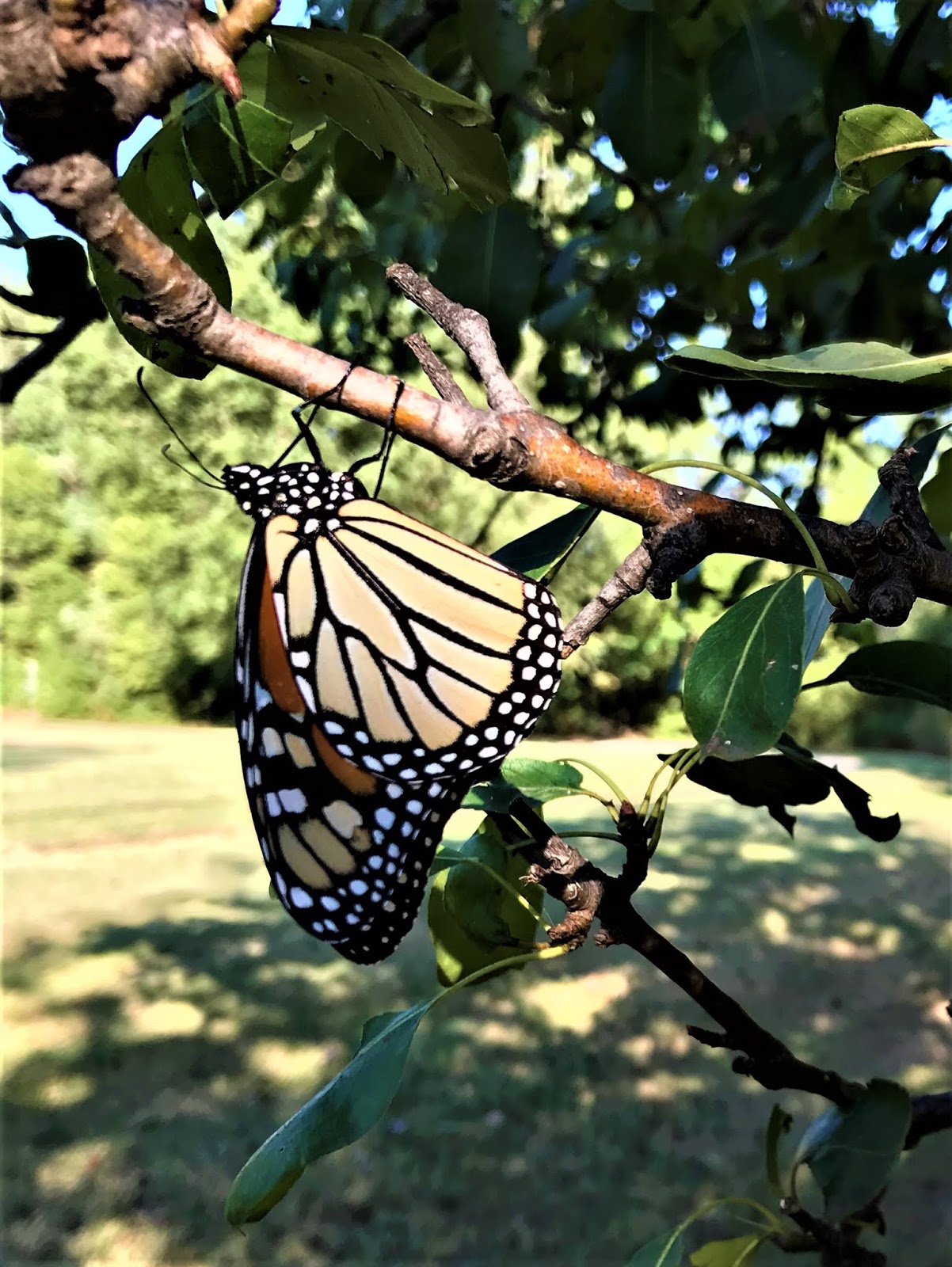
As I was mowing on Friday, I almost had a mid-air collision with this beauty taking a breather in a pear tree.
"I'll just back up and let you hang out," I told my visitor. 
Mowing isn't my favorite job. But it does have its perks during Monarch migration.