Showing posts with label corn 2020. Show all posts

Tuesday, June 2, 2020

County Line Virtual Crop Tour

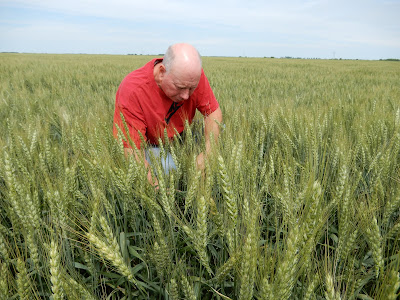
We had no trouble social distancing during our County Line wheat tour.

This year, because of Covid-19, the Wheat Quality Council substituted a Virtual Wheat Tour for its usual in-person variety. After the abbreviated version with volunteer scouts was completed the week of May 18, the final report estimated a potential Kansas wheat harvest of 284.4 million bushels. That was below the U.S. Department of Agriculture’s most recent estimate of 306 million bushels.
The virtual tour was not meant to fully replace the annual Wheat Quality Council’s Hard Winter Wheat Tour that annually hosts 80 to 100 or more participants. In that tour, participants drive across Kansas for three days, scouting several hundred wheat fields the first week of May. This year’s tour was hosted by Kansas Wheat and Kansas State University Research & Extension, with support from the Kansas Department of Agriculture. The abbreviated tour May 18 to 21 was offered as a snapshot of the wheat crop’s potential, using a later-season formula from USDA’s National Agricultural Statistics Service. 
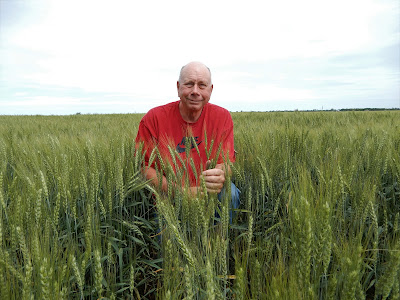
We completed our own County Line tour on Thursday, May 28. It was not virtual for me. I had my own personal guide and scout.
My guide believes our wheat is the best its been for several years.
Last year, this field was totally in corn because heavy rains in the fall of 2018 kept us from planting part of our 2019 wheat crop.
The wheat in this field is a little taller.
This past month, we've had timely rains - about 4 inches of gentle, soaking-in rain spread out in regular intervals during the month. (The photos below were taken on May 7.)
 
We've also had cooler weather, which has aided in filling the wheat heads. In our fields, there's not evidence of diseases like stripe rust, though some has been reported in parts of Kansas.
 
We did find some freeze damage, particularly in low-lying areas. You can see the damage at the top of the head in the photo above. However, there is grain further down in the head.

While it's not "amber waves of grain" quite yet, we're well on our way to America, the Beautiful in wheat country. A general rule of thumb from the farmers at the coffee shop says that we should be cutting wheat about six weeks after it begins heading. That would put our projected start date in mid-June. You've heard of "old wives' tales." We'll see how accurate the "old farmers" are.
Our County Line tour wasn't exclusive to wheat. We also had some stops in corn fields.
 The rains have been beneficial for the corn, too, which we planted the third week of April.
 
It's grown a lot since these photos were taken May 1.
It's amazing what a little time and some rain will do!
The rains have also been beneficial to greening up our pastures to enhance our cow-calf pairs' summer dining experience.
We had quite an audience as we fished at the Ninnescah on Friday.
Our alfalfa got off to a slow start because of insects. It's taken awhile for it to rebound, but Randy hopes to begin our first cutting this week. 

Randy planted silage yesterday, and milo planting is also on the agenda this week.

This completes this edition of the County Line Virtual Tour. You are cordially invited to attend future tours right here at this web address.

Thursday, April 30, 2020

Cleaning Up? A Corn 2020 Tale

If we were smarter, we might increase our corn income in 2020 by bypassing the corn and moving directly to the cobs.

We got this "special delivery" package from some caring (?) friends soon after the hoarding of toilet paper depleted it from store shelves.

Even though our local grocery store - Paul's in Stafford - has had most items in stock, they couldn't keep toilet paper on the shelves for awhile. Owner Jim Chansler didn't lose his sense of humor as evidenced by the display in the TP section.
Facebook post by Jim Chansler on March 18

(FYI: There is TP now in Stafford, though not a huge variety and not my preferred brand, but beggars can't be choosers as all the old wives will tell you.)

With corn prices in the toilet - so to speak - the cobs may be worth more than the corn. (I'm joking ... I think.)

Covid-19 has brought U.S. travel to a screeching halt, and with it, ethanol production has plummeted. The cutback in ethanol production has already led to a significant drop in corn prices, since corn is the predominant grain used in production nationwide. According to the Renewable Fuels Association, since early March, corn futures prices have fallen by 17%.

Out of the more than 800 million bushels of corn produced in Kansas each year, the Kansas Corn Growers Association says 27% goes to Kansas ethanol plants, 27% goes to Kansas livestock feed and 44% leaves the state. 

But we - like other Central Kansas farmers - are planting the 2020 corn crop. We began planting corn on April 20 and finished on April 28 (with starts and stops in between). 

As I've said before, corn is not a main crop for us. Last year, because of weather conditions that prevented wheat planting in fall 2018, we raised corn on 600 acres. But since we are primarily wheat farmers, that was a lot of acres for us.

This year, we are back to 180 acres committed to corn.
 
Today, many farmers plant RIB corn (refuge in a bag) - whether it's irrigated or dryland. Our farm is entirely dryland.
The green-colored seeds have a different genetic make-up and are treated with a different insecticide than the purple-colored seeds. The purple seeds are a refuge for several different insects in a field, giving them a habitat to satisfy EPA rules. Before RIB technology was available, farmers had to plant so many acres in a field to a corn that wasn't resistant to the bugs and the rest of the field could be resistant. With RIB technology, farmers can plant it all at the same time, without changing seed and figuring acreage requirements. 
Randy adds a seed talc - or lubricant - to the planter boxes to facilitate the seed's journey from planter to soil.
He is also putting on a starter fertilizer to promote early growth. The make-up of the starter fertilizer was determined after Randy did soil testing before planting. 
 
It includes 20 pounds of nitrogen, 15 pounds of phosphate, 5 pounds of sulfur and 1 pound of zinc per acre. After planting, the co-op is applying 70 pounds/acre of nitrogen, along with herbicide 
The fertilizer is in the tank pulled by the pickup. First stop is pulling up to the scales at the elevator to weigh the empty pickup and fertilizer trailer and tell the scale operator what kind of fertilizer we want. (There's another stop after the tank is filled for a final weight.) This year, because of social distancing, the request was made through the office window, rather than going into the office.

Then, it's off to the fertilizer shed, where an employee fills the tank with the "recipe" Randy has ordered.
This year, we again picked up the seed as we need it at Zenith so on some trips, we also get the bagged seed from another building.
Once back to the field, Randy can then use the fertilizer in the trailer to refill the fertilizer tanks on the planter, attaching a hose.
He starts a motor to pump the fertilizer to the planter.
He runs the motor until the tanks are filled.
 And then he's off to make another round. 
The corn planting was slowed briefly last week when we received 0.60" of rain. (We aren't complaining about that.) But Randy completed the task on Tuesday. Now we're waiting on it to emerge. Today, it's another day of moving cattle to summer pasture. More on that to come!