
During this month devoted to love, the 2022 wheat crop hasn't gotten enough of it.
At the moment, LOVE for a Kansas wheat farmer would be spelled with another four-letter word: RAIN ... or even SNOW.
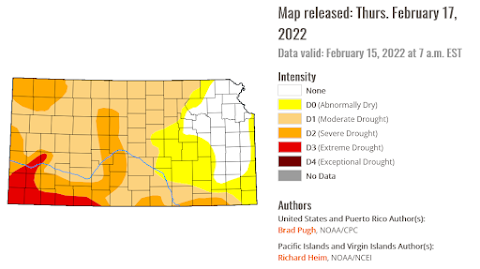
We have gotten a bit of moisture on the Stafford/Reno County Line since my January 21 wheat update. However, the Kansas drought monitor shows worsening conditions - not improvement - in our part of the world.
On February 8, the drought monitor looked like this, putting us in a region of moderate drought:

Just a week later, our area worsened to Severe Drought.
We did get some snow February 2 and 3.
It just wasn't enough to make much of an impact.
 |
The above photos were taken on February 4.
|
But, something is better than nothing.

By the time this snow melted down in the rain gauge, it amounted to about 1/2 inch.

Weather forecasters predicted snow for us February 16-17. However, our area received just a dusting.
This month's wheat update photo on February 21 was taken on an unseasonably warm day - hence short sleeves and no jacket for Randy. It was 73 degrees on Monday.
When we got up today, the temperature was 8 degrees, with the wind chill below zero. It's just one other motion on the roller coaster temperature fluctuations that this winter has brought.
Since the wheat crop is still in dormancy, the impact of the swing in temperature won't likely be appreciable, Randy says.
Another issue facing Kansas wheat farmers is the price of fertilizer, which has more than tripled in the past year. Thankfully, we put 60 to 70 pounds of nitrogen per acre on our wheat ground before we planted last fall. Randy chose to put herbicide and another 10 pounds of nitrogen on one field already this winter. It's a field that was replanted last fall. Because it wasn't established as well, it blew badly in the December 15 windstorm. He put the herbicide and fertilizer on after that, hoping to give that field a boost.
He likely will have the co-op put herbicide and 10 pounds of nitrogen per acre on the remaining acres next month, biting the bullet on the high price of fertilizer with the hopes of bumping yield.
We aren't the only ones contemplating the lack of moisture and the price of fertilizer. At a February meeting of the Kansas
Association of Wheat Growers (KAWG), board members reported that wheat fields across Kansas were
generally planted into sufficient moisture conditions and went into
winter with decent stands. However, more moisture will be needed over the
winter and into the spring to kickstart a crop emerging from dormancy
and maintain growth.
According to the
USDA’s National Agricultural Statistics Service, Kansas topsoil moisture
supplies as of January 23, 2022, were 77 percent very short to short and 23 percent adequate to surplus.
Subsoil moisture supplies were 31 percent very short, 41 percent short
and 28 percent adequate. In the same report, the Kansas winter wheat
crop was rated at 30 percent good to excellent, 39 percent fair and 31
percent very poor to poor. The next crop progress and condition report is scheduled to come out later today.
Perhaps more
importantly, KAWG members conveyed the difficult decisions producers are
currently making with their fertility programs. This winter application of nitrogen allows the nutrients to move into
the root zone with precipitation well before jointing begins to be most
efficiently utilized by wheat. Having adequate nitrogen available
supports spring tillering and helps ensure good yield potential.
This year,
however, fertilizer prices have exploded due to international supply
chain disruptions during the COVID-19 pandemic. According to a January
2022 report by Texas A&M University’s Agricultural and Food Policy
Center, “Based on current spot markets, it appears as though fertilizer
prices will increase in excess of 80 percent for the 2022 planting
season (relative to 2021).” KAWG members and their neighbors are feeling
this cost crunch, reporting many in their areas are putting off normal
topdressing applications to wait for moisture.
“While we cannot
control the weather and its impact on the wheat crop’s yield potential,
it is important to note that Kansas farmers are holding off on
fertilizer applications due to high prices and availability of
supplies,” said Kansas Wheat CEO Justin Gilpin. “Even with welcome
winter snow and — fingers crossed — well-timed spring showers, these
decisions could affect the final grain yields and quality of this year’s
wheat crop.”
When fertilizer
prices will stabilize or decrease is a difficult question, but KWCH
Chief Meteorologist Ross Janssen did offer welcome longer-term
predictions for weather patterns during Kansas Commodity
Classic. Janssen predicted shifting weather patterns could bring near to
below normal temperatures and wetter than normal moisture conditions to
the western two-thirds of Kansas in the next three months. Overall, he
predicted while winter will continue to drag out, Kansas farmers should
see near-normal rainfall this spring and are unlikely to have a major
drought this summer or a prolonged heatwave. Both predictions are
positive for the Kansas wheat crop as wheat plants emerge out of
dormancy this spring and continue their growth cycle until this summer’s
harvest.
With a projected 7.3
million acres of wheat planted in Kansas, according to the USDA’s Winter
Wheat and Canola Seedings report released on January 12, 2022, Kansas
farmers are keeping their eye on the markets and on the sky to make the
most of this year’s crop. That includes the farmers on the County Line, who are looking ahead to harvesting our final wheat crop as active farmers.
(Thanks to www.kswheat.com for some of the information in this monthly update on the County Line 2022 Wheat Harvest report.)


