Wednesday, June 18, 2014

And So It Begins

Wheat harvest 2014 has officially begun. I got my first ride on the combine this season after delivering supper to the field last night.

I was not the only spectator there. This doe was checking out the commotion in her usually quiet environment.
Kim's County Line gives me a diary of our harvest start times since 2010:
2010:  June 18
2011:  June 10
2012:  May 26 (the earliest harvest either Randy or I have ever experienced)
2013:  June 21
2014:  June 17
Randy earned his paycheck last night. Because of the drought, the wheat is short this year, so he has to run the header close to the ground.

And, ironically, he also had to battle mud from our recent rains. (Just to be clear, we're not complaining!) He had to back out of a few places, but other times, he was twisting and turning the combine wheel and gunning the engine like a race car driver maneuvering through traffic in his effort to keep from getting stuck.
Sunspots added dimension to the wheat as the combine disappeared into the horizon like a cowboy riding into the sunset in one of those old Western movies.

And so it begins.

***
I'm linked to the Country Fair Blog Hop hosted by Tales of a Kansas Farm Mom, Dirt Road Charm and High Heels and Shot Gun Shells and Country Linked. Click on the links to check out their blogs. 

Tuesday, June 17, 2014

Hay! Another Season Begins

Whan the sunne shinth make hay.
Whiche is to say.
Take time whan time cometh,
lest time steale away.
John Heywood, English proverb, 1546
 
We've already had harvest - sort of. But it's not the "amber waves of grain kind" that gets all the publicity.

The guys did try cutting wheat yesterday afternoon. It tested more than 16 in moisture. Hurry up and wait! It was not an auspicious beginning anyway. Randy found something on the combine that wasn't working correctly, and we're on the list for a Case repairman to visit this morning. Yesterday morning, the guys went to pick up the truck from the repair shop in town, and it died on the way home. But it seems to be working after the follow-up visit. Let's hope it's not an omen of things to come!

We have completed the first cutting on a portion of our alfalfa crop. I'm late posting photos from the process. Randy began cutting alfalfa on May 30, but we're still not done with the first cutting in all our locations. Because of rain delays, we still have about 70 acres still to swath and bale. Miraculously, it wasn't down and getting wet each time it's rained in the last couple of weeks. (I'm not complaining about the rain. The moisture will help produce more hay for the next cutting.)
Randy estimates that what we've cut so far has averaged about 1/2 ton an acre. On a good year, we would average about 1.5 tons an acre, but the first cutting was impacted by the drought.

The aroma of freshly-swathed hay could do well as a home air freshener fragrance, I think.
The purple alfalfa blossoms against a blue sky? It's just another reason to love living and working in Kansas. It doesn't hurt that the purple seems patriotic to this K-State family.
After the alfalfa is swathed, it has to dry down enough to bale. Sometimes, if the hay gets rained on, the guys have to turn it over, using the rake. If the hay is baled wet, it can mold and won't be as valuable for feeding to our own cattle or for selling.
The guys raked two windrows together to make baling go more quickly (photo below shows two windrows raked together).
Then, when it's ready to bale, Randy pulls a baler using a tractor. Randy centers the tractor over the hay, and it goes into the baler.
Once the monitor indicates that there is enough hay for the bale, Randy stops and the baler has to sit and do its work, wrapping the bale in net wrap. Then it dumps out the round bale.
We feed the majority of the alfalfa we raise, though we do sell what's not needed for feeding to our cow-calf herd and the feeder calves that we retain during the winter months.
This close-up shows the net wrap on the hay bales. It helps protect the hay quality.

For at least some of our hay, this farm quote works, too:
 
There is no reason to fear the wind
if your stack of hay is well tied. 
Irish Proverb

Proverbs are all well and good. But, sometimes, they are easier said than done!

Monday, June 16, 2014

Best-Laid Plans


Best-laid plans: I often have them.

They may be as meticulously plotted as an interstate highway. Or they may meander and shift like sand on a dirt road pummeled by the Kansas wind. But I like my plans and my lists. They just don't always work out as well as they do in my head. Know the feeling?

We spent last Tuesday night in Topeka. It was, admittedly, a roundabout way to get to Lincoln, Nebraska, for the Great Plains United Methodist Church annual conference. But there was a certain little girl who lives in Topeka that needed a visit from Grandma and Grandpa. Brent drove over from Manhattan, so we got to share a meal prepared by Jill and Eric and served under their backyard gazebo.

Then, Wednesday morning, I joined some 1,800 other lay delegates and pastors from United Methodist churches from every corner of Kansas and Nebraska.

Since it had rained, Randy went along for the ride. Actually, he drove the whole time, so I guess he went along for the "drive" ... in more ways than one. While I spent the time in meetings during the day, he "drove" little white balls across the landscape of three different Lincoln golf courses.

We ate at some fun places in Lincoln's historic Haymarket district. Thursday night, we went to the Sunken Gardens and Antelope Park, where I took dozens of photos. I posted one from Antelope Park to Facebook, but I thought I'd edit the rest of them and share the best ones after I got home.
Photo: Antelope Park, Lincoln, NE. And, no, I'm not skipping any church meetings. This is gorgeous!
I was trying to be a stellar church lay delegate and post photos from Pastor Ben's Friday night commissioning service to the Stafford United Methodist Church Facebook page. I accomplished that goal. 

But, in my efforts on an unfamiliar computer, I guess I erased the memory card. So my pictures of Kinley, the gardens and other snapshots of the conference are gone. As I told Jill (who is my anti-clutter preacher), she will have one fewer memory card to throw out one day.

So, I will have to be happy with the photos of Kinley I received by text last week. And I am.
Princess Kinley and her Royal Coach
Can you imagine what a sticky mess it is to feed a roomful of 2-year-olds watermelon?
My only scenic photo of Nebraska is the rainbow that I took on our way home on Saturday, which I also posted to Facebook.
Photo: Rainbow over Nebraska . Oh what a beautiful morning!
But, that's OK. I'm back to the County Line, where we may not have Sunken Gardens or a rose garden. But it's beautiful, all the same, especially after more rain. We got 0.50" while we were in Lincoln and then 1.30" Saturday night into Sunday morning. So, it will likely be a couple of days before we try cutting wheat or get back into the hay field.
It may not be the lily pool at the Sunken Gardens. But it's beautiful, all the same.

Thursday, June 12, 2014

Pastoral, Except for That Tree Branch!


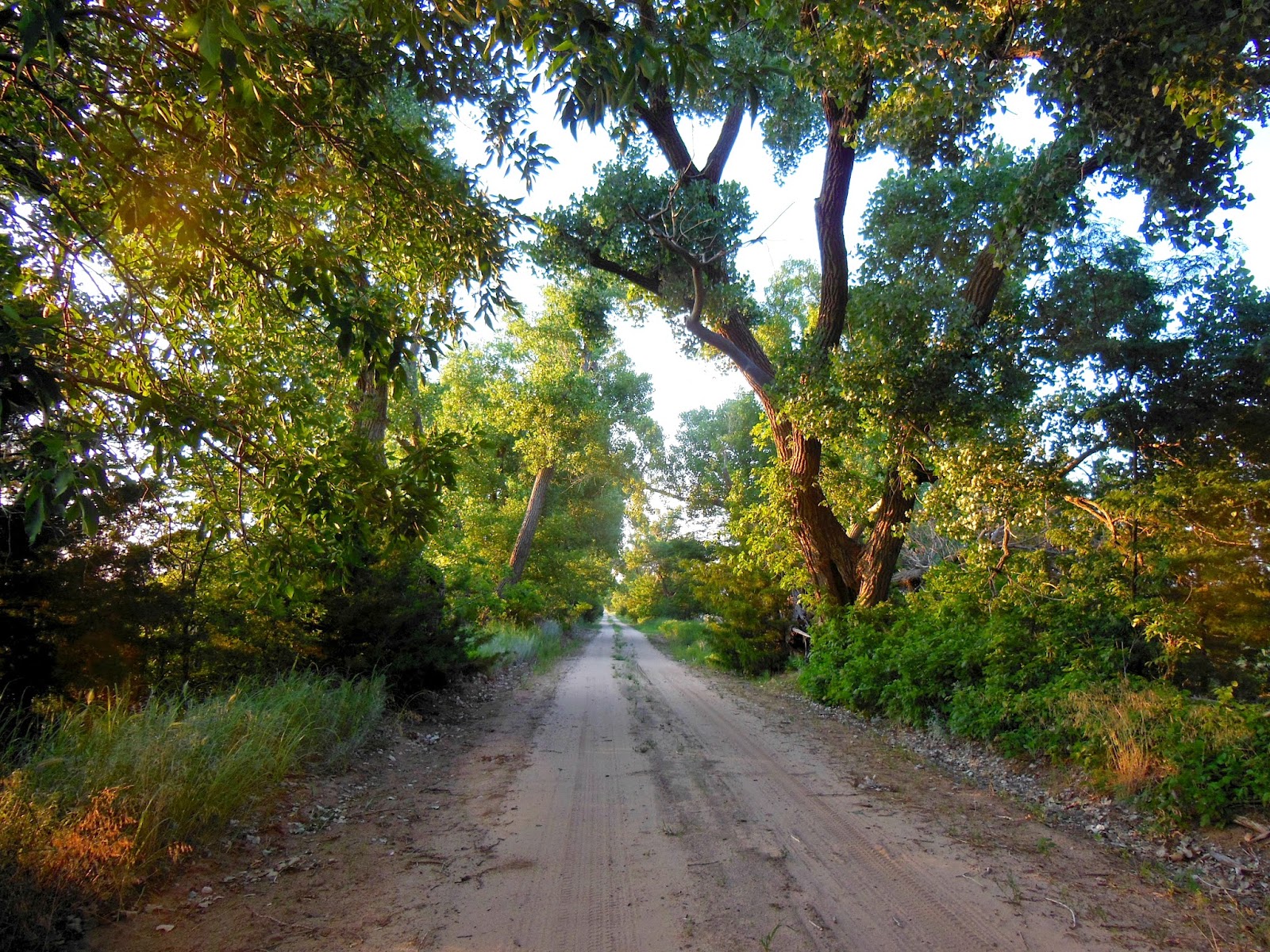
Mighty cottonwoods form a canopy down many a country road in rural Kansas. Early Kansas settlers found the native trees as they arrived from the eastern U.S. When the Kansas Legislature chose the cottonwood (Populus deltoides) are the state tree in 1937, the proclamation read:
"Whereas, if the full truth were known, it might honestly be said that the successful growth of the cottonwood grove on the homestead was often the determining factor in the decision of the homesteader to 'stick it out until he could prove up on his claim'; and Whereas, The cottonwood tree can rightfully be called 'the pioneer tree of Kansas.' " 
They are like the old family patriarch - tall, stately, but maybe a little rough around the edges after years of standing through the changing seasons. The road to the Ninnescah Pasture is lined with these big old trees, which seem to wave a friendly greeting in the Kansas breeze. On early morning or late evening trips to check cattle, the cottonwood's leaves rustle and birds serenade from their branches.
I love the old cottonwoods. Randy loves them, too -- until they fall on pasture fence. Then, maybe we're not quite so enamored.

A big wind last week blew a heavy branch right onto the fence line. I went along with Randy and offered to help, even as he pointed out some poison oak in the ditch. But I ended up clicking the camera button instead of running the chainsaw. (Big surprise!)
With that work done, we checked other pasture fence and looked for bulls in the Ninnecah Pasture via 4-wheeler.
The prairie flowers and greening prairie grasses provided a beautiful backdrop on a cool, overcast morning.

We found that the Hereford bull was doing what bulls were supposed to be doing.
We interrupted the black-white face's breakfast, as grasses hung from her mouth like a teenager with an aversion to napkins.
Mothers and babies paused to see what the noise was all about as the 4-wheeler zipped through the pasture.
It was the very definition of "pastoral" -- except for that pesky tree branch.
Above top: a beaver dam on the Ninnescah, just south of the pasture we rent. Immediately above: the view from the spillway.
I was glad I came along for the ride with my favorite chauffeur and lumberjack.

Wednesday, June 11, 2014

No-Roll Sugar Cookies


It's Flag Day this Saturday. What better way to celebrate than with some patriotic cookies?

I love sugar cookies, but I'm not a fan of rolling them and cutting them out. While these don't have exactly the same consistency as rolled cookies, they are full of flavor and just the right ratio of crunchy exterior to moist interior.

Our PEO group traditionally provides cookies for a grieving PEO sister's family so they can share a sweet treat and memories with their relatives and friends following services. Recently, I provided cookies for a PEO whose husband had served in the Vietnam War. I was glad I found both red and blue sugar in my Lazy Susan stash to give the cookies a patriotic feel. 
I left them unfrosted for the reception, but adding a simple frosting made of butter, powdered sugar, almond extract and a little milk with patriotic sprinkles further satisfies anyone's sweet tooth.
The idea of an annual day specifically celebrating the Flag is believed to have first originated in 1885. Schoolteacher B.J. Cigrand arranged for the pupils in the Fredonia (Wisconsin) Public School, District 6, to observe June 14, the 108th anniversary of the official adoption of The Stars and Stripes, as 'Flag Birthday.'

In 1914, Franklin K. Lane, Secretary of the Interior, delivered an address in which he repeated words that he said the flag had spoken to him that morning: "I am what you make me; nothing more. I swing before your eyes as a bright gleam of color, a symbol of yourself."

It was not until August 3, 1949, that President Harry S. Truman signed an Act of Congress designating June 14 as National Flag Day.

Hooray for the red, white and blue!

No-Roll Sugar Cookies 
Adapted from the Pratt United Methodist Church cookbook

1 cup shortening
1 1/2 cups sugar
2 eggs
1 teaspoon almond extract
2 1/4 cups flour
1/2 tsp. salt
1 tsp. baking soda
2 tsp. cream of tartar
Colored sugar or granulated sugar for rolling

Preheat oven to 350 degrees.

Cream shortening and sugar until blended. Add eggs and almond extract; blend until thoroughly mixed. Sift together flour, soda, cream of tartar and salt. Blend flour mixture with creamed mixture. Use a cookie scoop or shape dough into walnut-sized balls. Roll in regular or colored sugar mixture. Bake in 350-degree oven on greased cookie sheet for 8 to 10 minutes. Don't overbake!

As usual, I doubled this recipe, so that I could stash some in the freezer for future use. They freeze well. 

If you prefer, you may frost the cookies with a frosting made from butter, powdered sugar, almond extract and milk. Sprinkle with holiday sprinkles, if you'd like.

Need other ideas for Flag Day or the upcoming 4th of July celebrations? Check out these links to other tried and true recipes from my County Line kitchen.


Tuesday, June 10, 2014

Like a Sponge

If you stand in the corn field, you can almost hear the plants slurping water.

You can practically see it grow, too. Here at home, we've gotten 3.20 inches of rain in the past 30 hours or so. That's on top of the 2.20 inches we got Friday night. (A caveat: North of Stafford, we've had only 2.5 inches total from Friday through this morning.)
The photo directly above was taken on May 28. The first photo in this post was taken last Friday. Today, I'm leaving for Lincoln, Nebraska, for the Great Plains Annual Conference of the United Methodist Church. With some sunshine and this much-needed, soaking rain, I expect that my human measuring stick will be even more covered up by green corn when I get back.

The rain and cooler temperatures put the brakes on wheat harvest, which is good. I have been worrying about what I'd do if I was in Lincoln when it was time to cut wheat.
We are thankful for the rain. It's too late to help wheat yields, but it's great for the corn crop, alfalfa and our pastures.

Monday, June 9, 2014

Who Has Seen the Wind?


Pastor Ben and Arlene spent a lot of time transforming the sanctuary at the Stafford United Methodist Church for Pentecost on Sunday. We have a gorgeous and historic sanctuary anyway. It was even more beautiful.
But the transformation truly isn't just about sewing together fabric and dangling precariously from a ladder to hang it from fishing line.
It's about discovering the transforming power of the Holy Spirit in my life today - not just in Bible times. Today.

When the Holy Spirit comes (as told in Acts 2: 1-21), it comes with a sound like the rush of a violent wind and in tongues of fire.

Our other Scripture lesson for the day was John 7: 37-39:
37 On the last and greatest day of the festival, Jesus stood and said in a loud voice, “Let anyone who is thirsty come to me and drink. 38 Whoever believes in me, as Scripture has said, rivers of living water will flow from within them.” 39 By this he meant the Spirit, whom those who believed in him were later to receive. Up to that time the Spirit had not been given, since Jesus had not yet been glorified.
Living water ... rushing wind ... tongues of fire. Those aren't exactly stagnant images, as they?

As Pastor Ben said, "God's presence and the Holy Spirit change us."

It can happen slowly. Sometimes it's in an instant. But it's moving, not stagnant.

Living, moving water shapes canyons, moves boulders and changes the landscape.

Fire can be contained in a backyard fire pit, but its flames still reach up toward the night sky. Or it can race through a burning building.
We Kansans know wind. It can be a pleasant breeze on a hot summer day or a howling gale that thunders through trees and brings down heavy branches during a storm. It can be a dove kite gently rustling in air-conditioned breeze in a Kansas sanctuary.

As Pastor Ben shared, Pentecost isn't just a "story" that happened long ago. God isn't finished "moving" us and doing new things even today. The Holy Spirit comes to open our eyes and show us how to be more connected, have mercy, offer forgiveness and transform the world with justice and love.

But it requires movement. I have to leave a beautifully appointed sanctuary and go out into a messy, noisy, complicated world. As Pastor Ben says, "We have inherited the work."

The wind theme continued past church for me yesterday. At 2 PM,  the wind was blowing through a small Kansas cemetery as two young soldiers from Fort Riley honored a World War II veteran and his family. It was the service for my Great Uncle Oric Neelly, my Grandpa Shelby Neelly's youngest brother. Oric was the final one of the 10 children to be laid to rest.
Oric died on June 5, one day before the 70th anniversary of D-Day. He served for 36 months in the European Theatre in Africa, Italy, France and Germany. As a member of the Signal Corp in the First Armored Signal Battalion, he was aboard the SS Bliss when it was torpedoed off the coast of France prior to the invasion. He was rescued by a Frenchman in a small fishing boat. He rejoined his Army unit and went on to serve in the Invasion of Sicily. He was in Germany at the end of the war and helped liberate a concentration camp 40 miles from Berlin.

In the service bulletin, his family shared one of his favorite poems, "Who Has Seen the Wind?" by Christina Rossetti. It was one he recited often:

Who has seen the wind?
Neither I nor you:
But when the leaves hang trembling,
The wind is passing through.
Who has seen the wind?
Neither you nor I:
But when the trees bow down their heads,
The wind is passing by. 
Yesterday afternoon, the breeze picked up the mournful notes of "Taps" as another soldier was laid to rest. The final note gave me goosebumps as it softly drifted away into an overcast sky.

Whether being moved by the Holy Spirit or moved by the story of one of our nation's heroes, the challenge is there to live - not stagnate - and to make a difference.