Friday, February 10, 2017

The Way to a Man's Heart


My Valentine doesn't care much about cards. Unlike me, a sappy card doesn't seem to pull at his heartstrings.

"The way to a man's heart is through his stomach."

Yep, that sounds about right, at least around these parts. (I realize that's probably a sexist thing to say. Goodness knows, there's plenty of talk about such matters in my news feed these days, so I really am not looking to start a war.)

Truly, Randy would much prefer a blueberry pie instead of a $7.95 card. (I couldn't believe how much Valentine's cards are. He added the card to my Wal-Mart cart the other day, so the $7.95 card went on my credit card bill with our medicines. Ah, true love! At least the cashier carefully pulled it out of the envelope to scan it so that I couldn't see the front!)

If he's lucky, he'll probably get a pie.  I'm not sure whether it will be a double-crust blueberry pie ...

... or a crumb-topped blueberry pie. (It depends on whether I use the frozen pie crust already in the freezer or I whip up another recipe of dough).
 
But before the Super Bowl game last weekend, I made Caramel Puffed Corn. It's a recipe I've had in a "to try" pile for awhile now.
It uses "puff corn." Though it's the same name, it's not found in the cereal aisle. It's not popcorn. Find puff corn in the chip aisle. (I used Chester's Puff Corn, which is a Frito-Lay product.) And the caramel mixture is very similar to what I use for caramel popcorn, minus the salt.

One advantage of these giant corn puffs is that there are no hulls like you find in popcorn. When I make caramel popcorn, I try to keep the unpopped kernels out of the final product. Breaking teeth is not a romantic thought. But, no matter how careful I am, there inevitably seems to be a stray unpopped kernel or two in the finished product.

True confessions:  Randy says he didn't like the Caramel Puffed Corn quite as much as traditional caramel popcorn. But it was still good. If you want to jazz it up, add M&Ms in holiday colors - like for Valentine's Day. Or before a big game like the Super Bowl or the NCAA basketball tourney coming up next month, add M&Ms in team colors.

Enjoy! (See more Valentine treats below this recipe!)
Caramel Puffed Corn
3 3.5-oz. bags puff corn (not cereal - it's in the chip aisle. I used Chester's)
1 cup butter (no substitutes)
2 cups packed brown sugar
1/2 cup corn syrup
1/2 tsp. baking soda
1 tsp. vanilla

Spray roaster(s) with cooking spray. Put 2 bags of the puff corn into 1 extra-large or two smaller roasters. Set aside. In a large saucepan, melt butter; stir in brown sugar and corn syrup. Bring to a boil, stirring constantly, for 3 minutes. Remove from heat; stir in baking soda and vanilla. (It will bubble up; that's why you need a large saucepan.) Gradually pour hot caramel mixture over the puffed corn, stirring to coat. Mix in the additional bag of puff corn until pieces are well coated. (I like to do it in two parts because I think it's easier to mix and stir.)

Bake in 250-degree oven for 45 minutes, stirring every 15 minutes. Remove from oven. Turn out onto waxed paper or parchment paper to cool. If desired, mix in M&Ms in holiday or team colors. Store in tightly-sealed containers or plastic storage bags.

***
Here are some other ideas for Valentine treats:

Homemade Pretzels 


Blonde Brownies (add Valentine sprinkles instead of flowers)
 
If you're looking for cake, pie, cookies, coffee cake, etc., just type a key word into the search bar on the blog. It will give you lots of tried-and-true options from the County Line. 
 

Wednesday, February 8, 2017

The Bucket and Other Legacies

Maybe no one else can see the value and legacy in a beat up old Tupperware container. And just like that old container, we can sometimes be a little "worse for wear" in dealing with plummeting commodity prices on one side but rising equipment and input costs on the other side.

This old Tupperware container was part of our inheritance. Really. It's been used to hold the pulling chains and disinfectant since I've been part of the family, nearly 36 years now. I don't know how long it was used prior to that.

It used to be stored in my in-laws' mudroom, but it now makes its home in my basement or back porch, depending upon the season. I'm sure when Marie bought that Tupperware long ago, it was never intended for use in a barn or calving shed. In fact, according to the label, it was part of the Millionaire Line. Man, if only THAT had come true! After a quick perusal at the Tupperware website, I have concluded they don't make it anymore. Maybe I could suggest a whole new marketing campaign for cow/calf producer products. On second thought, no. Somebody somewhere would protest that the plastic isn't "GMO-free" or "local" or some other buzzword.
Just last week, Randy used it as a bucket when he milked out a heifer so he could hand feed its calf. 
I've done a fair amount of thinking about the bucket since calving started again. The bucket itself is certainly nothing remarkable. In its former life, it was probably used for beverages, since it has a pour spout. Since it still has a working lid, it's handy for keeping disinfectant in the container when we use it for the pulling chains or for disinfecting the scalpel when our bull calves become steers.

It could be replaced. It probably should be replaced, since I doubt the scratched and stained plastic container is impenetrable by germ-free standards.
However, the dingy old Tupperware is more than the sum of its parts. It's kind of a passing-of-the-torch symbol - a hold-it-in-your-hands representation of Randy's and my places in the fifth-generation of our respective farm families.
I wish I had a photo of Melvin and Randy using the bucket together. I know it happened, but I wasn't recording every moment in blogland back then. For seven years of our marriage, I was driving back and forth to Hutchinson as a reporter and editor at The Hutchinson News.
Randy's grandpa Clarence with one of their bulls.
While that off-the-farm work helped pay the farm bills, it didn't give me the opportunity to play an active role on the farm. During part of the that time, I was commuting with infant - then toddler - daughter, Jill. After Brent was born, I "retired" from the full-time newspaper job, but I was raising two young children and doing some freelance writing work and later working at the school. So I didn't always make it out to watch a calf being pulled. I took more photos of the kids than I did of the farm. And that's OK. That's the ebb and flow of life. Different seasons often bring alternate perspectives.


But in this season of life, I've used the same reporting and photography skills in a new way. And while I didn't begin the blog to garner attention, it's always nice to be recognized
Last week, I was notified that I had received a "Golden Tractor Award" from Lawnstarter.com. Here's the email I got:
First of all, we’re huge fans of Kim's County Line, which has been chosen by LawnStarter’s editorial team to receive our 2016 Golden Tractor Award! Congratulations!

The Golden Tractor Award celebrates the Top Farming & Agriculture Blogs on the internet. We spent countless hours scouring the web in search of the blogs that deserve recognition.

We judged your blog based on criteria such as:
  • How well-written and informative the 2016 content was
  • How engaging it was (social shares, comments, aesthetics)
  • Popularity (pageviews, “popular posts” lists, etc.)
We hope that you enjoy our list of winners and encourage you to show off your Golden Tractor Award on your website (along with other awards that we’re sure your blog has received).
You can read our article announcing the winners here.
Randy and his first 4-H calf.
In this era of "fake news" and "alternate facts," I think it's important for people in the ag community to tell our own stories. Nobody can tell it like the people who live it, even though fast food restaurants and advertising companies are glad to share their thoughts about the evils of modern agriculture. 

But, just like that old bucket, we persevere - one day at a time.

Monday, February 6, 2017

Light of the World

 Matthew 5:13-16  New International Version
13 “You are the salt of the earth. But if the salt loses its saltiness, how can it be made salty again? It is no longer good for anything, except to be thrown out and trampled underfoot.
14 “You are the light of the world. A town built on a hill cannot be hidden. 15 Neither do people light a lamp and put it under a bowl. Instead they put it on its stand, and it gives light to everyone in the house. 16 In the same way, let your light shine before others, that they may see your good deeds and glorify your Father in heaven.

Salt and light:  The Bible tells us we should be both. Many churches follow the lectionary for their Scripture readings from week to week, and, most weeks, our church does, too. This week, the Gospel lesson was from the book of Matthew, chapter 5.
 
Our pastor actually chose the Old Testament reading (Isaiah 58:1-12) and the Epistle (1 Corinthians 2:1-16) for the week. Usually, I  look for Sunday School materials for my adult Sunday School class that correspond to the Scriptures Pastor Nate is using. But this time, there was a Sunday School lesson which related the Gospel Bible passage to the Super Bowl, so I chose it instead. (And it turned out to be a fortuitous thing, since our pastor was ill, and my friend, Tami, and I ended up cobbling together a service based on the "salt and light" passage.)

Super Bowl weekend provides plenty of possibilities for salty snacks. One of the Sunday School lessons suggested buying a bag of low-salt chips and another bag of the salt-laden variety and seeing which tastes the best.

Salt makes things taste good (if you don't have to worry about things like blood pressure and such). Back in the pioneer days, salt was used as a preservative. It played an important role in sustaining the people.
And light? You know I'm a big fan of sunrises and sunsets. So maybe my attraction to the Matthew 5 lesson was natural. I did have several sunrise and sunset photos that I hadn't yet shared on the blog or Facebook. But I hope it was more than that.
I continue to be troubled by my Facebook feed. I suppose I should just quit signing in. But then I'd have to also ignore the evening news and newspapers. Being a hermit doesn't sound like a bad plan, I suppose. But, on the other hand, it's hard to be "salt and light" to the world if you're hiding under your fleece blanket at home.
It's so hard to know what to do: Do I keep my fingers idle instead of furiously pounding my keyboard with a heated response? Do I keep my mouth shut in a group where there are differing opinions - even my own Sunday School room?
For Christmas, Jill and Eric gave me a book of prayers written by the pastor of their Omaha church, Craig Finnestad. After my Bible readings in the morning, I've been using some of the prayers found in Prayers from The Water's Edge.

I also decided to follow his blog. Finnestad shared these observations this week: (Click on this link for the entire list and the blog post.)
  • We look most like Jesus when we serve, give, and forgive. Doing these is a blessing to others and ourselves. Do these things.
  • The world is made up of imperfect people so I am not going to expect perfection from anybody anymore. Excellence, yes. Perfection, no.
  • We can’t change other people. I’m doing my best to change my reaction to people. Less judging and arguing. More loving and listening.
  • I have so much to learn, and I need God.
There's a lot of ugliness in the world, but I don't want to contribute to it. Maybe those lessons can help me be "salt and light" this week. That's the plan anyway.

I'd also encourage you to check out his chart called The Effects of Political Posting on Social Media and Friendship. He has that particular blog post marked as "humor." But it's the truth. 

Friday, February 3, 2017

In Its "Hayday"

Randy uses the loader tractor to place hay bales on the truck bed.

hey·day

/ˈhāˌdā/

noun
1. the period of a person's or thing's greatest success, popularity, or vigor: "the paper has lost millions of readers since its heyday in 1964" synonyms: prime, peak, height, pinnacle, summit, ...
After the bottom level is loaded, he ties down the front and back bales.
We may not be in our "heyday."
But we've been in our "hay day" all this week.
The guys have loaded a semi with round bales of hay, then trucked it to Sebes Hay LLC near Larned every day this week. We feed the majority of the alfalfa we raise, though we do sell what's not needed for feeding to our cow-calf herd and the feeder calves that we retain during the winter months.
It's a good thing Randy isn't afraid of heights!
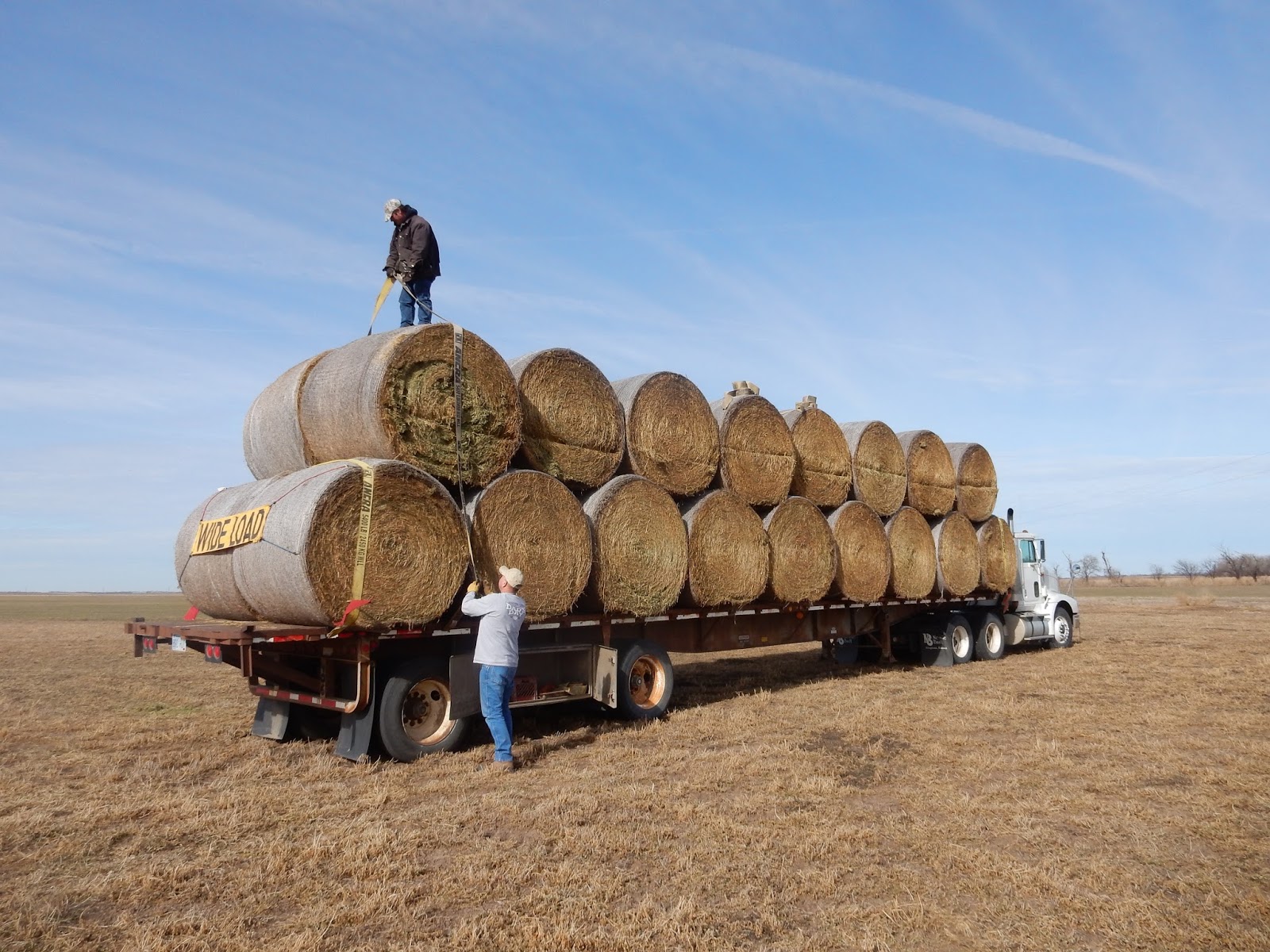
Randy has sold 12 semi loads. Today, they will truck the 8th of the 12 loads and will load the 9th. Each semi load has 34 bales and weighs in at roughly 25 tons or 50,000 pounds.
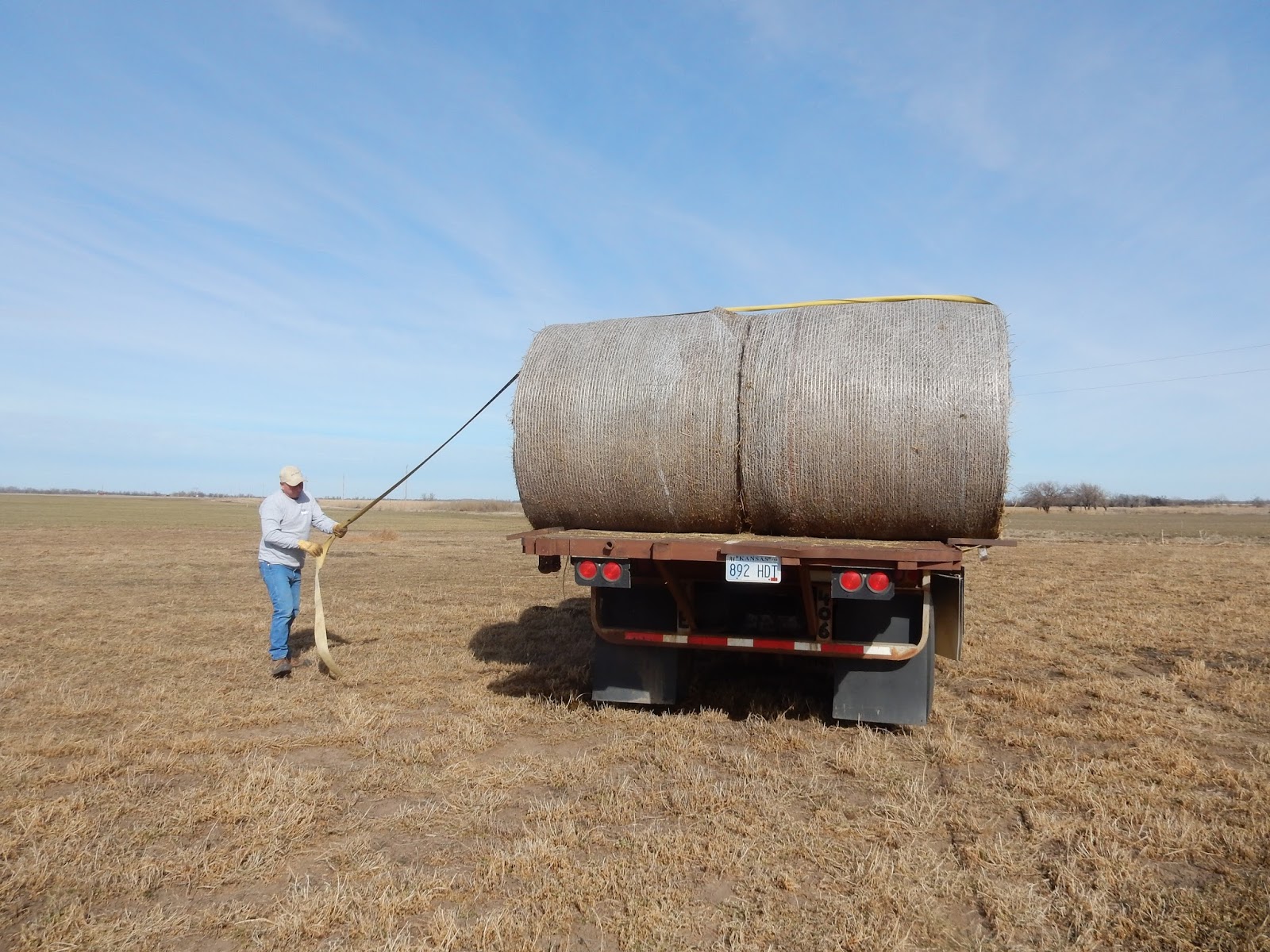
It's important to get the bales firmly tied down to the truck bed for their 45-minute trip to the hay mill.
It takes longer to load the semi than it does to transport it. On average, it takes 11/2 to 2 hours to get the truck loaded and tied down.
To me, it resembles a Jenga game, strategically placing items in an effort to keep them upright. But we definitely don't want them to fall down.
 
Randy picks up each bale in the grapple fork on the loader tractor.
He then deposits it on the trailer bed, placing the second layer of beds in the groove between the two bales below it.
This shows the net wrap on top of a bale - just a different perspective.
When we were in a drought a few years back, we barely raised enough alfalfa hay and sudan to feed our own cattle herd. But with good rainfall last summer and the hay crop it produced, we have extra hay to spare.
I am glad that Randy does the loading. It takes a steady hand to exert enough pressure on the loader for the bale to stay in place but not push the one off on the other side!
Once all 34 bales are loaded, it takes teamwork to get the straps died down. This time, Ricky was on top of the trailer and threw the tie-down straps down to Randy.
Randy hooked the straps onto the trailer bed.
And they continued the process down the length of the trailer.
The guys also add safety flags. The flags are on wooden poles that get stuck in the bales.
(Note to self: Maybe some new flags would be a good Father's Day gift!)
Most of the time, Ricky has been hauling the load to Larned, so I haven't gone along to document that part of the process. Once there, he weighs the truck and then takes it to the unloading area. Most of the time, a Sebes Hay employee has off-loaded the hay. Then, Ricky weighs the empty truck before returning to the field for another load.
More Wide Loads ahead!

For more about harvesting hay on the County Line, please click this link.

Though I haven't been on a delivery run this year, click here to learn a little more about that process. (It's a different hay mill, but the processes would be similar.)

Wednesday, February 1, 2017

Ground "Hog" Day: A Recipe

How about a little "ground hog" for Groundhog Day tomorrow? No, I am not suggesting that Punxsutawney Phil end up in a soup bowl on February 2. After all, we won't know until tomorrow whether the furry rodent is telling us we'll have six more weeks of winter or not.

On Thursday, for the 131st time, Phil will venture out of his burrow at Gobbler's Knob in Punxsutawney, Philadelpia. According to legend, if Phil sees his shadow, there will be 6 more weeks of winter. If the day is overcast and he doesn't see his shadow, there is supposed to be an early spring.

With all the TV cameras and lights involved with the TV morning shows, I figure Phil's going to see his shadow - one way or another. But we'll see what Phil's verdict is.

The celebration of Groundhog Day began with Pennsylvania's earlier settlers. It stemmed from a combination of religious beliefs and facts associated with hibernating animals. They brought with them the legend of Candlemas Day:

If Candlemas be fair and bright,
Come, Winter, have another flight;
If Candlemas brings clouds and rain,
Go Winter, and come not again.

We got a jump on "ground hog" day with a new soup recipe. It uses Italian sausage, but it doesn't discriminate. There's also some ground beef in it. I personally like the combination, since Italian sausage can be a little spicy. I personally liked that the hamburger tempered that a bit.

It also includes a variety of fresh-chopped vegetables - carrots, celery, onion and spinach. Yes, spinach. The recipe call for 5 ounces of baby spinach. That looks like a lot! But, after only a short time, it wilts down and you'll forget that it looked like mountains of green stuff to begin with!

Cannellini beans and ditalini pasta also provide the thickness we prefer in a soup. Canned or jarred marinara sauce, along with a little Italian seasoning, provide a lot of flavor without emptying the spice cabinet.

Enjoy with some cornbread or crackers! 
Hearty Italian Soup
8 oz. mild Italian sausage
8 oz. hamburger
2 carrots, peeled and chopped
2 stalks celery, chopped
1/2 onion (or more to taste), chopped
Salt and pepper, to taste
1/2 tsp. Italian seasoning
15 oz. can cannellini beans, drained and rinsed
24 ounce jar marinara sauce
3 cups chicken broth
4 oz. ditalini pasta
5 oz. baby spinach, roughly chopped
Optional:  Shaved Parmesan cheese for serving

In a Dutch oven or soup pot, brown the meats, breaking it up as it cooks. Drain excess fat.

Add all other ingredients, except spinach and Parmesan cheese. Turn heat up to high and bring to boil, then reduce heat to medium and partially cover with a lid. Simmer until the vegetables are tender. Add chopped baby spinach. Stir and cook until wilted, 1-2 minutes, then serve. If you like thinner soup, you may need to add a little more broth or water, especially when reheating leftovers. (Pasta always absorbs more of the liquid after sitting.)

If desired, top with shaved Parmesan cheese before serving.