Showing posts with label semi truck. Show all posts

Friday, March 3, 2017

2017: To Market, To Market

Who's the guy with the big smile? It's the guy who has cattle going to the sale, that's who!
On Wednesday morning, Darrel Harner Trucking came to the County Line to load our feeder calves for their trip to the Pratt Livestock sale barn. On Tuesday, we had sorted the calves we planned to sell from the 25 heifers we will keep at home to add to our cow-calf herd.
Though we have two farm-sized cattle trailers, it would take several trips to get all the cattle to the sale barn, so we hire Darrel Harner Trucking to haul them in one semi.
The semi is divided into different compartments, which can hold anywhere from six head to 25 head of cattle. Darrel would tell us how many he wanted at a time, and the guys would send that many into the truck.
The cattle go single file up a loading chute and into the semi.
Once they were all loaded, the semi pulled out for the trip to Pratt Livestock.   

Some years, they haven't all fit on the semi, so we've had to haul one farm trailer load to Pratt.
 
But this year, with all the cattle on the truck, I requested a few extra photo opportunities. (Big surprise, right?!)
I wanted to get a photo of the truck going down Main Street of Stafford.  
Randy wanted me to get one of the semi going by the bank. (You can see the bank sign on the right in the photo above.) Once we get the sale barn check, it goes directly to the bank to help pay down our operating loan.This picture is the very definition of irony!
We still beat the semi to the sale barn with a little cross-country driving!
 
Once the semi arrived, the sale barn workers helped Darrel back it up to the unloading chute.
 
The cattle came off the truck into a pen. 
 
Once they were all unloaded, the sale barn workers sorted our cattle by sex and size and put them into different pens where they had water and feed until sale time. There are lots of pens throughout the sale barn facility. Each sellers' cattle are kept separate.
Next up on the blog: Sale day!

Friday, February 3, 2017

In Its "Hayday"

Randy uses the loader tractor to place hay bales on the truck bed.

hey·day

/ˈhāˌdā/

noun
1. the period of a person's or thing's greatest success, popularity, or vigor: "the paper has lost millions of readers since its heyday in 1964" synonyms: prime, peak, height, pinnacle, summit, ...
After the bottom level is loaded, he ties down the front and back bales.
We may not be in our "heyday."
But we've been in our "hay day" all this week.
The guys have loaded a semi with round bales of hay, then trucked it to Sebes Hay LLC near Larned every day this week. We feed the majority of the alfalfa we raise, though we do sell what's not needed for feeding to our cow-calf herd and the feeder calves that we retain during the winter months.
It's a good thing Randy isn't afraid of heights!
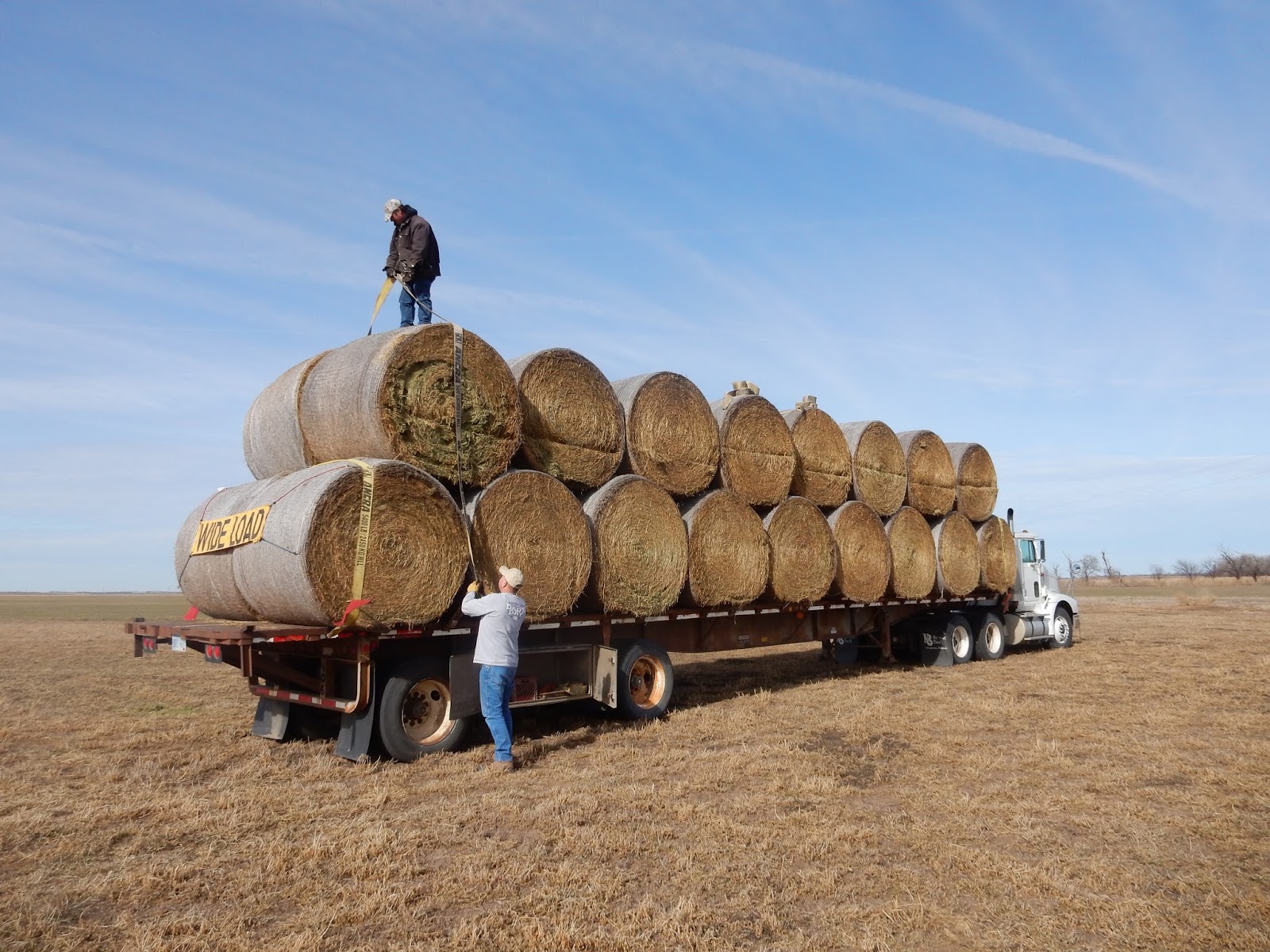
Randy has sold 12 semi loads. Today, they will truck the 8th of the 12 loads and will load the 9th. Each semi load has 34 bales and weighs in at roughly 25 tons or 50,000 pounds.
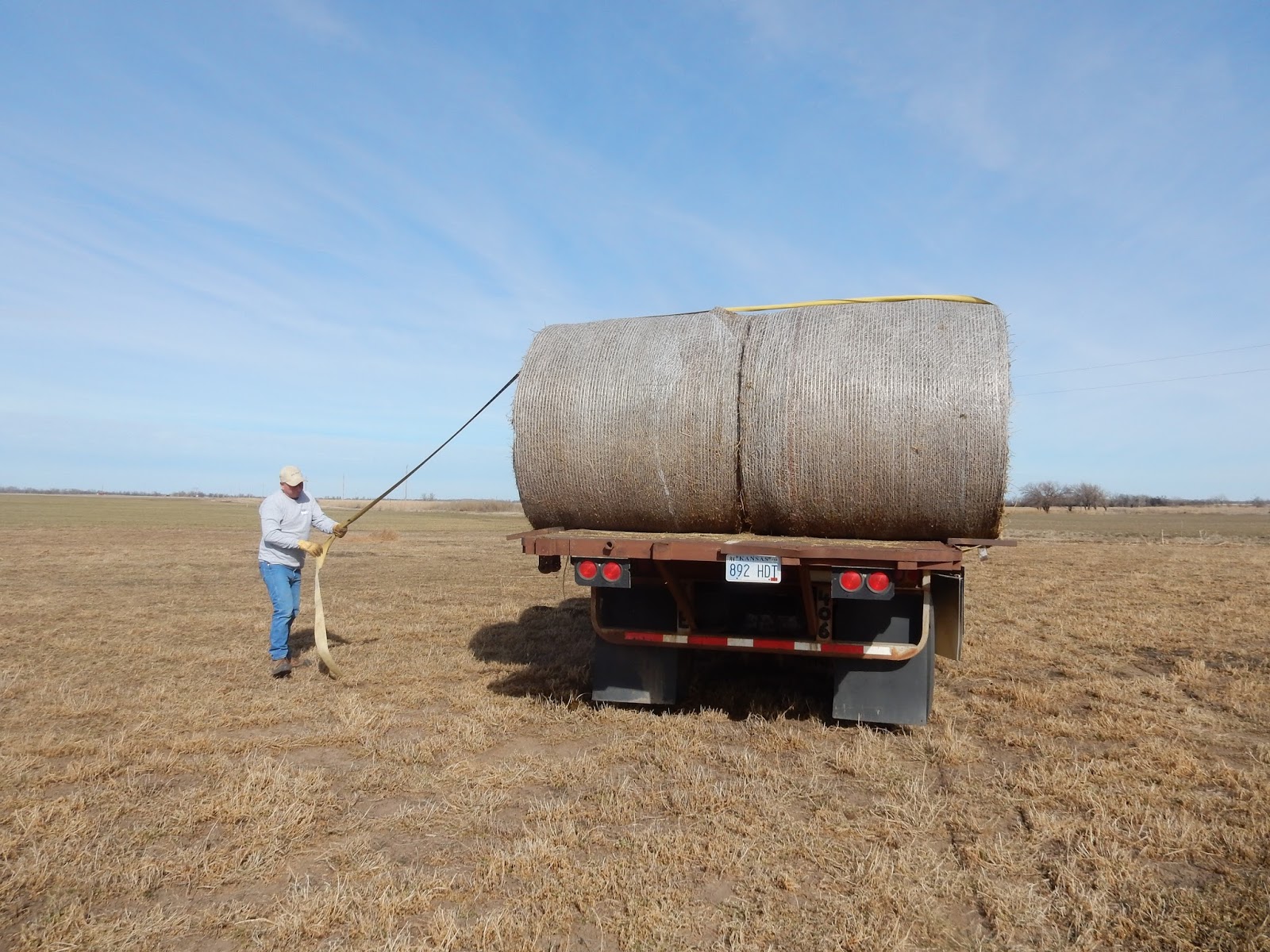
It's important to get the bales firmly tied down to the truck bed for their 45-minute trip to the hay mill.
It takes longer to load the semi than it does to transport it. On average, it takes 11/2 to 2 hours to get the truck loaded and tied down.
To me, it resembles a Jenga game, strategically placing items in an effort to keep them upright. But we definitely don't want them to fall down.
 
Randy picks up each bale in the grapple fork on the loader tractor.
He then deposits it on the trailer bed, placing the second layer of beds in the groove between the two bales below it.
This shows the net wrap on top of a bale - just a different perspective.
When we were in a drought a few years back, we barely raised enough alfalfa hay and sudan to feed our own cattle herd. But with good rainfall last summer and the hay crop it produced, we have extra hay to spare.
I am glad that Randy does the loading. It takes a steady hand to exert enough pressure on the loader for the bale to stay in place but not push the one off on the other side!
Once all 34 bales are loaded, it takes teamwork to get the straps died down. This time, Ricky was on top of the trailer and threw the tie-down straps down to Randy.
Randy hooked the straps onto the trailer bed.
And they continued the process down the length of the trailer.
The guys also add safety flags. The flags are on wooden poles that get stuck in the bales.
(Note to self: Maybe some new flags would be a good Father's Day gift!)
Most of the time, Ricky has been hauling the load to Larned, so I haven't gone along to document that part of the process. Once there, he weighs the truck and then takes it to the unloading area. Most of the time, a Sebes Hay employee has off-loaded the hay. Then, Ricky weighs the empty truck before returning to the field for another load.
More Wide Loads ahead!

For more about harvesting hay on the County Line, please click this link.

Though I haven't been on a delivery run this year, click here to learn a little more about that process. (It's a different hay mill, but the processes would be similar.)

Tuesday, September 6, 2016

One Of These Things Is Not Like the Others

Do you remember this song from "Sesame Street?"

One of these things is not like the others,
One of these things just doesn't belong,
Can you tell which thing is not like the others
By the time I finish my song?
Did you guess which thing was not like the others?
Did you guess which thing just doesn't belong?
If you guessed this one is not like the others,
Then you're absolutely right! 
We started corn harvest on Saturday. We also quit corn harvest on Saturday when we had a breakdown. The row headers (those things that look like missiles) are supposed to "float" and flex through the field. However, the cone on this particular header took a dive into the ground instead. The very same row header malfunctioned when Randy tried a test cut last week. He ordered a new one, and we picked it up Saturday morning in Hutchinson.
 
Naturally, it was Labor Day weekend, so the equipment dealership closed at noon Saturday and wasn't open on Monday. Randy plans to be at the parts counter when they open this morning. We'll see if we can get back up and running without having to wait on another part.

After lunch on Saturday, I was on my way to the field to get the first photos of corn harvest 2016. Randy had already cut one semi load of corn, but he wanted me to wait for pictures until we got into a little better corn than he found on the perimeter of the field. But, by the time I got there for the photo op, we were already broken down.

I rode along to Stafford in the semi instead.
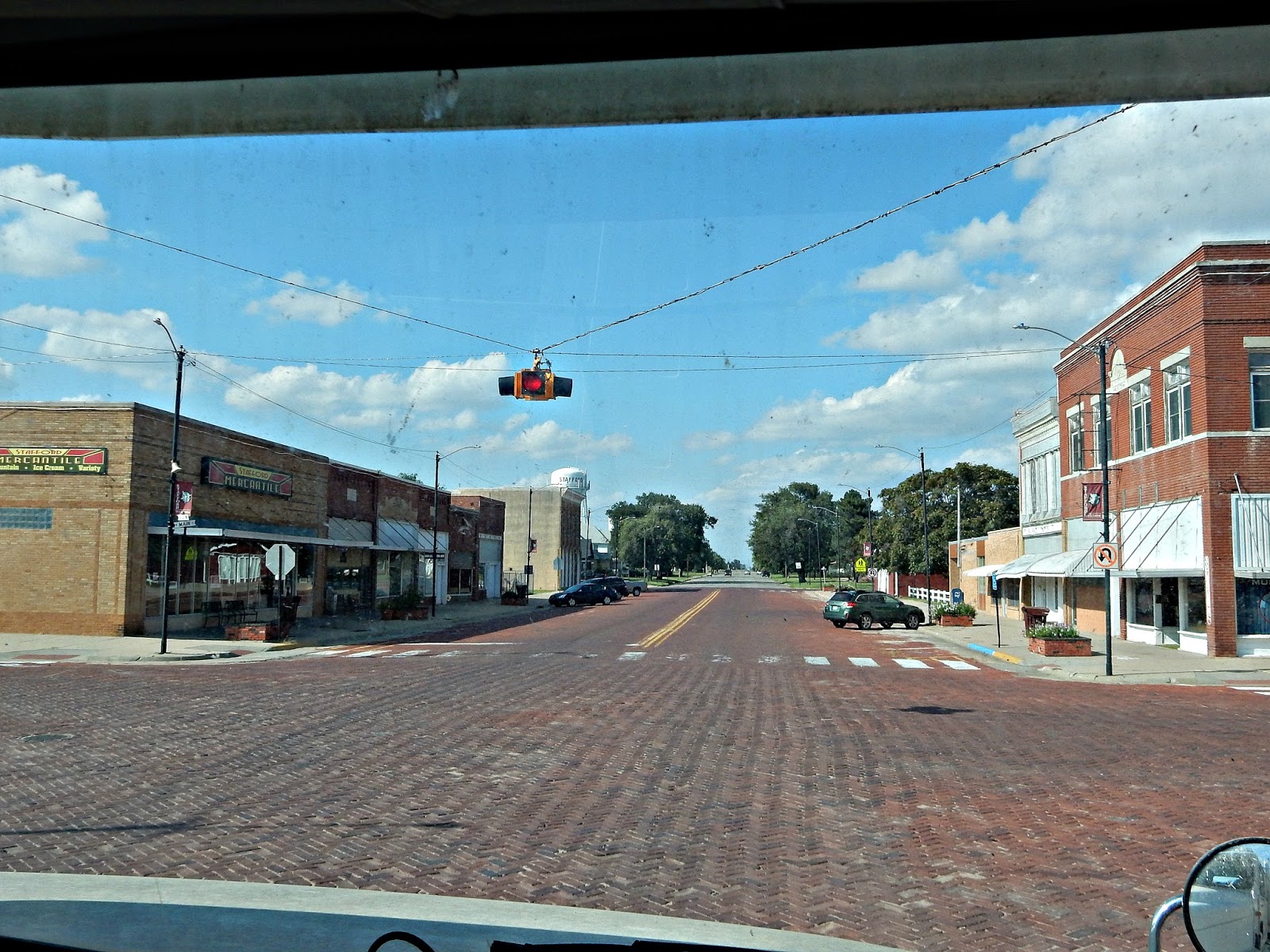
Main Street, facing south, as we approached the 4-way stop.
It was only a partial load, but Randy didn't want to leave it sitting in the truck, potentially "sweating" and increasing the moisture reading.
Taken through the back window of the semi as the grain probe dipped down into the truck to get a corn sample.
We take most of our grain to the Zenith branch of the Kanza Co-op, but it was closed for the Labor Day weekend, so we went the extra miles to Stafford.
It's always a little more of a challenge because the elevator is right on U.S. Highway 50.
It requires a bit of maneuvering - and several extra glances both east and west down the highway - to weigh on and then depart after unloading.
But it wasn't that busy on Saturday, so no traffic jams were involved.
There were no traffic jams on Main Street either, even though it was coffee time at Elroy's, the pizza place. Going down the brick streets of Stafford's Main Street in a semi can rattle your teeth a bit.
Sitting up higher gives a different perspective than the one I get in my car. Now, if only the windows had been cleaner, but even if I'd had Windex with me, I don't think my gymnastic moves would have been sufficient to get them cleaned. We already had one breakdown. We didn't need a farm wife breakdown on top of that!

So, we didn't "labor" as much as we'd planned during Labor Day weekend.

Thursday, June 30, 2016

Road Trip: Wheat Harvest Version

My first job on the farm was driving a pickup while my dad picked up fence posts. I was in elementary school at the time. Long before I had my driver's license, I moved trucks around in the harvest field. These were the days before my dad had a grain cart to haul the grain from the combine to the truck. So I'd move the truck closer to the wheat so my dad didn't have to go as far to dump the bin load each round.

When I got my farm permit, I drove the wheat trucks to the Iuka Co-op. Our hired man, Ed, was my patient navigator the first year. He taught me the fine points of waiting in line, unrolling the tarp, how to dump the truck and instructions in the fine art of elevator etiquette. But, after that, I made dozens of trips to the elevator during wheat harvest each year.

When Randy and I were first married, I worked at The Hutchinson News, so I didn't drive the truck, except on weekends. After I "retired" from that job and the kids got a little older, I was back in the driver's seat again.

However, I've never driven our semi. This is the second wheat harvest we've had it. I know I could learn. But we've had a hired man available to do it, so my job has transitioned to go-fer and cook.


The other evening, after one of our rain delays during harvest, our hired man wasn't back yet, so Randy asked if I'd like to go with him as he drove the semi with a load of wheat to Zenith.
It's definitely a different perspective, viewing the familiar Zenith Road from a loftier perch.
We arrived at our destination - our favorite prairie skyscraper.
Randy unrolled the tarp.
He pulled the semi onto the scales at the co-op office, where they weigh the loaded truck. With the orange probe, they get a sample of the wheat and test for quality, including weight, moisture, protein and foreign matter.
This was taken in 2015. This trip, I was inside the truck cab.
Through the rearview mirror, we could see that they wanted us to take the truck to location "B" - inside the elevator. 
These elevators were designed long before there were big semi trucks. It's a tight squeeze.
If I were the driver, I would much rather dump at the outside pit, location "C."
Photo from 2015 - the outside dump location
I captured Randy's shadow in the mirror behind us as he waited for the wheat to flow into the elevator pit. After so many harvests, I like finding different images that tell the story.
Photo from 2015, showing co-op guys opening the hatches.
Once the truck is in position, the co-op workers open the hatches underneath the truck. The semi truck is emptied through gravity. (We also have a tandem truck that has a lift to dump the grain. For photos of that, click HERE.)
With the grain unloaded, Randy pulled back onto the scales for an empty weight. We also pick up the ticket which gives a record of how much wheat we delivered that trip and its quality. 
Then, it was back to the field to fill 'er up again.
The farmer or landlord pays a storage fee to the co-op based on the amount of time the grain was stored before being sold. Then, it belongs to the co-op. When the co-op sells it, most is trucked out of the elevator to the buyer. (In the past, rail travel helped move a lot of grain, too, but most of it is trucked these days, at least in this area.)

FYI:  When I pulled up a blog post from last year, I saw that wheat was $5.15 on June 23. Wheat closed at $3.15 on the board at Zenith yesterday. 

Thankfully, we were able to start cutting again yesterday afternoon after our Tuesday rain delay. We had to move to a different location. It is a slow process, since the wheat is down fairly badly and he's still having to battle some mud. But the wheat yields are still above average, though quality has suffered with the rains.

Still, we're glad to be back at it! Every swath puts us a little closer to done.