Tuesday, March 29, 2022

From Camera Click to Museum Wall

It started with a camera click on the way to a pasture on a September afternoon and ended up on the wall of an art museum.


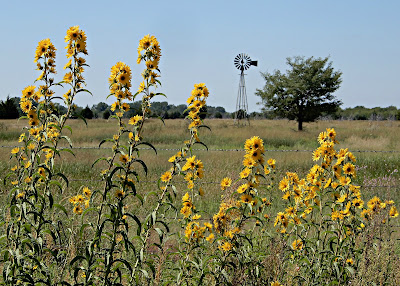
As an amateur photographer, I am honored that one of my photos was chosen by Artist Charles Baughman for an exhibit at the Vernon Filley Art Museum in Pratt. I am certainly not alone: 23 other photographers also had images chosen by Baughman. He recreated the photographs as paintings in his signature style, which he calls Splatterscape. He uses only his fingers, sticks and oil paint to produce abstract works. In the exhibition at the Filley Museum, his paintings hang side-by-side with the original photographs they are based upon.

From the Vernon Filley Art Museum Facebook page (You can see Baughman's rendition of my photo at the fair right.)  


Earlier in the year, the museum advertised the opportunity for photographers to submit up to three photographs to be considered. (Thanks to my friend, Nancy, for bringing it to my attention.) The artist didn't want photos with animals, people or structures. It's tough to try and second-guess what might appeal to another person. I submitted three photos and just hoped for the best.

But I was really excited when I received notification that one of my photos was chosen. Baughman chose my photo of Maximillian sunflowers with a windmill in the background, though he opted to leave out the windmill in the finished painting. Those late-season sunflowers lined the road to the Rattlesnake Pasture. On a September day in 2018 when the sunflowers seemed to rival the sun, I stopped and took a few photos. I used the photo on my blog, of course, and it decorates my own mantel during sunflower season.

Last Friday, photographers were invited to be there with the artist for the opening reception. But the exhibit will be in place until July 22, so, if you're in the area, there's plenty of time to see it. 

Photo from www.pratttribune.com

Charles Baughman is a nationally known, contemporary Abstract Expressionist painter, as well as a long-time art educator. He received his Bachelor’s degree in Studio Arts and Art History from Kearney (Neb.) State College and his Master of Fine Arts in Painting/Sculpture from Wichita State University. Since 2004, Baughman has owned and operated the Monart School of Art and The Art Park in Wichita with his wife, Kate Pepper.

"I'm happy to say that I'm a professional finger painter," Baughman said, generating a laugh among the crowd. "I'm open to happy accidents, which lead the viewer's eye on a journey." 

 A time-lapse video showed the process Baughman used to use paint interpret the photographs into paintings. This snippet features my photo.

Baughman told reception attendees that his  style of painting brings him closer to nature and celebrates all stages and seasons.

""Nature has a continuous process of destruction and rebirth," Baughman said in his artist statement. "Nature's rebirth often happens in unexpected ways - big events like earthquakes, tornadoes, hurricanes and fire. This destruction is always followed by new life - fresh, yet subtle, growth starts among grasses, trees and undergrowth first. Then, as the seasons cycle through, more and more regeneration happens. ... The spirit of life happens with the willingness to destroy and re-create something new."

With the Ninnescah Landscapes exhibit, he wasn't trying to replicate the photography. The cell phones in everyone's pocket make it possible to capture moments easily. He wanted to interpret the photos in a new and interesting way. And with his paintings he wants to remind people that nature is powerful, yet its beauty is also fragile.

That message definitely resonates with me, someone who often captures the fleeting moments of beauty that exist all around me in my everyday life.  

The artist statement I submitted with my photographs was this (in part):

The Kansas plains have always provided a backdrop for my life. Those scenes may not garner the same praise as towering mountains or waves hitting a seashore. In fact, Kansas is known as a “flyover state.” But these simple scenes are just as beautiful in a different way.

I’ve always enjoyed photography. As a fifth grader on a family trip to California, I took dozens of black and white photos of the Tournament of Roses parade. It became a bit of a family joke – dozens of black and white photos of scenes that were bursting with color! But that first experience of viewing the world through my very own camera lens served as a catalyst to a lifelong hobby....

Taking photos helps me pay attention. It helps me to see beauty in ordinary things. I look for beauty in my everyday life. And when you look for beauty, you often find it. 
Kim Fritzemeier Artist Statement

Baughman has been an instructor at the Wichita Art Museum, Wichita State University, Cowley County Community College, Butler County Community College, Wichita Center for the Arts, and Friends University. He has developed and taught classes ranging from Art Appreciation and Figurative Sculpture to advanced drawing courses and painting. 

Baughman doesn't believe in signing his name in the lower righthand corner of his work. Instead, he embeds a heart-shaped rock in the paint, and he signs the side of the work.


My photo and Baughman's rendition are also featured on the banner advertising the show outside the Filley. It was an additional thrill to see that!


This isn't my first time to have my photos on walls other than my own or my family's. Some of my work is also featured at the Kansas State University College of Business and K-State's Staley School of Leadership Studies.

But it's no less an honor. 

And the pair was sold the first night! That was a thrill, too!

Again, the exhibit will be on display at the Vernon Filley Art Museum in Pratt until July 22. Check it out!


Thursday, March 24, 2022

President's Project: To Make the Best Better!


I think I've dotted all my Is and crossed all my Ts now. On March 11, I installed my friend, Millie, as the next president of the Kansas Master Farm Homemakers Guild. And with that installation, I finished five years serving as an officer in the organization. (Randy finished up five years as an officer with Kansas Master Farmers.) Last week, I completed paperwork and wrote letters and thank you notes to end my term.

On the women's side, tradition has it that the outgoing president gets to choose a President's Project. Members - and others - are invited to contribute to a project of her choosing. 

I contacted Kansas 4-H Foundation Director Jake Worcester prior to the meeting for some ideas. I told him that 4-H foods and nutrition, as well as photography, were among my passions. After talking with Kansas 4-H state leaders, he suggested a project to help honor foods and nutrition exhibitors at the Kansas State Fair.

Foods and nutrition 4-H members have their food exhibits judged early on at the fair. There's only room for a few of those exhibits. And even those exhibits don't look too tasty by the end of the 10-day fair. 

The digital display board will be something similar to this.

My President's Project will help provide a digital display board in Centennial Hall on the Kansas State Fairgrounds where photos of the 4-Hers and their foods can be displayed during the duration of the state fair. It's a pilot project. If this display board works well, Kansas 4-H may add similar displays to honor other projects at the fair. 

Several of my fellow Kansas Master Farm Homemakers contributed to the digital display board. I know there are others of my friends whose roots in the 4-H program go just as deep as mine. If you'd like to contribute to the KMFHG President's Project, you may send a check made out to the Kansas 4-H Foundation with your contribution to:
 
Kansas 4-H Foundation
1680 Charles Pl., Suite 100
Manhattan, KS 66502

Please make a note that it should go toward the KMFHG President's Project.

The project was the perfect choice for me. 


I was a foods and nutrition member back in the 1960s & '70s in Pratt County.


 From the very first year of Jill's 4-H career, foods and nutrition was a favorite project.

Jill's first food demonstration on making a Raggedy Ann Salad

Foods demonstrations and exhibits were central to Jill's 4-H experience.  Jill and her friend, Holly, made dozens of pretzels one year. They made dozens of dinner rolls another. And they earned the right to take both those demonstrations to regional club day and the state fair.

Jill's friend, Holly, & Jill making pretzels for a demonstration
 

By the time she was veteran 4-Her, Jill was teaching others, and serving as a foods superintendent at the county fair.

She was the state award winner in the 4-H Foods and Nutrition Project her senior year.  

Last year, Kinley had her first experience as a foods and nutrition exhibitor at the Shawnee County Fair. She also gave her first foods talk for county club day, though it was a different experience having to do it on Zoom.


But this winter, she got to give her first in-person foods demonstration, making Energy Bites. She got a blue ribbon.

Brooke just began her 4-H journey last fall. But her very first Show and Tell at county club day was on foods and nutrition and My Plate.

The girls are the fourth generation in our family to be involved in the Kansas 4-H program. My parents were members back in the 1940s in Pratt County. Both were members of the Lincoln Bluebirds 4-H Club in Pratt County, the club that my siblings and I later joined. (During my time in the club, we consolidated with another club and became the Lincoln Climbers.)

Bob & Janis Moore - Pratt County Fair service award recipients in 2011      

All four of their children and all seven of their grandchildren were part of the 4-H program, two in Pratt County in the same club their grandparents attended, two in Stafford County and three in Clay County. Now that continues for five of their 10 great-grandchildren in Clay and Shawnee Counties.

Randy's parents were leaders in the Stafford County 4-H program, too, though we're not sure they were 4-H members themselves. For a dozen years, Randy & I were community leaders of the Corn Valley 4-H Club, the same club Randy was a part of back when he took his first cow to the fair. I'm still the 4-H foods superintendent at the Stafford County Fair.

In 2006, we celebrated 100 years of Kansas 4-H. The youth program has been part of the national landscape since 1902.

The 4-H website says:

The 4-H idea is simple: help young people and their families gain the skills they need to be proactive forces in their communities and develop ideas for a more innovative economy. That idea was the catalyst to begin the 4-H movement, and those values continue today.

The 4-H program continues to MAKE THE BEST BETTER!

I'm thankful that it's been all that and more for my family ... and will continue to be.

Kinley & Eric before their shift at the pancake feed. As Uncle Brent says, 4-H t-shirts haven't evolved a lot from the '90s.

***
A little more history: The Kansas Master Farmer award was started in 1927, by then-Kansas Farmer publisher Sen. Arthur Capper. A year later, The Farmer’s Wife magazine, which is no longer in print, started the Master Farm Homemaker Guild, with help from Kansas State University. More than 400 farm couples have been recognized and have become members of the Kansas Master Farmer Association and the Kansas Master Farm Homemakers Guild. The goal was to publicly honor excellence in farming, homemaking, farm living and rural citizenship. In 1953, Kansas State University Cooperative Extension Service took on the duty of the selection process and coordination of the annual honor banquet. Today, K-State Research and Extension and Kansas Farmer magazine co-sponsor the program, with financial support from Kansas Farm Bureau, Frontier Farm Credit and American AgCredit.