Tuesday, April 13, 2021

Candid Camera


I read an article not long ago about new facial recognition technology for cattle. 

On a recent day in the cattle pen, we weren't trying out the latest technical advances from our alma mater, K-State. But the article said that the university is capitalizing on the power of artificial intelligence to build a database for the cattle industry. 

Like humans, each bovine has a set of unique facial features that modern technology can scan and later use to track the animal throughout its lifetime. According to K-State extension beef cattle specialist KC Olson, who helped develop this idea, the technology is based on the geometry of the human face. It uses intricate biometric measurements to put a permanent identification on a person and is capable of nearly 100 percent accuracy.

I couldn't help but think about that as we were testing bulls last week. That day, our veterinarian Dr. Bruce wasn't paying a lot of attention to the facial end of the bull. Most of the attention was focused on the opposite end. 

However, each bull - and cow - has its own personality and characteristics.

This guy, for example, likes to have his head rubbed when Randy feeds a hay bale.


As I was standing there, I couldn't help but notice his white chest, too. He is unmistakably the daddy for No. 012, born in February a year ago. I used this photo on Valentine's Day 2020. 

February 2020

Now, No. 012 is one of the heifers who will calve for us in the winter of 2022. As she comes up to the bunk for feeding, I still recognize the heart shape on her chest. This morning, she and her cohorts will go through the cattle chute for the next step in their journey toward motherhood next winter.

Anyway, the new computer technology came about as Olson and a group of K-State experts in computer engineering, veterinary medicine and animal science began discussing how to apply facial recognition technology to cattle. Then, last fall, the research group made short videos of 1,000 feeder cattle that were restrained in a chute, taking a panoramic view of each calf’s head. From the videos, computer engineers parsed individual images and uploaded it to a neural network.

Once the pictures are loaded, Olson said, the system “teaches itself which of the biometric measurements are critical.” The K-State team recently tested the reliability of the network, also using images of cattle already in the system. Olson said it was accurate 94 percent of the time.

K-State is working with Kansas City-based company Black Hereford Holdings to build a smartphone app called Cattletracs,which will allow producers to submit pictures of their cattle. The app is due to be released soon, though its full capability is not likely to be in place for several months.  

When we unloaded our feeder cattle in Pratt this winter, there was a "be on the lookout" notice for stolen cattle. Maybe this new facial recognition invention will ultimately help with that. 


But, in the meantime, this big guy seemed ready for his close-up, too.

His fellow Angus buddy was a little more camera shy. (He hasn't been around here quite as long. He doesn't have the paparazzi schtick down as well yet.)

But, as I said, their faces weren't the real reason we were there. 

And it wasn't for a lesson on extension cord rolling - though that was a topic of the morning, too. (I've decided it's kind of like folding fitted sheets.)

No, we were there to make sure the four bulls were ready for their "job" this spring and summer. Quality bulls are a big part of the beef business. It's a good management practice to test bulls before you turn them out into the pasture with the heifers and cows each spring. Bulls have no value if they can't perform.

This time, Dr. Bruce brought along his own new portable working chute. In the past few years, our larger bulls have outgrown our home chute. Dr. Bruce's chute is wider, giving more room for the girth of the bigger boys.

Once the chute was set up, the rest of the routine was familiar. 

Dr. Bruce measures the scrotum and checks for defects. The extended period of sub-zero temperatures this winter was a concern for cattle producers - not just for baby calves but also for bulls. So it was especially important to test this year.

The bull is electrically stimulated so that the veterinarian can obtain a sample. 'Nuff said.
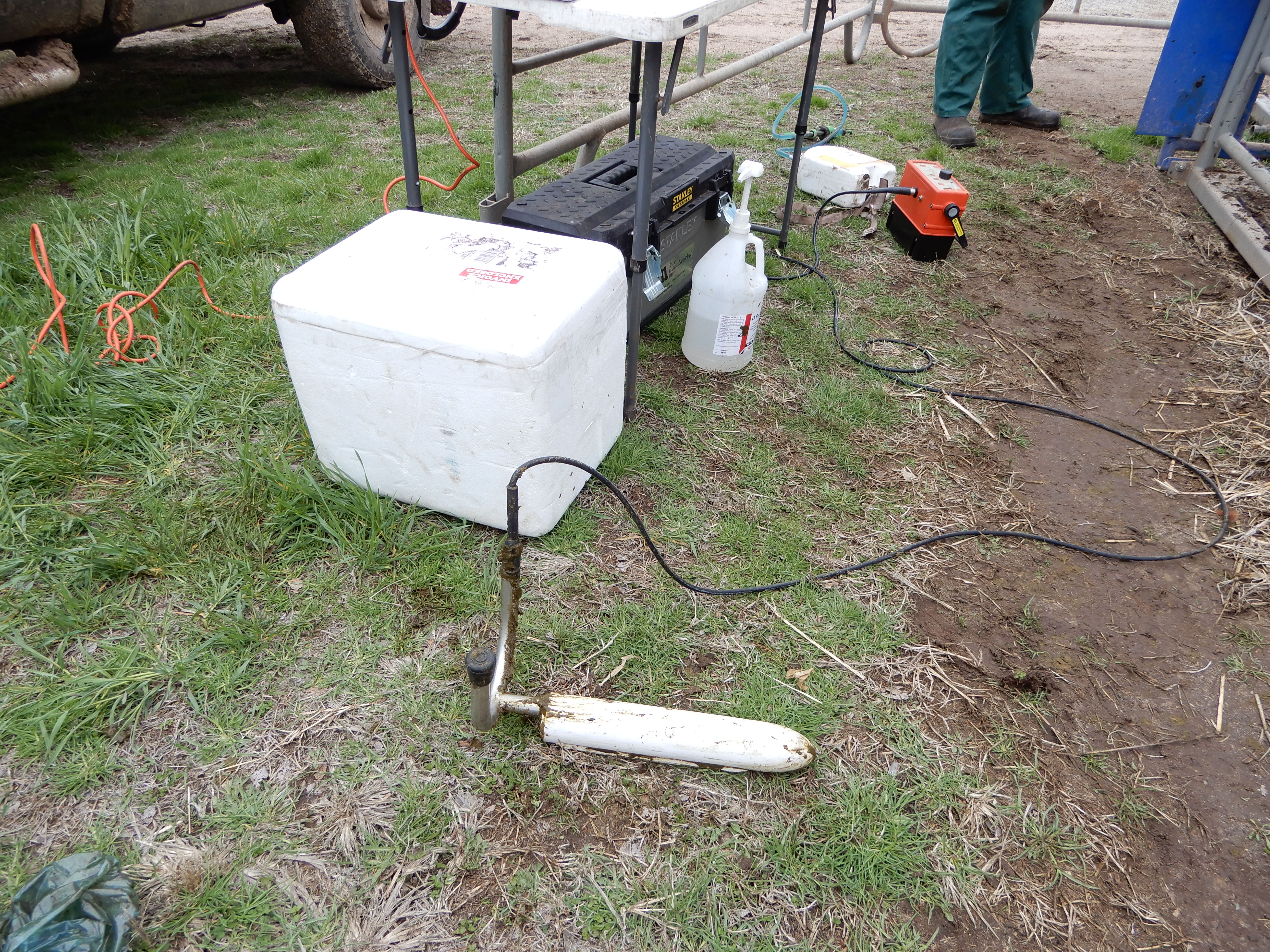
The sample is tested for motility, its "swimming" ability to travel to the cow's egg.


Dr. Bruce then smeared the slide with a dye, which killed the sperm. He could then look at morphology, the shape of the sperm. He was looking for abnormalities in the shape, which could indicate a problem with the ability to breed. 

After the successful tests, Dr. Bruce gave each bull vaccinations to keep them healthy during their summer in the pasture.

It's similar to giving our children vaccinations for their optimal health.

Dr. Bruce also applied a spray-on dewormer.


 All the bulls passed and are ready for action, so to speak. 


After their doctor's appointment, the bulls were hanging out in one of the lots. But after we get done with the heifers this morning,  they'll be heading for greener pastures with their lady friends.
County Line file photo from a different bull's arrival to a pasture, 2013


Thursday, April 8, 2021

Stubborn Streak: Cattle vs. Wind vs. Farmer

Baby calves and mamas with minds of their own weren't the only impediments to working baby calves this spring.

The Kansas wind also kept up its stubborn streak for most of our three days of working calves.

 
At least the baby calves are cute. The wind is just annoying.
 
I loved this one's heart-shaped face!
 
Our first day of working baby calves was the most pleasant from a wind standpoint. It provided enough breeze to keep working conditions comfortable and wasn't so strong that we needed dust blinders.

And it's a good thing: That was the day we drove cattle from the Peace Creek pasture half a mile to the pens and working chute. By "driving," I don't mean that we chauffeured them with a limousine. Instead, we used 4-wheelers to "encourage" them from Point A to Point B.
 
For awhile, my job seemed to be keeping them from traveling too far to the west. The guys were back in the pasture, trying to get a baby calf to come out of the fence. By the time they decided it wasn't going to happen, they couldn't see me anymore and Randy thought maybe I'd accomplished it myself.

I wish.

Instead, I was trying to get them to turn back toward the farmstead. It was a lot easier once reinforcements arrived. (I took a grand total of this one photo during that time. I was too busy running the 4-wheeler accelerator to pull the camera out of my pocket.)
 

I had a little more time for camera "clicking" while the babies were in the chute. If a young bull calf was undergoing the operation to become a steer, I took a brief time out for a few glamour shots.  
 
The calves got glamour shots ... and regular shots. When Jill and Brent were little, I took them at the appointed times to get their vaccines at the pediatrician's office. Our baby calves undergo a similar process each spring. For this appointment, Randy fulfills the role of "physician's assistant." He certainly doesn't have the education of a Doctor of Veterinary Medicine. We do use a veterinarian for many of our cattle herd's health needs, and we ordered the medication from our vet, Dr. Bruce. But this is a task that Randy does, with help from me and a neighbor.
 
The babies go, one at at time, down a lane and into a calf cradle - a miniature squeeze chute. (That part takes some pushing, thanks to our neighbor, who's much younger and much more spry!)
The first order of business is giving each calf a number tag and notch in its left ear. This year, the numbers all start with "1" to indicate the baby was born during the 202"1" calving season. 
 
I didn't get many photos, since I was busy as the "doctor's" assistant, handing him the ear tagger, syringes, etc., in succession.

 
Then the baby calf and his friends got Tic-Tac-sized growth implants in their ears. The hormone stimulates the pituitary gland and helps the calf grow. The $1 implant will bring a $3 return. Randy believes it's a matter of using the technology available to more efficiently grow food for consumers. And, yes, we eat the meat that we produce here on the farm and share it with our children and grandchildren. 
We give each calf two injections. One is an immunization to prevent blackleg. The other prevents viral diseases in cattle. People often question the reasons for giving immunizations to animals that will eventually enter the food chain. But these injections are like giving immunizations to our own children. It helps keep the calves healthy, and healthy cattle provide a good source of protein in the human diet.

The bull calves also become steers during their time in the chute. 

 I might have had a little eyelash envy with this one.

We could tell when a few of them were born, just by looking at their ears. This one began life during one of the coldest parts of our winter, so his ears got frostbitten. It was a little tougher to get the ear tag in those ears, and we had to go through a few extra tag buttons to get the job accomplished.

Once we were done with the baby's "doctor" appointments for our Peace Creek inhabitants, we loaded the babies into a cattle trailer for their short ride back to the pasture.
The mamas did a good job of following the trailer, with only a few minor diversions caused by lush green wheat.
However, Randy let the baby calves out of the trailer a little prematurely and many zoomed out of the gate again.
However, it didn't take long for mamas and babies to be guided back to the right location - with only a slight detour. 

The system changes from pasture to pasture. At some of the locations, we separate the mamas and the babies from each other. We then haul the babies to the working chutes with a cattle trailer.
 
The mamas protest this forced separation. 
 
But, it's not long before they're back together again. 
 
The mamas and babies will be in their appointed lots until we take them to summer pasture in early May. 
 
Check: Another item off the to-do list!


Tuesday, April 6, 2021

Backyard Cardinals


The bird guides don't say anything about cardinals liking cat food.
But they do.
At least the ones in our backyard are big fans.
 
Even though the cats lurk nearby, the cardinals find plenty of opportunities to swoop in for tasty treats.
 
According to Cornell's Bird Lab, Northern Cardinals eat mainly seeds and fruit, supplemented with insects. Common fruits and seeds include dogwood, wild grape, buckwheat, grasses, sedges, mulberry, hackberry, blackberry, sumac, tulip-tree, and corn.
 
See? No cat food listed.
 
We've had four or five pairs who have provided a splash of color to our backyard landscape during the drab and dreary winter days.
 
However, the bird references were accurate about the cardinals' behavior.
 
They like to hop through low branches and forage on or near the ground. Cardinals commonly sing and preen from a high branch of a shrub. 
 
The distinctive crest can be raised and pointed when agitated or lowered and barely visible while resting. You typically see cardinals moving around in pairs during the breeding season, but in fall and winter they can form fairly large flocks of a dozen to several dozen birds. ...They fly somewhat reluctantly on their short, round wings, taking short trips between thickets while foraging. Pairs may stay together throughout winter, but up to 20 percent of pairs split up by the next season. 
From All About Birds, The Cornell Lab


They also like our backyard fence.

During one of my pandemic cleaning binges, I unearthed an old book that belonged to Randy. "Birds: A Child's First Book about Our Most Familiar Birds" was a Christmas gift back in 1959 from his Grandma Ritts. The book was published by Golden Press in 1958. It was written by Jane Werner Watson and beautifully illustrated by Eloise Wilkin.

Even though it claims to have our most familiar birds, it almost disappointed me. But I finally found a small illustration of a cardinal on the title page, along with a robin - another frequent flyer to our yard. 


The copyright page says:
In this first book, a sense of the joy and wonder of birds is created for every child through Eloise Wilkin's sensitive illustrations and Jane Werner Watson's informative text. The songbirds in the trees, the waders of the seashore and river, plovers and pigeons - over 25 birds have been simply described and vividly pictured in a way that every child will enjoy.
 
I'm sure children did enjoy it, though Randy doesn't have a lot of childhood memories of the book. But the vintage illustrations definitely captured my attention. 
 The book has joined some of my bird photography and knicknacks in my spring decor.
Jane Werner was one of the original editors of the Little Golden Books series, which were published by Western Publishing in conjunction with Simon and Schuster. She wrote some 150 books in the Little Golden Books series. According to Penguin Books, many of Werner's titles were illustrated by the great children’s illustrators of the mid-20th century. Some of her bestselling titles include The Fuzzy Duckling (illustrated by Martin and Alice Provensen), Animal Friends (illustrated by Garth Williams), and My Little Golden Book About God, The Christmas Story, and Wonders of Nature (all illustrated by Eloise Wilkin). 
 
Eloise Wilkin also was the illustrator of the bird book. Wikipedia says that many of the books she illustrated became classics of American children's literature. I certainly can agree with that. Jane Werner Watson called her friend Eloise Wilkin "the soul of Little Golden Books." 

Her watercolor and colored pencil illustrations are known for their glowing depiction of babies, toddlers, and their parents in idyllic rural and domestic settings.
Wilkin won a drawing contest for New York schoolchildren at age 11 and graduated from the Rochester Athenaeum and Mechanics Institute. Soon after college graduation, Eloise and friend Joan Esley opened an art studio in Rochester, NY, but struggling to find work, the pair moved to New York City, where Century Company gave Eloise her first book to illustrate, The Shining Hours. Many of her early illustrations were for school books.

In 1944, Wilkin signed an exclusive contract with original Little Golden Books publisher Simon & Schuster, requiring her to illustrate three books each year. She often used her children and grandchildren and their friends as models for her illustrations. A devout Christian, Wilkin frequently illustrated religious picture books including several compilations of prayers for children. I realized that one of our other vintage Little Golden Books, Prayers for Children, was also illustrated by Wilkin.

Want more? Here's a blog post that had some illustration from Prayers for Children.


Thursday, April 1, 2021

You Might Be a Toddler If ...


Isn't that just like a toddler ...
Tongue stuck out ... but sneaky about it. Check.
 

 Someone else has his tongue out? Sure, why not? I'll go for it, too. Check.


Petulant attitude. Check.
 
 
Attitude? I'll give you attitude. Check.
 

Found in peculiar places? Check again.

 
Desire to be King of the Universe? Up on a pedestal? Double check.

 Trying (and spitting out) food? 
 

Check.

Cuteness overload ... Check.


 Check.
 

And check. 
 
Yep, must be a toddler. 
Must be the County Line Class of 2021.