You send the kids to school, and they come home with all sorts of newfangled ideas.
Randy went to Wichita for one of the evening stops on the 2021 Wheat Quality Council's Hard Winter Wheat Tour. Last year's tour was abbreviated and mostly virtual because of Covid-19. But the 2021 tour from May 17-20 was back in session. The 63rd tour hosted 45 participants from 13 states, traveling along six routes from Manhattan to Colby to Wichita and back to Manhattan. On the way, carloads of participants stopped in wheat fields in an effort to project wheat yields for Kansas' wheat harvest.
Each evening, the tour groups would reconvene and share their findings. Randy went to the evening session in Wichita.
At the tour's conclusion, the three-day average yield estimates were calculated to be 58.1 bushels per acre. This surpassed the USDA's estimate of 48 bushels per acre. The official Wheat Quality Council tour projection for total production of wheat this year in Kansas is 365 million bushels, again more than National Ag Statistics' May 1 prediction of 331 million bushels. You can find the Kansas Wheat recap here.

As many good students are wont to do, Randy came home and used the same formula in one of our wheat fields. For this year's tour, they used a later season formula. (Previous tours were completed earlier in May, so they used a different formula for calculating yield.)
First, he measured off one foot, using a yardstick.

Then he counted the number of heads in 1 foot.

Next up was counting the number of spikelets per head. He counted several different heads and averaged them
 |
| From the tour booklet |
|

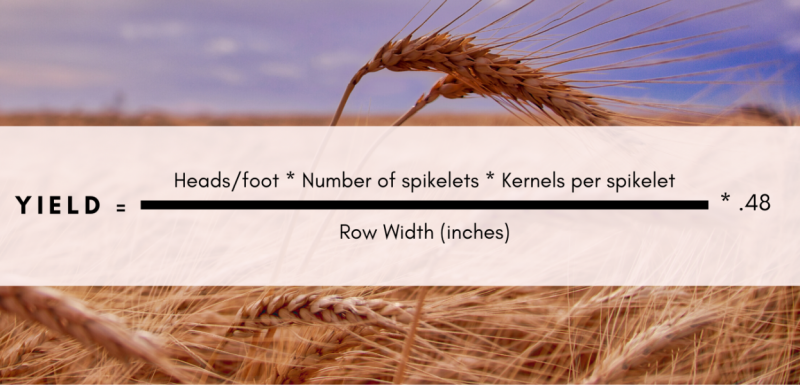
Plug the numbers into a formula and get the estimate for that field.

The estimated yield he derived was astronomical for a wheat yield. If it happens, it will be the largest crop we've ever harvested ... by a long shot. It would be a miracle.
I insisted he got the formula wrong.
He showed me his handy-dandy handout.
Yield Formula, Late Season
1. Enter the field.
2. Count the number of wheat heads per foot.
3. Measure the width between rows. Usually 6 to 10 inches. (Ours are 7 inches).
4. Take a few heads and return to the car. Make observations on uniform stand, crop maturity and expected harvest date.
5. While you travel to your next stop, look at the head.
6. From the bottom of the head to the top, count the number of spikelets (usually 6-12). Spikelets are the V-shaped cover where the grain is produced and held until harvest.
7. Count the number of kernels in each spikelet. Usually 2-3.
8. Enter your findings into the yield formula below.
9. Note: The formula is just a guide. It does not take into consideration high test weight or low test weight.
10. Ask questions.
I'm good at No. 10. I question the results, all right. Actually, so does Randy.
 |
The wheat was pollinating when I took this photo, May 20, 2021. See the little straw-colored flecks on the green wheat heads?
|
We aren't even going to record the pre-harvest yield estimate on the blog for posterity. If it happens, I'll be the first to let you know. I hope I have to eat my words ... but I REALLY doubt it.
 |
May 20, 2021
|
Note: I took the photos with Randy calculating yield on May 20, but I didn't get it written until now.
 |
June 4, 2021
|
The wheat is now starting to turn, even with all the rain we've had. During the Memorial Day weekend, we had 2.15 inches of rain. It delayed our start to the alfalfa swathing, but the moisture and cooler weather provided textbook conditions for filling wheat heads.
You can even see some smaller kernels filling in, which likely wouldn't have happened without the rain.
The wheat is kind of that "yellow green" color you find in the Crayola box.

It's not the vibrant green of earlier spring, and it's not the beautiful gold that will signal the start of harvest. But I'm sure not complaining about the view.
 |
June 6, 2021
|
(As an aside, we got 0.70" of rain yesterday afternoon (June 7). A
neighbor said it looked like there was a black cloud over our house, and
it just poured. Only a couple of miles away, it barely sprinkled. Of
course, we had every field of hay swathed and waiting to dry out to
bale. Such is life on the farm.)