The prairie grasses swayed gently in the breeze of a pleasantly cool November morning. As I gazed out across the landscape now dressed for fall, I thought about the past.

This little bit of Kansas prairie probably looked much the same back in 1900. At that time, Albert Brinkman bought acreage along the Rattlesnake Creek in
Stafford County, Kansas. Brinkman, who was a great-great-great
uncle of Randy's, paid about $4 an acre. Originally in a tract of 1,040
acres, 560 acres remain in the Fritzemeier family.

Today, Randy owns the pasture, along with his cousin, Don Fritzemeier. Two generations ago, Randy's Grandpa Clarence owned the pasture with his brothers, Ed (Don's father) and Harve.
 |
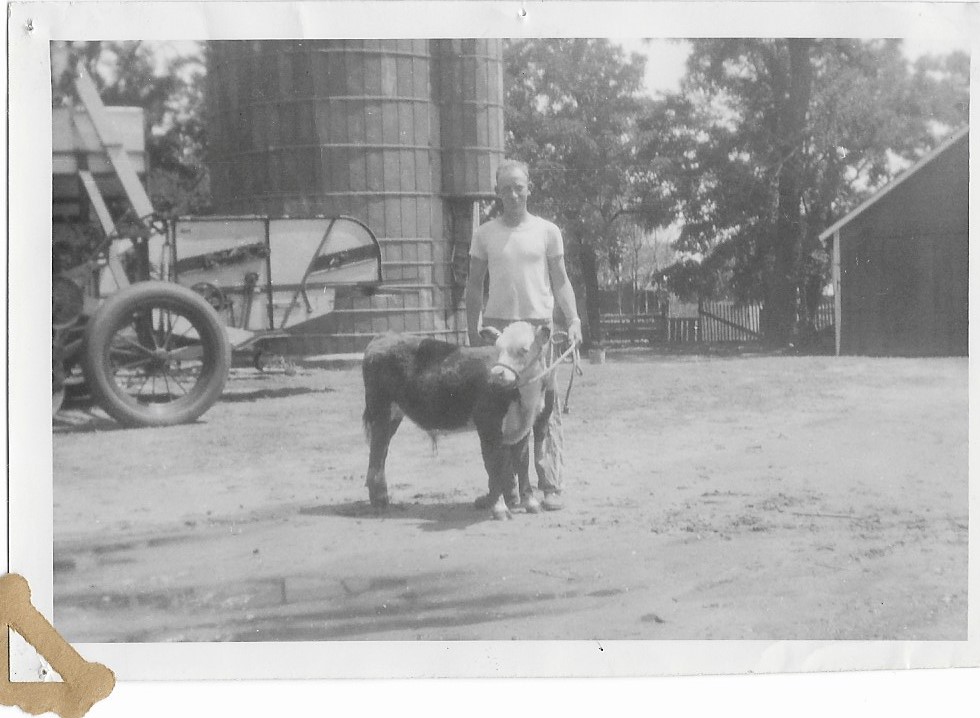
| This is an
undated photo of Randy's Grandpa, Clarence Fritzemeier, with a bull. The
back of the photo has written (in Randy's Grandma Ava's handwriting):
"He looks like he knew he was going to be sold." |
The breeds and the characteristics most coveted by cattleman have changed through those 120+ years, just as the landscape shifts from verdant spring green to faded fall hues to the sparse monotone of winter.

But the land itself has been there - silently playing a part in the family's farming legacy. For 121 years, the family has been the steward of the land they call the Big Pasture. And the land has been good to them. Those native grasses have helped sustain cows and their calves, adding diversity to the family's crop farming operations.

The meandering Rattlesnake Creek has been a source of life blood for the cattle that graze there.
 |
A summer view - August 2020
|
Some years, the weather and the markets shone on the family's
financial coffers.

Other years, conditions were less than ideal. But,
through it all, the legacy has continued.
And it will continue. But our role in that legacy is shifting. On November 8, we completed our final cattle roundup at the Big Pasture. We will continue to own the land. But we are leasing our cow herd as part of our transition from active farming to retirement next year.

In truth, I'm not convinced it will be Randy's last cattle roundup. Since we will own the cows and retain a share of the calf crop, he can probably be persuaded to help with the roundup. But we sold our feeder calves this fall, rather than keeping them and feeding them throughout the winter. It will be nice to have the flexibility to go to family events without having to find someone to care for our herd.
But it may be tough when January and February roll around, and the parade of baby calves is not quite as easily accessible. (For the record, our partner in the cow/calf operation - Tye - has said I can visit and take photos any time.)
As I sat in the pickup, honking the horn to attract the cows and calves to the hay and lead the parade to the corrals, I thought it was fitting that my eyes were focused on the rearview mirror.

As we eye a new "normal," it's still important to look back at the legacy.
Years ago, the extended family would gather in the spring to take the
cattle to pasture and then round them up in the fall. I think this
undated photo would have been taken in the 1950s.
 |
| L to R:
Clarence Fritzemeier (Randy's Grandpa) Milton Giedinghagen, Ben
Fritzemeyer, Melvin Fritzemeier (my father-in-law) & Harve
Fritzemeier. Yes there are two different spellings on Fritzemeier - it's
not a typo! | |
While the guys were rounding up and sorting the cattle, the women got together to make a big meal.
 |
| My mother-in-law Marie, Jean Newell Fritzemeyer & Marjorie Giedinghagen on a cattle working day back in the 1950s. |
I
helped with the round-up there for the first time in 2019, though I'd been helping at other locations for years and years. To our
knowledge, I was the first woman to help with the actual cattle work at the Big Pasture. (If I want to get
technical, the woman still gets the job of making the meal. It's just sandwiches instead of a full-course hot meal.)
 |
| Undated photo - Clarence and Melvin |
Back when Randy
and Don were young, the brothers and families hauled all the cattle back
home in small trailers. As they drove through Stafford, Randy remembers
his dad telling him to "duck down." School was in session, and Randy
was absent for the day. (Knowing Melvin, it was probably more joking
around. It wasn't unusual for kids to be excused for a day of work back
then.)
Don recalled a cattle moving day when Clarence took more than one unintended dip in the Rattlesnake. They also remembered a run-in Melvin had with a cow who was reluctant to leave the wide open spaces of the Big Pasture. She appeared to be trying out for the Olympics with a vault over Melvin's 4-wheeler. Luckily, both man and beast were unhurt.
Who knows? Maybe this Hereford pictured with Melvin was on the Big Pasture at some point.
At that time, the Fritzemeiers raised horned
Herefords.
Randy and I also had Hereford bulls as well as Angus bulls for our
crossbred herd. But we opted for polled Herefords.
My horn honking finally paid off with some of the herd heading toward the corrals.

It took more than one excursion for the guys on the 4-wheelers to find all the cows and calves scattered through the acreage.
Once they were gathered, it was time to set up panels, the loading lane
and loading chute so we could get the cattle from the pens to Don's
semi. Don built the lane and chute one winter.
The guys have done the set-up so often that it's kind of like watching a choreographed dance.
Just like their ancestors before them, they used plenty of wire to keep everything together. (It's a farmer thing!)

Then it was time for sorting. Our cattle and Don's were intermingled, so we sorted out our cows for the first semi load. The two cousins (along with a couple of other helpers) sorted while I
ran the gate. The guys have been doing this a long time, and they seem
to know instinctively what the other is going to do.


That done, we separated our calves for the next semi load.


This year, Don opted to load his cows and calves together, so that sped the process.
By now, the guys are used to my insistence on photos.
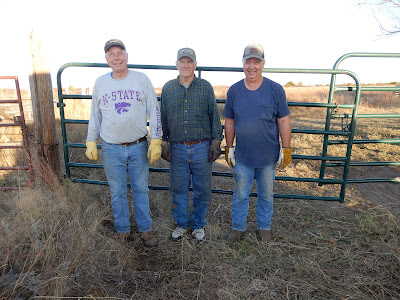
Our friend, Mike, has been helping at the Big Pasture long enough that he's learned the "choreography" as well. I had to convince him to be in the photo. But then he insisted it was my turn, too.
It's tempting to look in the rearview mirror and remember only the good parts. But, just like anything, we've had our share of "mud" - the challenges and obstacles inherent in any business operation. It's just that our obstacles were sometimes literally mud ... and other organic matter.

But those challenging times are just part of life and business.
Since our children have chosen other careers, we will partner with a young farmer who has come back home to work with his family. As I wrote earlier this summer, Randy's Uncle Glenn gave him the opportunity 50 years ago as a sophomore in high school to get started with farming. Randy is thankful for the opportunity to "pay it forward," hopefully helping another young farmer - Tye Miller - make this farming and ranching thing work.
The sun was going down as we returned to the farmstead after a long day at the Big Pasture. We unhooked the trailer and headed for home.
As we drove away, I asked Randy to stop for a sunset shot.
And I was thankful for this legacy and this life.

.jpg)

.JPG)
.jpg)

.JPG)


.JPG)
.JPG)


.JPG)
.JPG)
.jpg)
.JPG)