Showing posts with label Iowa. Show all posts

Tuesday, August 22, 2023

All I Owe I-O-Way

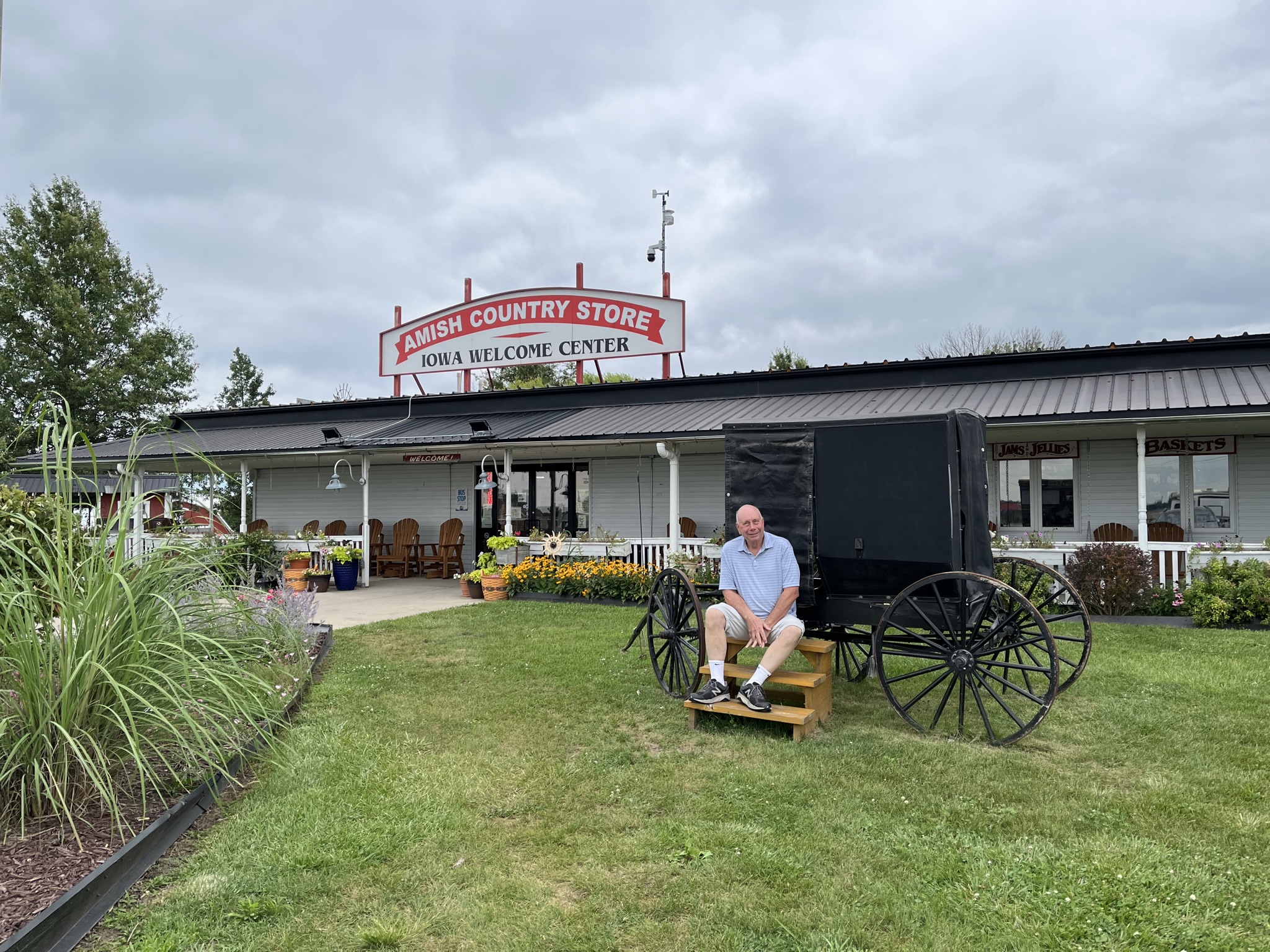
We had to laugh at our first stop in Iowa. I made Randy take a photo by a buggy in front of the Amish Country Store at Lamoni, Iowa.  I told him I could have gotten a similar photo and only driven about 40 miles east from our home to Yoder, Kansas. 

But, it was still a good place to stretch our legs and wander through a country-style store before getting back in the car and heading on to Des Moines. 

Iowa was our first stop as we journeyed toward Chicago to attend the wedding of our brother-in-law Andrew's oldest daughter, Julia. My other siblings flew, but we took the more scenic route. Best laid plans often get derailed. The trip to Des Moines was uneventful (thankfully), but Randy was supposed to golf the next morning before we moved onto our next overnight stop. But it was raining, so we pivoted. A Facebook friend had recently posted photos from the Amana Colonies in Iowa. I saw that was fairly close to the route we had planned to take anyway. So we went to the Amana Colonies for the day instead.

After seeing the Amish buggy at our first Iowa stop, I assumed the Amana Colonies would be similar to the Old Order Amish that reside in Yoder, just 45 minutes from our house. I was wrong. Yes, there were quaint shops featuring handmade items and the place was full of history. But the Amana Colonies were settled by the Community of True Inspiration. I had never heard of this religion. It is a group of Christians descending from settlers of German, Swiss, and Austrian descent who originally settled in New York state. When that area got too congested for their liking, they migrated west to Amana, Iowa, where they settled in seven small towns in East Central Iowa along the Iowa River.

They lived a communal life for nearly 80 years. The Amana residents achieved this independence and lifestyle by adhering to the specialized crafting and farming occupations that they had brought with them from Europe. Craftsmen passed their skills and techniques on from one generation to the next. They used hand, horse, wind, and water power, and made their own furniture, clothes and other goods. The community voted to form a for-profit organization during the Great Depression - the Amana Society - which included the Amana Corp. (Yes, the Amana Corporation that made home appliances.)

Today, the Seven Villages of Amana are a tourist attraction known for their restaurants and craft shops. The colony was listed as a National Historic Landmark in 1965. There are still about 300 people who attend the True Inspirationists church services. The Society still owns the farm ground and some of the church members are tenant farmers on the Inspirationist-owned land. Unlike the Amish, they embrace new technologies, including GPS in farm implements and modern conveniences in everyday life. However, like the Amish, during their church services, men still sit on one side of the church, and women sit on the other.

The Amana Colonies don't shy away from beer or other spirits. We ate lunch at the Ox Yoke Inn, and Randy sampled a flight of beer. Good German that he is, he also had the Jager (pork) Schnitzel with spƤtzle, homemade mashed potatoes and gravy, a yeast roll and homemade strawberry jam. (I didn't get a photo of that.) I had the Reuben sandwich. I guess it was a local favorite, too, since the Amana Colonies sauerkraut was one of their commodities.

We toured the Communal Kitchen and Cooper Shop, which the Amana residents left much as it was back when it was used three times a day.


The General Store is also set up much like an old country store at the turn of the century.

The landscaping around these buildings was gorgeously manicured.

The shops and restaurants were housed in the old - but beautifully maintained - buildings.

Though not on the "official" tour list, we also walked through a cemetery. One of the guides had told us that Amana citizens aren't buried in family plots. Instead, they are buried by date of death. 

Just a small portion of an old wooden fence remained.

The pine trees in the cemeteries were beautiful.

We went to each of the seven Amana villages just to see them before we drove onto Davenport, Iowa, for the night. The next morning, we went to LeClaire, Iowa. Our first stop was Antique Archaeology, home of American Pickers.

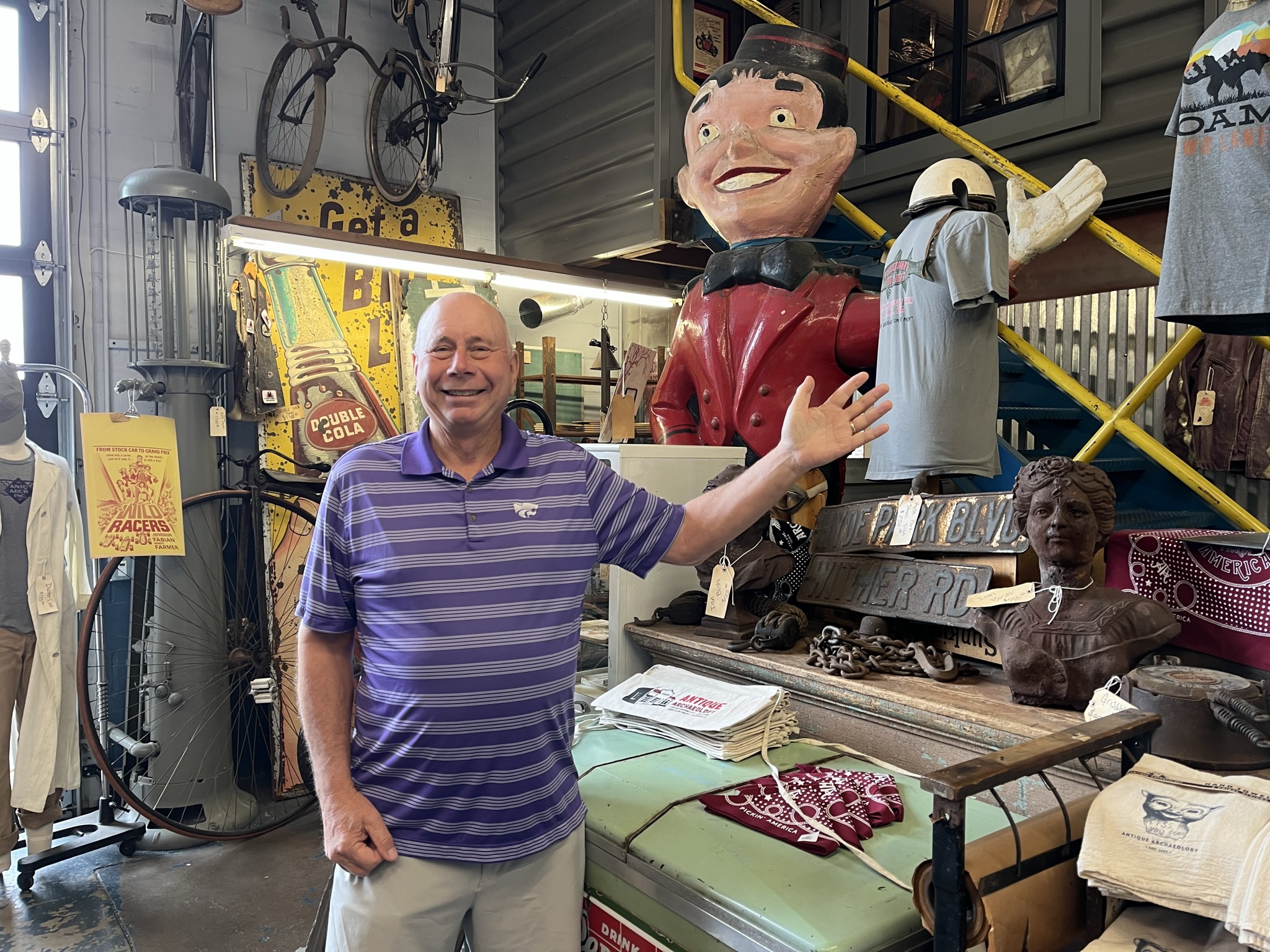
We like watching the TV show on the History Channel. We didn't see any of the television stars, but we still enjoyed the stop.


We remembered this giant papier mache head from one of the episodes.
After we spent a little money at the store, we asked where we could get down to the Mississippi River. Randy has always been fascinated by rivers - even if we live nowhere near one. When we drive over big bridges, I'm always afraid he's going to turn the steering wheel the same direction as his gaze as he peers over the railings in an effort to see any barge or boat traffic on the big waterways.

So he was thrilled he got to see this barge being pushed down the river. 

 We also toured the Buffalo Bill Museum right along the waterfront. 


William Buffalo Bill Cody was born in LeClaire.

Besides information about Buffalo Bill, the museum included the steamer, the Lone Star.

The Lone Star is a National Historic Landmark. It operated from 1890 to 1967 and is one of the longest running wooden steamboats in the U.S. It is the last remaining example of steamboats built in the Western Rivers style of construction. This consists of a shallow wooden hull supported by a hogging truss system. This style was necessary for the shallow waters of the Mississippi River system.


After another look at the river and lunch at Big Dave & Holly's, we took off toward Chicago. More from our trip to come.

By the way, the title of the blog is a song from the musical, State Fair, about all Iowa has to offer. We missed the state fair by a week or so this time, but it may be in our travel plans in the future. We know some experienced guides (our friends - and Eric's parents, Alan and Christy).

Thursday, September 16, 2021

Bridges of Madison County


We weren't starring in a big-screen romance. But we did have our own moment on The Bridges of Madison County.

A couple of weeks ago, Randy and I traveled to Iowa for a National Master Farm Homemaker convention. We enjoyed a visit with Jill's in-laws - Alan & Christy Ladd - in Atlantic, Iowa. It was more than bed and breakfast since we got supper, breakfast and lunch ... plus an after-supper tour and lots of good conversation.

Randy is used to my frequent requests for photo stops. Alan was willing, too, but I found it hard to translate the rolling 3-D hills to my 2-D camera screen.


 Iowa farm ground is so different from the flatlands of Kansas where we farm.


It was beautiful in a whole different way.

The next day, we went to church at the Atlantic United Methodist Church. 

It was nice to sit in the pews and not be responsible for the music or anything else.
Ceiling glass at Atlantic UMC
But back to the bridges ...

As we were driving from Atlantic toward Des Moines on Highway 92, I saw the Madison County sign. And I didn't want to come all the way to Iowa, drive into Madison County and not see the famous bridges.

Randy reminded me of our less-than-successful search for covered bridges near Morehead, Ky., when Brent worked there. But when we drove by the sign for the Roseman Covered Bridge, I again pled my case, and Randy turned around. 

There was no mileage sign to our destination. And after we drove down a twisted gravel road, we were beginning to have deju vu from our Kentucky search. But after 4.3 miles, we arrived at the Roseman Covered Bridge. 

As it so happened, two other travelers were there at the same time, so we swapped cameras and took photos of each other. Bonus!

Built in 1883 by Harvey P. Jones and George K. Foster, the Roseman Bridge is 107 feet in length and sits in its original location. It was renovated in 1992 at a cost of $152,515. In Robert James Waller’s novel, The Bridges of Madison County, and the movie of the same name, Roseman is the bridge Robert Kincaid seeks when he stops at Francesca Johnson’s home for directions. It is also where Francesca leaves her note inviting him to dinner. 

There's also a connection to Eric's family at the Roseman bridge. Christy said her maternal grandpa, Roy Hatfield, and his family grew up south of the bridge. His initials and his brothers' are carved in the bridge. The last time they visited, they could still find the initials. (I didn't look.)


Christy says her Great Uncle Frank was interviewed when the Roseman Bridge came to fame after the release of The Bridges of Madison County movie.

I saw the movie and read the book, but I could probably stand to do both again after our visit. 

Also known as the “haunted” bridge, Roseman is where two sheriff’s posses trapped a county jail escapee in 1892. It is said the man rose up straight through the roof of the bridge, uttering a wild cry, and disappeared. He was never found, and it was decided that anyone capable of such a feat must be innocent.

Though only six covered bridges remain, there were many covered bridges that once dotted Madison County in the early 19th century - all built by local bridge builders, with each builder utilizing his own engineering design that uniquely separated the various construction styles of Madison County's six covered bridges still standing today.  


Many still ask the question, "Why did they cover the bridges?" They were covered to protect them from the weather and extend their longevity. In 1870, the Board of Supervisors adopted new rules for bridge construction that includes the required that they be covered, siting that "the expense of the roof is more than made up by the permanency of the bridge." The bridges ranged in cost from $900 to $1,900. One historian quipped, "Bridges were covered for the same reasons women wore hoop skirts and crinolines - to protect the beauty seldom seen, but nonetheless appreciated." These remaining covered bridges paint a story of pioneer people who took what they had and did the most with it. These structures ... are a tribute to the generation of pioneers who left a land better than they found it and leaves to us a link with a romantic past.
From the plaque at the Roseman bridge

The bridge spans the Middle River, which eventually empties into the Des Moines River near Carlisle in northern Warren County.

We only had time for one more bridge before we needed to leave for me to get to my meeting. It was located in the Winterset, Iowa, city park, and honestly, we had more trouble finding that bridge than the one 4.3 miles down a dirt road! My Google maps kept leading us astray. Randy had to do it the old-fashioned way and stop for directions.
Built in 1870 by Eli Cox, the Cutler-Donahoe bridge is 79 feet in length and features a pitched roof. Originally located over the North River near Bevington, it was moved to its present site in Winterset’s City Park in 1970.
I got a photo of Randy at that bridge ... and then I couldn't resist a photo of him by the Bridges of Madison County display at the State Historical Museum of Iowa in Des Moines, one of our tour locations during the convention.

Meryl Streep and Clint Eastwood weren't the only movie stars with an Iowa connection.

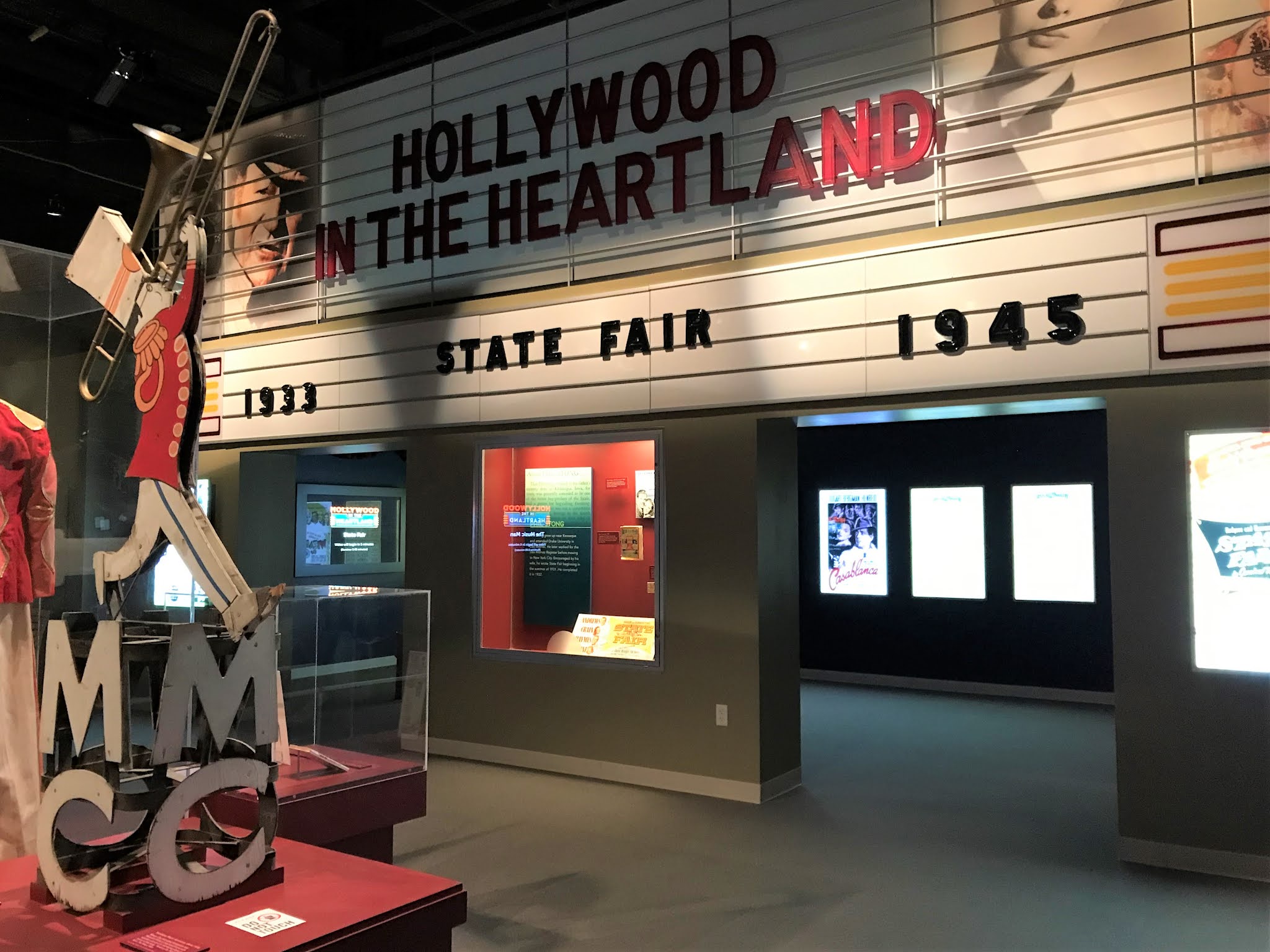
One of my favorite museum areas was Hollywood in the Heartland.

There, I couldn't resist a photo in front of a scene from one of my favorite musicals, "The Music Man." I had to text that one to my brother, who had the starring role in high school.


Since we'd just seen the pro baseball game played at the Field of Dreams on TV, we were also interested in that display.

Photo by Millie Dearden (her photo turned out better!)

We did have meetings in Iowa, too. Here's a photo of the Kansas ladies who attended.