Showing posts with label Stafford. Show all posts

Tuesday, January 17, 2023

Loving Our Library


Our hometown library is undergoing a renaissance. 

In October 2021, the Preserving Nora's Legacy fundraiser began. The goal was to raise money for restoration projects at the Nora E. Larabee Memorial Library. A dedicated group of volunteers dreamed big. They called their neighbors. They called their classmates. They sent letters. They talked about their dreams at civic clubs and in the local grocery store aisles. They wrote grants. They talked some more. 

And the community responded, raising more money than even those big-dreaming volunteers thought possible in a little town during uncertain times. A Wall of Giving - Preserving Nora's Legacy - was recently installed at the library. (Thanks to local artisan Robert Owens for his beautiful work.) It includes the names of those who donated at least $100 to the project. 

This photo is by "courthouselover" on Flickr. Currently, they are working on the front door replica and the yard was torn up as crews worked on the foundation, so I didn't take my own photo.
And I took this photo in 2014. (We could sure use the moisture from that snow!)

The Preserving Nora's Legacy Facebook page appropriately uses a children's book analogy to symbolize the volunteer's efforts: "I think I can, I think I can..." It's a book we all read as children, whether it was in the basement children's room at the Larabee Library or from a library in another town or sitting on our mother's lap. And, we, like that Little Engine That Could, dreamed about doing big things.

I can't help but think of the people who originally gifted the library to the city. They were certainly big dreamers as well. The Larabees left quite a footprint in Stafford - in banking, flour milling and civic leadership.

Nora Larabee was the only daughter of two of Stafford's leading citizens, Mr. and Mrs. J.D. Larabee. When Nora died of tuberculosis in 1904, her parents wanted to build a tribute to her. In 1906, they erected a red brick building at a cost of $5,000. Nora Larabee's portrait in stained glass dominates one of the library's west windows.


The building was designed by Charles E. Shepard, a leading architect in Kansas during the first part of the 20th century. At that time, most libraries weren't designed by architects. But he envisioned the dark red brick building in a Corinthian style. The Larabees and Shepard also cooperated on a bank building in Stafford at Main and Broadway. (It is currently one of the buildings used by the Stafford County Historical Society.)


 The library hasn't been without controversy:

      The library is unique as a focal point in a 1907 feud between the town banker and The Stafford Courier editor. The building became a public library only after a controversy which turned the town upside down. Public sentiment about the library was so strong that the entire Stafford City council and mayor resigned before the deed for the building was finally accepted. The condition of the deed that caused the furor read as follows: "Owing to certain unwarranted attacks made by The Stafford Courier…it is made a condition of this deed that the present editor of said newspaper, nor any of his family shall at any time be a member of the said board of directors."
        Finally, in May of 1907, a petition from Stafford citizens requested the library council to either accept the conditions of the deed to the library or resign. The new city council voted to accept the building from the Larabee family along with the stipulation that the editor of The Stafford Courier and his descendants be barred from membership on the library board in perpetuity.
Information from http://skyways.lib.ks.us/towns/Stafford/libhist.html

Besides the individual donors, the library received monies from the Heritage Trust Fund grant program from Kansas State Historical Society.

The renovation projects include:

  • Trenches were dug and pipes were laid to carry water from the downspouts away from the building to the curb. The trenches are now back-filled, the sidewalk replaced, the lawn graded and leveled and grass sown.
  • The interior basement walls got a functional facelift; the bricks and stone were re-pointed with the historically-correct mortar "recipe."
  • The exterior will be spot-repointed and masonry reconstruction will restore a portion of the north wall.
  • The historic door was irreparable, but a master craftsman is working on a new replica that will incorporate the original beveled glass.
  • The electrical system has been updated.
More projects listed on the architect’s report of 2017 are now under consideration by the board and committees. Topics under discussion are:
  • Updating entries, steps and one bathroom to meet ADA-compliance recommendations.
  • Making the envelope of the building safe and secure, specifically windows. 
  • Front step renovation.
  • 4 windows (double-hung and beveled glass surround), stained glass windows around Nora's portrait window, trim repair/painting, replacement of overhead light fixtures in two original rooms, and baseboards.
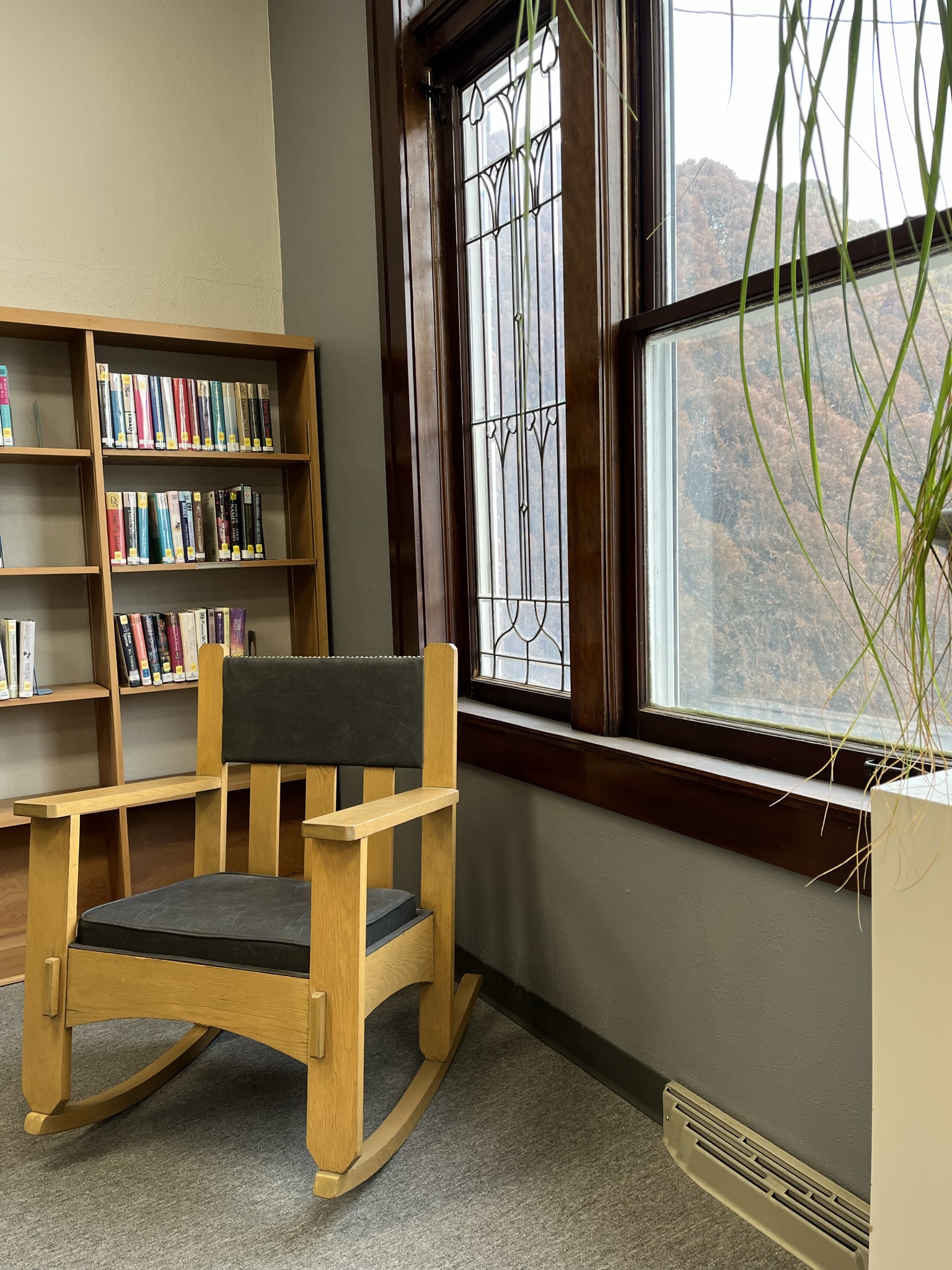
The stained glass window isn't the only unique feature of the library. Many of the other windows feature leaded glass. (Even though it doesn't show the woodwork, I like the angled view below because I could avoid the storm siren and the power lines you see when you look out the window directly.)
The windows are encased in beautiful original woodwork.
This photo also shows one of the pieces of 100-year-old Mission-style furniture in the library. It's a photo I took in 2014. 


Photo taken January 2023

The library remains today, more than 100 years after it was constructed as a memorial to honor a beloved daughter. 

It's not just the building that's undergoing a renaissance. During the past couple of years, the library has added a First Friday event to its programming in the spring, summer and fall. They've featured artists, musicians, photographers, magicians, a car show, readers, crafts and much more. 

The library also offers classes and other special events, along with summer reading for children and adult reading programs all through the year. In fact, I picked up my next contest sheet when we were at the library the other day.

(NOTE: I took some of the photos of the library in 2014, when there was snow on the ground.)

Thursday, December 13, 2018

Shop Local - Stay Local

Shop Local - Stay Local. It's more than the latest internet buzzwords. It could mean the difference between survival or death for local businesses.
Let's face it: It's usually not too difficult to find a parking spot on Main Street in small-town Kansas, including Stafford.
Stafford's Main Street looks different than it did in this photo from 1955 (found in Stafford's Centennial book, Crossroads of Time: 1885-1985).

By contrast, back in the early- to mid-20th century, Main Streets provided the hub of social and business activity on Saturday nights as farm families loaded up the car and came to town.

During the past three months, the City of Stafford and the Stafford Chamber of Commerce asked people to Shop Local - Stay Local. People could keep receipts and a tally of monies spent at local businesses. Then, there was a drawing for prizes - for everything from gift certificates at local businesses to a credit for electricity to a summer pass for the new swimming pool. (I won one of those passes. I am going to see if I can gift it to a Stafford youngster who might enjoy using it!)

On the little leaflet in which we collected our local receipts, it said this:
If 100 families within Stafford spent an additional $75 locally per month, that would inject more than $90,000 annually into the local economy. Shop Local - Stay Local
We are doing our part - especially at the grocery store, farmers' co-op, lumber yard and auto parts store.

The world is different today. We're more prone to "like" something one of our "friends" said on Facebook than to make plans to meet them for a treat at the soda fountain or share a tub of popcorn at a Saturday movie. For many, the big box store in the town 30 or 40 miles away is the place to stock up on paper goods or groceries. A click of a button on a website means that a store will deliver your every want and need to your own front door.

We say we want to shop local. But do we choose to do it enough?
Before Black Friday and Small Business Saturday, I saw an editorial in The Salina Journal. Here's part of that column:
We'll be spending money. A lot of money. According to the National Retail Federation, we’ll shell out $717.45 billion to $720.89 billion total this holiday season. According to the federation, each shopper will spend about $1,007.24 apiece.Make sure, though, when you plan out that spending, that you think about what companies benefit. Will you be funneling your dollars to Amazon or a big box retailer? Or will you be supporting local businesses?

That decision makes a difference. ... It makes a difference to the city and state economy, which benefit directly from you keeping your dollars in the community. It makes a difference to businesses, many of which work mightily to survive in a shifting retail marketplace. 

Think about it this way: Big online retails extract capital from cities. With few exceptions, we don't see that money again. Local retailers put that money straight back into the local economy.
Brent's first job out of grad school was at Morehead State University in Kentucky. Morehead had a vibrant "shop local" initiative. At one of their local eateries, tucked alongside the menu, there was a page thanking people for shopping there. It detailed 10 ways that the decision to patronize at a locally-owned business made a difference. Here are just a few:
1. You kept dollars in our economy. For every $100 you spend at one of our local businesses, $68 will stay in the community. What happens when you spend that same $100 at a national chain? Only $43 stays in the community.

2. You embraced what makes us unique. You wouldn't want your house to look like everyone else's in the U.S. So why would you want your community to look that way?

5. You nurtured community. We know you, and you know us. Studies have shown that local businesses donate to community causes at more than twice the rate of chains.

10. You made us a destination. The more interesting and unique we are as a community, the more we will attract new neighbors, visitors and guests. This benefits everyone. 
Does it really make any difference whether I spend the bulk of my grocery dollars at Wal-Mart or at my local Paul's Grocery?
 
Does it matter if I buy paper goods at Paul's or at Stafford's Simply Overstock store instead of stocking up in Hutchinson? Randy and I think it does. Even something as mundane as toilet paper can make a huge impact on the success or failure of our small-town businesses. (Click on the link for more details.)

Instead of being like Chicken Little and yelling, "The sky is falling, the sky is falling," we need to be part of the solution. I believe the possibilities could be as vast as the big, blue Kansas sky if businesses worked together and small-town citizens made a commitment to buy locally first.
Admittedly, smaller storefronts don't always have every single item you need. I'm not saying that you can never shop in a Wal-Mart or Target again. I shop in those stores, too, and I keep a running Hutchinson shopping list for ingredients and other items I can't buy locally. I just think it's time to look at our small towns for all the pluses instead of concentrating on the negatives.
Admittedly, Main Street Stafford isn't as bustling as it was in the early 1900s or during the oil boom of the 1940s. But there are businesses that have been here for the long haul and some new ones that complement them. (I started to list local businesses and then decided that was a formula for leaving people out. Our little town has restaurants, a bank, a flower and gift shop, farmers cooperative and many other businesses that contribute to a good quality of life for its citizens and neighbors.) We are fortunate to still have Stafford District Hospital and a rest home meeting health care needs in our hometown.
 
We have the Ritz Theatre showing first-run movies each weekend. Several years ago, the city upgraded the sound system to digital.

Our Stafford USD 349 continues to offer quality education to our community's youth, including adding innovative programs like the Stafford Entrepreneurship and Economic Development (SEED) Center. Students start their own business and become business owners through this program.

Our high school added a Culinary Arts and Management program several years ago, cooperating with local restaurants, Stafford County Flour Mills at Hudson and others in the private sector. Vo-ag students have built a greenhouse on school property and they're even trying to impact world hunger. Technical career education is a focus for our school district. It just goes to show that you don't have to be a big, metropolitan school to offer innovative, hands-on programs.
Sunset, July 15, 2016
Shop Local - Stay Local:  It's a message that should resonate during this holiday season ... and every other day of the year. It has to ... if we want to keep our rural communities from becoming ghost towns.

Monday, November 14, 2016

Is the Sun Setting on the Stafford Depot?

Sunset, July 15, 2016
Is the sun setting on the Stafford Depot?

An email campaign to  BNSF Railroad is underway to save the depot. In recent weeks, the windows were removed from the building, and the rumor mill was swirling that the depot would be torn down. Stafford native and historian F. Clare Moore started investigating. This wasn't Clare's first foray into trying to save the depot. Ten years ago, he also led efforts to keep the depot from the wrecking ball. This time, he says, the railroad personnel were helpful in trying to connect him with the right person.

On Thursday, Clare posted this to his Facebook page:
SAVE THE STAFFORD DEPOT! OK, here's your chance to make a difference. A huge email campaign would impact the saving of the depot. Send an email to Andy Williams, Kansas Public Affairs director for BNSF Railroad, and indicate your support for saving the Stafford ATSF Depot in Stafford, Kansas. Tell him you support for saving the depot and anything else that you want to say. It is vital that you bombard him with emails. It WILL make a difference if anything will. He needs to know of community support. His email address is andy.williams@bnsf.com Please share this and get to as many people as possible whether they have a Stafford connection or not.
Clare proposes pursuing a Transportation Enhancement grant. If a grant were awarded, 80 percent of the money for restoration would come from the U.S. Department of Transportation and the remaining 20 percent would need to be raised from the community and supporters, Clare says.
The depot has been a landmark in Stafford for more than 100 years. An article on the front page of the August 25, 1910, Stafford Courier announced the news that a new $14,000 Santa Fe train station would be built at Stafford.
It is with the keenest sort of pleasure that The Courier is able to announce definitely that the new depot is soon to be a reality. For about five years, this new structure has been one of the things that Stafford has desired and needed above all else.

E.C. Smith, agent of the Santa Fe here, received word from Topeka Tuesday that the construction of the new Santa Fe depot in Stafford would start in about three weeks. ... Just about five years ago, the people of this city took up the matter with the Santa Fe Company. Letters were written to the officials about all of the business men of the city and as a result of this bombardment of literary missiles, Superintendent Ayers and some other of the big men of the company came here to talk it over with our citizens.  ..."
From the August 25, 1910 Stafford Courier

I suppose it's ironic that "literary missiles" will again be part of the Stafford Depot story. This time, they are being sent through cyberspace. The people of 1910 would find the technology hard to fathom, I suppose. And they likely wouldn't believe that the depot - which was so vital to their commerce a century ago - hasn't been used for decades.
Stafford has for years enjoyed the reputation of being one of the best paying shipping points on this great system. The tonnage in and out of Stafford has far exceeded that of many towns of much greater size. Stafford has had the reputation with the company of being a genuine 18-karat live-wire town, and the new depot we are soon to have will prove an added stimulus in keeping it so. We have worked hard and we have waited long for this thing, and we appreciate it the more for our working and waiting.
August 25, 1910, Stafford Courier
I found an article about standardized railroad stations in Kansas at the Kansas State Historical Society website. On page 13 of the 14-page article, there was a photo of Stafford's depot. (I couldn't find the date of publication.)

In the article, it said that the Stafford depot was patterned after one built in Girard, Kansas. (See page 4 of the document.)

As far as I remember, the depot hasn't been in use for the 35+ years I've been part of the community. But it has been the subject of more than one photo during that time - from me and from other photographers. I took the most recent ones in July during the Stafford County Fair. The sky was so beautiful that I walked across the road from the 4-H beef show to snap a few photos. I had others at sunset, but I also found this 2010 shot when the scene included scattered snowflakes.
While the depot hasn't been used for years, it is a landmark part of Stafford's history.
Stafford was a major grain depot for the county with two grain elevators, one at the north and the other at the south end of town. In 1887, two railroads came to Stafford:  the Chicago, Kansas and Western, which 10 years later became the Atchison, Topeka and Santa Fe, and the Denver, Memphis and Atlantic, which became the Missouri Pacific. Their depots were located at either end of Union Street, the Santa Fe at the north end and the Missouri Pacific depot at the south end ... The Missouri Pacific depot was demolished in 1984 and its brick was used for planters lining Main Street.

Wednesday, December 23, 2015

Christmas in a Small Town

Stafford Christmas 2015 - Intersection of Main and Broadway, the "main drag"
With its millions of lights and perfectly-crafted displays, a trip to Botanica is like entering a fairy wonderland of Christmas finery. All the parts and pieces fit together like a symphony orchestra building up to a crescendo. I loved it (as evidenced by the photos I shared earlier this week).

But there is beauty in simplicity, too. Too often, I get distracted by the hubbub and the "noise." The thing that is "squeaking" the loudest captures my attention first. That to-do list with items still not crossed off seems to scream the loudest right now.
Stafford may not have thousands of visitors clamoring to see synchronized light displays. But there is beauty nonetheless. And isn't that the meaning of Christmas? Christ didn't come to Earth in amazing 3D technicolor.

Mary was a young, unwed mother. She had her first baby - not in a well-appointed delivery room - but in a stable with animals all around. She laid Him in a manger filled with straw, not a crib with sheets that matched a nursery theme. It wasn't all that pretty.
How can we, in the midst of our culture's conspicuous consumption and demand for perfection, turn our focus on the Child who was born into poverty as a sign of hope and salvation for a broken world? While it may seem the world demands perfection, the Gospel message demands nothing from us. Rather, God invites us to gather around the manger just as we are: unfinished lists, burnt pies and all. No matter our imperfections, great or small, God invites us to peek into the manger and gaze at the real Christmas message: That Christ came for us all to be a beacon of hope for the hopeless and to bring peace.
Rev. Amy Slater, 
Stafford UMC newsletter, Christmas 2012

When I went to choir practice last week, the Christmas tree in the church foyer was like a beacon in the darkness.
 Through the multi-paned door, I also caught a glimpse of the cross hanging at the front of the church.
Inside, in the dark foyer, it looked perfectly appointed. But I remembered the little hands that hung the ornaments only a few weeks ago at our annual Hanging of the Greens. Without a little creative rearranging by adults, there might have been a "blizzard" of snowflakes on the lower branches of the tree. They guided the helping hands to other parts of the tree. The cooperation and guidance lit a dark night.

O God, prompt me to shine a light on Christ’s coming through my words and actions.
So maybe not every single treat will get made. Perhaps the dusting won't stand the "white glove test." And it will still be OK. It will be better than OK ... 
... especially if I sit in the living room with my glasses off. It's the only time that being really nearsighted is a benefit.

Maybe I should be nearsighted in another way, too. Rather than looking at the big picture, I should remember the central message.
A treasured nativity from friends
"Noel!" Christ is born!
These two photos taken at Stafford United Methodist Church

 Let the list go and enjoy the time with your family! (Now, if only I can take my own advice!)

Tuesday, April 8, 2014

A Blend Between A School and Community


Stafford Schools USD 349 may be small. But leaders sure don't "loaf" around when it comes to big ideas. Stafford Schools has converted its Family and Consumer Science classroom to a commercial kitchen. It's giving students a career pathway for their future. In addition, it has sparked cooperation among hometown businesses and the school to make new opportunities for all involved.

 "The Commercial Kitchen is a project that was built out of a desire to have culinary arts curriculum available at SHS," said Mary Jo Taylor, superintendent at Stafford. "This hope became a reality when a grant from the state became available called a Rigorous Program of Study (RPOS grant).  The effort to earn the grant was successful.  For the past two years, the Board of Education and staff have worked at planning curriculum and kitchen space.  Teachers have had to be trained for this unique method of teaching and learning.  In the end, the entire Family and Consumer Science Room has been remodeled and turned into a commercial kitchen.  It is an exciting new venture for the school."
Bread made from a 60/40 whole wheat/white flour blend is being tested by the school and Stafford County Flour Mills.
One of those ventures is working with Stafford County Flour Mills, maker of Hudson Cream Flour. In 1881, Gustav Krug migrated from Saxony, Germany, and settled on a farm north of Hudson, Kansas. His father, Karl, was in the milling business in Germany. In 1905, Gustav's and his brother-in-law Otto Sondregger organized the "Hudson Milling Company" and began producing 75 barrels of flour a per day. More than 100 years later, it was named as one of the 8 Wonders of Kansas Commerce by the Kansas Sampler Foundation.  It is one of the last independent flour mills remaining in the U.S. Many home bakers (like me!) are already loyal to the Hudson Cream Flour brand.

But a new cooperative endeavor with Stafford Schools is addressing the need for school cafeterias to comply with new USDA guidelines for whole grains in students' diets. As of the 2014-15 school year, all grains served in schools as part of the National School Lunch and Breakfast Program must be whole-grain rich. Currently, school cafeterias must use baked products using at least a 50/50 blend of flour - 50 percent whole wheat flour and 50 percent enriched, all-purpose white flour. However, food service directors cannot order such a product already mixed, according to Superintendent Taylor. For example, Stafford Schools food service director Sheila Zehr mixes it by hand.  

Taylor approached Stafford County Flour Mills President Reuel Foote about a partnership which would team the school's new culinary career track with the mill's products and name recognition. Taylor also worked with Stafford County Economic Development Director Carolyn Dunn, who suggested developing mixes for for school cafeterias and recipes that optimize the flavor. 
At a fundraiser meal recently,  Culinary Arts Instructor Denise Dickson said they are working with the mill on a mix that uses 60 percent whole wheat flour and 40 percent enriched all-purpose flour. The mill purchased a "ribbon mixer" for this project and can also add other ingredients to the mix, including additional gluten and other seasonings.

Dunn wrote a successful grant which is being used to research, develop and market the flour blend. They are also using the services of two area foods professionals - a dietitian and a food scientist - to help with market research and recipe testing.  

Currently, they are conducting a survey among school districts statewide to determine what they would like to have available in a mix to be used for school lunches and breakfasts. The school and the mill hope there will be sufficient interest among food service directors that they will request it from vendors and vendors would, in turn, carry a pallet of the new product on their distribution trucks. If there is sufficient interest and schools order the new product, it would create a small income stream for the culinary arts program, Taylor said.

The cooperation between Stafford County Flour Mills and the school is just the first step in a bigger vision, Taylor said. 

"Our vision includes the baking, moving on to vegetables utilizing the schools' greenhouse and ultimately 'suppers to go,' a service we tried offering a few years ago. We'll see how it goes," Taylor said.
One slice - er, step - at a time, it seems.

**If you're in the Stafford area, you have an opportunity to see the commercial kitchen, as well as other new features of the school, including a greenhouse and safe room. The school will host an open house from 6:30 to 8 PM, TONIGHT, Tuesday, April 8. Enter through the high school and check in at the Commons Area for tours.**  

If you're interested in learning more about the Stafford County Flour Mills, this is a great short video:


Monday, February 24, 2014

Back to Nature

Near the confluence of  the Rattlesnake Creek and the Arkansas River in central Kansas, water remains the great driver of a diverse complex of salt marsh and unique native sand prairie community that is Quivira National Wildlife Refuge. The combination of these productive habitats as well as the refuge's mid-continent location continue to attract millions of birds needing to replenish essential reserves and to find protection in the mosaic of largely open grasses, sedges, rushes and water. 

For visitors, each moment is unique -- the smell of the moist earth and salty air, the primitive call of a crane, the whispering bluestem, the cacophony of geese, the early steps of a snowy plover chick or the discovery of a subtle pattern or design in nature.
From the U.S. Fish and Wildlife Service
Draft Comprehensive Conservation Plan & Environmental Assessment


Bricks and mortar build towns. The buildings and critical services anchor us to the communities we call home. Sometimes, the buildings are more than utilitarian, like the architectural treasures that are the Stafford library and the Stafford United Methodist Church. Sometimes, memories are built at soda fountains, like that at the Stafford Mercantile.

But another of our local attractions celebrates change. Each visit to Quivira National Wildlife Refuge is just a little bit different as the sky, the wind and the seasons collide in new and spectacular ways.

Stained glass windows at the library and the church are gorgeous. But it's tough to rival God's very own light show. It's different every time.
Quivira National Wildlife Refuge is part of the Wetlands and Wildlife Scenic Byway, which encompasses parts of Barton, Stafford, and Reno counties in central Kansas. (It's just one of a system of 11 byways that dot the state of Kansas.) Quivira is located just a few miles from our farmstead. 
The Spanish word "Quivira" is a form of the Native American name, "Kirikuru," which is what local people called themselves when the Spanish explorer Don Francisco Vasquez de Coronado visited the region in 1541 in search of the fabled Seven Cities of Cibola. Instead of gold, he found grasslands and wildlife. After his expedition left, only a few trappers and explorers came to the area until the mid-1800s.

The General Land Survey was conducted in the region in 1871, evaluating its suitability for farming and grazing. One surveyor noted:
Section 17, T22S, R11W (2 miles weest of what is now the Migrants' Mile area): "All pure sand without any vegetation. All hills and hollows. Constantly drifting. Worthless."
The first European settlers came to Stafford County in the 1860s. By 1876, a few people located near the Big Salt Marsh. A company was organized for the purpose of manufacturing salt, which was soon found to be unprofitable. Homesteaders began using the marshes and grasslands for pastures, hay land and cattle production. Besides agricultural uses, the salt marshes were used for commercial and recreational waterfowl hunting after the turn of the 20th century.

In May 1955, the Migratory Bird Conservation Commission approved the establishment of the Great Salt Marsh National Wildlife Refuge to recognize two unique, historic salt marsh and salt flat areas, the Big Salt Marsh and the Little Salt Marsh. In 1958, the name was changed to Quivira National Wildlife Refuge after the Spanish term for the area. The refuge consists of 22,135 acres in Stafford, Rice and Reno Counties.

It's a stopping point for migratory birds.
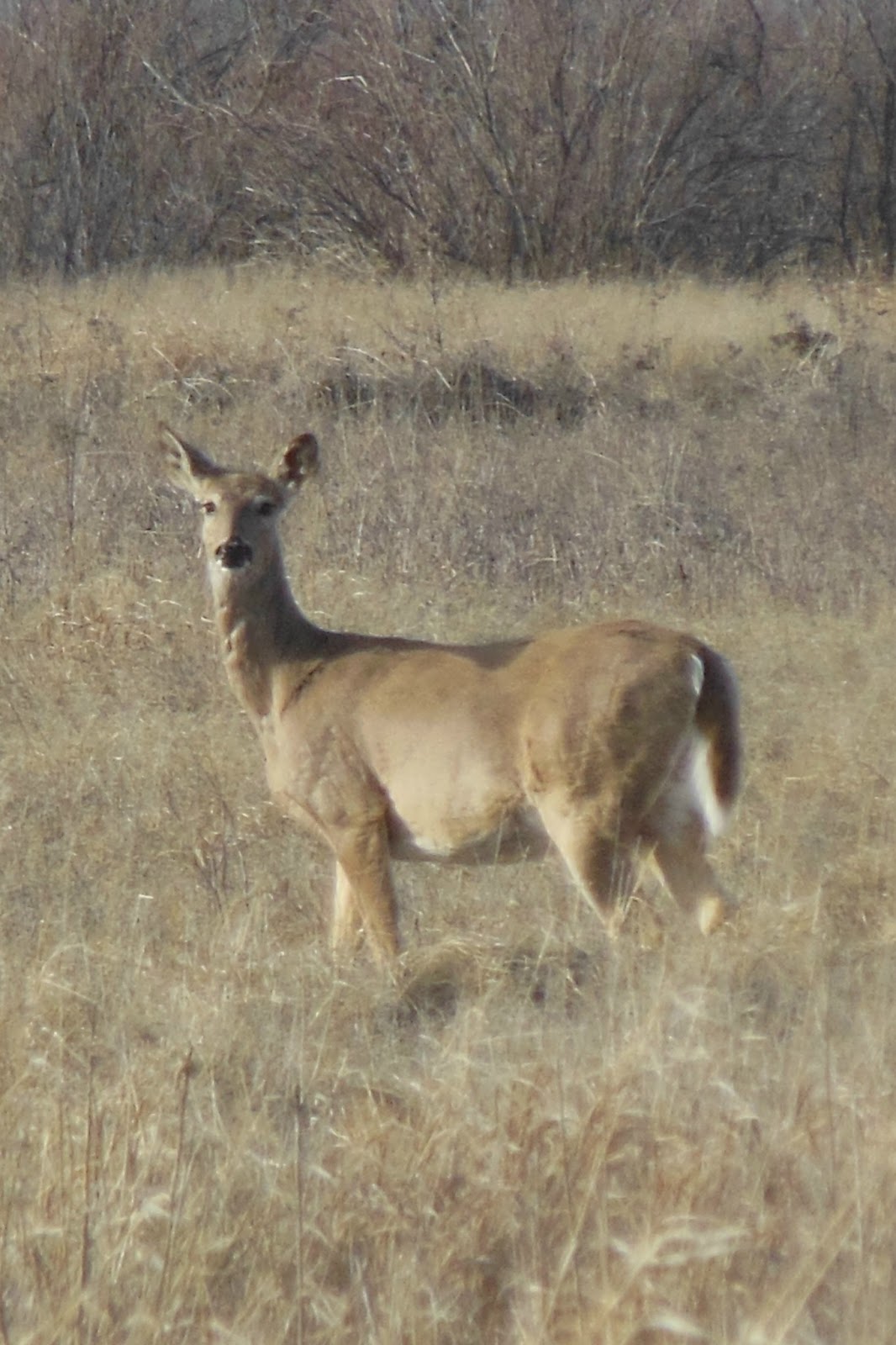
But you can see lots of other animals during an afternoon drive, including deer ...
and a turtle who must have lived a hard life, if his shell is any indication.
The refuge hosts educational events like Monarch Mania, which I visited for the first time last fall. (I shouldn't have waited so long for something that happens each year, practically in my own backyard.)
For more information about Quivira, visit their website. There's a Visitor's Center located at the south end of the Refuge, overlooking the Little Salt Marsh. Our own toddler tour guide, Kinley, provided a look at Quivira when she visited the farm last fall. Normal hours are Monday through Friday, 7:30 AM to 4 PM, but it is sometimes open on weekends during spring and fall.
 
Call the Refuge, 620-486-2393, during weekly business hours to get any updates on operational hours.

** Historical information was taken from the U.S. Fish and Wildlife Service Draft Comprehensive Conservation Plan & Environmental Assessment, a 263-page document.

Friday, February 8, 2013

Stafford: Making Sundaes from Plain Old Vanilla

From a mile away, you can see our "skyscrapers" in the background.
"Stafford Next 5 Exits."

The sign is accurate, though the tongue of the creative sign maker was planted firmly in cheek. There are five streets from which travelers can choose to turn off U.S. Highway 50 and enter Stafford: Population 1,042.
However, Stafford County mirrors what is happening in rural America. Parts of the rural Great Plains have been losing residents since the Great Depression. Some areas saw a baby boom after World War II. In the 1940s, Stafford experienced a modest population gain during an oil boom.


Main Street looks different than it did in this photo from 1955 (found in Stafford's Centennial book, Crossroads of Time: 1885-1985). The latest census shows what everyone already knows: The population in rural communities, including Stafford, keeps decreasing. But, instead of giving up, Stafford citizens are pulling together and trying to make lemonade out of lemons - or, in this case, beautifully topped ice cream sundaes out of plain old vanilla ice cream.

Tomorrow, Senator Jerry Moran will be in Stafford to present a Building Better Communities Award. The award spotlights positive community action in Kansas and shows how creative thinking and teamwork make a positive difference. Senator Moran will be at the Stafford Mercantile at 9:30 AM, Saturday, February 9, to honor the residents of Stafford for efforts to revitalize the community.

 In a speech on the U.S. Senate floor on January 30, Senator Moran said:

     In small communities across America, the people there, they work hard. They come together to find common-sense solutions. They solve problems. They try to make a difference in the life of their families and their community. They also strive to provide a better future for their kids, so that every child has the opportunity to grow up, pursue the American Dream and reach their goals.
     For rural communities to survive and prosper, citizens have to work together to create their own opportunities for success. … The reality is that those communities that are going to have a bright future are those who decide, on their own, to work together within that community to make certain that’s the case.  An example of a community that rallied together in a way to make good things happen and make the community better for the future is the community of Stafford. ...
     Rural communities across Kansas have been hit hard by the economic downturn over the last few years and many towns have encountered the closing of businesses. Main Street looks a lot less appealing. There's a shortage of health care services. The younger generation is leaving home in search of employment. In light of these challenges, the community leaders of Stafford have taken steps to secure that town’s future.  …


Comments from Senator Jerry Moran, R-Kansas

Speech from the floor of the U.S. Senate

January 30, 2013

See the complete speech
It seems fitting that the senator will be at the Stafford Mercantile to make the presentation. The variety store on Main Street Stafford has been open since last fall. Local investors came together to return a business to the vacant storefront, after national retailer Duckwall's pulled its stores from most small Kansas communities two years ago.
The Mercantile makes it possible for residents to shop for things like Wrangler jeans or a bridal shower gift without driving 30 minutes to Pratt or Great Bend or 45 minutes to Hutchinson. 

The centerpiece of the Mercantile is a 1928 marble soda fountain. It was originally in Smart Drug in Stafford, but was stored in a neighboring town for years. 
From the Stafford Centennial Book. You can see the marble soda fountain as it was in Smart Drug on the lefthand side of the photo.
Those renovating the soda fountain added oak columns from a Stafford Victorian-era home. The back bar was from a prohibition-era speakeasy near Stafford Lake, and booths and marble tables are original to the same drug store as the soda fountain.  All were dug out of different storage places and refurbished.
Senator Moran's staff also prepared a video that's been posted to Youtube (That link is at the bottom of this post.) There are three other videos that focus on specific ways Stafford is looking to thrive (click on each of the underlined links to see those videos.) Besides featuring the Stafford Mercantile, another talks about how the community rallied to save the Stafford District Hospital. Another features Stafford USD No. 349's SEED (Stafford Entrepreneurship and Economic Development) Center, a charter school for high school students. It's where students develop a business plan, talk to the banker, make a product or deliver a service and then actually open and operate their own business on Main Street Stafford.
Stafford is proving that when communities look within themselves for growth, they do have the capability to forge a stronger, more positive future.
Stafford County Economic Development Director Carolyn Dunn
It's about using plain old ingredients - like vanilla ice cream - and making that tasty sundae - complete with cherry on top.

Or maybe revitalizing a community is like making an old-fashioned cherry limeade. Even in a community "squeezed" by challenges, the future looks a lot more "rosy" when people get "stirred up" and come together. (You can get one of those cherry limeades at the Mercantile's soda fountain by the way. They are even half-priced on Thursdays!) 


See this related post. Yes, even toilet paper can make a difference in a small community.