Showing posts with label Stafford High School. Show all posts

Monday, September 26, 2016

Go Big Red: No, Not the Football Team

Kansas grows more sorghum than any other U.S. state. However, here on the County Line, we are not contributing much to the total.
 
Still, it was the first time in four years that we'd had any milo planted.  I, for one, was glad to see it back. I think it's pretty.
August 20, 2016
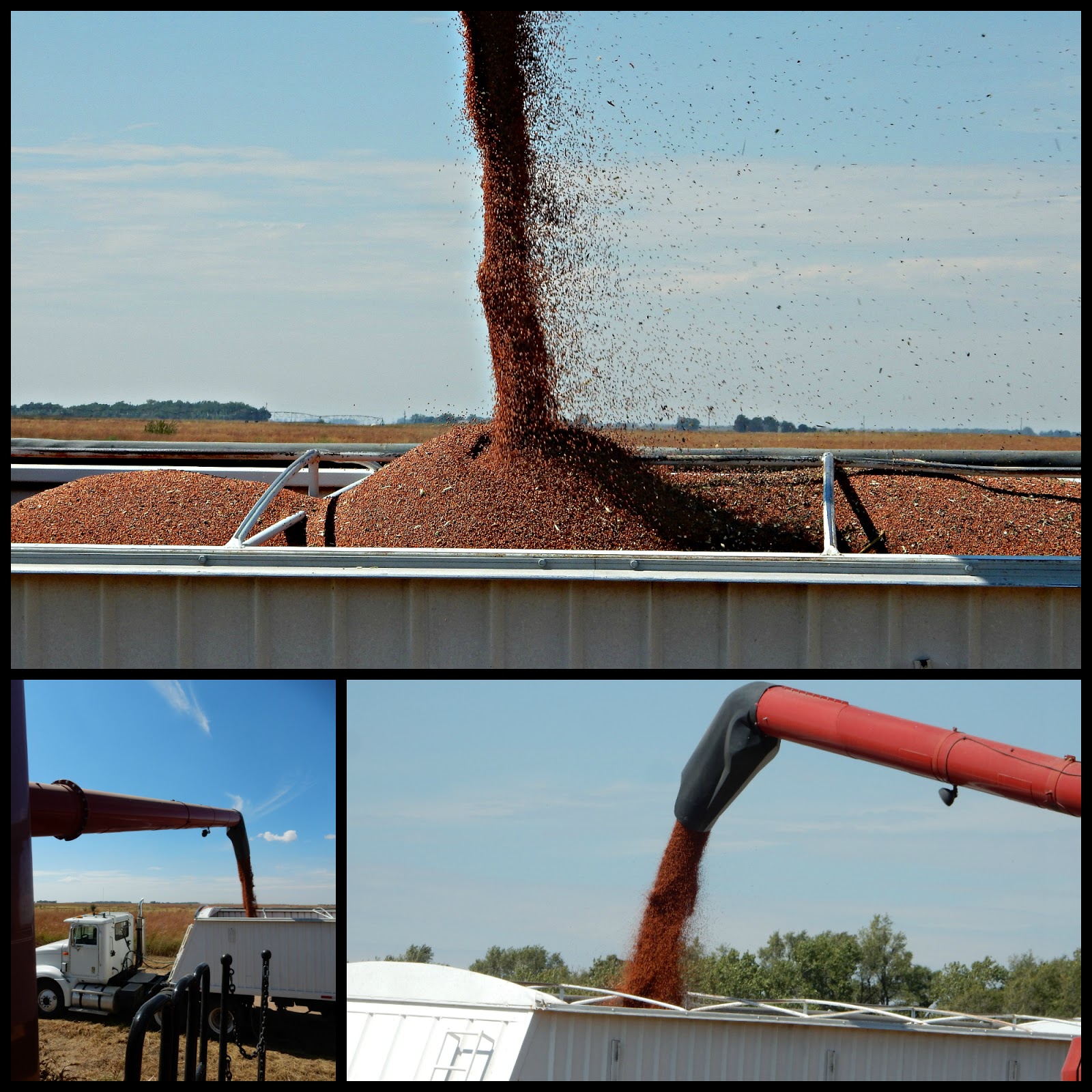
However, that is not a valid reason for planting a crop (much like choosing a car by color only). This year, Randy planted milo on some poorer ground on which corn had not been productive. It took us less than a day to harvest the 30 acres we'd planted to milo.
August 20, 2016
By the end of the growing time, there was a factor that didn't make it nearly as pretty. The milo fields were invaded by sugarcane aphids. Those are the tiny little white dots on the milo leaves in the photo below.
 
Because the grain on the County Line had mostly turned color by the time the aphids arrived, we didn't spray the milo with an insecticide. (Our silage and sudan also have sugarcane aphids. We did have our silage sprayed by an aerial applicator to try and prevent further damage to it. That field isn't right by our house, so I didn't hear the plane and I missed the opportunity for pictures. Darn!)

When I went to the milo field to take photos of harvest, I noticed all the ladybugs. They were feasting on the aphids.

The tiny aphids migrate on southern winds, pierce the leaves of sorghum plants, suck out the sap and excrete a sticky substance known as honeydew that will gum up harvesting equipment such as combines and ensilage cutters.

As Randy moved through the fields, you could see the sticky residue, making the milo leaves glisten. Thankfully, it didn't gum up the combine for us.

A custom harvester who was eating breakfast in town last week said he'd told his customers that he wouldn't cut aphid-infested fields without them being sprayed because he didn't want to tear up his equipment. It's kind of a Catch-22. Choosing whether or not to spray comes down to a couple of factors: economics and harvestability. It can cost between $15 and $25 an acre to spray the insecticide. Also, there's a four-week withdrawal time before it can be harvested. With milo only at $2.57 a bushel, it's not easy to make a decision to add additional expenses to production of the crop. 
“Right now, with the price of sorghum, you need 90 to 100 bushels just to break even,” said J.P. Michaud, entomologist at the K-State Agricultural Research Center in Hays.
In the photo above, the little dots on the combine windshield are ladybugs. They were taking a ride as Randy went through the field.
One field of our milo made 90 bushels per acre. The other field averaged 60 bushels per acre.
In 2014, Kansas ranked first in grain sorghum production in the U.S. with more than 200 million bushels grown, which equated to more than 40 percent of the country's total production. 

The use of sorghum for human consumption is being developed further in countries where malnutrition and hunger are prevalent. The fall issue of the Kansas State University College of Agriculture Ag Report had an article about sorghum:
In the Mara Region of Tanzania, one of the most starved areas of the world, K-State grain scientist Sajid Alavi is part of a research team working to improve child nutrition and health by providing a sorghum-soybean porridge blend to children younger than 5. ... While the results of the five-month study are yet to be finalized, Alavi said the early indications are that children were more healthy and had average growth rates.
 Even closer to home, Stafford High School students are researching milo. A post to the Stafford High School Greenhouse and Aquaponics page last week showed a photo and explained research being done by students at our small, 1A school. (That makes me really proud of our school!)
From the Stafford High School Greenhouse and Aquaponics Facebook page
Here's what they had to say:
The Ag Research class has begun to investigate sorghum as an alternative to corn production in arid regions of the world. Sorghum isn't nearly as thirsty or hungry as corn, yet produces a grain seed with 95% the nutritional value of corn (lacking vitamin A). We soaked locally grown sorghum in water overnight, next morning brought the container to a rolling boil, then let it simmer for almost 2 hours. The sorghum berries where soft and tender ready to be eaten. Compared to beans, sorghum would save preparation time and save limited resources while providing a nutritious replacement for beans. The sorghum grown in the most of the US is for feed.
Last night, Luke Alpers and his teacher Mike Cargill spoke at a PEO gathering. Luke has been selected to represent the state of Kansas as a delegate to the 2016 Global Youth Institute in Des Moines, Iowa, October 12-15. He'll be part of the conversation with the World Food Organization about world food security. Luke will present his paper on the aquaponic system at Stafford High School.

The SHS students are also doing experiments with mealworms.These insects were able to utilize non-food products - like Styrofoam, cardboard, banana leaves and cut-up plastic milk cartons - and convert the media into a biological food source. The worms could provide another protein source for malnourished countries and could also have implications at landfills. It is fascinating stuff! Want to know more about what our SHS students are doing? "Like" the Stafford High School Greenhouse and Aquaponics on Facebook for periodic updates on what's going on in the greenhouse and in the Ag Research class. 

Monday, October 20, 2014

Beauty and the Beast


As we left church yesterday morning, my eye was drawn to the beautiful fall colors across the street. The bright orange blazed against the clear blue sky.
If I honed in just on the fall colors and how they complemented the red brick facade of the old Stafford High School, I could forget the ugliness of a March fire for just a little bit. I could ignore the fence and the sign: "POSTED. No trespassing. Keep out" from a place that had been designed to welcome the community's children for so many years.
I could look past the rubble to beautiful leaves against a clear blue sky. In all the world's ugliness, it's medicine for the soul to focus on the good and the beautiful.
Then, as if I needed more confirmation, this email devotional from Guideposts appeared in my inbox this morning:

A Time to Think

Never say there is nothing beautiful in the world anymore.
There is always something to make you wonder
 in the shape of a tree, the trembling of a leaf.
 –Albert Schweitzer, theologian and medical doctor

A Time to Act

Take time today to nourish your soul with beauty and silence.

A Time to Pray

Lord, let me see Your beauty in the beautiful things You have made.
I think it's a good prayer for the week.

If you are a Stafford High graduate and want a brick from the old school, Dale Hearn has procured a pallet of them and is selling them for $5 a brick (more for shipping). Call him at 620-546-4535,  first come, first served.

Monday, April 7, 2014

What's Cooking at Rural Schools? More Than You'd Think!

Stafford Schools USD 349 is a small school in a small Kansas town. But small doesn't equate with dying or stagnating. The small school continually is looking for big ways to make a difference in the lives of their students and in the community.

For the past two years, Stafford Schools has been working to convert its Family and Consumer Science room into a commercial kitchen.

A couple of weeks ago, Randy and I went to a fundraiser dinner at the school for the culinary arts program. SHS Alumni Barry and Meta (Newell) West shared their knowledge of cooking and baking with culinary arts students at SHS during the day.
Then Barry (SHS Class of 1961) and Meta (SHS class of 1965) demonstrated techniques to the patrons who gathered that evening to see the new kitchen being used (and eat a fabulous three-course meal).
Culinary Arts instructor Denise Dickson talks about the program with dinner attendees.
For several years, Superintendent Mary Jo Taylor and the Stafford USD 349 Board of Education had been contemplating the future of the Family and Consumer Science program. The leaders were looking for a way to make FACS more relevant to career-oriented individuals.

Career emphasis isn't a new idea at Stafford Schools. Several years ago, the school opened the Stafford Entrepreneurship and Economic Development (SEED) Center at a downtown Main Street location. The SEED program is an innovative approach for meeting the educational and school-to-work preparation needs of high school students.   SEED Center classes are elective classes.  Students learn entrepreneurship and marketing principles while participating in individual and group projects. Each student operates an entrepreneurship project and utilizes marketing strategies to promote his/her business project. Students are allowed to keep 70 percent of their net profits. (Businesses have included T-shirt design, converting videos to DVDs, personalized dog collars and lip balm, just to name a few.)
The SEED Center, Photo from SEED's Facebook page
In addition, there are students who've been taking classes in a health care curriculum. They can get health care certifications, like Certified Medication Aide, etc. Many of them gets hands-on experience working at the Stafford County Hospital. (Randy had blood expertly drawn by a high school senior for some recent lab work there. The same student helped draw blood at the health fair last year.)

The commercial kitchen is yet another way to introduce students to possible future careers.
"The Commercial Kitchen is a project that was built out of a desire to have culinary arts curriculum available at SHS," Superintendent Taylor said. "This hope became a reality when a grant from the state became available from the Kansas State Department of Education (KSDE) called a Rigorous Program of Study (RPOS grant).  The effort to earn the grant was successful.  For the past two years, the Board of Education and staff have worked at planning curriculum and kitchen space.  Teachers have had to be trained for this unique method of teaching and learning.  In the end, the entire Family and Consumer Science Room has been remodeled and turned into a commercial kitchen.  It is an exciting new venture for the school."
School photo
Superintendent Taylor said that KSDE was looking for an innovative idea to provide a model for other schools in the state.

"KSDE leaders, especially a former FACS teacher now at KSDE, Gayla Randel, loved the idea of proving that a rural school could take on a project like this and provide a model for rural schools," Taylor said. "Most folks think this grant money should go to large schools to affect more students.  But, if many rural schools could learn from this, many students will be affected.  That is why much of our funding was to go to staff development training and technology.  We are supposed be be able to document our progress and present it in a way for other schools to learn."

After the school got the RPOS grant, Stafford County Economic Development Director Carolyn Dunn obtained another grant from the Federal Home Loan Bank for $20,000 to help pay for the new equipment.  The school paid for the remodeling of the kitchen.

As a component of the grant, the school also had to establish corporate sponsorships.  They include: Stafford County Flour Mills (more on that tomorrow), Apron Strings, Elroy's Pizza, Joan's Cafe, Wheatland Cafe and Catering and Stafford County Farm Bureau.  These entities don't necessarily give money but serve in an advisory capacity (although a couple of them are generous, Superintendent Taylor says).  Other partnerships are:  Kansas Sampler Foundation, Kansas Small Business Development Center, Wetlands and Wildlife National Scenic Byway, Stafford County Economic Development, Stafford County K-State Extension, Stafford Chamber of Commerce, STARS After-School Program and Kansas Restaurant and Hospitality Association.

"An advantage of learning this curriculum at the high school level is that students can obtain professional certifications that put them ahead of the game if they pursue this career path," Taylor said. "For example, an industry standard is the "Serve Safe" certificate.  Another is the "Pro-Start" certificate.  Upon graduating from high school a student may go straight to work as a cook in a restaurant or already have the background to take their career to the next level as a caterer, restaurant manager, restaurant owner or any number of careers in Hospitality and Tourism."

If students decide to climb the management ladder, SHS has articulation agreements with two community colleges, Barton Community College and North Central Kansas Technical College at Beloit and Hays.

"By articulating, it means that courses are already seamlessly coordinated to go from one step to the next with ease, thus increasing the efficiency of the education obtained," Taylor said.  "The only college currently offering a bachelor's degree in this major is Fort Hays.  We expect K-State to offer this major soon."

Culinary arts students at SHS can take classes offered in a Culinary Arts and Management Strand through a Career Cluster, part of KSDE's Career and Technical Education Curriculum. The classes include culinary arts I and II, baking and pastry I and II, food science and event planning and management. SHS won't offer all the classes each year.

The reason I am such a big fan of CTE," Taylor said, "is that students can take an interest and pursue it a little or turn it into their life's work.  Certainly the certificates could help a college student get a higher paying job at a restaurant and help them with college expenses."

Yes, high school classes can have a profound effect on your life. Meta Newell West, who was one of the chefs at the culinary arts fundraiser, brought with her a recipe book she compiled during Stafford High School home economics classes. (Her former home economics teacher, Betty Byer, was at the fundraiser dinner!)
The methods may change over the years, but SHS has been working to effectively educate its students for more than 100 years.

**If you're in the Stafford area and missed the fundraiser, you still have an opportunity to see the commercial kitchen, as well as other new features of the school, including a greenhouse and safe room. The school will host an open house from 6:30 to 8 PM Tuesday, April 8. Enter through the high school and check in at the Commons Area for tours**

Monday, March 24, 2014

SHS: Memories Cling Like Smoke

Like the smell of smoke from the still smoldering ruins, the memories cling as tenaciously to our minds as smoke does to cloth.
On March 15, the old Stafford High School was destroyed by flames. We had been out of town and didn't know anything about it until Sunday morning, March 16.

The school sat just catty-cornered from the Stafford United Methodist Church. As I stood at the door and greeted people for the Sunday church service March 16, I kept glancing over at the front of the school, the upper floors blackened by soot and wood pieces hanging out of broken windows. When we saw flecks of white in the air, we weren't sure whether they were snow or ash.

After church, we explored, staying behind the yellow crime scene tape. As I looked at the 1916 date on the east doors, I thought about the history there.

1916 ... 98 years standing in that very spot.
But I was remembering another Sunday morning in December 1998. We had crossed the street after church that day, too. I had been taking photos outside the church, trying for that year's version of our annual photo Christmas card. 


But I wanted to mark another event. That Sunday, while Jill and Randy were dressed up, I took some photos of them in front of the school. A move to the new school just down the street to the east on Broadway was planned for February 1999. I wanted some photos of the two members of our family who had walked the halls of the grand old building as students. Randy graduated from Stafford High in 1974. Jill was a 7th grade student at the time, and the middle school attended classes there. (Brent didn't make the photos because he was a 5th grader and was still in the elementary school building.)
It was a minor miracle that I found the photos in my less-than-organized tubs of photos.
And then there were the photos of moving day, February 25, 1999. Bernard Bartlett carried mementos from the old school to the new one by a horse-drawn buggy.

Earlier, teams of students formed a version of a bucket brigade to transfer supplies from the top floors to the ground floor. They sat in the auditorium and listened to some history. Some of the students then carried desks and trophies to the waiting buggy.
Just as it had for many other families, the school was the centerpiece of the community. Randy's maternal grandmother Laura Russell (Ritts) graduated from there. So did both his paternal grandparents, Clarence Fritzemeier and Ava Hornbaker (Fritzemeier).

His Dad, Melvin Fritzemeier, graduated from SHS in 1948, and his Mom, Marie Ritts, got her diploma two years later. As I dug through tubs looking for old photos, I found a 1948 Staffordonian, the yearbook from Melvin's senior year.
The front of the yearbook showed the school through a window. Inside, someone had drawn a sketch of the school. (I think the artist may have been Lawrence Tretbar. Click on the photo to see it larger.)

Randy graduated there in 1974; his brother, Lyle, in 1976, and sister, Kathy, in 1984. Their graduation ceremonies were all in the old auditorium, where the memories were piled as deeply as the debris.
I took a photo of Jill on Moving Day 1999. The torch of education was passing from the old three-story building to the brand new addition a few blocks east.
It's there where Jill's graduation ceremonies happened in 2004 and Brent's two years later in 2006.

But last Sunday, I was remembering the old school. It's where I went to work part-time in the middle/high school office when Brent was a first grader. It was a teeny-tiny office I shared with Judy Clough. It's where I first accompanied for the high school choir under the direction of Presley Herndon. On several May days, I was one of four pianists who played Pomp and Circumstance on two pianos in the auditorium for SHS graduation.
It's where Jill debuted as Woodstock in "You're A Good Man, Charlie Brown" in 1996. It was a high school play, but as a fifth grader, she got to play the part of the little yellow bird. (My attempt to find a photo is unsuccessful so far.) She remembers staying up past her bedtime to go to play practice. She says that if Dad took her to town for practice, she got to get a pop. (I guess Mom wasn't so easy.)
Then, as a seventh grader, she joined the cast of "Grease."  It, like Charlie Brown, was under the direction of Pam Turner. Jill and several of the middle school kids, were added to the large cast. Grandma Marie made her a poodle skirt.
Jill sang a solo as Teen Angel (bottom left in the collage above). It would have been the last play in the old auditorium, produced November 13-14, 1998.
It's been a week of reminiscing as crews have torn down the walls of the old school. With three days of working baby calves, I didn't witness it in person.
Photo by Stafford Emergency Services

But the school's demise was center stage on Facebook news feeds for Stafford residents and SHS graduates.
Photos in collage by Janet Vasey Hardin

Just one week later, the majestic east entrance is all that's left of the three-story building. The corner of Broadway and Park will never be the same.
But the memories? The good thing is that they don't just drift into the atmosphere like smoke. They are alive and well.