Showing posts with label ice storm. Show all posts

Monday, February 20, 2017

Leftovers

We chomp through our share of leftovers around here. I know there are husbands who don't want to eat them. Thankfully, mine is not one of them. As long as there's something to eat, he isn't picky about whether it's a re-run. Oftentimes, I prefer the term "planned overs." I take leftover taco meat, for instance, and turn it into something else the second time around - like a taco pizza.

But last week, the loader tractor bucket also bit into a few leftovers. In January, an ice storm affected much of Central and Western Kansas. While it created a lot of beauty, it also brought some damage, including to the big high-line poles that run through one of our fields. Crews spent a day repairing it, and they put the "leftovers" in the ditch.

Some people might see trash. (True confessions: I was one of those people who didn't appreciate the boxes, buckets and even fast food wrappers left behind. That was especially true after someone came and destroyed the insulators - apparently just because they thought it would be fun. Besides the needless destruction, I see dollar signs rolling upwards as the broken pieces end up piercing our tires as we drive in and out of the field.
But Randy didn't just see trash. He also saw opportunity. Much like I see another meal in the leftover pot roast that becomes beef and noodles the next day, he saw replacement fence posts amidst the trash.
When the company called to talk about damages to the wheat field, Randy asked whether we could take some of the poles.
So after the semi got done hauling the 12 loads of hay we'd sold, it was ready for a new payload. Randy and Ricky hauled a couple of loads of leftover poles to our fencing piles. 
We can use the sturdy poles to replace rotted out posts in a corral or they could become corner posts in a new fence-building project.
Best of all: They were free. (Well, except for the labor and a little gas to haul them away.) And Randy called a couple of neighbors to share the bonanza. 

Friday, January 27, 2017

Power to the People

From outward appearances, the tall and mighty power poles that stretch across our wheat field looked unharmed after the ice storm two weekends ago.
Harvest, June 2013

The poles often play starring roles in my sunset photos as silhouettes to mark the departure of another Kansas day. They are part of our western landscape, a line marching steadily toward the horizon. However, like most people, I don't think a lot about electricity until I don't have it. During this ice storm, we were fortunate. We were only without power for a few hours, and we were sleeping during most of that time. Many others were without electricity for several days.
We know how that is.  After a 2007 ice storm, we were without power for 12 days. The only good thing that came out of that 2007 ice storm was a photo of the sun coming up after a week of gray days and sub-freezing temperatures. I put that photo on canvas and it decorates my living room, part of my "There is a time for every season ..." Ecclesiastes grouping.
On our way to church last Sunday, we saw a parade of vehicles in the field. Evidently, outward appearances didn't tell the whole story. (There's another lesson there, isn't there?)
The ice that had draped fences and coated trees and made art out of weeds had also clung to the cross bars of the power poles.
 
A subcontractor, PAR, worked all day last Sunday to repair the damage on the poles, which are owned by Midwest Energy.
Wet fields and heavy equipment don't mix. The company had to use bulldozers to pull their trucks through the muck. (We know a little about that after a combine was buried in mud during our last wheat harvest!)
One of the supervisors came to the house to get a phone number and contact information so the company could settle any damages to the ground and crops. He also shared both a company phone number and his personal cell phone, just in case we didn't hear from the company.  What a nice guy!
Less than a week later, the company has already called to make reparations for the damage done. Some of the money will go to the landlord. (We don't own the ground.) And some will come to us.
We are thankful that the company is trying to "make it right." But we're even more thankful for electricity and for the workers who do all they can to get power up and running after a storm.

My Grandpa Shelby Neelly was was one of the people who helped develop the rural electric cooperative in Pratt County back in the 1940s. He served on the Ninnescah Rural Electric Board and also the Kansas Rural Electric Cooperative board. My dad later served on both boards as well.
We rural residents owe a lot to our ancestors who worked so hard to bring the convenience of electricity to our rural communities.

The first electric light bulb twinkled into history in 1879, when scientists in Thomas Alva Edison’s laboratory corralled this new form of power.  By 1930, nearly 70 percent of city dwellers were hooked up to the electrical lines and poles that dotted U.S. cities.  At the same time, however, only 10 percent of farm families had access to electricity. 

In 1932, presidential candidate Franklin Delano Roosevelt promised a “New Deal” to help combat the Great Depression.  One of his New Deal programs was the formation of the Rural Electrification Administration (REA) in 1935. 
First rural electric line in Kansas, Brown County, 1938. Photo from Kansas State Historical Society.
In 1935, with the passage of the Emergency Appropriations Act, a zero-interest loan program was established for building electric transmission distribution lines into rural America.  However, existing investor-owned companies still weren’t interested in providing electricity to farms because they didn’t believe it was profitable.  In 1936, with the passage of the Electrification Act, not-for-profit cooperatives were encouraged to apply for the loans.  Neighbors joined together to create and control the future of their electric companies.
Grandpa Neelly and me, 1957
 Shelby Neelly had been living in the central Kansas community of Greensburg.  The teacher and coach enjoyed the electricity available to city dwellers.  But, in 1942, when Neelly moved back to Pratt County to farm, he and his family were again without the modern convenience of electricity. 

When the Ninnescah Rural Electric had first approached his neighbors, they didn’t see the need for electric power.  Only a couple of families along the road had signed up in the cooperative’s initial recruitment effort.  Then, World War II curtailed the use of wire and other supplies necessary for building miles of electric line. 


“My kin, Ray Denton, drove up and down the roads in two or three townships out here trying to get people to sign up,” recalled the 99-year-old Neelly in a January 2004 interview.  “It was $5 to sign up, and a lot of people didn’t think they had the $5. At that time, people couldn’t even imagine all the electrical appliances we have today.”

From from Kansas State Historical Society, Brown County, KS
Getting the monetary commitment from farm families was just the beginning.  The cooperative boards spent hours mapping out the best locations for electric lines with engineers.  They again made the rounds to neighbors to purchase land easements for placing the lines.  They also had to apply for the loans to the REA.
Photo from Energy for Generations archive
By 1945, the Neelly family had electricity in their farm home, just like many other farm families in Kansas.  At first, only the kitchen, living room and dining room had the single bulb in the middle of the ceiling.  It was a far cry from the outlets located on every wall in today’s country homes, but it was miraculous at the time to have indoor plumbing.  Farm families were able to replace their ice boxes with electric refrigerators, no more lugging 25-pound chunks of ice into the kitchen.  Farm wives and children no longer hauled pail after pail of water into the home for washing dishes or taking baths.  Families could sit around their living rooms at night listening to the radio and reading by the light of their electric light bulbs rather than the muted glow from kerosene lanterns.

All across the country, farmers and ranchers began to realize the potential for electricity in their daily work.  Electricity could grind feed, shell corn, pump water and saw wood. It powered milking machines and lifted hay into the barn.  Farmyards were often lit with lights, adding extra hours to accomplish work.  

The importance of electricity in the lives of rural residents continues today.  It’s hard to predict what the future will hold. 

“As technology evolves, almost all of it is powered by electricity,” Bob Moore said in a 2004 interview.  “Today we have more technology available than we could ever have dreamed of when I was a boy. It’s amazing that we have computers and television that connect us to the whole world.  The future is not that different from the past.  All kinds of new innovations will require electrical power. We just can’t imagine what all of them will be.”

On Sunday, we'll celebrate Kansas Day. It's been 156 years since Kansas joined the Union. I'm thankful for the pioneers who established this land and for those innovators who came along later - from the people who brought electricity to the plains to those today bringing high-speed internet connections. 

Thursday, January 19, 2017

Ice Breaker

"Now it's time for an ice breaker!" Usually the words are uttered by a perky individual at the front of a meeting room. About that time, my heart starts beating a little faster, my throat gets dry and I surreptitiously scan the room for the closest exit.

I'm not wild about playing games among family and friends. Put me in a room full of strangers, and "ice breaker" is akin to torture.
This photo was taken on Sunday. The bulk of them were taken on Monday.
This week, "ice breaker" took on a whole different meaning. After our weekend ice storm, the temperatures started warming. As the thermometer went up, the ice on the trees around the house started falling down onto the roof, sounding like artillery rounds. After reading about a massive tree limb going through a roof in Hutchinson, I figured we were in the middle of a combat zone.

The ice caused cancellations and reshuffled schedules. It made feeding cattle a more time-consuming job. It did a lousy job trimming trees. And it is still causing power outages across the state, though we were fortunate this time around. This "ice breaker" was about as fun as one of those meeting types I dread.
But it also created undeniable beauty. When I saw this ice-coated "3" in the weeds, I thought about the Count on Sesame Street.
Use a little imagination, and this icy weed looks ready for Valentine's Day. 
The red berries looked like holdovers from Christmas decorations. 
 This one looked like it could form lace on a dress or a necklace dripping with diamonds. 
The ice and the overcast day made everything monochromatic (though I helped this one along by making it black and white.)
After checking the bulls, I asked Randy if we could stop at the Peace Creek Cemetery to wrap up my morning-long photo foray.
I had been seeing ice-encased farm fences all morning, but this one was unique - the delicate ice contrasted against the rough brick wall. 
One of the finials on a gravestone had a little extra decoration.
These little angels provided a fitting reminder to the morning: It's good to find the joy, even when conditions are less than perfect.
That's an ice breaker that always applies.

Tuesday, January 17, 2017

The Ice Capades

When I was in grade school, we took a vacation to Colorado. While there, our parents treated us to an evening at the Ice Capades.
The silo is barely discernible through the icy fence.
For weeks afterwards, we girls twirled and swirled throughout our days. The living room became an ice rink. The hallway was transformed into a small venue, and we used the mirror as our imaginary camera, smiling broadly for our imagined adoring crowd. Socks on the marble entryway was the closest thing we had to fulfilling our skating fantasies, its slick surface a conveyance for our imaginary Ice Capades sequined costumes and glittery headgear. We thought we were so graceful as we dipped and swayed in our fictional shows.
We had our own version of the Ice Capades this week in Kansas. But now that I am old and wise, I know that I don't have a graceful bone in my body. My goal for the past couple of days was to remain upright. There was no twirling, unless it was a little dance for balance when my feet slipped on the icy ground.
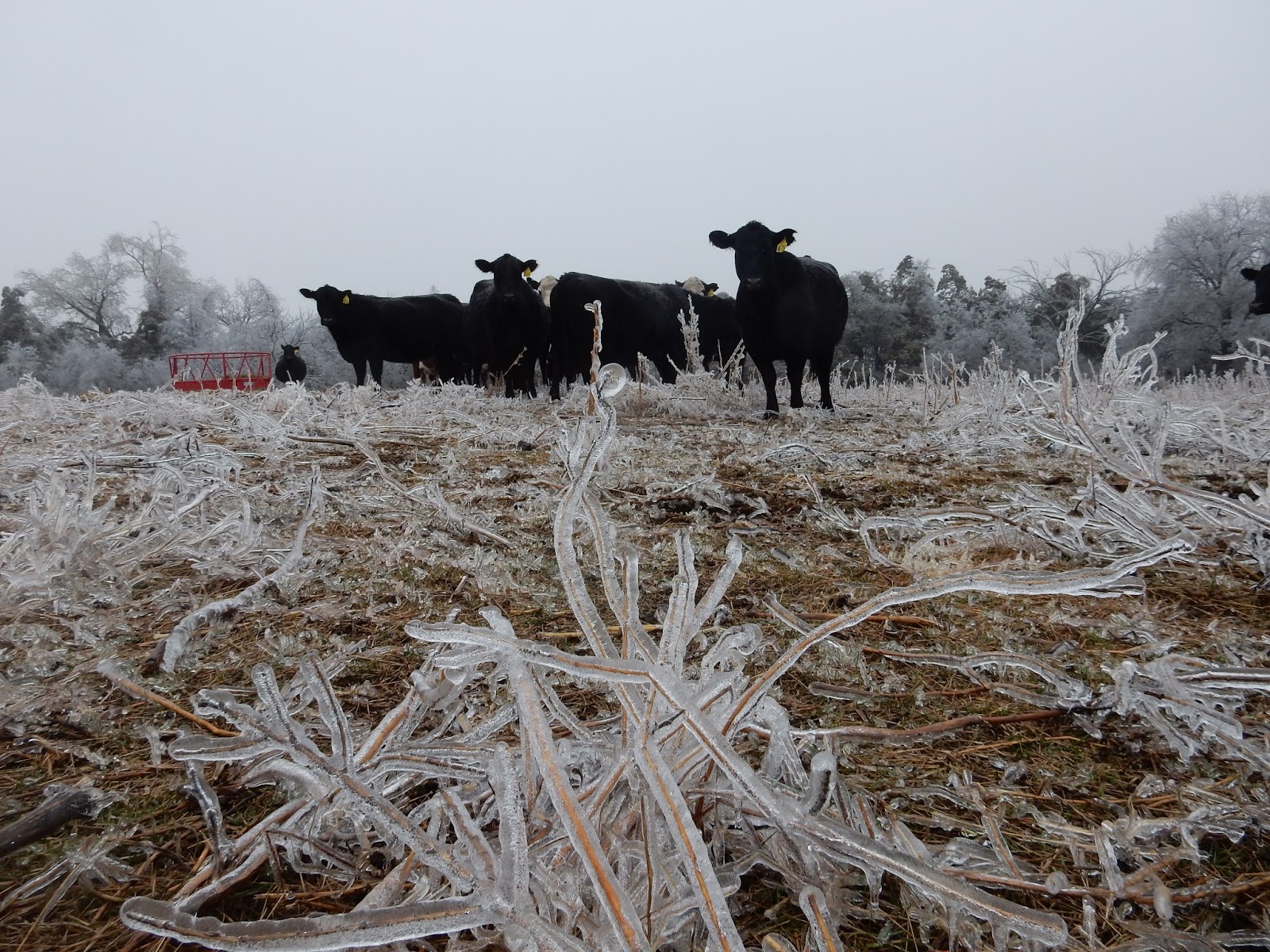
The guys didn't have the option of whether they were going out in the icy mess. The cows needed to eat, so there was no "snow day" in the work schedule - and no "ice day" either. I decided to go along for the ride.
These two soon-to-be mamas wondered what I was doing as I crouched down for an icy camera shot through the fence.
They were interested in me until the tractor came.
I used the icy barbed wire fence as a photo frame as the guys fed bales of hay.
Then we went to the pasture, where Randy undid the net wrap from the hale bales ...
... while the cows patiently waited for breakfast ...
... before Ricky deposited the hay into the bale feeders. 
I  was surprised when a few icicles survived the tractor dumping the hay into the round bale feeder.
The cows didn't seem to care that they were having "iced hay" for breakfast.
We checked on the bulls in another pasture to make sure ice-laden trees hadn't fallen on the fence, giving them an escape route. All was well.
The solar panel that usually fills the water tank looked more like an ice sculpture than a functional piece of equipment, so we also checked the water level in the tank.
As the guys fed at another location, I wandered around and clicked the camera shutter.
I liked the contrast of the teardrop ice on the weeds and the rustic wooden fence post and rusty chain.
Even though the ice made the roads and corrals sloppy and slick, the moisture was cause for celebration. Our part of the state was on the drought map. By the time the rain, freezing rain and ice was done, we had accumulated 2.60" of rain in the gauge.
The moisture will be a boon to the winter wheat crop ...
... even though it looked like a slushy machine had exploded all over the fields.
Along with the beauty, there was plenty of destruction.
Our old trees look like they've gone through another war. For us, it wasn't as bad as the December 2007 ice storm, when we were without electricity for 12 days. We were without power only for a few hours. I know there are many others (including my parents and brother) who are still waiting for the power to be restored, so we are very thankful that we didn't even have to hook up the generator.
But there is still a lot of cleanup to do at home and to clear the way to get to the cattle at several locations.
As we listened to limbs cracking and ice hitting the roof, Randy was afraid that the branch holding our swing would fall.
While several other limbs from that tree fell to the ground, the swing is still there. It will be ready for Kinley and Brooke the next time they're at the farm!
More beauty shots from the ice storm in the next blog (I took 179 photos yesterday morning and some the day before, too. I promise I'm not showing all of them.)