Showing posts with label military. Show all posts

Thursday, November 11, 2021

The Land of the Free & the Home of the Brave


This is a post from my Kim's County Line archives (with a new photo created after the bald eagle visited in October.) It comes with my heartfelt thanks for veterans, active duty military and their families on this Veteran's Day.

***

C. Melvin Fritzemeier, 10th Infantry Division, U.S. Army

My late father-in-law, C. Melvin Fritzemeier, served in the U.S. Army following the Korean War. He didn't talk about his service with me. But on this Veteran's Day, I wanted to pay tribute to him and others who have faithfully served our country during wartime and times of peace.

Maybe I just needed to take him on a road trip by Fort Riley. As a kid, Randy remembers hearing "war stories" in the back seat as his Dad drove by the fort, where he had trained before being shipped out to Korea. 

C. Melvin Fritzemeier in uniform; upper right, Camp Casey, Korea, 11-Sept.-54, Saturday night was on the back of this photo; lower left photo was not captioned; lower right, caption says, "Ready to ship out to Korea from Fort Lewis, Washington."

Not long ago, I was digging for photos and came across several from Melvin's military service. After Randy's folks died, we cleaned out their farmhouse. By the end, we were all tired of sorting, so we ended up putting family photos in plastic tubs. We got elected to be the repository for all the tubs. 


Also in the box was this Indianhead insignia, the symbol for the Army's Second Division since October 1917 at Bourmont, Haute-Marne, France, from troops in World War II. The color markings (red, white, and blue) used to identify the division and their equipment in France were chosen  by the commander of the division as the colors for this insignia.  The star and Indian head signify the American origin of the division.

 Melvin was drafted three months after the Korean War officially ended. He served as a truck driver. Randy says he talked about sleeping outside in tents.

Melvin often told a story about Army food. He would never eat dried beef gravy after serving in the Army. He also never touched fruit cocktail. Randy says that he and a buddy each ate a gallon of fruit cocktail that they'd cooled in a nearby stream. He ate so much of it that he never wanted it again. 

As is the case today, servicemen and women leave behind their families as they go to serve their country. I found several little yellow books of photos, which Marie must have sent to Melvin overseas. Marie stayed with her mother in Stafford while Melvin served, and she worked at the Farmers National Bank until he returned and they moved to the farm.

Melvin served two years. By the time he returned to Stafford, he had traded his Private 2nd Class stripes for a Corporal designation.

On this Veterans' Day, I'd like to thank all the veterans for their service. Our little community of Stafford has a number of young men and women who have served in the Armed Forces. I thank them for keeping America strong, and I thank their families for the sacrifice of being apart from their loved ones, often in dangerous places. 

This nation will remain the land of the free 
only so long as it is the home of the brave.
  ~Elmer Davis


Wednesday, December 7, 2016

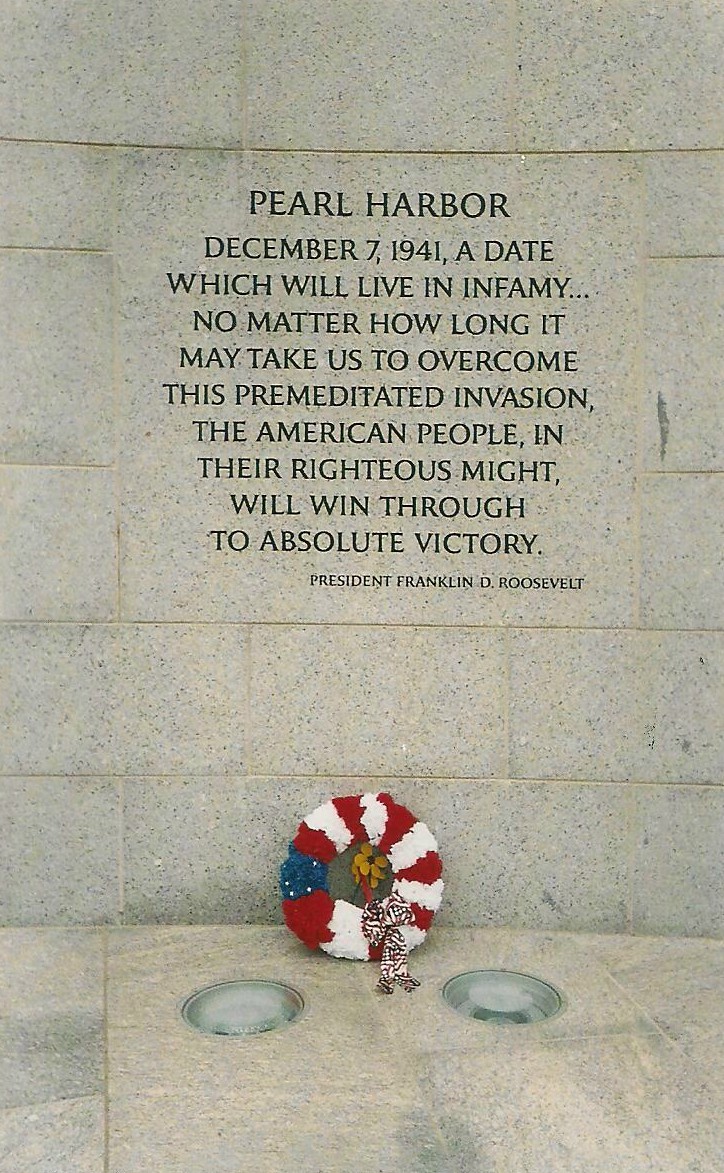
A Day Which Will Live In Infamy

Photo by Brent Fritzemeier

December 7, 1941:  It was a typical Sunday. Early church bells had just begun to ring. Some servicemen were still sleeping. Others were on their way to breakfast.

But the ordinary turned to extraordinary in just moments. On that Sunday morning, the first two waves of aircraft - about 180 planes - roared off the decks of Japanese carriers north of Oahu at 7:49 AM.
Photo from Yahoo images
At 7:55, the quiet morning at Pearl Harbor was ripped apart when the first Japanese bombs dropped. Some Japanese aircraft swooped down on the harbor and Battleship Row. Others headed for nearby airfields, where American planes were lined up, wing-tip to wing-tip. Within minutes, the aircraft were reduced to useless heaps of torn and melting metal and the harbor was choked by black smoke and fire as mighty ships slipped toward the ocean floor.
Photo from Yahoo images
A few minutes into the attack, a message was sent to the U.S. capitol: Air raid, Pearl Harbor - This is no drill! Pearl Harbor was pounded with bombs, torpedoes and bullets from 7:55 until 9:45 AM. As the Japanese planes roared away, they left 2,403 American officers and fighting men dead and another 1,178 wounded. Civilians were also caught in the crossfire of the surprise attack.
Photo from Yahoo images

For most Kansans, it was just another typical Sunday. Many had gone to church and were relaxing with their families and friends after a big Sunday dinner on this day of rest. Many had been listening to the Sunday afternoon broadcast of the New York Philharmonic Orchestra when the first newsflash interrupted the programming.
From Yahoo images
President Franklin D. Roosevelt had hoped to keep America out of World War II. All that changed on December 7, 1941.
Yahoo images
Today marks the 75th anniversary of the attacks on Pearl Harbor. In 2008, I interviewed about 20 servicemen and women who had served our country during World War II. The hours of interviews eventually led to a story that took up 24 pages - all single-spaced in a Word document - so I can't reproduce it here. The story was broken into a series of articles for the Wesley Towers Tapestry newsletter. All of those I interviewed were residents of the Hutchinson retirement facility. Many of them have since passed away. None of them were at Pearl Harbor, but several of them joined the service in response to the attack.
The interviews were some of the most moving stories I'd ever heard. They talked humbly and quietly about their service at Guadalcanal, the Island of Tarawa, the Aleutian Islands, Italy, at the Battle of the Bulge, the Battle of Leyte Gulf, the Battle of Okinawa and on ships in the Pacific. Two of the men actually saw the flag raised on Iwo Jima. Some served on bases on the homefront. One woman shared her experiences as the wife of a Prisoner of War. One woman served in the U.S. Cadet Nurse Corps, and another was a special services librarian. Those men and women who shared their stories represented all branches of the armed forces.

The commitment to serving the U.S. in this way has not waned for some. In recent years, Stafford has had several young men and women willing to serve our country. These were the kids I watched on the football field. I served some of them cupcakes at classroom Valentine's parties. They, too, grew up doing ordinary, everyday things in a small town in South Central Kansas. Yet today, they are doing extraordinary things to serve our country. It is their efforts - and the sacrifices made by their families left at home - who help us to continue as the land of the free.
Photo by Brent Fritzemeier,
the Washington Monument from the World War II Memorial
Our little community is no different than others across the nation. Throughout U.S. history there has been an image of the farm boy putting down a hunting rifle to join the military. It was not until the turn of the 21st century that the data was available to document what many suspected – that rural America supplies more than its fair share of military recruits (Wessels Living History Farm - Nebraska).

 On this 75th anniversary of "a day which will live in infamy," let us never forget. It's more than a page from a history book.

... Long may our land be bright
With freedom's holy light;
Protect us by Thy might,
Great God, our King.
Yahoo images
Last Sunday, CBS Sunday morning featured several stories related to Pearl Harbor. Click on this link for one of them.

Tuesday, November 12, 2013

American Hero - Part II

(Flyover at K-State football game, October 29, 2011)

In honor of Veterans Day, I'm sharing a feature story about Vietnam POW Bill Talley. I wrote the story for Wesley Towers, the retirement community in Hutchinson where Bill and his wife, Louan, now live. Wesley Towers gave me permission to reprint the story from their Fall 2013 newsletter, Tapestry. (I've been writing for Tapestry for nearly 25 years.) As a side note, Bill's wife, Louan, grew up in Stafford and then lived in Stafford while Bill was imprisoned in Vietnam.

Part I was printed in the blog yesterday. (Click on the link to read it.) Because it was long, I printed it in two parts. On May 11, 1972, Talley's plane was hit by a missile over Hanoi, it went down, and he was captured by the Vietnamese. Here is the "rest of the story," beginning when Talley arrived at the Hanoi Hilton, the infamous prison.

***

The Hanoi Hilton
     For the first few weeks at the Hanoi Hilton, Bill Talley was in solitary confinement. Each night, he was taken from his cell, where his captors interrogated him for hours.
    “I was surprised that they didn’t really ask me that much about military operations,” Talley said. “They were more concerned with propaganda. They wanted me to denounce the U.S. military and the war through writing letters or at a press conference. They used fear tactics, telling me that they would withhold treatment on my knee if I didn’t cooperate. My knee was black and blue, six inches above and six inches below the kneecap. I had red streaks running down toward my ankle. The interrogators would say that I needed to write the letters or give a press conference so that I could get treatment and so that my leg wouldn’t have to be amputated. I refused, over and over and over again.”
    After about two months of solitary confinement and nightly interrogations, Talley was moved into a large room with 12 other POWs. It was only then that his captors informed the U.S. military that he’d been captured and was a prisoner of war.
   “That’s when my wife found out my status,” Talley said. “It was typical for the Vietnamese to delay reports of capture. Some wives didn’t know the status of their husband for several months and a few didn’t know for several years.”
    Talley didn’t know where his wife and children were either. He knew that they’d have to move from McConnell, since he was no longer on base. It took several months for him to learn that they had moved to Louan’s hometown of Stafford. Though families wrote letters and sent packages to the POWs, the guards rarely let the prisoners read their mail.
   “But we could always tell when a package arrived. The guards would smell like aftershave.”
   Still, Talley was grateful for the move out of solitary confinement.
   “For a short period of time in my life, I lived in the company of heroes, who chose their own attitude despite extraordinary deprivation and cruelty. We survived because of our determination to resist the enemy by any means available and our commitment to something greater than ourselves – the survival of our comrades. Some of these men had been captured four to six years before me. They were like big brothers to me and gave me advice, encouragement and help I needed to sustain me until release.”
    The POWs endured rats, mosquitoes and filth. They ate two bowls of soup a day, pumpkin in the summer and cabbage in the winter. They were sometimes confined in handcuffs and leg irons or had to kneel on broken glass.
Faith during adversity
    Talley said it was his faith that kept him going. After he was moved to the room with other POWs, a ranking officer assigned him the job of chaplain. Using a bit of confiscated lead that they fashioned into a pencil with threads from their clothes and blankets, he transcribed the Apostle’s Creed, words of hymns and Bible verses that he learned in Sunday School as a boy in Oklahoma. He used sheets of rough brown toilet paper for his makeshift prayer books. Once a week, they would quietly sing the songs and read the words, taking comfort in the ritual that reminded them of home and family.
    “Although my life as a prisoner was miserable, I can’t say that the time was entirely wasted,” Talley said. “A person develops a new perspective towards life and his fellow man when he can personally witness people caring for and administering to sick and wounded under the most severe conditions. I have seen hungry men give up what little food they had to help a companion. I have seen cold men share the few clothes they had with sick or injured prisoners.
    “One of the most impressive sights was to see men fashion a simple cross from two sticks and, in their own way, worship God, despite their circumstances. One lesson I learned in prison was that I can be happy and comfortable in life with less than I previously thought necessary. (Eugene) “Red” McDaniel told me while we were still in prison that he didn’t consider his six years as a POW wasted. He believed when we were released he would be able to live and enjoy the remainder of his life more than people who had not shared our experiences. He could enjoy simple acts that most people take for granted, like getting a drink of cold water from the refrigerator. I think he was right.”
POW-MIA Memorial at the Stafford VFW
 Operation Homecoming
   In December 1972, Talley and his fellow prisoners were thinking about Christmas. They were tying together old olive green socks and fashioning them into a make-shift Christmas wreath.
   “We heard a rumble like thunder,” Talley recalled. “It was continuous, and it got closer and closer and louder and louder. Through the bamboo curtains over the windows, we could see the orange glow of fires as bombs were dropped. The POWs who’d been there awhile told us, ‘Pack your bags, boys. The B-52s are coming, and we’re going home.’ ”
    Later, the POWs learned that President Richard Nixon had ordered the B-52s to bomb Hanoi, an unprecedented move since the U.S. hadn’t previously bombed there. Nixon ordered the bombing stopped on Christmas Day, but it resumed the day after and continued for five days. The Vietnamese signed a Peace Treaty January 28, 1973, and the war ended.
   Talley was released from the Hanoi Hilton after 322 days in captivity, along with 589 other Americans, during Operation Homecoming, March 28, 1973. 
    “When we came home after the war, we were asked to write a one-page message of how we endured a cruel time in our lives,” Talley said in a recent speech. “Nearly all of the POWs credited their survival to three faiths: Faith in God who would not abandon us. Faith in America who would not forget us. Faith in our comrades who helped us in the daily struggle of life.”
    Colonel William H. Talley remained in the Air Force until his retirement in December 1981, serving 26 years. The Talleys moved to a Wesley Towers Heritage Home in May 2012.
***
William Talley's ribbons
Hero or Not?
    Bill Talley might not call himself a hero. But others are not so quick to exclude him. Senior District Judge William “Buck” Lyle nominated Talley for an Armed Forces Hero award, which he received at the Central Kansas American Red Cross Heroes Award banquet in June.
   “I didn’t know Bill until this year,” said Judge Lyle, who flew 163 missions in B-52s in Vietnam. “I read an article about him in The Salina Journal, after he’d given a talk at the Salina Rotary. … He had been shot down in Vietnam and spent almost a year in the Hanoi Hilton. I didn’t know him, but he was already my hero. Three of my classmates from the Air Force Academy had spent time in the Hanoi Hilton, and I knew what that meant. … I met him for the first time when the Red Cross was filming both Bill and me for a video they were putting together for the banquet. Since then, I know firsthand that Bill is a great guy with a sharp mind and a great sense of humor.”
   Since meeting, the two have gotten together to trade Air Force stories. Lyle, too, retired from the Air Force as a Lieutenant Colonel, then was squad commander of the 117th Air Refueling Squadron based at Forbes Field in Topeka, leading a squadron to Desert Shield and Desert Storm. There are plenty of war stories to go around when the two get together.
    “After getting to know him, I was right: He is a hero,” Judge Lyle said. “He’ll be my hero forever.”

Monday, November 11, 2013

American Hero - Part I

Bill Talley
In honor of Veteran's Day, I'd like to share a feature story about Vietnam POW Bill Talley. I wrote the story for Wesley Towers, the retirement community in Hutchinson where Bill and his wife, Louan, now live. Wesley Towers gave me permission to reprint the story from their Fall 2013 newsletter, Tapestry. (I've been writing for Tapestry for nearly 25 years.) As a side note, Bill's wife, Louan, grew up in Stafford and then lived in Stafford while Bill was imprisoned in Vietnam.

Because it's long, I will print it in two parts. Come back tomorrow for the "rest of the story." Remembering veterans and their families on this day, including my late father-in-law, Melvin Fritzemeier, who served in the Korean Conflict. 
***
Hero or Not?

    Bill Talley was like many young boys who grew up in the Great Plains in the 1930s and ‘40s. Looking up at the wide open Oklahoma sky, he’d imagine becoming one of those flying aces of World War II featured on the news reels before Saturday movie matinees. He carefully glued together model airplanes, adding the decals for the Flying Fortress or the F-47 Thunderbolt, and he dreamed of soaring.
    Midwestern practicality trumps dreams, so when he graduated from high school in the small town of Sayre, Okla., he opted to study pre-veterinary medicine at Oklahoma A & M College to build upon the passion for animals he discovered as an FFA member.  
    He didn’t know that Air Force ROTC would forever change his life. He just thought he was fulfilling a requirement for all male students at land grant universities of the time. He chose Air Force ROTC over Army ROTC, remembering those dreams of flying and the handsome heroes from those matinee movie reels.
   He made the Air Force his career. In 1972, Air Force Lieutenant Colonel William H. Talley was shot down near Hanoi, Vietnam, and became a prisoner of war.
    He says he isn’t a hero. He saves the “hero” label for his friends and mentors.
    This is Talley’s story. You can decide whether or not to call him hero. 
**
    When Talley finished his second year of college, his ROTC commanding officer encouraged him to give up his plans to become a veterinarian and pursue the military as a career.
    “He was the epitome of a military man,” Talley recalled. “He was a tall, handsome, well-dressed Air Force guy with rows of medals on his uniform. He advised me to go into advanced ROTC, telling me that I would be subject to the draft if I started vet school. … I thought about it. Nobody was knocking at my door, wanting me to be a veterinarian. This man I admired was telling me that he thought I would be a good fit for advanced ROTC. So that’s what I did.”
   Talley earned his bachelor’s degree in biological sciences, and then was commissioned through the Air Force ROTC on May 28, 1955. He married Louan Jenkins in June 1955 and moved to active duty that August.
   “I didn’t originally plan on a career in the Air Force,” Talley said. “But I had 20/20 vision, and they were ready to send me to pilot training. What young guy wouldn’t think it was the epitome of life to become a jet fighter pilot? On weekends, I’d take an airplane out and fly across the country. I’d look down and see all those cars and trucks, looking like ants traveling down the road. I could fly as far in an hour as it took them driving all day. I was hooked.”
RF-101C Voodoo. Photo from http://heritageflightgeardisplays.wordpress.com
Pilot wings
    Talley earned his pilot wings in September 1956. He completed advanced fighter training and reconnaissance school. His first overseas assignment was May 1959 to June 1962, flying reconnaissance missions out of Laon Air Force Base in France in RF-101 Voodoo planes equipped with cameras, not guns. At the time, the Voodoo was the fastest operational airplane in the world, flying at one and a half times the speed of sound.
    The Talleys were the typical military family, moving from assignment to assignment and moving up the ranks. After consulting with Louan, Bill decided to make the Air Force his career. He set a goal of becoming a Major by his 20-year mark in the service. In reality, it took him only 17 years to make Lieutenant Colonel.
    Talley completed F-105 Thunderchief Combat Crew and Wild Weasel Training before deploying to Southeast Asia, where he flew 151 combat missions as an F-105 pilot with the 44th Tactical Fighter Squadron out of Korat Royal Thai AFB, Thailand, from November 1969 to March 1970.
    He then came back to the States and was stationed at McConnell AFB in Wichita.
    “It was Easter week, 1972. I had completed a 10-month tour of duty and a temporary duty to Korat, flying missions in Laos and North Vietnam. U.S. forces were being withdrawn from Southeast Asia. I had been selected for a promotion. On Good Friday, I was verbally told of a new assignment. I intended for it to be my last assignment in the Air Force. I planned to retire at the end of that assignment with 22 years active duty. I didn’t plan to return to Southeast Asia.
    “However, on Easter weekend, the North Vietnamese Army began a large-scale offensive across the demilitarized zone into South Vietnam. Our squadron was put on alert. Four days later, I deployed again to Korat.”
   Neither Bill nor Louan was worried about him going to Southeast Asia again. Bill knew it was part and parcel to go where he was needed. As a military family, Louan, 15-year-old son Mike and 12-year-old daughter Susan had plenty of practice at waving goodbye as Bill bounded up the steps of his F-105 and took off into a world they could only imagine.
   “It’s just like with anything else,” Bill said. “You never think anything is going to happen to you. Even though I’d been in plenty of combat situations when I was diving toward the earth while bullets were coming at me and tracers were whizzing by, I never thought about being shot down or killed.”
    Talley says he wasn’t superstitious then. And he isn’t today, even though it was on his 13th mission of that tour of duty that his plane was hit by a missile over Hanoi. The mission on May 11, 1972, was his 182nd as a pilot.

 Shot down
     “My backseater Major Jim Padgett (electronic warfare officer) and I were flying a surface-to-air-missile suppression mission in an F-105 when we were shot down by a MIG near Hanoi,” Talley recalled. “I asked Jim if he was ready to eject.  … We were in a valley, and I knew we couldn’t clear the next mountaintop, so I initiated the ejection.
   “I never saw Jim’s chute. … I heard an explosion and looked over my left shoulder and saw a ball of fire, our airplane. As I came down, I hit a boulder hard, banging up my knee. My parachute was hung in a tree, and as I was trying to pull it out, I heard a call on my radio. I answered, and the pilot said he had a good fix on my location. … I climbed to the top of the mountain, which was steep, and I had to go part of the way on all fours. But, when I got to the top of the mountain, there wasn’t a good place to hide. I looked over the edge of the cliff and saw another large rock with a ground hole under it that was large enough for me to crawl through. The hiding place gave me enough room to lay with my feet curled in a fetal position.”
    He waited for the rescue radio call.
    “By dusk, I had given up. While hiding, I could hear the Vietnamese calling in a kind of yodel. The sounds got closer, and after dark, I heard footsteps nearby five or six times. At first light (May 12, 1972), I crawled out from underneath the rock, extended the antenna on my radio and heard someone calling for me. I answered, and then I got back under the rock. My hopes were up, and I thought someone would be there within an hour.
Captured
     “Just before noon, I believe, there were rifle shots around me. I laid still for a couple of minutes, thinking they might go away. Then, I thought they might be trying to shoot into the hole I had crawled in. So, I wiggled out, stood, and saw about 20 Vietnamese circling and more running toward me. I raised my hands to surrender. The Vietnamese took off my flying suit and boots, tied my arms behind my back, and we started walking down the mountain.”
    Talley walked over the rugged terrain with no shoes and was led by his captors through Vietnamese villages for the next three days, where villagers kicked him, hit him with sticks and rocks and spit in his face. After he’d walked on a bad knee for three days with little food and water, he collapsed.
   “The guards put me in an ox cart to ride for an hour or so, then transferred me to an Army truck. I could see the Big Dipper and the North Star, I could smell the salt air, and I knew we were going south along the ocean. But after walking three days, then riding in a truck about 30 hours, I had no idea where I was when the truck stopped.”
This undated photo is an aerial view of Hoa Lo prison and hangs in the museum entry. Most of the prison has been torn down. Photo by Wyatt Olson/Stars and Stripes. Retrieved from www.stripes.com
Hanoi Hilton
    Talley had arrived at the infamous Hanoi Hilton, the Vietnam prison.

***
TOMORROW:  The story continues. Bill Talley talks about how his faith and fellow prisoners helped him make it through months of captivity in the infamous Hanoi Hilton. 

Tuesday, November 13, 2012

Road to the Past

We are ready to do battle with mud or sand. The County Line now has its very own Army truck.

When I first heard it rumble into the farmyard, I grabbed my camera and found both Randy and Jake grinning from ear to ear. 
"Boys and their toys," I told them.

Randy bought the 1991 5-ton, 6-wheel drive Army truck from a local auto repair shop, which has bought and resold at least 10 of the trucks. Randy plans to add a feed box on the back of ours and will use it to feed cattle in the winter. Some of the other people who've purchased the trucks around here are using them to haul water and chemicals.
Back during the Korean Conflict, Randy's Dad drove an Army truck. We don't have photos of the trucks he operated, but I did find some photos online that might represent the vehicles he drove.
I wonder what Melvin would think of the latest addition to the vehicle fleet around here. I'm guessing he'd been grinning, too. Boys and their toys, you know.

I practically needed a boost to get up into the cab for my maiden voyage around the section.
 I felt like I was up among the tree branches as we motored down the road.
This shows the size of the truck, compared to our pickup.
Our diesel-powered Army truck has 16,000 miles on it. It has a heater, but no air conditioner. You can't have everything, I guess.

The operator can inflate or deflate tires from the cab. If you're starting to get stuck in the mud or sand, you can let out air to increase the surface area. If you get a hole in the tire, you can inflate it from the comfort of your truck cab.

Of course, it will have to rain for us to test out the maneuverability of this monster machine.

Randy had some help reading his new instruction manual. Kinley seemed pretty excited about the new addition to the farm fleet, too.
Kinley's Grandma is reserving judgment.