Showing posts with label planting. Show all posts

Tuesday, March 26, 2019

Mares Eat Oats ... And So Do Cows

When I was a kid, one set of grandparents lived in Haskell County. To a child, it seemed like it took FOREVER to get to western Kansas from the south central part of the state. One of my memories of those long car rides was of my dad singing nonsense songs. One of them went like this:
Mares eat oats
And does eat oats
And little lambs eat ivy
A kid'll eat ivy, too,
Wouldn't you?
 
When sung quickly, it ends up sounding more like this:

Marezedotes,
and doezedotes
and littlelambszedivy
Akidllivytoo
Wouldn't you?

Other songs in my dad's car repertoire included "Tumbling Tumbleweeds" and "I'm An Old Cowhand from the Rio Grande."

I must admit the old song formed an ear worm as Randy planted oats last week. Horses and deer eat oats, but we're hoping to have some to feed our cattle, too.

Randy planted the oats in an old alfalfa field. He used the disc to lightly break up the soil and to kill volunteer cheat and other weeds. Then, he planted the oats, using the same drill we use to plant wheat.
 Disking up the alfalfa wouldn't be a "normal" thing to do. But it's an old field, and this is its last "hurrah." After we harvest the oats/alfalfa combination, Randy will disc up the field. But this final cutting should provide a mixture of alfalfa and oats that we can bale up for cattle feed. An alfalfa field is productive about 7 to 8 years.
He planted 2 bushels of oats per acre.
A bushel of oats only weighs 32 pounds, compared to 60 pounds per bushel of wheat.
There's not a big market for oats in our area. We can't haul them to the grain elevator. But they will provide good feed for our cattle.
These are "haying" oats vs. "grain" oats. These will get taller than other varieties.
The oats are also a good source of nutrition for our cattle herd. At the end of May or the first part of June, he will swath the field and then bale it.
 
Randy had the co-op apply a fertilizer with nitrogen, phosphate, sulfur and zinc. Even though he wasn't concerned with grain yield, he thought the ground was low in nutrients.
It costs about $57.00 per acre to plant the oats, figuring cost of seed, fertilizer and use of the machinery. The cost of oats had gone up considerably since the last time we'd planted them two years ago. But it should yield a couple of tons of oats and alfalfa for that last cutting. That will increase the value of the last cutting of the hay and provide good feed for feeder cattle.

And there you have it: The song may be nonsense, but we're hoping the oat planting makes perfect sense.

Tuesday, June 16, 2015

False Advertising

Randy was a false advertiser. He was wearing an old Kansas Wheat shirt, but that's not what he was planting.
June 6, 2015
Instead, he was planting silage. (For the record, he doesn't have a Kansas silage shirt.) After being sidelined with wet conditions for most of May, silage planting was on the agenda on June 6.
Just like the marker on the planter, we're attempting to carry on a straight course to get everything done before harvest.
The fast-growing crop is now coming up, just a week later.
June 15, 2015
Randy planted 35 acres of silage, which we'll later have custom harvested for winter cattle feed. He planted the seeds in two different locations, but both are relatively close to the trench silo. That makes it easier (and cheaper) to have the feed hauled to the silo next September or October. 

Thursday, July 31, 2014

TDN? BMR? It's Alphabet Soup!

As a voracious reader and writer, I understand the ABCs - most of the time anyway. But when my farmer starts throwing around unfamiliar initials, I have to stop him and make sure he enunciates. Our alphabet-filled conversation centered around the 130 acres of a sorghum-sudan cross that he just finished planting.

But, before I get started on the whys, wherefores and alphabet soup related to sudan, I just have to point out that jet contrail in the sky. (Yes, I am easily distracted.) When I delivered Randy back to the field after lunch, it appeared to be falling from the sky. It was a different kind of sky writing, it seemed, saying, "Hey! Look at me!"
Back to the sudan:  Randy used the drill to plant the sudan, which we will use for cattle feed. It's a fast-growing hybrid that goes from seed to feed source in approximately 60 days. Sudan can be grazed or it can be put up for hay. We'll likely do some of both.
It's higher in TDN than alfalfa. TDN is total digestible nutrients. However, it is lower in protein. So it's a cheaper ration for maintaining weight in cows, but it's not desirable as a growing ration for feeder cattle.

Sudan also has a trait called BMR - brown midrib. After the sudan is grown and you cut the stalk in two, you can see a brown circle near the center. It makes the stalk more palatable and digestible for the cattle. (I will take Randy's word for it.)
The 0.40" of rain we got during our day of drizzle yesterday should help the sudan germinate and come up.

The sudan was planted on ground from which we'd harvested wheat. Next year, the same ground will be planted to corn in our crop rotation.

And there you have it - the next crop for which we'll slow down as we pass the field to see if the green is breaking through. It may not get the headlines devoted to wheat or corn, but it's an important cog in the wheel, too. Such is life on the farm.

Tuesday, April 29, 2014

Miracles in the Making?

God says, "Leave the miracle part to me. 
I've got the seed, the soil, the sunshine, the rain and the seasons.
I'm God and all this miracles stuff is easy for me. 
I have reserved something very special for you 
and that is to plant the seed."
--Jim Rohn, Author & Motivational Speaker

Two weeks ago, I walked across the road and took photos of Randy planting corn. It was one of those days when the brilliant blue sky dusted with wisps of clouds beautifully offset the brown earth. My farmer was planting seeds.

A farmer believes in miracles. If he didn't, he'd never plant a seed. Last Friday, we walked across the road again, and little green corn sprouts lined up like soldiers down rows of brown earth.
We had gotten 0.40" of rain Wednesday night and early Thursday morning. That little bit of moisture had perked up these tiny, delicate plants. Do we need more rain to make this start a crop? Yes. We didn't get more than a sprinkle over the weekend when some areas in Central Kansas got as much as 1.5 inches of much-needed moisture.

Do we need the wind to die down and quit blowing dirt across Kansas? Absolutely, and that's where the miracle comes in, I suppose.
Wheat is still our primary crop at the County Line. But this is our second year of adding dryland corn to the rotation. In recent years, there has been some dryland corn planted in our area, but wheat is the dominate crop. For most in this immediate area, irrigation is not an option. Our proximity to Quivira National Wildlife Refuge and its salt marshes is not ideal for quality ground water for irrigation.
Corn was a primary crop in this area when it was settled. The 6th Biennial Report of the Kansas State Board of Agriculture of 1888 reported that corn was the main crop for Stafford County, covering 48,030 acres. Oats were grown on 10,849 acres, while the winter wheat crop totaled 8,717 acres. Pasture ground was tallied at 13,446 acres. Other crops in 1888 were millet, spring wheat, rye, Irish and sweet potatoes, sorghum, castor beans, cotton, flax, hemp, tobacco and broom corn. Swine outnumbered cattle in livestock. (Information taken from Stafford County History: 1870-1990.)

The corn across the road was planted on ground where we harvested wheat last year.

We have a no-till planter, so we are planting into the residue left after the wheat was harvested. The multi-fingered blades cut through the wheat straw so that the seed can be deposited into the soil. After the last few days of relentless wind, Randy's investment in buying the no-till planter seems smarter by the minute. With the sky (and we humans) choked by flying dirt, the residue on the surface is helping to keep a fragile hold on the soil in the corn fields as the small plants emerge.
Randy also applies fertilizer to give the seed a boost of energy for germination and early growth.
In some ways, I guess we are returning to Randy's Stafford County farming ancestors' roots by planting corn. However, the corn planted today is much different than the varieties planted 125 years ago.
 
Today, many farmers plant RIB corn (refuge in a bag) - whether it's irrigated or dryland.
The green-colored seeds have a different genetic make-up and are treated with a different insecticide than the pink-colored seeds. The pink seeds are a refuge for several different insects in a field, giving them a habitat to satisfy EPA rules. Before RIB technology was available, farmers had to plant so many acres in a field to a corn that wasn't resistant to the bugs and the rest of the field could be resistant. With RIB technology, farmers can plant it all at the same time, without changing seed and figuring acreage requirements. 
Our planter was set at 18,800 corn seeds per acre. Each $260 bag had 80,000 seeds and plants 4.3 acres. One bag of certified wheat seed costs $15 and plants a little more than 1/2 an acre. A bag of milo seed costs $100 and plants 14 acres.
Prior to last year, we planted milo as our row crop. Corn offers a potential for higher yields (or so my Farmer says. I don't think he is just justifying the purchase of a corn header for the combine). There is more drought tolerance built into dryland corn seeds than previously available. 

Additionally, corn is Round-Up ready, and milo is not. We have been having trouble controlling weeds in milo. If there are weeds and grasses in the corn, we can spray with Round-Up without harming the growing plants.


As with any crop, there is a great deal of time between planting and harvest. We will need rain to fall and hail to stay away and the wind to quit blowing in 50 MPH gusts. But, my always optimistic farmer is hopeful. That's just the way he's built, though I must say the unrelenting wind is cracking his armor of optimism just a bit. 

I know for certain that miracles happen,
but only for those who hang on to hope.
--Nick Vujicic
Life Without Limits: Inspiration for a Ridiculously Good Life 
I walked across the road last night near sunset, and the little plants looked like they'd been in a nine-round prize fight against a heavyweight champion. They have. They've been beaten by the unrelenting Kansas wind for the past three days. And the forecast today won't give the tender plants a breather in the neutral corner either. Randy says the corn can come back from this beat-down. I think they will have to be champion prize fighters to do it!

Tuesday, April 12, 2011

Sowing (Wild) Oats

Admit it. When you read "wild oats," you thought maybe this was true confessions or something. Nope, just boring old me.

But I guess Facebook thought I was all racy last week. When I tried to post my working cattle tales last week, I got a message saying I was being blocked because of offensive content.

Offensive content?! Who me? I finally figured out that maybe they weren't happy about me using the term "castration." (There I go again: I'll probably get blocked today, too. Will I ever learn?!)

I had to type the information into the little form, telling them why I believed it was an error that I got the blocked message. Long story (albeit not so short), I figured out how to post it anyway. Take that, Facebook.

But that's about as wild as I get around here.

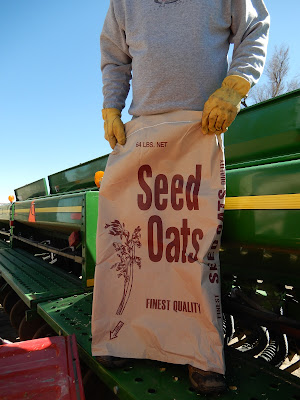
We did, however, plant some oats this spring. This is how the oats look, right out of the seed sack.

Oats are not typically in our crop rotation. This year, Randy planted the oats on March 1 in an old alfalfa field.

He used the drill to sow the oats (which weren't wild, by the way).

(This photo was taken during wheat planting, but it shows the drill.)

He planted oats in the alfalfa so that he could get one more cutting from the field before he worked it up. An alfalfa field is productive about 7 to 8 years.

The oats are also a good source of nutrition for our cattle herd. At the end of May or the first part of June, he will swath the field and then bale it.

Even though we usually don't turn down a rain, he'll be hoping for no moisture on the swathed oats. Oats spoil more quickly than alfalfa if it's rained on.

This photo makes the plants look huge, but it's perspective. I had the camera on the ground and in the "close-up" mode. Still, I wanted to show the two different plants. The "bushy" plant is alfalfa and the grass-like plant is the oats.

It costs about $25.00 per acre to plant the oats, figuring cost of seed and use of the machinery. But it should yield a couple of tons of oats and alfalfa for that last cutting. That will increase the value of the last cutting of the hay and provide good feed for feeder cattle.

And there you have it: Not so wild oats on the County Line.

Thursday, August 26, 2010

Luck of the Draw


What does it take to produce a good stand of alfalfa? I suppose I could innumerate things like a firm seed bed, cooler temperatures and just the right amount of sun and rain.

Those things are all important, according to my personal crop consultant.

But what does it truly take?

Luck.

Yes, there you have it. The definitive answer is luck.

That isn't according to The Old Farmers' Almanac or some crop science teacher at K-State. No, that's just homespun wisdom from a long ago neighbor. This neighbor always seemed to have great success when he planted new fields of alfalfa. Some of his neighbors asked him why his new alfalfa fields always seemed better established and more lush than theirs.

He gave them his advice, full of things like that firm seed bed and planting by the right light of the moon and other assorted wisdom.

And then, as so often happens when we think we have everything all figured out, he ended up with crop failure after crop failure.

It was then that he dispensed his greatest wisdom.

"Well, boys ..." (I can imagine him pronouncing at the coffee shop). "It turns out the most important factor for alfalfa production is ... luck."

Randy decided to try his luck last week when he planted a couple of new fields of alfalfa. And as is so often the case, his luck ran out about 1:30 in the morning on Tuesday. That's when it started raining. And before it was done, it dumped almost 3.5 inches of rain on the newly planted fields.

At church on Sunday, he had told a neighbor that he would order about a quarter inch of rain, slowly dispersed over a day, with the moisture falling gently and evenly on the newly-sown field.

Somehow, the order got mixed up.

Our alfalfa adventure began with a visit to Miller Seed Farm near Hutchinson to pick up seed. Randy did have a little luck involved in this venture before he ever started planting. He won one bag of seed at a customer information meeting earlier in the month. At $200 a bag, that was definitely an evening well-spent (plus he got supper out of the deal, too)!

Another nice by-product of planting alfalfa? It's a great weightlifting exercise to carry all the 50-pound bags into the shop until you're ready to use them. (You will notice that I carried my camera instead of the bags, even though I could probably use a little weight training in my fitness routine.)

He and Jake changed the settings on the drill, since you plant alfalfa seed at a shallower depth than wheat seed.
Last Friday, Randy got a little more weightlifting in when he filled the drills with the alfalfa seed. (Again, I successfully avoided the task by using my camera. Now my friends know why I take so many photos.)

Here's how the alfalfa looked in the drill.

And here's a close-up of the seeds, which are treated with fungicide and inoculant.

He also mixed in a quarter pound of turnip seed to cover the 70 acres we were planting. The turnips provide a little additional cover during the winter on the newly established alfalfa fields. (Plus, his wife is in charge of the church's food area at the fall bazaar. I'm always looking for turnips to sell by the pound. Nice side benefit.)

Jake disked the fields to clear them of weeds and work in the wheat stubble. It also helps create that firm seed bed.

Randy then followed with the planter. The yellow tank on the planter holds fertilizer, which he also applied as he planted the alfalfa.

An alfalfa field produces hay for about seven years, during which we harvest the crop to feed to our cattle and sell the extra.

And then came the rain.

I then learned another tidbit: Alfalfa doesn't like wet feet. Well, I'm not a huge fan either, but I guess it's a little more serious for the alfalfa. If alfalfa is sitting in water for 48 hours, it will die. That's why mudholes in fields never have alfalfa.

But, there were glimmers of hope. Yesterday morning, we were able to find a few hearty sprouts of alfalfa in the field.

My eternal optimist isn't ready to write off the entire crop. However, he figures that replanting is in his future. It costs about $50 an acre for seed each time you plant. (That's why I can never re-do the bathrooms in my house. Alas, such is the life of a Kansas farm wife. There are trials along with the considerable perks.)

So next time, we hope to sprinkle in that ever-so-important factor ... LUCK.