Showing posts with label sunrise tree. Show all posts

Tuesday, April 4, 2023

Let Me Love


syn·chro·nic·i·ty: A meaningful coincidence—an event on the outside that speaks to something on the inside—as opposed to just a random occurrence

Do you ever feel like messages are coming to you like a flashing movie marquee? Or maybe like light breaking through the darkness of predawn, silhouetting a Kansas silo at sunrise?

During Lent, as we've traversed our way toward Holy Week this week, it has seemed that I'm seeing messages about love and light streaming into my mind. It's come in disparate way - listening to scripture at church, watching NCAA basketball, shivering in the coolness of a Kansas morning as I watch the sun's ascent, searching for music for a community Palm Sunday service or opening a series of unrelated emails. 


It has seemed a little like the planets coming together - kind of like we were supposed to see in our night sky last week. While I may not have had success in the nighttime sky realm, I do find messages - or God winks - scattered throughout the minutes of my days. 
 
After my K-State Wildcats defeated the Michigan State Spartans in overtime in the Sweet 16 of the NCAA Tournament, our head coach - Jerome Tang - talked to a sideline reporter and had this to say:
 
"When you love people, it's amazing what you can accomplish."
Jerome Tang, Kansas State University men's basketball coach
after an overtime win in the NCAA tournament 
 
(Photo by Jamie Schwaberow/NCAA Photos via Getty Images)

I immediately sent the quote to my kids and to several friends. Earlier that week, my friend, Linda, and I had gotten together to practice my solo for the Palm Sunday community service. I had combed through lots of music, but I kept coming back to one song called "Let Me Love." 
 
The words include:
Lord, You came to dwell on earth and share with us our lot.
You became our Sacrifice, our lives on Calv'ry bought.
Take this simple life, dear Lord; Take complete control.
Put the love of Jesus in my soul. ...

The song is certainly not showy. It wouldn't be one of those songs to get "The Voice" coaches on TV to hit their buttons and twirl their red chairs. It doesn't cover huge vocal range or have a huge ebb and flow of dynamics. But while the melody and the tune are simple and straightforward, the message isn't necessarily easy. 
 
After we were done practicing, Linda and I sat to chat for a little bit. Just a few weeks before, Stafford had united behind our boys' basketball team as they made their first appearance in 70 years at the state basketball tournament. A sea of red t-shirts filled the stands as the Trojans took to the court. At the time, people commented on Facebook about it bringing the town together. 
 
And it did ... for a little bit.
 
But it didn't take long for us to forget that comradery, that feeling of united purpose. The contentiousness crept back onto Facebook as neighbors railed against other neighbors - with Facebook posts to prove the point. 
 
 
Ripples inevitably spread out from all of us - both positive and negative.
 
Stafford certainly isn't alone in that. Turn on the evening news or scroll through Facebook or Twitter. Do people like being bent out of shape? It sometimes seems so. 

It could be easy to be discouraged by that. And, I sometimes am.
 
But even in the midst of my discouragement, I kept getting related messages.
 
I'm not sure how I got on an email list for an Inspiring Quotes email, but I did. And I often find inspiration from those posts. One recent one featured the words of poet Shel Silverstein:

How much good inside a day?
Depends how good you live ‘em.
How much love inside a friend?
Depends how much you give ‘em
.

– Shel Silverstein 
 “How Many, How Much" from "A Light in the Attic"
Stafford UMC

Another Inspiring Quotes email featured the words of writer Edith Wharton. 

There are two ways of spreading light: 
To be the candle or the mirror that reflects it.
Poet Edith Wharton
 Christ candle & the cross at Stafford United Methodist Church

In other words, carrying on the “light” of another — be it ideas, joy, love, or inspiration — can be just as valuable as creating it yourself.

I saw another post from Character Counts, titled "Courtesy is Kindness in Action." Here's part of what writer Michael Josephson had to say:

As a society, we have become almost obsessed with identifying and asserting our rights – to think, say, and do what we want. That’s not surprising, given the history of our country and the prominent role the Constitution and Bill of Rights have played in shaping our culture.

We have a right to be unkind, thoughtless, and disrespectful – but it isn’t right.

Ralph Waldo Emerson pointed out, “Life is short but there is always time for courtesy.”

The idea is to act in ways that make the people we are dealing with feel valued. Courtesy is kindness in action....Always be kinder than necessary because you can never be too kind.
Michael Josephson


I get several daily devotional emails. Sometimes I find them more meaningful than other days. I'm sure that has more to do with my attitude - not the devotionals themselves. Some days, it's just another confirmation of the other messages that subtly come into my day. 

The devotional New Each Morning had this to say:

Today's Reflection

Each time we step out of our comfort zones and into the messy and sacred world of caring about others, we risk stepping in the confusion of humanity. We may find ourselves asking questions about God and about this world filled with both beauty and affliction. When we share our journeys and questions with one another, our capacities to love and serve with humility, faithfulness, gratitude and peace grow.
- Rebecca Bruff, Loving the World with God: Fourth Day Living (Upper Room Books, 2014)

Today’s Question

 Reflect on the prayer of St. Francis today:
Lord, make me an instrument of your peace.
Where there is hatred, let me sow love.
Where there is injury, pardon.
Where there is doubt, faith,
Where there is despair, hope.
Where there is darkness, light.
And where there is sadness, joy. 
 

Today’s Scripture

And let us consider how to provoke one another to love and good deeds.
Hebrews 10:24 (NRSV)
 
It sounds like a goal to aspire to during this Holy Week. I hope to still find the light in situations - both physically and spiritually.  


Tuesday, November 1, 2022

Sunrise Silhouettes

I'm no stranger to sunrise silhouettes. A tree a half mile south of our house has become my "sunrise tree," and it's been photographed in every season - from leafy silhouette of summer to the stark, bare branches of winter's cold.

An old, unused silo is another of my typical sunrise silhouettes. From our vantage point on the flatlands of Kansas, the silo towers into the sky, giving a focal point for the varied colors and positions of the rising sun in the skies just east of our house. 

Sunrise, October 27, just south of our house on the SF/RN County line

But sunrise at the Arches National Park in Utah provided a unique backdrop to sunrise during our retirement trip in October.

After we were turned away the day before because the park was "too full," we entered Arches before any park rangers could check out Randy's lifetime National Parks pass. But we certainly weren't alone. There were plenty of other cars winding their way up dark, curvy roads, hoping to catch first light. Though moms will tell you, "Don't follow the crowd!" we did in this case, hoping that others might know the best place to watch the sunrise. 


We - and probably 200 others - ended up at the Windows Trail. The photos don't do it justice. But it was one of my favorite experiences during the trip.

While I climbed up some rocks, I wasn't as adventurous as some of these people who actually experienced sunrise inside an arch. (You can see them, if you look closely at the photos.)

The South Window (left) and the North Window (right)

Arches Park contains more than 2,000 natural arches within the maze of red sandstone fins. Arches has the greatest concentration of arches in the country. Water and ice, extreme temperatures and underground salt movement are responsible for the sculptured rock scenery of Arches. Balanced rocks and tall spires add to the landscape.

In the Windows area, you can see many stages of arch formation. Some arches are hard to see because of rock walls behind them. Entrada Sandstone - the rock in which arches are formed - was deposited as sand more than 150 million years ago. Over time, it was buried by new layers, hardened into rock and shaped by the powerful forces of erosion.
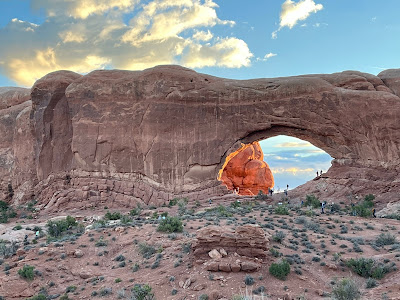

 After the sun was up, the light on the arches changed. But the light show wasn't just to the east. 

As the day dawned, the light cast on rock formations as we looked to the west changed constantly, too.

Even though the rock seems permanent and unchanging, it's not. The landscape of the park continues to change as rain falls, the wind buffets the rock surfaces and erosion occurs. 


 From that parking lot, we could also walk to the Double Arch.


We weren't the only ones trekking to the Double Arch. A wedding party made their way along the path. We could hear the cheers later, as we reached the parking area, when they were announced husband and wife by the park ranger.

It would be a memorable place for a wedding, all right!


 The bride wasn't the only one with a bouquet. Nature provided some flowers as well.


Not all the arches were massive. The arches range in size from a 3-foot opening - the minimum considered an arch - to the longest, Landscape Arch, measuring 306 feet base to base. (I think you must have to hike awhile to see it because we didn't it.) But it does demonstrate how the park constantly evolves. In 1991, a rock slab 60 feet long, 11 feet wide and 4 feet thick fell from the underside of Landscape Arch, leaving behind an even thinner ribbon or rock. 

At the Delicate Arch, the top is a 5-foot-thick layer of Moab Tongue. A remnant of an ancient fin, the arch today has an opening 45 feet high and 33 feet wide. Water and time have sculpted Delicate Arch, and erosion continues to slowly wear away the features. Although it will eventually succumb to the same forces that created it, the arch now stands as an iconic feature of the American West.

Later, in the gift shop, there was a copy of the first known photo taken of the Delicate Arch, back in 1906.


While the arches are the main attraction, there are plenty of other formations, including the Fiery Furnace.


The path to the Sand Dune Arch was like walking on a beach.

We squeezed through narrow fins to find a hidden room, flanked by rock walls.


Arches also includes ancient petrified sand dunes. Some 200 million years ago, the area was covered by extensive sand dunes. Winds from the northwest carried tons of fine-grained sand into the area, creating an immense desert. Over time, the sand drifts were covered by other layers of sediment, compressed and cemented by quartz and calcite into Navajo Sandstone. Erosion has since washed away the overlying layers, exposing the petrified dunes.

Balanced Rock is a boulder more than 55 feet high that rests on top of a 73-foot pedestal. 

When my kids were little, we used to find shapes in the clouds dotting the Kansas skies.

All the different rock formations had me looking for animals and other figures among the rocky spires. 


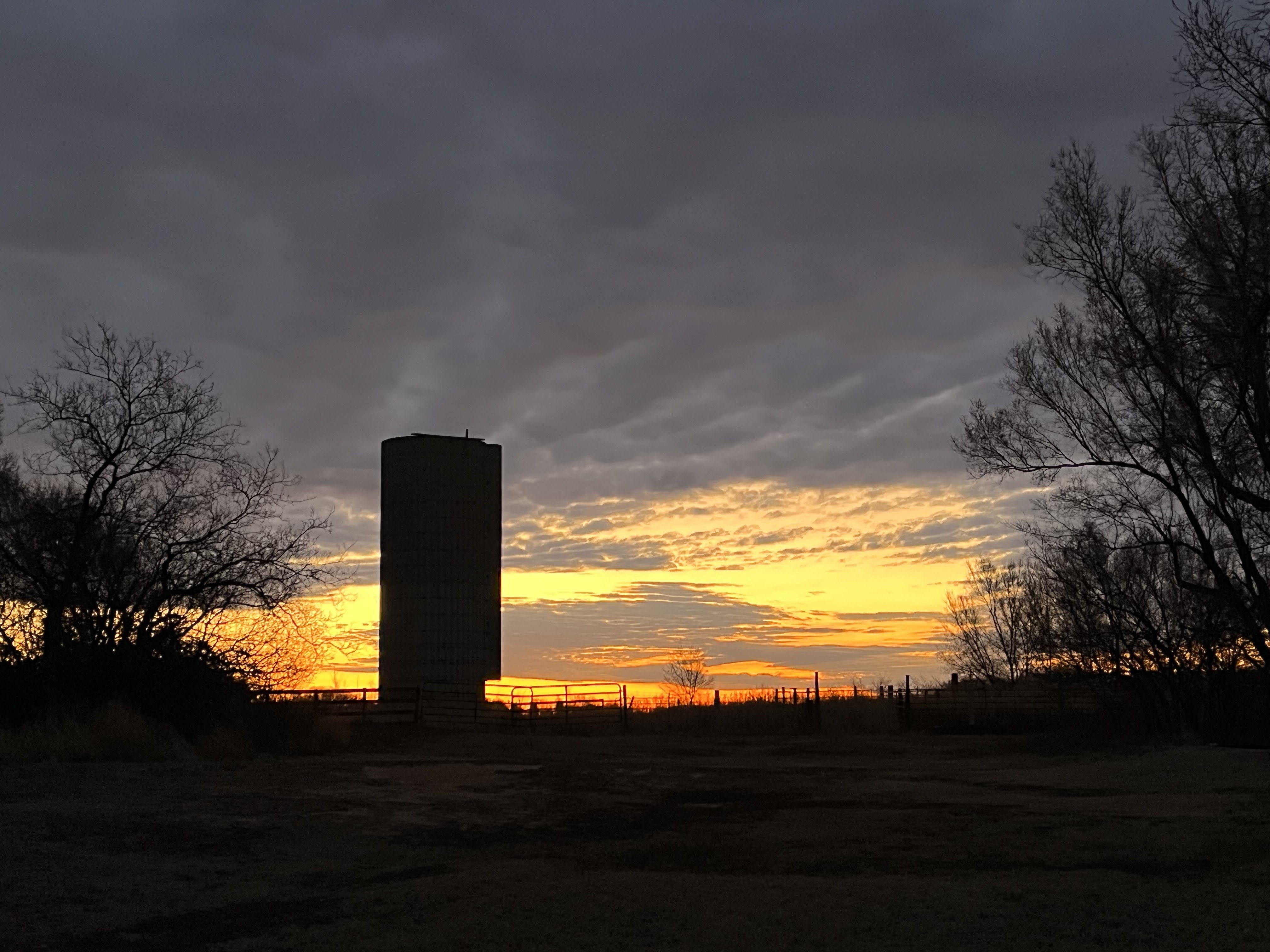
It was too dark to take a photo at the Arches sign as we entered the park before sunrise. So we captured the moment as we left - after a stop in the gift shop, of course.

Thursday, October 8, 2020

Life Is Sow-Sow

Life is sow-sow.  Sow some wheat in this field. Move to another field and sow some wheat there.

Actually, around here, we call the process "planting wheat," but there are those who refer to it as "sowing wheat."

Randy began planting our 2021 winter wheat crop on September 21. He finished up on October 6. For the 2021 crop year, 1,486 of our acres will be devoted to wheat. That's down from last year, when we harvested 1,575 wheat acres, the most we'd ever planted. In 2019, our wheat acres were down because of prevented planting.

We didn't get off to an auspicious start this year. The first day, we had a major breakdown with the tractor used to disc ahead of the planter. I made three or four trips to the field - which, of course, was the furthest location away from the farmstead.  (Kind of like childbirth, I've forgotten the actual number now.) I made a parts run to Hutchinson. Thankfully, I didn't have to make a parts run to Omaha, where we eventually found the part. 

"We'll be glad to pay overnight shipping," I told the clerk, while trying to keep my frazzled farmer calm after a frustrating by-phone and on-line search from cell phone never-never-land.

Thankfully, the parts - though important - were small. And, as I told Randy, overnight shipping was worth every penny. (I must admit I'm glad the parts weighed ounces, not pounds. But still ...)

As is always the case, there have been frustrating breakdowns along the way. But there have been bright spots, too. Literally.

On the first day of October, I rushed out the door after glimpsing the sky through our tree-lined farmstead. I drove to an unobstructed vantage point for the perfect way to start the day.
It's amazing to me how the sky changes in just the seconds it takes to travel a little further down the road. It's kind of a reminder that life can be like that, too. It can change in seconds, so I'd better appreciate living it - breakdowns and all.

But back to the facts. Here in Central Kansas, we plant winter wheat. It's planted in the fall and then goes dormant during the cold months of winter before coming out of its "hibernation" and growing again next spring, then maturing for a June (or July) harvest. 


We saved some of our 2020 crop in bins on the farm to use as seed wheat. It's binned during harvest, and then we load it into the truck to take to Miller Seed Farms near Partridge for cleaning. They treat it with a fungicide, which helps protect the small wheat plants from disease. It's also treated with an insecticide which helps keep bugs at bay. (Those treatments are what gives the wheat its pink tinge.) Then we auger it back into storage bins until it's time to plant. (Photo above.)

When it's time for planting, we load the binned wheat into a grain truck and deliver it to the field, where Randy uses an auger system to transfer it from the truck to the drill.


We also buy some certified seed from Miller Seed Farm to plant for our own seed wheat for the following year. This helps keep the purity in the seed. 


This year, Randy bought Bob Dole and Zenda for our certified seed wheat.

Since I'm the one who transported the bagged seed wheat from Miller's to home, I like to joke that I chauffeured Bob Dole.


I also fulfilled another vital job - sack stomping. It's the Kansas farm wife equivalent of grape stomping. That way, we could keep the sacks corralled until we could dispose of them.


Another of my duties was worrying as Randy climbed to the top of the slick wheat truck bed to sweep kernels down to the bottom as we finished up the final field.

OK, worrying wasn't in my job description from Randy. I was supposed to be augering the remaining wheat into the drill as Randy scooped.

Thankfully, we both completed our tasks without incident. 

As with every planting season, I think about the optimism that seems to be part of the fabric of every farmer. They put a seed in the ground and then wait like a kid on Christmas morning. 


They slow down as they pass a planted field, just waiting for that first glimmer of green.


And sprinkled in among the breakdowns and the frustrations, there are the beautiful skies that remind us to be thankful for each day and moment.

And we wait for yet another miracle - 9 months in the making.