Thursday, March 18, 2021

Score with a Snack Buffet

From upper left: Cheese Popcorn, chips (purchased), Toffee Snack Mix, Wholly Guacamole, Chipotle Raspberry Black Bean Dip, shrimp cocktail (purchased), Recipe links are at the bottom of this post.
 

It's NCAA tournament week. It's time for basketball and for the hoops version of a tailgate party.

The tournament won't look the same this year. The stands won't be packed with fans. The teams are all congregating in "bubble format" at venues near Indianapolis.

And it's likely the big watch parties of years gone by will be "bye-bye" for another year. But after 2020 when the NCAA tourney was stopped before it ever started, it's still good news for basketball fans to contemplate hours of watching the Big Dance.

We had our own Super Bowl watch party back in February. Yes, just us two. (That's where the photo above originated with some tweaks for round ball.) So we may just have to have our own NCAA snack buffet, too ... even if my K-State Wildcats will not be making an appearance this year. I have the Big 12's teams circled on my bracket so I don't miss any of the action. And Wichita State University attempts to play into the tournament in a game tonight.

One of the new snacks I tried for our Super Bowl party was a Chipotle Raspberry Black Bean Dip. I had a hankering for a dip that's popular at So Long Saloon in Manhattan. (Ah, the pre-pandemic days of restaurant dining ... and trips to Manhattan!) And I even found a recipe from Cooking for Keeps blog that mentioned So Long and Aggieville by name!

The blog's author - Nicole - is a fellow K-State alum. So I was excited to try her version of the restaurant dip. It didn't disappoint. 
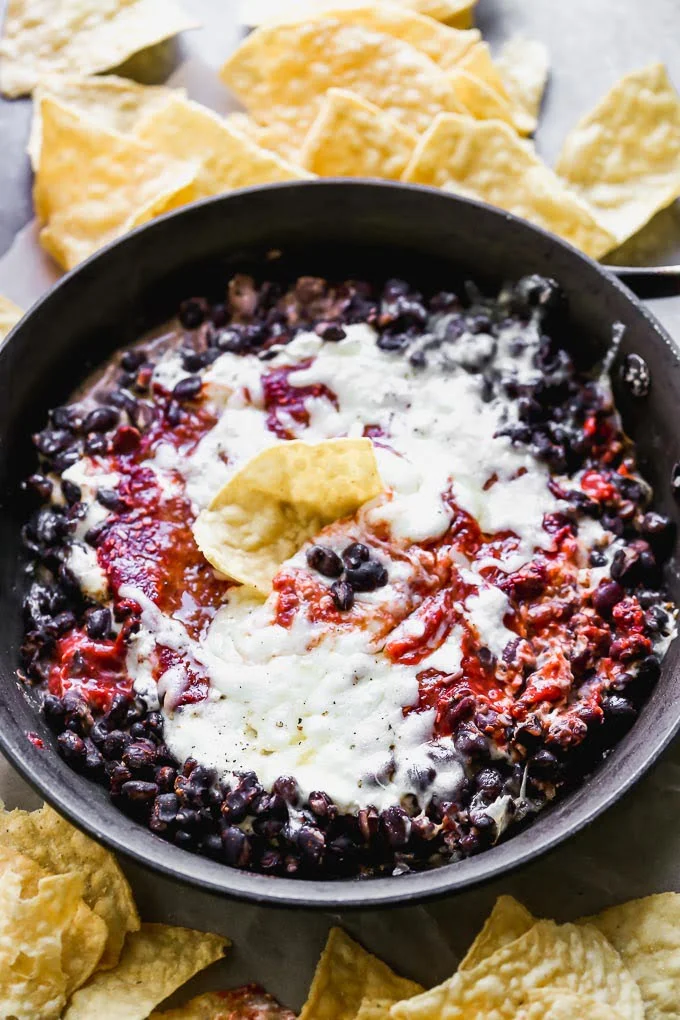
Photo from Cooking for Keeps. For more information and lots more about the recipe, go to the Cooking for Keeps blog.

Nicole's version used fresh raspberries as the base for the sauce, rather than purchasing a bottled salsa or sauce. Score!

Chipotle Raspberry Black Bean Dip
From Cooking for Keeps blog

1 tbsp. olive oil, divided
1/2 cup diced onion
2 large garlic cloves, minced and divided
10 oz. raspberries
1/4 cup + 1 tbsp water
1/8 cup white sugar
1 canned chipotle pepper in adobo sauce
2 tsp. adobo sauce (from the canned chipotles)
1 14-oz. can black beans, rinsed and drained
1/4 tsp. chili powder
1/2 tsp. salt, divided
6 oz. cream cheese
1/2 cup shredded Monterey Jack cheese
 
Preheat oven to 375 degrees.

Heat an oven-proof medium skillet to a medium heat. (Cast iron works well if you have it, but don't worry if you don't.) Add 2 teaspoons olive oil. Once the oil is hot, add onion and 1 garlic clove and cook until slightly softened, about 2 minutes. Add raspberries, 1/4 cup water, sugar, chipotle pepper, adobo sauce, and salt. Bring to a boil and reduce to a simmer. Simmer until the raspberries break down, stirring occasionally, about 5-7 minutes.

Transfer the mixture to a blender or use an immersion blender and blend until smooth. Season with salt and pepper. If you want your sauce a little bit spicier, add more adobo sauce or chopped chipotle peppers until you reach your desired heat level. (It was plenty hot for Randy and me, but our kids tease us about our low spice threshold!)

Rinse the pan you cooked the sauce in and wipe clean. Add remaining olive oil to the pan. Heat over a medium flame. Add remaining garlic; sweat 1 minute. Add black beans, water, chili powder and remaining salt. Saute until garlic is softened, about 2-3 minutes.

Push the black beans to the side and put the cream cheese in the middle. Cover with sauce. Sprinkle with cheese. Bake until the dip is hot and bubbly, and the cheese has melted, about 10 minutes. Serve with tortilla chips. 
 
NOTE: As I indicated, I don't have a cast iron or oven-proof skillet, so I just assembled the components in a square glass baking dish. You can still bake until the dip is hot, bubbly and melty. 
 
For the other snacks pictured at the top, visit the links below:
 
WARNING: Neon yellow fingers are a side effect of this snack. Cheese Popcorn.
 
If you want to get really fancy like a popcorn specialty shop, combine cheese popcorn and Caramel Corn. (Click here for the Caramel Corn recipe.) 


Toffee Snack Mix

You can always search my blog for tried-and-true recipes. Type in "sandwiches," "meatballs," "snack mix," "drop cookies," "dips," "bar cookies," etc., in the search engine in the upper lefthand corner of the blog. It will give you lots of options.


Tuesday, March 16, 2021

Top Dressing

This must qualify as a form of "topdressing," too. The sun "dressing" a dewy wheat field this morning.

 I talked to my son-in-law during the work day last week. His mom - AKA Grandma Christy - was keeping the girls during their spring break from school while Jill and Eric worked.

Christy and the girls Facetimed with me to show the volcano they'd constructed from a Little Passports box. (Randy & I and my folks teamed up to gift Brooke with a monthly subscription to Little Passports for her last birthday. Kinley gets a year of monthly Kiwi Crates.)

Anyway, Eric got drawn briefly into the conversation since the girls had moved downstairs to show me yet another project. Jill is back in her downtown office, but Eric is still working from their spare bedroom where he's been ensconced for the past year.

Christy told Eric to back up from the camera so I could see the full fashion statement he was making. Yes, like many work-at-home staffers during the pandemic, he was business on top and plaid flannel pants and warm socks on the bottom.

That's the pandemic version of "top dressing."

 
We have arranged for "topdressing" of another variety on our 2021 wheat crop. The Kanza Co-op sprayed our wheat on February 22 and 23 with 20 pounds of nitrogen per acre, along with Finesse herbicide. Because it's sprayed "on top" of the crop which was planted this past fall, it's called "topdressing."

Randy was hoping to get the task done before it rained. Mission accomplished. Just a few days later, it rained about 0.40". Then, this past weekend, we got another 1.55 inches of rain.

The rain helps incorporate the nitrogen and herbicide into the root system, making it more effective. 


The rain and some warmer temperatures have made the wheat seem to grow overnight. (You can see the difference in the photos between February 22 and March 15.) 

This year, Randy decided to apply 20 pounds of nitrogen per acre. He used the results from soil samples to determine the nitrogen application level. With each unit of nitrogen added to the field, there's a "diminishing return on investment." In other words, the cost eventually outweighs the potential yield bump.


His original plan for this year was to have the co-op apply 10 pounds of nitrogen per acre. However, with a bump in wheat price, he decided to up the application rate.

During the applicator's same trip over the field, Randy also had them apply Finesse, an herbicide used to control broadleaf weeds, including kochia, henbit and wild mustard. Finesse needs to be sprayed before the wheat breaks its dormancy. Rain helps incorporate it into the soil. 

The Farmer is happy and already looking forward to Harvest 2021! However, just like in a fairytale, there are a lot of pages between "Once upon a time" and "They lived happily ever after." (For a complete look at the life cycle of wheat on our Kansas farm, check out "Aggie Visits the Wheat State," a blog I wrote a few years ago when we had Flat Aggie visit from a California elementary school.) 

Thursday, March 11, 2021

Luck of the Irish: Soda Bread


Top o' the mornin' to you!

I have shamrocks and leprechauns out at home as St. Patrick's Day approaches on March 17. When the kids were little, we always changed table and mantel decor and did little crafts for the holidays. And even though I just do it for myself these days, I still pull out each seasonal tub and make the holiday transitions. (Randy doesn't really care ... as long as he doesn't have to do it.)

It made me think about a quick bread recipe I used to make with my 4-H cooking kids - Irish Soda Bread. It was a fun March meeting for beginning cooks. There's no yeast involved, and there's a tasty product in a fraction of the time. At this point, I don't remember where I got the original recipe.

The bread is best served warm. I continued the Irish theme by serving it with baked potatoes topped with Goop. The potatoes are Irish ... the Goop not so much. It's way better than it sounds. But a fun family St. Patrick's Day dinner would be a baked potato bar with lots of different toppings to suit every taste. Serve a fresh green salad on the side to complete the meal.

Even though the bread is best still warm, Randy will vouch for it later in the day, too, spread with a little cherry jam we got as a Christmas gift.

If you have kids or grandkids who need a weekend kitchen project, Irish Soda Bread is a good one to try. (It is supposed to be chilly and rainy this weekend around here, so a kitchen project sounds good.)

Other fun St. Patrick Day ideas, especially for kids:

  • Take 2 refrigerated biscuits per child and tear each in half. Place three of the pieces together to form a shamrock and use the other one to roll into a stem. Sprinkle with green sugar and bake.
  • Another easy green treat: Combine equal parts cream cheese and marshmallow cream. Tint green and serve as dip for green apples.
  • Gold Cookies (for the pot of gold at the end of the rainbow!): Take two Ritz crackers. Put peanut butter between them. Dip them in melted butterscotch chips. Place on waxed paper until set up.
  • Substitute Lucky Charms for some (or all) of the cereal in your Rice Krispie treats.

Here's hoping you find some St. Patrick's Day "Luck o' the Irish" at the end of your rainbow ... or in your kitchen. (There are some more ideas and links after the Irish Soda Bread recipe.)

Irish Soda Bread

2 1/2 cups all-purpose flour
3 tbsp. sugar
2 tsp. baking powder
1 tsp. baking soda
1/2 tsp. salt
1/3 cup cold butter (no substitutes)
1 1/4 cups buttermilk**
1/2 cup currants, raisins or dried cranberries

Note: The original recipe called for currants or raisins. I used dried cranberries this time.

Heat oven to 375 degrees. Combine all ingredients except buttermilk and dried fruit in large bowl; cut in butter with pastry blender until mixture resembles coarse crumbs. Stir in dried fruit. Add buttermilk and stir until just moistened.

Turn dough onto lightly floured surface; knead gently 10 times. Shape into ball. Place on parchment paper on a baking sheet. Pat into 6-inch circle. Cut 1/2-inch deep "X" in top of dough with sharp knife.

Bake for 30 to 35 minutes or until golden brown. Serve warm.

Recipe note: If you don't have buttermilk, substitute 4 teaspoons vinegar or lemon juice plus enough milk to equal 1 1/4 cups. Let stand 10 minutes before using.

Here are some other St. Patty's Day foods I've shared here in the past:

Good As Gold Snack Mix

Kinley and Brooke helped me make these Mint Chocolate Chip Cookies when they were visiting a year ago:

I made those same cookies for the Core meal I delivered to the church this week. I figured they might enjoy a little holiday-themed treat, too!

For a main dish with an Irish twist, try Reuben Crescent Bake. (Well, at least, it's got corned beef and cabbage. I don't think it's very Irish.)

For cabbage minus the corned beef, try this slaw recipe:

Slaw Salad 

May your troubles be less and your blessings be more
And nothing but happiness come through your door.


Tuesday, March 9, 2021

Bird Brain

Bird brain:  It could be a derogatory label. But I will just say I have birds on the brain.

As I wrote earlier this winter, I've been on a quest for photographing a pheasant. I see plenty of pheasants. But no one gave them the memo that I would like for them to:
  1. Stand still.
  2. Stand in a location with good lighting.
  3. Come close enough to the road for my camera.
It hasn't just been a desire this winter. I've wanted a pheasant photo for years. 

And it finally happened. 
It's not perfect, but it's the best I've ever gotten.


 Most of them looked like this ...

... somewhat blurry ...

The backyard cardinals are somewhat more cooperative, but I still have to stealthily shoot through the back porch windows.

 (Yes, those windows should probably be washed if I'm going to attempt photography through them!)
As I was coming out of the pasture in the feed truck one snowy day, I found a meadowlark crouched down on a hay bale. It was one of those frigid days, so I guess he was too cold to fly away.

This better photo was from a fence-fencing escapade a couple of years ago.
 
While I'd like the pheasants and the cardinals to hold still for their closeups, we'd prefer that the snow geese depart from our wheat and silage fields. We don't really care about them hanging out on the silage ground, since it was harvested last September. But they invariably drift over onto the nearby wheat ground.

We chased thousands of them off the fields before feeding cattle a couple of days. 

While hunters are glad to see them, they do a lot of damage eating the green wheat in our fields. Hungry geese can decimate a wheat field fairly quickly.

Uninvited guests can wreak havoc at a party. No Kansas wheat farmer wants to provide a never-ending buffet for tens of thousands of geese. But, migrating geese evidently saw an all-you-can-eat buffet sign flashing green from the heavens. And they said, "Don't mind if I do!"

Farmers try to send them on their way by honking their horns and making more drivebys than a police cruiser trying to clean up a shady neighborhood. But about as soon as farmers moseyed on down the road to the next location, the geese circled back for another taste of tender green wheat.

While hunters might have enjoyed the influx of geese in Central Kansas, wheat farmers prefer the feathered beasts find their buffet elsewhere, since they can eat a young wheat field to bare ground faster than a teenage boy and his friends can plow through a bag of chips.

Thursday, March 4, 2021

Tortellini Primavera


It's a sad state of affairs. Our freezer is dangerously close to running out of beef. When the pandemic hit last year and grocery stores were having trouble stocking essentials, consumers suddenly wanted to purchase beef and other meats from farmers and ranchers.
 
That's a great thing for the industry. But it created a new problem. Suddenly, producers were booking extra harvest dates for their animals at the small butcher shops. 
 
It pushed wait times for appointments to more than a year away. We called our processing plant a year ago. The first available date was September 2021!
 
While we normally would have butchered a couple of steers this spring, we are now waiting until September. I'm already out of our homegrown hamburger, and I've already gone through the first extra 20 pounds we purchased from Ellinwood Packing. 

So I've found some recipes that don't use my go-to freezer beef. This Tortellini Primavera was one we enjoyed. 

It's loaded with veggies. It also used up some frozen tri-color tortellini that had been hanging around in my freezer. So win-win!
 
If you have leftovers, add a splash of cream or milk. Pasta always absorbs liquid after it's refrigerated.  

Enjoy!
 
 
Tortellini Primavera
Adapted from The Pioneer Woman blog
 
2 tbsp. butter
1 small onion, finely diced
2 cloves garlic, minced (you can use jarred minced garlic)
3 whole carrots, peeled and diced
1 cup broccoli florets, rough chopped
1/2 cup chicken broth 
1/3 cup heavy cream
1/2 cup grated Parmesan cheese
Salt and pepper to taste
3/4 cup cooked ham, diced
1 cup frozen peas
1 pound cheese, spinach or tri-color tortellini
Extra Parmesan for serving

Cook tortellini a couple of minutes less than package directions call for. Drain and set aside.

Melt butter in a large skillet over medium-high heat. Add onion and garlic and cook for 1 minute. Add carrots and broccoli, stir and cook for another 2 minutes. Add chicken broth, and cook for another 2-3 minutes until the liquid reduces a bit. Stir in cream and 1/2 cup grated Parmesan and stir.

When the mixture is hot and a cream sauce has formed, stir in peas, ham, salt and pepper. Allow them to heat through. When the sauce is hot, stir in the tortellini. Check seasonings and add more salt and/or pepper, if needed. Allow the pasta to heat back up, then serve with extra Parmesan. Serves 6.

If you have leftovers, add a splash of cream or milk. Pasta always absorbs liquid after it's refrigerated.


Tuesday, March 2, 2021

Orange "Earrings" and Vision Tests

I had one of those peripheral vision tests at the eye doctor a week ago. As a firstborn with test anxiety, I absolutely hate those blinking lights and the pressure to click my little signaling button at the correct times. 

"Did I miss one?" "Why is there so much time between blinks?" "Am I going BLIND?"

I have horrible eyesight: It's -6 in the right eye and -7.5 in the left - whatever that means. In real life, it means that my glasses are the first thing I put on in the morning and the last thing that hit the bedside table at night.


I had a vision test of another kind last week, too. It was just as difficult. It involved trying to pick out little orange "earrings" on feeder calves while they were moving. I didn't take any photos of the sorting process that day. As Randy says, I was a little busy at the time. But I found a photo I took from the feed truck which demonstrates what a challenge this eye test can be. 

Here' a better look at the tag from a different sorting event several years ago. 

Last week, we gathered the feeder calves so we could sort the heifers (girls) from the steers.


We've been feeding them silage and hay since we weaned them from their mothers last fall.

Once we had the 95 calves up in the sorting pen, our mission was to sort the heifers with the calfhood vaccination tags from the steers and the unbanded heifers.

Easier said than done. It's not easy for people with good vision to see the orange tag on the right ear. It definitely raises the level of difficulty for someone with poor vision like me!

We retain 25 heifers which were calfhood vaccinated last fall as replacement heifers for our herd. The heifers will have their first babies next January/February 2022. The heifers without the calfhood vaccinations and the steers made a trip to the Pratt Livestock sale barn last week.

To sort, we keep running the calves into smaller corrals. Randy and I were the sorters. Our neighbor, Todd, ran the gate in case one - or more - got past us. Besides the fact that the orange tags are pretty tiny on a 650-pound animal, it seems they further complicate the task by turning their rear ends toward us instead of facing forward. They also have their winter hair, which sometimes makes it hard to see their orange vaccination band on hairy ears, especially at a glance.

Last November, Dr. Bruce Figger came to the County Line to help us work calves that had been born last winter. As heifers came through the chute, Randy would decide whether or not it was one he would potentially want to add to our herd. If she was in good body condition and had good confirmation. Dr. Bruce would give her a calfhood vaccination.

The vaccination  prevents brucellosis, also known as "bangs." This disease causes abortion or premature calving. The vaccination must be performed by an accredited veterinarian, in compliance with state and national regulations.
Dr. Bruce uses a device to "tattoo" the animal to show it had received the brucellosis vaccination. Then he used green ink to mark the tattoo.

The orange "bands" help identify the calves who've been calfhood vaccinated. Most of these heifers become part of our cow-calf herd and will have their first calves in 2022 as 2 year olds. 

After sorting, the 25 heifers were sent into a separate lot, and the remainder went back to the pasture until Wednesday morning, when the semi truck arrived to take them to the sale barn. 

Selling cattle always puts a smile on the farmer's face.


 (I was smiling for a different reason. We didn't have to complete this task the previous week - when it was -14F. And I wasn't the one having to back the semi up!)


Though we have two farm-sized cattle trailers, it would take several trips to get all the cattle to the sale barn. So we hired Darrel Harner Trucking to do our hauling to market.

The semi is divided into different compartments, which can hold anywhere from two head to 25 head of cattle. Darrel told us how many calves he wanted at a time to load the semi, and we sent them on their way.

We met Darrel and the cattle at the Pratt Livestock sale barn for the unloading.

With semis and small trailers coming into the sale barn yards, it was like a traffic jam - country style.
 
The sale barn personnel count the cattle as they come off the truck.

After they're unloaded, the cattle are put into different lots to await sale day.

Last Thursday, the Pratt sale barn had some 4,200 cattle go through the auction ring. Ours were among them.

The price on feeder calves is down some. But it's still a good feeling to get a paycheck for all the work.


We sold 27 heifers (average weight of 614 pounds each) and 43 steers (average weight 734 pounds each.) 

January 2020 - 2nd calf born in 2020.

It's an end to a year-long journey, which began with their birth last winter. There were plenty of chapters to the story between then and now ...


... from working calves on our 39th wedding anniversary (note the ear tag number) ...


 ... to sorting, loading and transporting the calves and their moms to summer pasture ...

 ... to gathering and bringing them back home again in the fall ....

... working them again ... (missed photos of that this year) ...

 
... and feeding them every day since then - rain, snow or shine.
 

Au revoir to much of the Class of 2020! (We're still feeding and watering the replacement heifers and all the other cows until we move them to summer pasture in May.)