Showing posts with label Kentucky. Show all posts

Wednesday, December 4, 2013

Love Came Down at Christmas

My house still doesn't reflect any Christmas spirit after our trip.  (I did get all the Thanksgiving "stuff" gathered up yesterday.) But even though our tree is still in the cardboard box and the Nativity sets are likewise cushioned safely in their plastic tubs, I've been thinking about Christmas ever since our visit to Morehead (KY) State University last week. 

The bell tower in the center of the campus was decorated for Christmas. When I saw the tower and the snow-dusted world on Thanksgiving Eve, a song kept going through my head:

What the world needs now is love, sweet love.
It's the only thing that there's just too little of.
What the world needs now is love, sweet love.
No, not just for some, but for everyone.

The bell tower was presented to Morehead State University in April 1997 as a tribute to Kentucky horse breeder William Paul Little by his wife, Mary Caudill Little, who was an advocate of education through the creativity of the arts. Each of the tower's four sides feature a virtue important to the Littles:
WISDOM
You can barely see WISDOM through the eagle's wing from this angle.
SERVICE  (and love) ...

JUSTICE (and love). 

When I got back home, I realized that LOVE kept showing up in my shots of the bell tower. How fitting was that! (The greatest of these is LOVE. I Corinthians 13:13)

As the carol says,
Love came down at Christmas
Love all lovely, love divine
Love was born at Christmas
Star and angels gave the sign. 

 
Maybe if we incorporated a little more love into our daily lives, we, too, could fly like eagles in the face of our too-busy lives. Worth a try, right?
Those who hope in the Lord
    will renew their strength.
They will soar on wings like eagles;
    they will run and not grow weary,
    they will walk and not be faint.
Isaiah 40: 31

That's a message I need to hear during this busy holiday season.

***
Today, I'm linked to Jennifer Dukes Lee's Tell His Story and to Emily P. Freeman's Chatting at the Sky. 

***
Another interesting fact about the bell tower:  The bell came from the Littles' Palmeadow Farm. Cast in 1886 by the C.S. Bell Company of Hillsboro, Ohio, the iron bell is one year older than Morehead State University.

Friday, February 15, 2013

Looavul, Looeyville, Luhval???

On the Louisville Convention & Visitors Bureau brochure, see www.gotolouisville.com
Now that Brent has lived away from Kansas for a couple of years, we hear a little regional dialect creep into his language. After stints in South Carolina for grad school and his current domicile in Kentucky, "Y'all" seems to be part of his vernacular -  in speech and via text mesage. (He contends it's pretty efficient for texting. I suppose he's right.)

It led to an interesting discussion about how to pronounce the Kentucky city, Louisville. After seeing the city's brochure, I don't think we're the only family having that discussion. (Kudos to that marketing specialist. How clever is that?!)

Louisville was one of our stops as we made our way from Kansas to Kentucky. We certainly didn't see it all, and we hope to see more attractions on a return trip during warmer weather. (It's a recurring theme from this trip. What did we expect in January?)
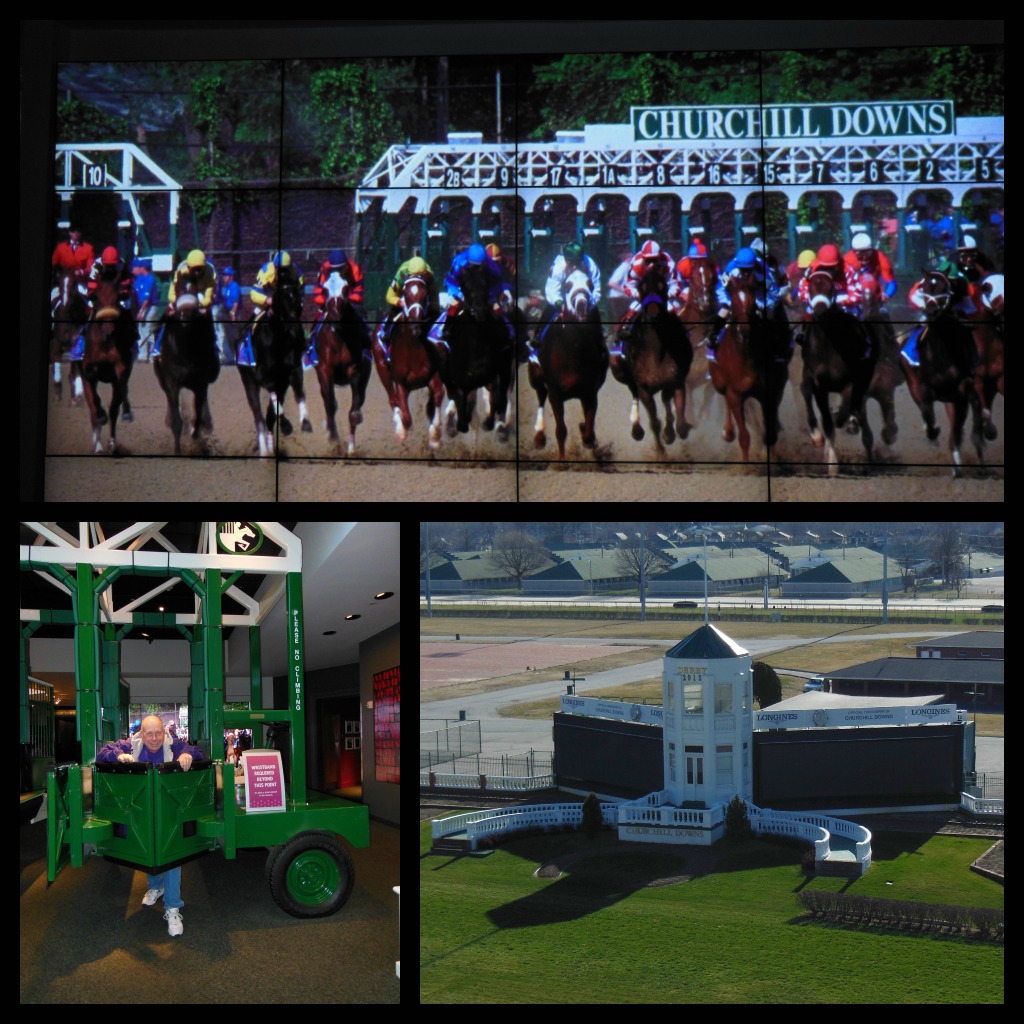
Churchill Downs was one of our stops on the whirlwind tour of Louisville. We got our own private, behind-the-scenes tour of the grounds. Our tour guide took us into the suite where the Queen of England watched the Kentucky Derby. (I don't think that was a regular part of the tour, but the guide was cold, too.)
The guide was a native Louisville resident, whose family had a box at Churchill Downs for many years. He says he also spent one Kentucky Derby of his youth in the infield during the great race. People who "watch" from there likely won't see a horse all day, he contends. He told of one of his friends who shimmied up a flagpole and then spent Derby Day in one of the four holding cells in the infield.
We didn't see any racing. The top photo was a huge video screen in the museum.
Racing in Louisville dates back to 1783 when races were held on Market Street in the downtown area. Churchill Downs was born after 26-year-old Col. M. Lewis Clark traveled in England and France in 1872-1873. After his return from Europe, Clark began development of his racetrack which would serve to showcase the Kentucky breeding industry. The track would eventually become known as "Churchill Downs."

To fund the construction of the track, Clark raised $32,000 by selling 320 membership subscriptions to the track at $100 each. Eighty acres of land, approximately three miles south of downtown were leased from Clark's uncles, John and Henry Churchill. A clubhouse, grandstand, porter's lodge and six stables were all eventually constructed on the site for the opening of the track. For his inaugural race meet, Clark designed his three major stakes races, the Kentucky Derby, Kentucky Oaks and Clark Handicap, after the three premier races in England, the Epsom Derby.

And the rest, as they say, is history. (For more on the history, visit the Churchill Downs website.) The 139th running of the Kentucky Derby will be May 4.
 
We also spent some time at the Louisville Slugger factory. They are big on history, too (about as big as that bat that towers 120 feet at the Main Street museum).  J. Frederick Hillerich emigrated with his family from Baden-Baden, Germany to Baltimore, Maryland in 1842. The Hillerichs moved to Louisville in 1856, where J. Fred started a woodworking shop, making everything from butter churns to bedposts.

In 1880, Bud Hillerich (J. Frederick's oldest son) became an apprentice in his father's shop. An amateur baseball player, Bud made his own baseball bats along with bats for several of his teammates. According to company legend, the first pro bat was turned by Bud for Pete Browning in 1884. Browning was a star on Louisville's professional American Association team, the Eclipse.

The success of the growing bat company was further enhanced in 1905 when Honus "The Flying Dutchman" Wagner, a shortstop for the Pittsburgh Pirates, signed a contract as the first player ever to endorse a bat. His autograph was also the first to be used on a bat and the first time a professional athlete endorsed an athletic product. (For more on the factory, museum and history, visit their website.)
It's kind of amazing how a little "hometown" company can evolve. Each day, the Louisvlle Slugger factory turns 2,000 to 5,000 wooden bats for professional and recreational players, plus an additional 4,000 to 5,000 mini bats.
I'm holding my mini bat after our tour.
Next time we're in Louisville, I'm going to find a place that serves Hot Browns, a sandwich made famous by the Brown Hotel. We ate at a local sandwich shop not far from the Louisville Slugger Museum, but we had to settle for reubens there.

We learned about Hot Browns while walking at the mall in Columbia, Mo., where we stayed overnight on the way to Morehead. While Randy was waiting on me to finish walking, he sat at a table with some locals. (I texted both Jill and Brent that Dad had made new friends. No one was surprised.) Anyway, one of the guys recommended eating a Hot Brown. After seeing the recipe once we got home, I would have had to do a whole lot more walking to walk that off. Until next time, I guess.

We're looking forward to a repeat visit to Louisville ... Looeyville ... Luhval ... Looavul - whatever you want to call it!

Wednesday, February 13, 2013

A Horse of Course!

We brought Kinley a horse from Kentucky. Lucky for Jill and Eric, it was stuffed. Unlucky for them, a 13-month-old needs help zipping and unzipping her horse into its handy carrying case. (Just remember how many Barbie dolls I dressed and undressed for a certain someone, once upon a time.)
The stuffed horse was practically the only horse we did see at Keeneland Race Track at Lexington, Kentucky. We got up before dawn in Morehead to make the hour-long drive to Lexington. Last fall, my parents watched a morning workout at the race track while traveling back with a tour group that attended the K-State & West Virginia football game. Of course, that was in October, not January, but Keeneland's website proclaimed that mornings were the best time of day at the racetrack because that's when the horses workout. This was the scene we got instead.
The website needs an asterisk. Horses don't work out when the temperature is 16 degrees. Duly noted by this Kansas farm couple who were admitted into the stadium by a kind guard.
We saw the finish line - just no horses to run past it. We did eat breakfast at what the website calls one of Lexington's best-kept dining secrets, the Track Kitchen. I'm not sure I'd go that far. Randy compared it to eating breakfast in town with his farming buddies. But, instead of talking about rain (or lack thereof), the locals were talking about the cold. We also shared the tables with some of Keeneland's workers, who came in for a hot breakfast on a very cold morning.

Down the road on a neighboring farm, we finally did see some horses and their bundled-up riders.
Honestly, we couldn't blame Keeneland for keeping the horses inside on such a frigid morning.
 
We don't think these riders were jockeys, since they seemed normal sized. The only jockeys we saw were these statues near the stadium.
I had to take a picture of this one: Even though it wasn't representing Morehead State, it sure looked like it could have.
Since we didn't get enough of the cold at Keeneland (Is my sarcasm meter going off?),  we then went to the Kentucky Horse Park. As we walked in, the lady who took our money said, "Oh, a few more crazy people!" Yes, we concur.
The horse at the top is Funny Cide.
We met a retired Kentucky Derby winner, Funny Cide, and Da Hoss, who is one of only two horses to win two Breeders' Cup trophies. We checked out Cigar, who earned $9.9 million over his racing lifetime and is a descendent of Seattle Slew. Next time we visit, we'll have to pick a warmer day. That gives us a reason for another visit to Brent's, right?

Tuesday, February 12, 2013

From the Mixed-Up Files of Kim Fritzemeier

Rural Lexington, Kentucky
When I was a child, I loved the book, From the Mixed-Up Files of Mrs. Basil E. Frankweiler by E.L. Konigsburg. (It was published in 1967 - when I was 10 - and received the annual Newbery Medal for excellence in American children's literature in 1968.)

Anyway, since returning from visiting Brent in Morehead, Kentucky, I think Kim's County Line has had that mixed-up quality. It's not that this space is ever all about one subject. Still, I've written a couple of posts from our trip, but more timely things have crept into the forefront.

So, from the Mixed Up Files of Kim Fritzemeier (which won't win any Newbury Awards by the way), I thought I'd return to Kentucky and points in between. (But, just know that it may not be a straight line to the end of these travel posts.)

Though Kentucky is bluegrass country, you can't tell it in January. It was bitterly cold the week we were there. But even though the grasses were more brown than blue-green - just like home - it was still beautiful country.
Named for the color of its calcium- and phosphate-enriched grass, the bluegrass region was settled by Europeans in the 1780s. By the mid-nineteenth century, agrarian-based industries such as tobacco farming and bourbon distillation sprang up there, along with breeding and racing of prized horses.
 
The days were overcast, but there was beauty in the quiet. There's weren't many horses outside their fancy barns since it was unseasonably cold, but there was beauty in horse country just the same.
I had to use the telephoto lens to find any horses at all!
Historically, barns in Kentucky and other tobacco states are black, brown, or some other dark color to help heat the barn where tobacco was curing. The black fences aren't painted, but rather, covered with creosote, a black tar-like substance. One internet source said that the creosote keeps the horses from chewing on the fence. 
Kentucky also provided my first look at a covered bridge. There are 13 left in the state. Though a brochure said there are eight in the Morehead region and surrounding counties, we only found one before dusk and before we needed to be back to town for a Morehead State basketball game.
I loved how the old church was framed by looking through the bridge. You could still drive through this bridge on your way to this church and some houses.
The Goddard "White" Bridge in Fleming County is the only surviving example of the Ithiel Town Lattice design in Kentucky. The timbers are joined with wooden pegs (tree-nails).  The sign said that the date of its construction is unknown; however, a pamphlet we picked up in the Daniel Boone National Forest said it was built in 1820. It may be the oldest covered bridge in Kentucky still open to traffic. The 63-foot span was restored in 1968.
Just to the north of the bridge was this barn, a part of the Foothills Quilt Trail. Though we saw lots of quilt pieces on barns and other buildings, this is the only one I got a photo of, since we were already stopped. The Foothills Quilt Trail is a multi-county and multi-state project which honors both quilting and farming, two important aspects of Kentucky culture.
It was beautiful country, even in the cold of winter and even though my fingers got mighty chilly taking all the photos. The price for beauty, I guess.