Showing posts with label Mo.. Show all posts

Tuesday, August 29, 2023

The M-I-S-S-I-S-S-I-P-P-I!


Do you remember as a grade school kid learning that little chant to help you remember how to spell Mississippi? I do, just as easily as I remember that riveting poetry, "Pop, pop, pop, goes the popcorn in the pan! Pop, pop, pop! You can catch me if you can!" (Yes, sometimes I can't remember why I walk in a room, but I remember grade school poetry).

Our trip back from Chicago included a stop in Hannibal, Mo. It is located on the banks of the M-i-s-s-i-p-p-i. As I mentioned in the earlier blog post from LeClaire, Iowa, Randy is fascinated by our country's major rivers. It's not like he grew up by the water - unless you count Peace Creek or Rattlesnake Creek. But he's fascinated, nonetheless. 

As we were figuring out our itinerary for the trip to Chicago for the wedding, he planned the stop on our way back home at Hannibal, Missouri. Several weeks before the trip, Randy called the Mark Twain river boat, hoping to book a dinner cruise on the Mississippi. But the day we were to be there, the river boat was booked for a private event. He was disappointed, but we still decided to stop in Hannibal. We could still see the river up close instead of from the top of a highway bridge. And we knew Hannibal provided plenty of history with the Mark Twain museum attractions. 

From the shoreline, we watched the Mark Twain river boat set sail that Sunday evening as they motored down the Mississippi with a private group.

Earlier in the day, we had seen the boat out on the river - along with a dramatic sky!

We also got to see a tug boat - the Sir Randall - taking off from the Center Street Landing. However, we weren't able to see it perform its duties after it departed.

We were thrilled to discover there were hour-long scenic cruises offered - sans meal service - on the Mark Twain river boat. We booked two spots on the boat for the next day.

My travel companion was a happy camper - or happy boater.

 We sat up on the third deck so we could have a wide open view.


We saw the Mark Twain Memorial Lighthouse from the river. We did not walk up its 244 steps. 

I think one of the reasons Randy is interested in major rivers is because they serve as a thoroughfare in moving and exporting grain. 

This barge was loaded with wheat. Another barge parked out in the river was loaded with cement from the Continental Cement Plant, a business that's been operating in Hannibal since 1903. The riverboat captain said the company's cement has been used in many construction projects, including the Empire State Building and the Panama Canal.  More recently, the cement was used in the Minnesota Vikings’ new football stadium and the St. Louis Cardinals’ newest baseball stadium.

Coming back onto the landing after our cruise.

The riverboat captain also recommended going to Riverview Park, and we were glad he did. What beautiful views of the Mighty Mississippi!


From there, we could also see the grain handling facility - another bonus for Randy. It was located right along the river and by a train track.

A giant statue of Mark Twain also looked over the river from the park. It commemorates Twain's days as a riverboat captain. In 1859, he became a licensed pilot on the Lower Mississippi River. 


When his piloting career ended with the outbreak of the Civil War in 1861, Clemens went to the Nevada Territory where he first used the pen name Mark Twain in 1863 while writing for The Territorial Enterprise in Virginia City, Nev. Clemens took the name from the river sounding that indicated 12 feet of water, which was safe for navigation. 

I told Randy this photo would be more impressive if you couldn't see the cars in the museum parking lot - ha!

Before our river excursion, we toured the Mark Twain Museum complex.  It included the Huckleberry Finn House, Mark Twain Boyhood Home, Becky Thatcher House, and Grant's Drug Store.

Twain wrote his many books at this desk, including those about Tom Sawyer and Huck Finn.

Mark Twain was a master at "stretching" the truth and adding exciting details to dress up stories. Real people were developed into exciting and colorful characters. He used his childhood in Hannibal to inspire the characters.

The museum has an impressive display of Norman Rockwell art. Already famous for his Saturday Evening Post covers, Rockwell got the opportunity in 1935 to illustrate editions of The Adventures of Tom Sawyer and The Adventures of Huckleberry Finn.

I discovered that none of the previous illustrators had taken the trouble to visit Hannibal, Missouri, where Twain had lived as a boy. ... After I'd been in Hannibal for a few days, I had a sketchbook full of authentic details.
Norman Rockwell

The edition of Tom Sawyer with Rockwell's illustrations appeared in 1936 and Huckleberry Finn in 1940. Rockwell gave them to the Mark Twain Museum before his death in 1978.  

As an avid reader and a former newspaper writer and editor, it was interesting to me to learn that Twain was not without his naysayers. Book banning is nothing new.

The Concord (Mass.) Public Library committee has decided to exclude Mark Twain's latest book from the library. One member of the committee says that while he does not wish to call it immoral, he thinks it contains but little humor and that of a very coarse type. He regards it was the veriest trash. The librarian and the other members of the committee entertain similar views, characterizing it as rough, coarse, inelegant, dealing with a series of experiences not elevating, the whole book being more suited to the slums that to intelligent, respectable people.
The Boston Transcript
March 1885

Mark Twain definitely didn't take himself too seriously.

High and fine literature is wine, and mine is only water. But everybody likes water.
Mark Twain
 
Since we returned home, Randy has re-read both Tom Sawyer and Huckleberry Finn.
The home of Tom Blankenship, who Twain used as inspiration for the character Huck Finn.

 We also had to visit Becky Thatcher's Ice Cream Parlor.

After leaving Hannibal, we also enjoyed an overnight stop in Kansas City, where we got to see these two. 

We ate supper at the Kansas City Taco Co. and had ice cream at Betty Rae's. Then we listened to jazz at the Green Lady Lounge. I didn't get a photo, but we were also glad to see our friend, Barb, before returning home - just in time to make dinner for 40 for the Core group two days later. Back to reality!

Tuesday, May 9, 2023

Little House on the Prairie


"Once upon a time ..." doesn't just apply to little boys. It also applies to a retirement-aged woman nostalgically recalling her childhood years.

As I wrote last week, we recently returned from a 2,150-mile road trip that took us through parts of four states. Randy was our driver, and I was the navigator. Sometimes, when the traveling duo is on the same stretch of road for an extended period, the navigator may take a break from her directional duties. OK, yes, I was reading. 


But, at just the right time, I happened to look up from my book and saw a glimpse of a billboard. It was advertising the Laura Ingalls Wilder Historic Home and Museum in Mansfield, Mo. A quick search of Google maps showed that the attraction was in a town along our route. 

I didn't even have to campaign to add the stop to our travel itinerary. Randy knows I have wonderful memories of my mom reading the Little House books to us. We three girls would cuddle up on the living room couch and listen to my mom read after supper. Jill read the books while she was in elementary school, and Kinley has read some of them, too.

Laura Ingalls Wilder was born in 1867 near Pepin, Wisconsin. However, her "Little House" books were all written in Mansfield, a small town in the Missouri Ozarks. Laura, her husband Almanzo (Manly) and daughter Rose moved to Missouri from De Smet, South Dakota, leaving the drought-stricken area in a covered wagon on July 17, 1894.  (Drought-stricken definitely sounds familiar right about now!) While at the museum I bought her book, "On the Way Home" about that journey. It was one I hadn't read before and was compiled by daughter Rose from a diary that Laura wrote as they journeyed. 

"Parts of Nebraska and Kansas are well enough, but Missouri is simply glorious. There, Manly interrupted me to say, 'This is beautiful country.' " 
Laura Ingalls Wilder from "On the Way Home"

They arrived in Mansfield on August 30, 1894.  In September, they purchased 40 acres of land, including the site that became Rocky Ridge Farm, where they raised dairy cows, poultry and fruit.

Rose describes the day her parents found the homestead:

My father was glowing, and my mother shining. She never had talked so fast. Just what they wanted, she told Mrs. Cooley, so much, much more than they'd hoped for. A year-round spring of the best water you ever drank, a snug log house, in woods, on a hill, only a mile and a half from town so Rose could walk to school, and, to cap all, just think! 400 young apple trees, heeled in, all ready to set out when the land was cleared. They'd bought it, and as soon as dinner was over, they were going to the bank to sign the papers.
Rose Wilder Lane in "On the Way Home"

The Wilders began building a farm house to replace the log cabin. Almanzo built their farm home, one room at a time. It took him 17 years to finish and it was completed in 1913.

In 1911, Laura started a career as a journalist, writing about rural life in local publications. Their daughter, who was also a journalist, moved back to Missouri in 1928 after living abroad for several years. Rose built what is called the Rock House on the property, a smaller home that she patterned after an English cottage. She thought her parents would appreciate a smaller home to care for and she used proceeds from her writings. She had an architect modify plans from a Sears-Roebuck catalog house.


While with her parents,  Rose encouraged her mom to share her childhood stories. So Laura began writing with a pencil on Big Chief tablets, reliving the stories of her youth.


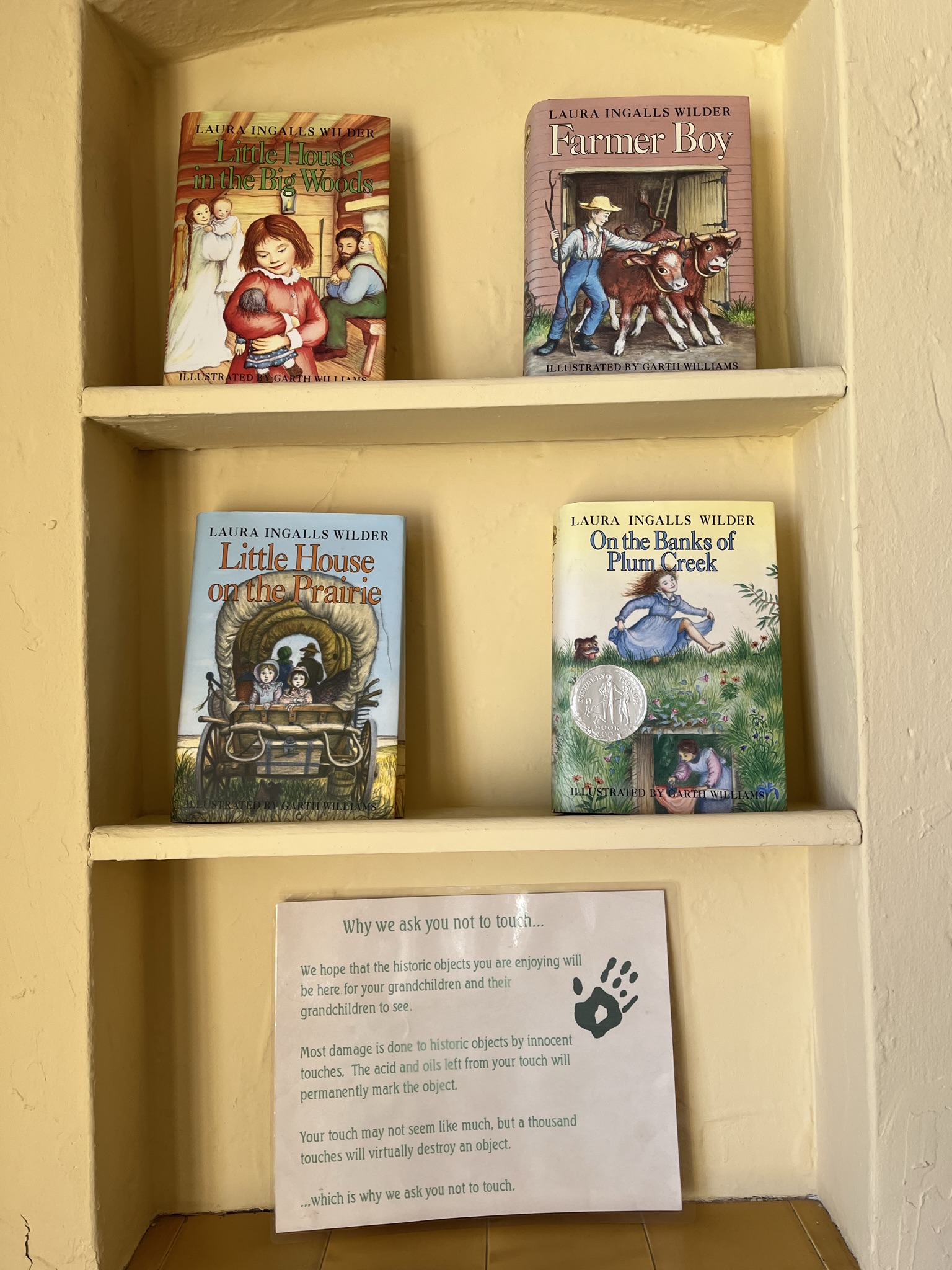
While living at the Rock House, Laura wrote "Little House in the Big Woods," "Farmer Boy," Little House on the Prairie" and "On the Banks of Plum Creek."

The books written by Laura while she lived in the Rock House are displayed in the dining room there.
 

I could picture Laura writing at her dining room table, looking out the windows at the green countryside she'd loved since arriving. Since she wrote "Little House on the Prairie" there, I could almost see Laura remembering her childhood in Kansas. Of course, as a little Kansas farm girl who grew up to be a Kansas farm partner, her "Prairie" book holds a special place in my heart.

During the same time, Rose Wilder Lane wrote, too, including her best-known novel, "Let the Hurricane Roar," which was published as a serial in The Saturday Evening Post in 1932. It became a bestselling book during the Depression. 

By 1936, Rose left Missouri for New York City. Her parents then returned to their original farm home, and the Rock House was sold. However, in 1990, the Wilder Association purchased the property. After restoration, the house was dedicated in 1997 and became part of the museum complex.

Books by Rose Wilder Lane displayed in the Rock House dining room.

After Laura and Almanzo moved back to their original farm house, Laura wrote the other Little House books: "By the Shores of Silver Lake," "The Long Winter," "Little Town on the Prairie," "These Happy Golden Years" and "The First Four Years."

Again, I could picture Laura writing on the table or window seat, while she looked out at the blooming flowers and green grass.

Looking out the window at the Wilders' farm home

Almanzo died at Rocky Ridge in 1949 at the age of 92. Laura lived there until her death at age 90 in 1957. After her death, Rocky Ridge Farm, was turned into a museum that attracts visitors from all over the U.S. - including me!

Laura's Pa called her Half Pint. As an adult, she was less than 5' tall. This was a life-size photo cutout in her farm house kitchen. 


From the dining room, looking back through a pass-through into the kitchen. Almanzo built their farm home, one room at a time. It took him 17 years to finish and it was completed in 1913.

The house is furnished like it was back when the Wilders called it home. 

As you might expect, a library was part of their home.

Almanzo was quite a craftsman. He built Laura many gifts, including this clock, which was mentioned in the Little House books.

After the house tours, we also spent some time in the museum building.


The museum houses hundreds of possessions and artifacts from Laura and her family, including Pa's fiddle which is featured prominently in the Little House books. Visitors can see clothes, photographs, dishes and more.

One of the quotes in the museum said:

As you read my stories of long ago, I hope you will remember that the things that are truly worthwhile and will give you happiness are the same now as they were then. Courage and kindness, loyalty, truth and helpfulness are always the same and always needed. I am beginning to learn that the sweet, simple things of life are the real ones after all.
Laura Ingalls Wilder


No wonder I can relate to Laura!

There are other sites throughout the U.S., located at the sites that Laura's books take place. In fact, one is in Independence, Kansas. I've never been there, but maybe we'll have to add it to the list.

More from our trip next time.