Showing posts with label breeding heifers. Show all posts

Thursday, April 15, 2021

Calendar Girl

 
This trio of calves was my March "centerfold" on this year's family birthday calendar.

It was one of my favorite baby calf photos of last year. And when family members were thumbing through the calendars at Christmastime, they invariably commented on these cute little faces. These portraits also ended up on notecards.

I'd been looking for "my little calendar girl" on the right this winter. With her unusual markings, I wanted to see how she looked now that she's all grown up. 
 
Here she is in the heifer lot earlier this winter, awaiting my daily delivery of silage to the bunks. 

And here she was in the working chute. On Tuesday, No. 87 - along with 24 of her "friends" - began the next step toward motherhood.  It had me singing Neil Sedaka's "Calendar Girl" in my head.
 
Calendar Girl 
by Neil Sedaka
I love, I love, I love my calendar girl
Yeah, sweet calendar girl
I love, I love, I love my calendar girl
Each and every day of the year

Babies are always special. My "baby" will turn 33 this year. (Not sure how that happened so fast.) And it's now been a decade since we first learned we'd be grandparents. 

(This was Kinley's first "photo" on Kim's County Line.)

So why is No. 87 the one who caught my eye? Her buddies were equally cute as babies. But her distinctive facial markings had me looking for her this winter - just to see if I could find her among the crowd at the bunks when I fed every day. (She didn't have the eartag when I took the photo, so I was trying to match facial features while running the auger on the feed truck, getting it positioned, etc.)


It's "birds and bees" time on our Kansas farm. On Tuesday, No. 87 and her fellow heifers went through the working chute in preparation for this season of "love," or, more accurately, lust.

As I wrote earlier this week, the bulls had their doctor's appointments with Veterinarian Bruce Figger to make sure they were ready to fulfill their job description here on the County Line. But the bulls aren't the only factor in the "birds and bees" of a Kansas cattleman. The heifers who will become first-time mothers next winter also have been getting some extra care.

Because they require some additional attention for calving, we want to get the first-time mothers to come into estrus (or heat) at the same time. It gets the heifers' reproductive cycles "in sync" to shorten the calving season for the heifers, which saves labor at calving time. (Well, it saves some labor for the humans - not the mama cows.) We check them frequently in case they are having trouble calving.

This year's OB/GYN candidates were born in early 2020. In 2022, they will become mothers for the first time. 

Beginning March 11, our 25 yearling heifers had their silage topped with MGA. MGA is melengestrol acetate, which suppresses the ovulation cycle for the heifers.


 For 14 days, Randy added the MGA to the silage and fed the equivalent of 1/2 a pound per head per day.

Then, on April 13, we ran the heifers through the working chute to give them a shot of of Lutalyse, which makes them come into heat.

Here's No. 87 as she's arriving for her "appointment."

They also get a vaccine to prevent respiratory issues and diarrhea when in the chute, but the Lutalyse is part of the "birds and bees" equation.

We also used a pour-on insecticide to guard against lice and other critters.

When I opened Facebook Wednesday morning, guess whose face was staring at me as a Facebook memory? Yep, it was my March calendar girl and friends. It was a year ago that I first published No. 87's photo on Kim's County Line with this blog post, Social Distancing in the Cattle Lot.

Out of curiosity, I looked to see if I recognized any other of the babies from that year-old blog post.

No. 80 (who looks like she was playing hide and seek on Tuesday) was also part of the 2020 blog post. Here she was a year ago:

March 2020

 And lo and behold, there was another one. No. 75 now ...

... and then.

March 2020

And here's No. 54 in March of last year, waiting her turn in the lane before entering the calf cradle working chute.

No. 50 - who was in the photo with No. 87 near the top of the post as they were waiting for breakfast - was also in the March 2020 "social distancing" post. (Look at those eye lashes!)

 
I knew I had a photo of No. 01, since she would have been the second calf born last year.
February 2020
It was a trip down memory lane. And it's one of the rewarding things about operating a cow-calf operation. The girl babies sometimes become part of our herd after they are all grown up. And we get to watch them have babies and continue the cycle as the years pass.


After their shots, we turned them out into the lot with the bulls where we let nature take its course, so to speak.  


"Hey, ladies! Welcome to the neighborhood!" a couple of the bulls appear to say.

Maybe they are finding their "calendar girl" right about now, too!

Thursday, October 29, 2020

Multi-Tasking


I don't believe I'll be entering this photo in a contest or using it for our family birthday calendar. But it's indicative of the quality of photo you get when you're using one hand to hold the end gate of the working chute open and clicking the camera shutter with the free hand.

It may not be a good photo, but I'm kind of guessing Dr. Bruce prefers it to getting a concussion from a falling end gate while in the "business end" of a bred heifer.

Last week, Dr. Bruce came for the first of a series of pregnancy checks for our cattle herd. The heifers were his first patients on the County Line this fall. These 25 ladies are first-time mamas who began life as part of the Class of 2019 calf crop two winters ago. 

They were a lot smaller when they went through the chute in the spring of 2019!

Now, they'll be delivering the first arrivals of the Class of 2021 to The County Line at the end of January and early February.


Just look at the tilt of that head: Believe me, ladies, I can feel this way about my annual ob/gyn appointment, too. 

But back to photo quality: As I learned last year, there is a marked decrease in photo quality when working cattle now that I have more hands-on assignments. With no hired man, I have added a few more roles on cattle-working days. Photographer is not one of them.

I started taking photos as we were gathering the heifers from the Palmer Pasture. 

Here's the ringleader of our little caravan, bringing the heifers along the fence.
So far, so good ...
But, when they began circling back around - away from the open gate - the camera went in the pocket, and I got more serious about urging the ladies to go the direction we requested.

That mission was accomplished. However, getting them to quit turning in circles and go through the open barn door was the next challenge.

I didn't take the camera back out of my pocket until I was guarding the gate while Randy took the first load to the farmstead. 

I didn't fare much better during our appointment with Dr. Bruce. 

Between encouraging the heifers to move the lane for their appointment, then holding the end gate up while Dr. Bruce did his exam, I didn't get many quality photos. And I then went around the table to record each heifer's ear tag number, along with the "degree" with which she was "with child." Most were 5 or 6 months along. 


On a few occasions, I snapped a few photos while Bruce gave vaccines, but alas, those hurried "clicks" didn't yield any memorable shots.

I'll have some other opportunities in the next couple of weeks. We're supposed to work the next group on Saturday - Happy Halloween farm style! That's if we can get the group gathered from the Ninnescah Pasture tomorrow. We'll see whether the rain curtailed those activities ... not that we're complaining about rain. The Rattlesnake Pasture round-up will on the agenda next week. 

My cattle working photos weren't anything to get excited about. But yesterday, we loaded up the three open heifers for their ride to the Pratt sale barn. Sometimes those extra cattle tasks put you in the right place at the right time.

I guess it all evens out in the end.

We also saw 14 whooping cranes on two different days this week. They were too far away to get a good photo, but I tried anyway. 

On Tuesday, they were at a circle just about a mile from our house as the crow - or whooping crane - flies. On Wednesday morning, they were on ground we farm. But again, they were half a mile from a road and my camera zoom just wasn't powerful enough.

On a trip to the pasture, I had Randy stop for a quick snapshot of the fall leaves with our dusting of snow.

So I guess I can't complain about the view - unless it's the one where I'm holding up the working chute end gate.

Sometimes, being at the right place at the right time keeps the vet from getting a concussion from a falling end gate. Other times, it brings you rainbows. Which is more important? Depends on your perspective, I suppose. I'm guessing Dr. Bruce would vote for the end gate - even if it doesn't yield the best photos.


Tuesday, April 28, 2020

NSYNC (In Sync)

"This I Promise You:" NSYNC is more than just a 1990s boy band.

Maybe on a Kansas farm, it's more "in sync" than NSYNC. But before we say "Bye, Bye, Bye" and our cattle are "Gone" to summer pastures, it's time for our heifers and bulls to do a little "dancing" to "The Music of My Heart"

"You Don't Have to Be Alone," we tell our heifers. So we help them get "in sync" ... without a radio.

The heifers will become first-time mothers next winter. Because they require some additional attention for calving, we want to get the heifers to come into estrus (or heat) at the same time. It gets the heifers' reproductive cycles "in sync" to shorten the calving season for the heifers, which saves labor at calving time. (Well, it saves some labor for the humans - not the mama cows.) We check them frequently in case they are having trouble calving.

This year's OB/GYN candidates were born in early 2019. In 2021, they will become mothers for the first time.
Beginning March 19, our 25 yearling heifers had their silage topped with MGA. MGA is melengestrol acetate, which suppresses the ovulation cycle for the heifers. For 14 days, Randy added the MGA to the silage and fed the equivalent of 1/2 a pound per head per day.
 
Then, on April 20, we ran the heifers through the chute.
 
Just like we other ladies, they didn't appear too eager for their doctor's appointment.
As NSYNC would say, "We're Only Thinking of You." OK ... we may be thinking about efficient management. A shot of Lutalyse makes them come into heat.
They also get a vaccine to prevent respiratory issues and diarrhea when in the chute, but the Lutalyse is part of the "birds and bees" equation.
After their shots, we turned them out into the lot with the bulls where we let nature take its course, so to speak. 
This bull could be professing that he'll spend "A Little More Time..." with his "Girlfriend" with "No Strings Attached."
This is as risque as the photos will get. This is a family blog after all.

And that's as many NSYNC songs as I could work in.

The exodus to summer pasture has begun. It will be the heifers' turn on Thursday.

Thursday, February 6, 2020

Birth Day

This is what happens when you are trying to take a photo one-handed!
In these days of sexual harassment claims, I probably should have gotten this heifer's permission to post her personal "business" all over the internet.
Goodness knows, I didn't want video cameras or even still cameras documenting the birth of my offspring until the action was over. And even then, I let the Lamaze coach and the guest of honor be the focus of the star's first-ever photo shoot.

However, I guess it's in No. 885's "contract" for room, board and plenty of food that the Chief County Line Correspondent gets to have exclusive coverage of her baby's birth story.

The heifers - including No. 885 - are in a corral to the east of our house. That makes it easier for Randy to check them more frequently and gives us easy access to the calving shed. Because they are first-time mothers, Randy checks the heifers throughout the day and night, just in case one is having difficulty.

With the heifers, Randy uses a bull for "calving ease" - a bull whose progeny is lower birth weight but which gains well after birth. Most of the time, the heifers calve naturally, but, once in awhile, they need a little help.

No. 885 had been showing awhile, and after an hour, Randy didn't see any further progression. We ran her into the calving shed to pull the calf, something we do to help both the mama and the baby.
We put the heifer in the head gate, my Christmas gift of 2010. Sometimes cows can be riled up with the birthing process, so having them contained in the head gate is a much safer option for both mama and people. She set her feet and didn't want to go into the head gate. But, once we finally got her situated, she was very calm.
Randy first splashed disinfectant on the heifer to try to keep the birthing canal as clean as possible. (We've been using the same Tupperware bucket for this job since Randy's folks were in the cow-calf business. It was part of our inheritance.) Just like on Grey's Anatomy or Chicago Med, Randy gloved up for the procedure.
I should have done the same, but my work gloves were in the house, and I wasn't all "up in her business," as I might euphemistically describe. It would have just been more sanitary for me. Randy tied a chain above the ankle on each of the front hooves of the calf. Then he tied the two chains together.

Randy attached the chains to a calf puller, which is a long rod with a pulley on the end. (Since I was helping, I used the photo below from another year.)
 Randy put the leather strap of the calf puller on the cow's rear end, and I held it in place to get started.
   
Then Randy used the pulley system to gently pull the calf from the mama's womb, sometimes pausing to wait for another contraction. The baby comes out with the front feet and the head first.

 Welcome to the world, baby!
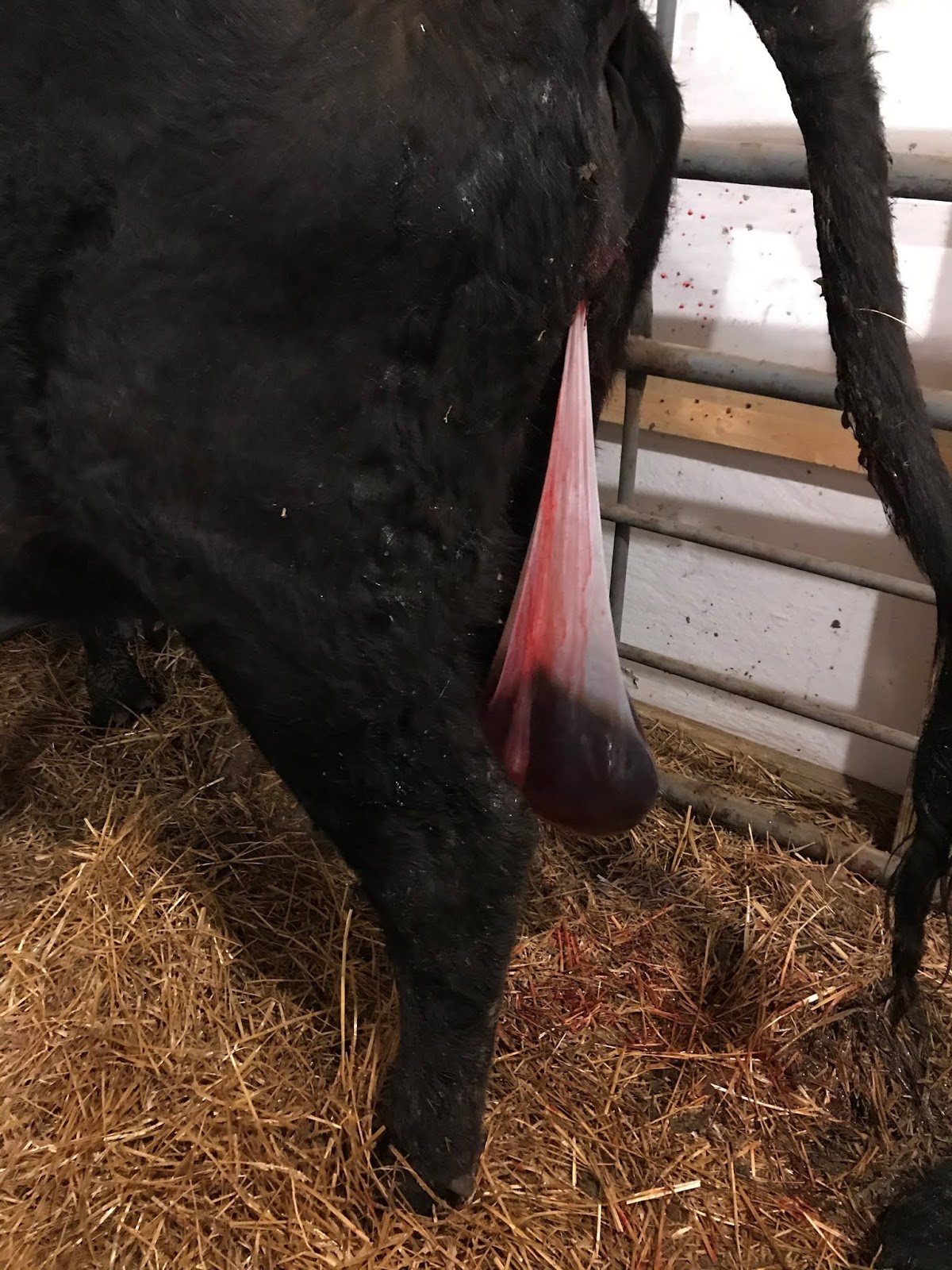
The mama still had part of the birth sac hanging immediately after birth. Many times, it bursts as the calf is delivered, but not in this case. However, just like with a human birth, the mama then delivers the after-birth.
Mama gets the job of cleaning off the baby by licking it. It's part of the bonding process for the pair.

We left the two alone in the calving shed to get to know each other.
In 2012, I wrote "The Miracle of Birth," which showed photos of the guys pulling a baby calf. Click here to read that post and see the photos. (Since I was just an observer instead of a helper, you can probably see the equipment used better in that post.)

And, while the farm is full of miracles like this birth, this life also encompasses the other end of the spectrum. We did our best to help this baby whose mama didn't accept it. We thought we'd successfully grafted it to another mama. But it died over the weekend. RIP, little 003.