Showing posts with label sale barn. Show all posts

Tuesday, August 3, 2021

Heifers and Helpers


I may not be as cute as this little helper at the Pratt sale barn. But I like to think I was just as indispensable. 

I am under no delusion that I was the most vital helper during the County Line's latest cattle work. That honor went to our veterinarian, Dr. Bruce.

He was at the farm Monday to preg-check 25 heifers - our first-time mothers. Many times, he has done  the examinations manually. But this time, he brought along a helpful machine. It's like a sonogram machine for cattle.

I seem to have mostly gotten Bruce's reflection in the photo below, but maybe you can also see an image, too. It's a little hard to see what you're photographing when you're taking the shot over someone's shoulder in bright sunlight. (Thanks for your patience, Dr. Bruce!)


 Most of the first-time moms were 2 1/2 to 3 1/2 months pregnant. 

I was the secretary for the ladies' doctor's appointments and also helped move them up the lane. Dr. Bruce inserts a wand to get the image and determine the approximate gestation, based on the size of the baby.

When I saw 001 come through the chute, I had to take a close-up. I knew I'd be able to find a baby photo of her. She would have been one of the first babies born in 2020, and she would have been born to a heifer, too.
August 2, 2021

January 25, 2020

No. 001 was pregnant, but three of her pasture mates were not. Those three - and an Angus bull - made a trailer trip to the Pratt sale barn. 

To make the sorting job easier, Randy always marks the  "open" cows with "O" on their sides and puts a chalk streak down the front of their faces. 


We sorted them off from the rest, and they had a chauffeured ride to Pratt, where they'll be sold on Thursday.

As one was walking away at the sale barn, I realized the Hereford-looking one was my 2020 Valentine's calf. I always thought she was so pretty, and I also noticed her as we fed silage this past winter. But, just like a sports team, you have to make tough cuts to the roster. And not being pregnant is a big deal for cattlemen.

Notice the "heart" shape on her chest: She made an appearance on the blog in February 2020.

 The rest of "girls" were transported to a different pasture, where they will graze as "ladies in waiting" until this coming winter when they will deliver the Class of 2022.


Thursday, January 9, 2020

Sold! Home-Raised, Home-Grown, Homespun

"Look at these here, boys: They are home-raised, home-grown, homespun."

We collected a paycheck for our "home-raised, home-grown, homespun" feeder calves a little earlier than usual when we sold 73 of them at Pratt Livestock on December 19.

Because our supply of silage was dwindling, Randy decided to sell the calves in December, rather than our usual January or February. (We sold February 7 last year.) Just what I needed: More to do in December, along with the Christmas rush. But ... such is life.

That move to the auction block is only a small portion of the journey that epitomizes that "home-raised, home-grown, homespun" slogan.
 
The first one born was this little guy, who got the first ear tag of the year - 900. (The first number on the eartag tells us when the baby was born - in this case, 2019.)
 
He wasn't the only cutie, of course.
 
 They warmed up on cold winter days with their own personal milk machines - aka their moms.
On our wedding anniversary in March 2019, we worked baby calves for the third day in a row, giving them vaccinations and eartags. The boy calves were also transitioned from bulls to steers.
This eartag caught my eye, since it was our 38th anniversary.
 
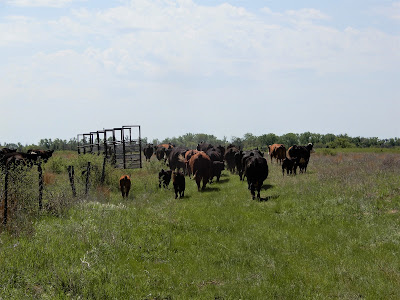
 In May, the calves traveled via trailer with their mamas to summer pastures.
This group arrived at the Big Pasture, which has been in Randy's family for more than 100 years. While there is definitely less work with cattle when they are on pasture, this year provided its own set of challenges with five pair that would not stay in, no matter what we did.
We lost track of the number of trips we made on 4-wheelers to bring them back to the pasture. As Randy says, we toured some shelterbelts and back roads that we'd never experienced before.
In early November, on a frosty morning, we gathered the cattle from the the Ninnescah pasture and brought them back home.
On another day, Randy and his cousin Don (along with some other excellent help, if I do say so myself), gathered cattle from the Big Pasture and we transported them home.

After they arrived home from the pastures, they were weaned from their moms. Like wellness checks for humans, the calves had a doctor's appointment, too. Dr. Figger gave them another round of vaccinations. 
My stint with the feed truck began in earnest.
In December, with feed supplies dwindling, Randy was ready to sell.
After getting them in the corrals, we sorted out the 25 heifers we planned to keep. They will become mothers in our herd for the first time in 2021.
There are no pictures from sorting because I had plenty of other things to do. The following day, the semi arrived to transport the 73 calves to the sale barn.
Though we have two farm-sized cattle trailers, it would take several trips to get all the cattle to the sale barn. So we hired Darrel Harner Trucking to do our hauling to market.
The semi is divided into different compartments, which can hold anywhere from six head to 25 head of cattle. Darrel told us how many calves he wanted at a time to load the semi, and we sent them on their way.
It's always a good feeling to watch the semi leave the farmstead ...
... and then watch it arrive in Pratt at the sale barn.
As we watched the calves unload, I noticed our shadows. This journey requires a lot of teamwork from start to finish.
The calves stayed overnight so they were ready for the sale the next day.
Randy says sale day is always a highlight for him, a culmination of a season of work. He had hoped the calves would weigh 600 pounds apiece, but they weren't quite that big. While the price wasn't quite as good as last year, he was pleased enough with the paycheck.
The cattle work didn't end. We are still feeding the 25 sisters left behind at home. Randy is hauling hay and water to the expectant mothers. Today, with the cow's due dates fast approaching, we are driving one group of cattle off stalks and into a pasture. We are sorting another group that got mingled together earlier this winter.

The 2020 maternity ward is only a couple of weeks away. And the whole process will begin again. (I'm hoping for no repeat of the summertime escapees in 2020.)

Tuesday, October 8, 2019

Hay! Here's an Conundrum for You!

 
It's kind of an oxymoron: We raise alfalfa, so you'd think that going to a hay sale to purchase, rather than sell, is counterintuitive.

However, that's just where we found ourselves a couple of weeks ago.  I went with Randy to buy some small bales at the Central Livestock hay auction.
An old sign from 1945 at Central Livestock
Most Tuesdays throughout the summer, the hay auction takes place outside the South Hutchinson sale barn before the sale ring opens for cattle later in the morning.
We got there early to look over the selection brought to the auction by those who had bales to sell. 

So why would we need to buy hay when we raise hay? In fact, we grow alfalfa and sudan, both of which we bind up in big round bales and feed to our cattle. Randy was bidding on small square bales of hay to use as "bait hay." (That's an oxymoron, too: The "square" bales are actually rectangular. Hmmm - That's what they're called anyway.)
 
The small bales come in handy for my role in calling cattle into the corrals to bring them home from summer pastures or to entice them to change locations during the winter. It's a little tough to toss those 1,500-pound big round bales, don't you think? A 60-pound bale works better. (And let's get real: I'm not tossing the whole bale myself either. I end up pulling chunks from the bale for enticement purposes.)
 
Who knew there'd be such a crowd? There were preschoolers there with their Daddies and plaid-shirted farmers. There were cowboy hats and seed company caps. The variety didn't end with the people. There was brome hay. There was alfalfa. There was millet hay. There were small bales, big square bales and a couple of big round bales.
I may sometimes toss some hay into the air for calling the cattle, but I leave the whole bale tossing to my favorite farmer. He's been doing that since junior high days. Growing alfalfa has always been part of the crop rotation for Randy's family.
 
Back when Randy was a child, they used a sickle mower which laid the hay flat. Then, they would rake the hay. Since they didn't own a baler, a neighbor would bale it into square bales. Then, Randy, his brother and dad would pick up the hay from the field. 
These days, he isn't bucking bales in a whole field. As auction bidder No. 835, he raised his hand and purchased two different piles of alfalfa hay, totaling 34 bales. 
Besides looking for quality hay, he chose a couple of piles closest to the driveway for easier loading. Always thinking, my farmer! I'm always thinking, too. I occupied myself with paying for the hay and then taking photos. I could say I forgot my gloves. But, honestly, Randy didn't ask me to help and I didn't volunteer.
Once we got home, he reversed the process and unloaded the hay in a storage shed. A couple of kittens who'd been hiding out in the few remaining bales of hay we purchased a couple of years ago had to be momentarily relocated to the wheelbarrow.
The kittens were returned to their hay "condominium."
 However, the mother didn't like the human interference and moved them.

Our neighbor borrowed a few bales for a homecoming float. And now we're ready for those cattle-gathering expeditions this fall.