Showing posts with label straw. Show all posts
Friday, February 7, 2014
A Rancher's Snow Day
You know how you fluff up the fleece blanket and get nestled in with a good book and hot mug of coffee on a cold winter day?
We do the same thing for our cattle -- minus the book, of course. And the mamas take care of the warm drink.
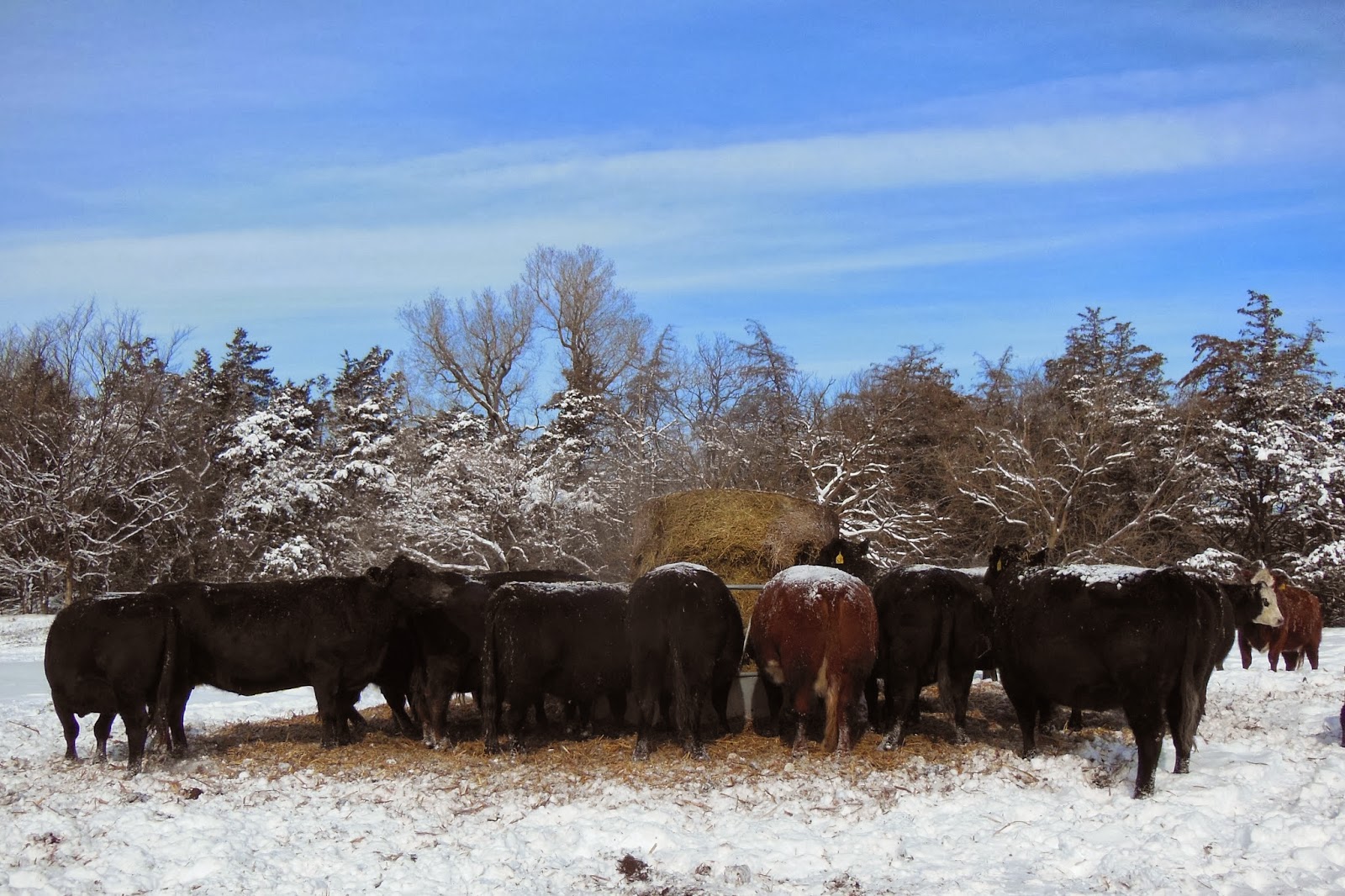
After the snowstorm on Tuesday, the guys brought big round bales of straw to each of the locations where we have cows or heifers waiting to calve. On the front of the tractor, Jake carried one bale of straw. On the back, he hauled two better quality alfalfa bales for the cows to eat.
The guys had spread straw out earlier, but it was covered up by the 9 inches of snow we received. First, Jake used the scoop to scrape away some of the snow and level it out. They selected a spot south of a windbreak, in this case, the old barn.
After Randy removed the net wrap from the straw bale, Jake used the grapple fork to shake the bale apart.
He picked it up.
And put it down.
He continued the process until the bale was fairly well broken apart. I was focused on taking photos, so I didn't see any extra passengers - aka mice - scatter as the bale was spread out. Randy says that's a common occurrence, but I'm not a fan of the little critters, so I'm glad I missed that!
The straw gives a drier and warmer place for the cows to lie down. You always hope they are smart enough to have their babies in the straw, too, but it doesn't always happen that way.
These photos are from another year (and a different location), but it does show that the cows and calves put the straw to good use.
The snow also makes it more challenging to feed. The guys still load and feed silage for the feeder cattle. They haul alfalfa hay to all the locations. They also have to haul water to the locations where it's not available on site.
We have to keep the mamas "fueled" so the babies have plenty of warm milk to drink.
Everyone likes a warm drink on a cold day.
Tuesday, July 16, 2013
Farmers: The Ultimate Recyclers
Environmentalists would like to believe they invented recycling. But the nation's farmers have been finding ways to effectively use resources for centuries.
Straw isn't the "cash crop" when you're harvesting wheat. The goal is to separate the grain from the straw and the chaff, leaving only the kernels which are transported to the elevator for sale.
Usually, the straw is scattered behind the combine with the combine's straw spreader, which distributes the residue (and creates a cloud of dust and straw that experienced harvest helpers avoid by standing upwind)!
Since our combine is still in the shop and I don't have a photo of the straw spreader when it's not in action, here's an illustration that shows some of the parts:
On one wheat field, Randy took off the straw spreader so that the straw would be laid down in windrows. He then baled the straw into 20 big round bales.
We always hope that the mamas who deliver during a snowstorm will be smart enough to give birth on the straw for a little protection from the elements.
Sometimes, they do just that.
The straw itself doesn't have much nutritional value, though it can be used for roughage. Since we grow alfalfa, we use the alfalfa hay as cattle feed, and the straw bales are used only for bedding.
We weren't the only ones baling straw during and after harvest this year. With stacks and stacks of straw bales in the area, Randy assumes that some people are planning to add anhydrous liquid ammonia to the forage. Ammoniation is a method of treating low-quality roughages to improve their nutritional value for ruminant animals, like cattle. It involves sealing the straw in a gas-tight, enclosed container and adding anhydrous liquid ammonia. At about 21 days, the chemical action is complete, and the product can be used for feed. Randy assumes that some of the people who have put up straw bales are planning to use it in that way.
Others may add a molasses-based, protein rich formula to the straw bales in order to create a feed for cattle.
Many of the people putting up straw put it into large square bales (probably more accurately called rectangular bales!) rather than round bales.
Even if the straw doesn't end up in bales (like the majority of our wheat fields), the chopped up straw is residue on wheat fields. The residue helps put nutrients back in the soil and increases organic matter. The straw residue also helps control wind and water erosion.
Recycling at its best - all on Kansas wheat farms!
Straw isn't the "cash crop" when you're harvesting wheat. The goal is to separate the grain from the straw and the chaff, leaving only the kernels which are transported to the elevator for sale.
Usually, the straw is scattered behind the combine with the combine's straw spreader, which distributes the residue (and creates a cloud of dust and straw that experienced harvest helpers avoid by standing upwind)!
Since our combine is still in the shop and I don't have a photo of the straw spreader when it's not in action, here's an illustration that shows some of the parts:
![]() |
| Illustration credit: http://www.thisland.illinois.edu/60ways/60ways_1.html |
We'll use the straw as bedding next winter for cattle. Before a snow storm, the guys spread some of the bales near a windbreak (like the trees in the photo below). It helps give a place for mama cows and babies to have a drier place to congregate.
We always hope that the mamas who deliver during a snowstorm will be smart enough to give birth on the straw for a little protection from the elements.
Sometimes, they do just that.
The straw itself doesn't have much nutritional value, though it can be used for roughage. Since we grow alfalfa, we use the alfalfa hay as cattle feed, and the straw bales are used only for bedding.
We weren't the only ones baling straw during and after harvest this year. With stacks and stacks of straw bales in the area, Randy assumes that some people are planning to add anhydrous liquid ammonia to the forage. Ammoniation is a method of treating low-quality roughages to improve their nutritional value for ruminant animals, like cattle. It involves sealing the straw in a gas-tight, enclosed container and adding anhydrous liquid ammonia. At about 21 days, the chemical action is complete, and the product can be used for feed. Randy assumes that some of the people who have put up straw bales are planning to use it in that way.
Others may add a molasses-based, protein rich formula to the straw bales in order to create a feed for cattle.
Many of the people putting up straw put it into large square bales (probably more accurately called rectangular bales!) rather than round bales.
They look like a Lego building project sitting at the edge of stubble fields.
Even if the straw doesn't end up in bales (like the majority of our wheat fields), the chopped up straw is residue on wheat fields. The residue helps put nutrients back in the soil and increases organic matter. The straw residue also helps control wind and water erosion.
Recycling at its best - all on Kansas wheat farms!
Subscribe to:
Posts (Atom)