Thursday, November 17, 2022

Potpourri


I'm a Jeopardy! fanatic. I DVR it so I don't miss any episodes. One of the occasional categories on the TV quiz show is Potpourri. (It happened just last week during the Tournament of Champions.) If Jeopardy! can do it, I suppose I can follow suit.

Thanks to anyone who's "traveled" with us through multiple blogs featuring the National Parks of the Southwestern U.S. Even though I didn't share all 1,000+ of the photos I took, the number was still plentiful. And here are a few more. 

Paul Harvey always talked about "the rest of the story." Here are some photos from "the rest of our journey." (Alex Trebek and Paul Harvey: How can I go wrong?)

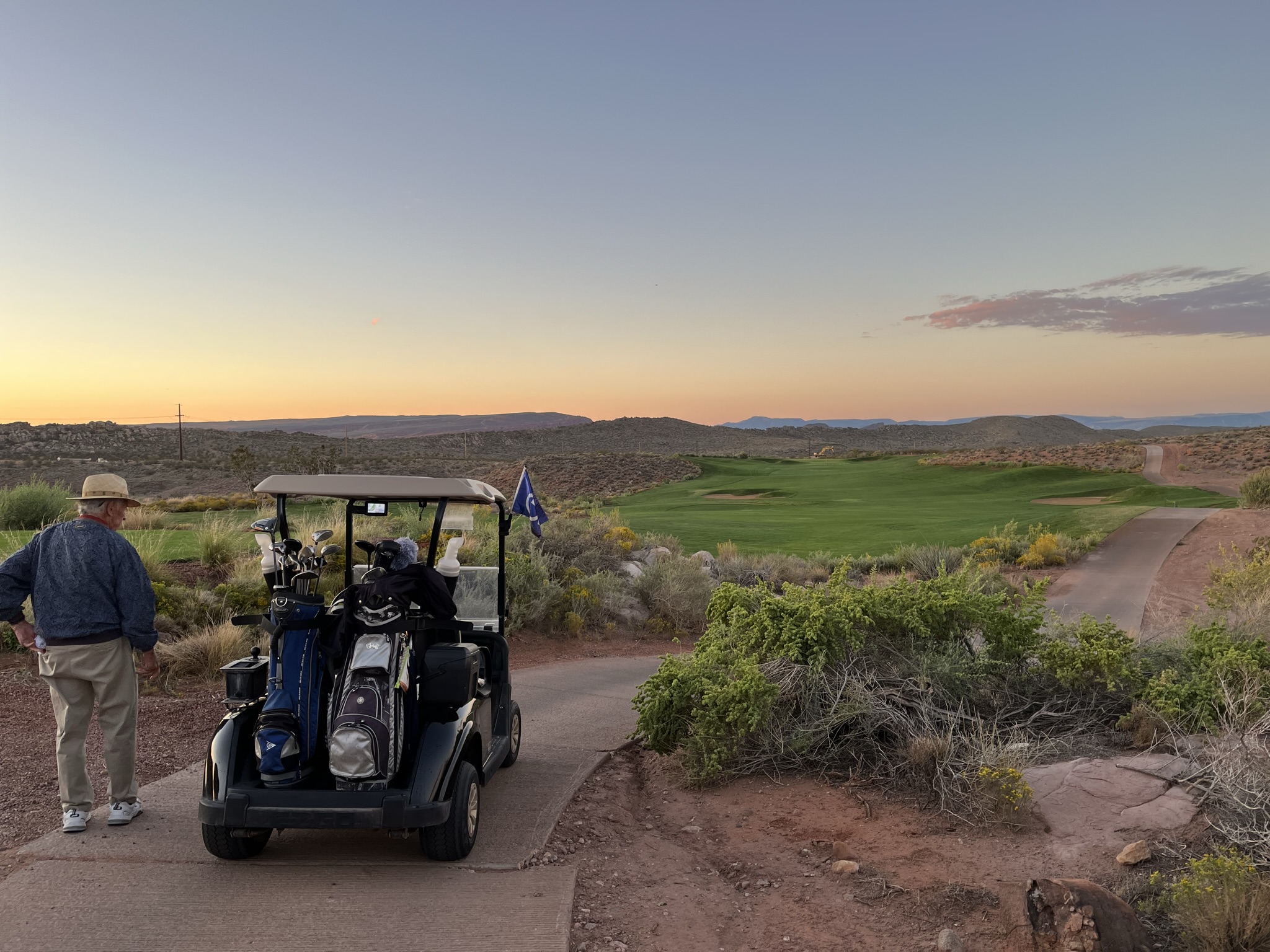
The first hole - Coral Canyon Golf Course

Randy golfed one morning at Coral Canyon Golf Course in St. George, Utah. He and a husband/wife duo from Colorado were the first to tee off that morning. 


For Randy, it ranked among the most beautiful courses he's ever golfed. 


As is customary, I had a book along. However, it was not customary that I didn't crack the book during the entire morning. My other golf accessory - my camera - was called into action.

While we had to get up early to be the first to tee off, I was glad for the cool morning. Later in the day, it would have been hot.


While we were in St. George, Randy kept getting asked whether he was competing in the Senior Games, which were going on at the time.  Our hotel was home base for a whole lot of tall, "mature" men and women. Every time someone asked him if he was a competitor, his grin got a little bigger. Evidently, some of the senior games people played the Coral Canyon golf course for a golf tournament a few days after we were there. Alas, it was not Randy. 

Because we got such an early start to the day (and Randy wasn't competing in any official events at the Senior Games), we added Snow Canyon State Park to our itinerary. The officiant at Brent's and Susan's wedding used to live in Utah. She gave us several suggestions for restaurants and also mentioned Snow Canyon as a favorite place for their family. (Thanks, Allison! It was so helpful to have some insider knowledge!)


Snow Canyon State Park is a 7,400-acre park tucked amid lava flows and sandstone cliffs. Created in 1959, it's located in the Red Cliffs Desert Reserve. 

At the Pioneer Names Trail - We couldn't find the names, but the pamphlet said the trail passes pioneer names, written in axle grease, dating back to 1881.

 We may not have found the names, but we "pioneers" from Kansas took photos there anyway.


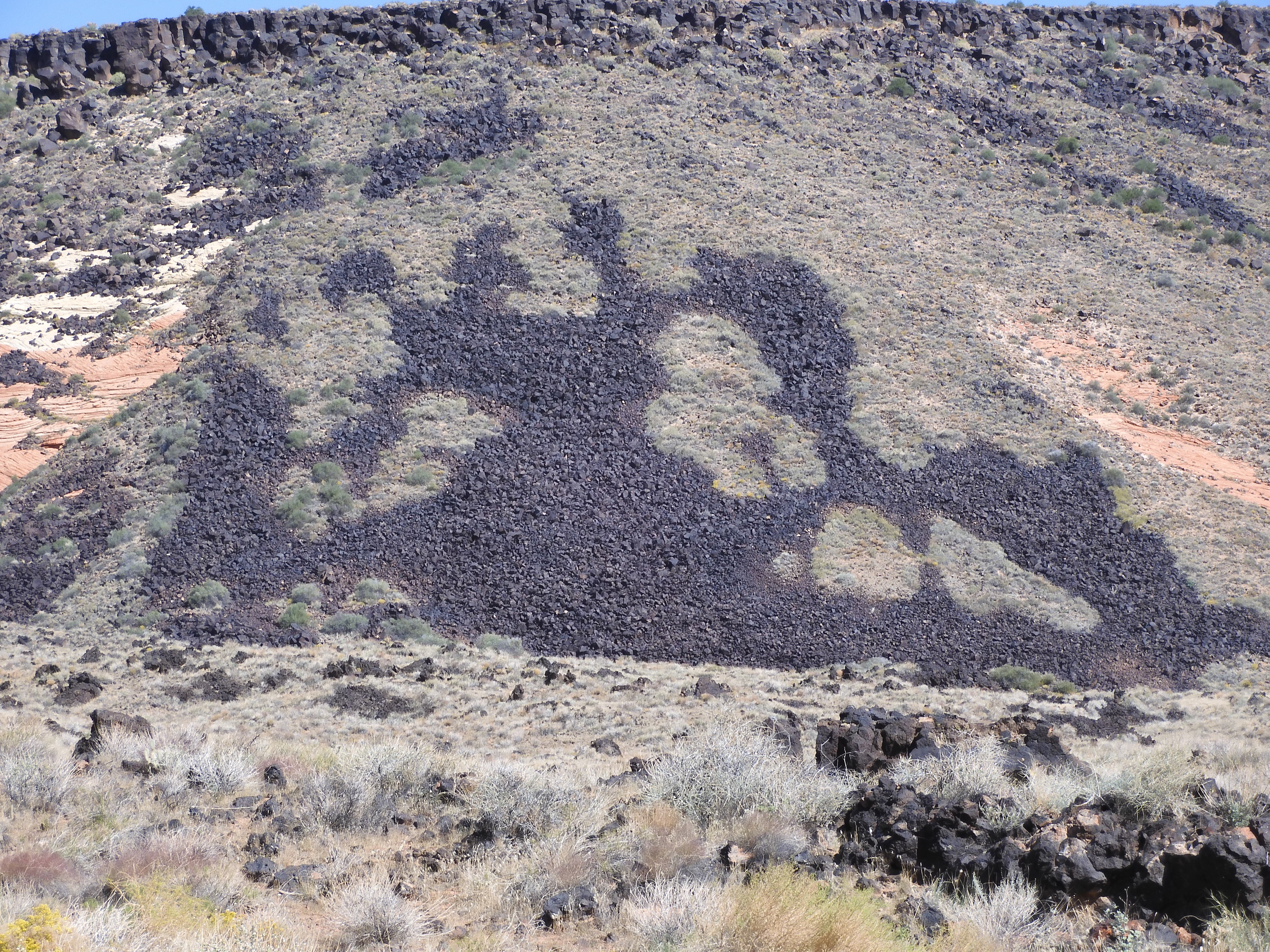
While many of the rock formations were red and others were sandstone, there were also lava flows. This lava flow was said to look like a butterfly. I can see it: Can you?
Snow Canyon was also the setting for several famous movies, including Butch Cassidy and the Sundance Kid, High School Musical 2 and John Wayne's The Conqueror.  

That wasn't the only movie location we visited. Our trip home included brief photo stops in Monument Valley. 

Monument Valley is known as John Wayne Country. He starred in five films there: including "Stagecoach" (1939), "Fort Apache" (1948), "Rio Grande" (1950), "The Searchers" (1956) and "She Wore a Yellow Ribbon" (1949). Other movies filmed at Monument Valley include Forrest Gump, Mission: Impossible 2, Easy Rider, Back to the Future Part III, National Lampoon's Vacation and the 2013 version of The Lone Ranger.

It rained that day and was overcast.

As we traveled toward Durango, we even saw a flash flood. (I didn't get a photo of that.)
We were hoping to bring the rain home with us, but, unfortunately, that didn't happen.

We traveled 3,070 miles during our 12-day trip. I really did take more than 1,000 photos. We were both ready to be home, but Randy is already thinking about the next adventure. This resident "homebody" will likely take a little longer to be bitten by the travel bug again.

The purpose of life is to live it, to taste it, to experience to the utmost, to reach out eagerly and without fear for newer and richer experiences.
-- Eleanor Roosevelt


Tuesday, November 15, 2022

Golden Moments


Cliffs and canyon dominate the landscape of the National Parks of the American Southwest. 

Kolob Canyon, Zion National Park

The grandeur of the rock formations in places like Bryce Canyon, the Grand Canyon or Zion National Park is undeniable, But the fleeting beauty of aspens dressed in fall finery was something I looked forward to on our retirement trip. 


We saw glimpses of fall foliage at the national parks earlier in our trip. 

At Bryce Canyon

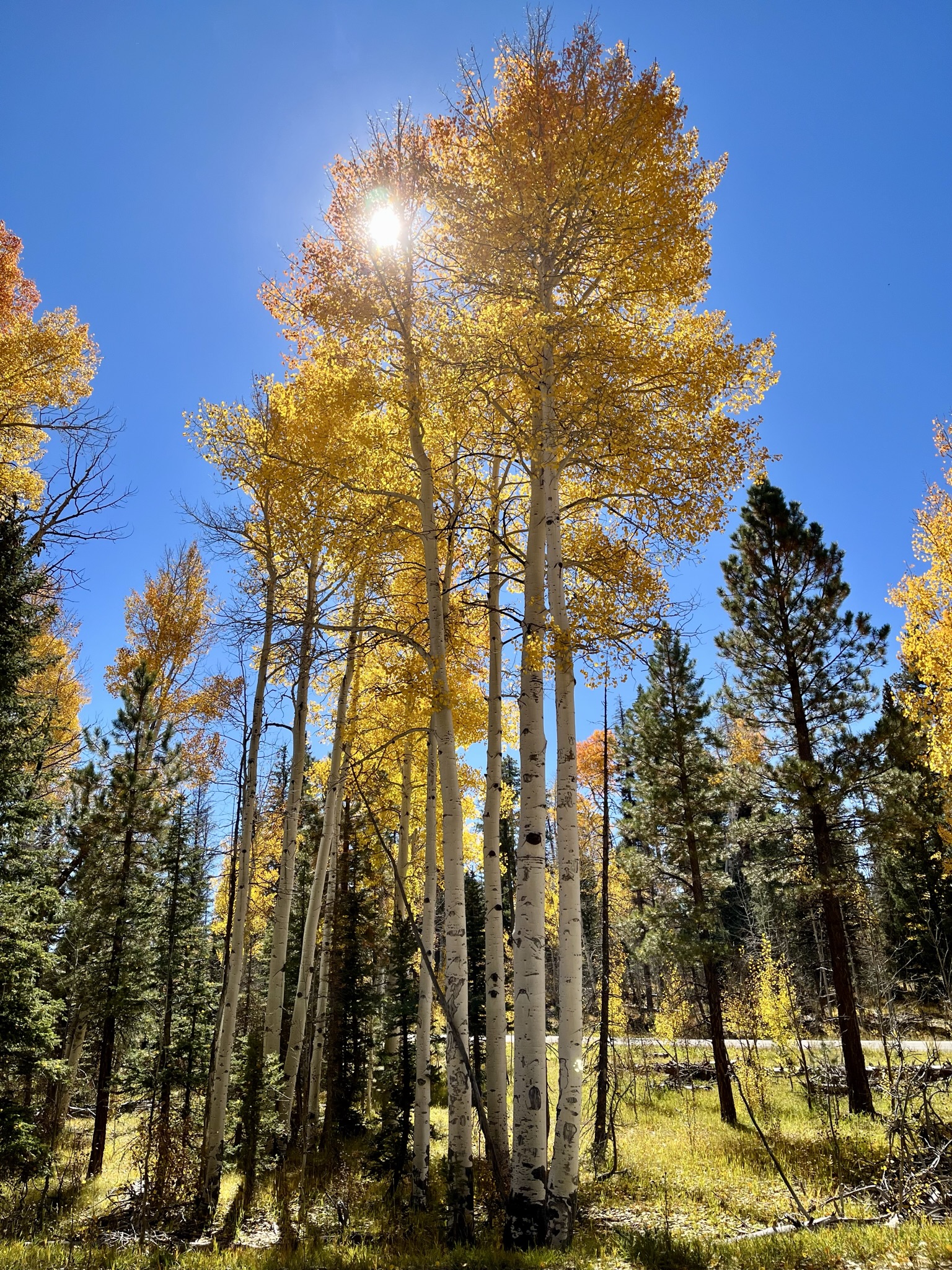
But it wasn't until the drive leading toward the north rim of the Grand Canyon - the final national park on our itinerary - that we finally could walk into a grove of aspens. The trip along Cape Royal Road was a visual treat.


One of my friends often goes to Colorado in the fall to witness the changing of the seasons. She has beautiful photos of aspens from her travels. I may not have gotten any photos to rival the artwork on her walls, but it was still a highlight of our trip for me. (I did add a couple of enlargements featuring aspens to my fall decor.)

Not only that, aspens could teach us a thing or two:

From afar, a forest of aspen trees is a wonder to behold. Dig a little deeper, and you'll find something even more fascinating. Every single one of the aspen trees in a grove is connected as a single living organism. Aspen trees have a complex underground root system from which each individual tree sprouts and grows. 
From The Secret Lives of Aspen Groves, The Weather Channel


Being interconnected is probably a lesson from which we could all learn, especially during an election season.

Writer Gail Goodwin had this to say in that regard: 
 
Imagine a world where we all acted like aspen trees ...
  • Move aside to help and encourage the sunlight to shine on those below us.
  • Share energy and stress with one another as a unit, so that we can better handle the ups and downs of life.
  • When someone is in need, share our abundance, knowing that, as a part of the whole, we can never truly be in need.
  • Know that we are all one with no need for competition.
  • Know that our roots are deep and can withstand even the worst of disasters.  
Small aspens were growing in landscape that had been scathed by fire.
  •  Just like the aspen tree, we are all connected to one another at the source of our being. We are all brothers and sisters. We are all a part of something so much greater than our individual selves. We are connected by our roots.

And yes, that is true whether we're Republican or Democrat or Independent ... or any other definition you can attach to others or to yourself. 
 

Go spend time with aspen trees. They'll tell you to look to your roots for energy. They'll tell you there's warmth below the surface.
Kaya McLaren, author, How I Came to Sparkle Again


Thursday, November 10, 2022

Shutting the Place Down: Grand Canyon's North Rim


We shut the Grand Canyon's North Rim down. No, we weren't rowdy. In fact, it was a pretty quiet place. But we were at the historic Grand Canyon Lodge for its final two days of the 2022 tourist season. 

In mid-October, lodging and services at the North Rim close for the winter. The South Rim is open year 'round. We visited the South Rim BC - Before Children - so that's been awhile ago. Staying at the North Rim was on Randy's bucket list.


Accommodations were "rustic," I reported to my family. However, my sister-in-law put things in perspective when she asked if the bathroom was inside the cabin. It was. And she texted back the  #winning. Indeed!

The main lodge was built in the 1920s on the lip of the canyon. The Lodge was rebuilt after a fire in 1932. Randy estimates our cabin was only about 100 yards from the rim.

 
These photos were taken Saturday afternoon, October 15, as clouds moved in.


On the first night, we had dinner in the Sun Room and watched the sun set. 


The meal was delicious (and expensive). But the meals on the next day were meager, as staff attempted to use up supplies before closing everything down. While refrigerator-case sandwiches were not the culinary highlight of our trip, it was a "million dollar view" all day long.

Since we'd watched the sun set the day before, we were up before the sun and on the patio to watch the sun rise that Saturday morning. 


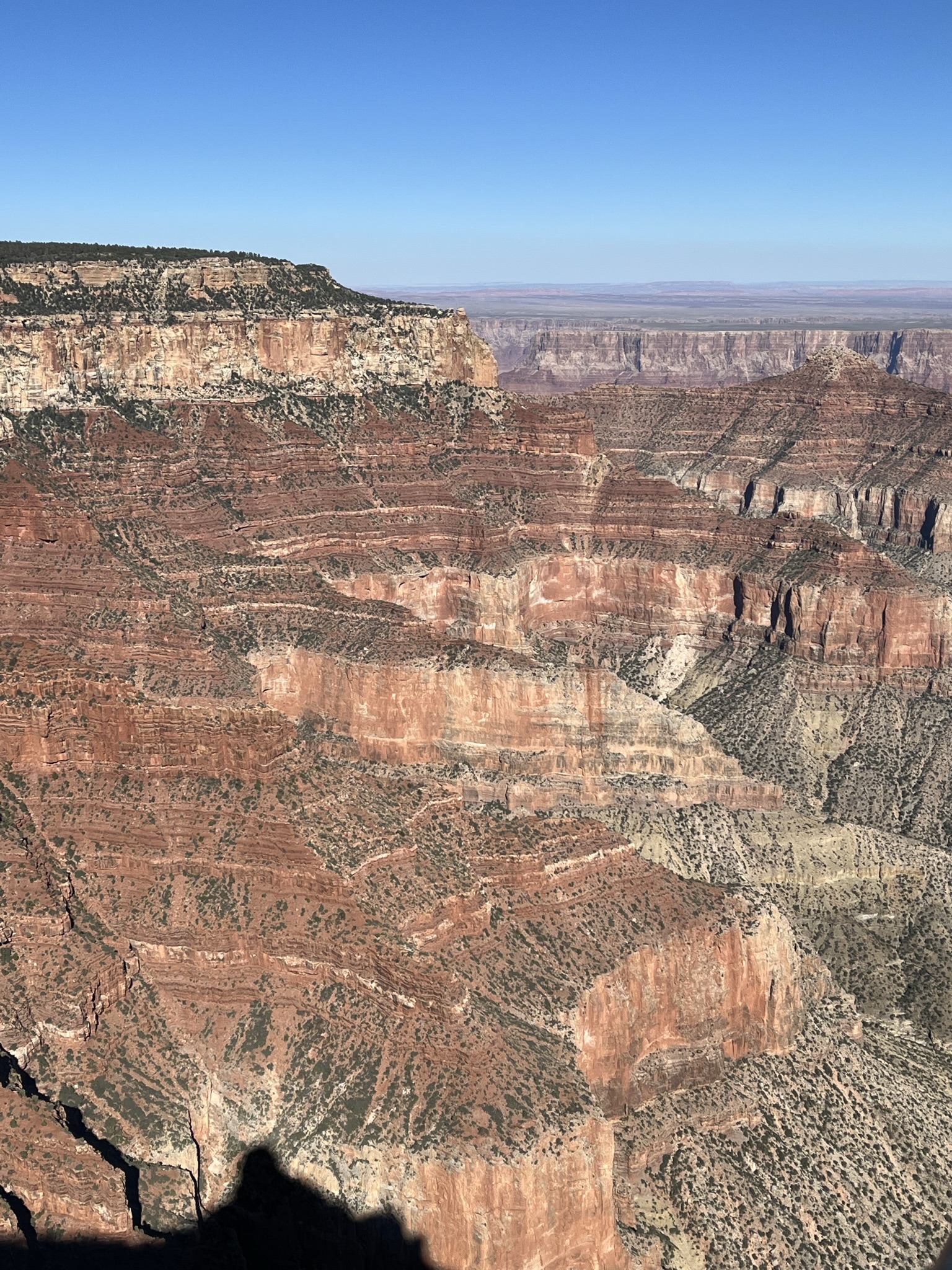
We were able to watch as the sun began touching the canyon peaks. While the canyon walls themselves may seem unchanging and timeless, the scene changed subtly throughout the day as the sun and shadows moved throughout the canyon.


The glories and the beauties of form, color and sound unite in the Grand Canyon - forms unrivaled even by the mountains.
--John Wesley Powell, 1873

The view into Grand Canyon from the North Rim shows a geological history that spans nearly 2,000 million years. Collisions between giant land masses and flooding by ancient seas created the canyon's rock layers. Squeezed between the Pacific Ocean floor and the Rocky Mountains, the layers rose to form high-elevation plateaus. During the last 5 million years, the Colorado River has carved the massive canyon, and the river is still at work today. 
 
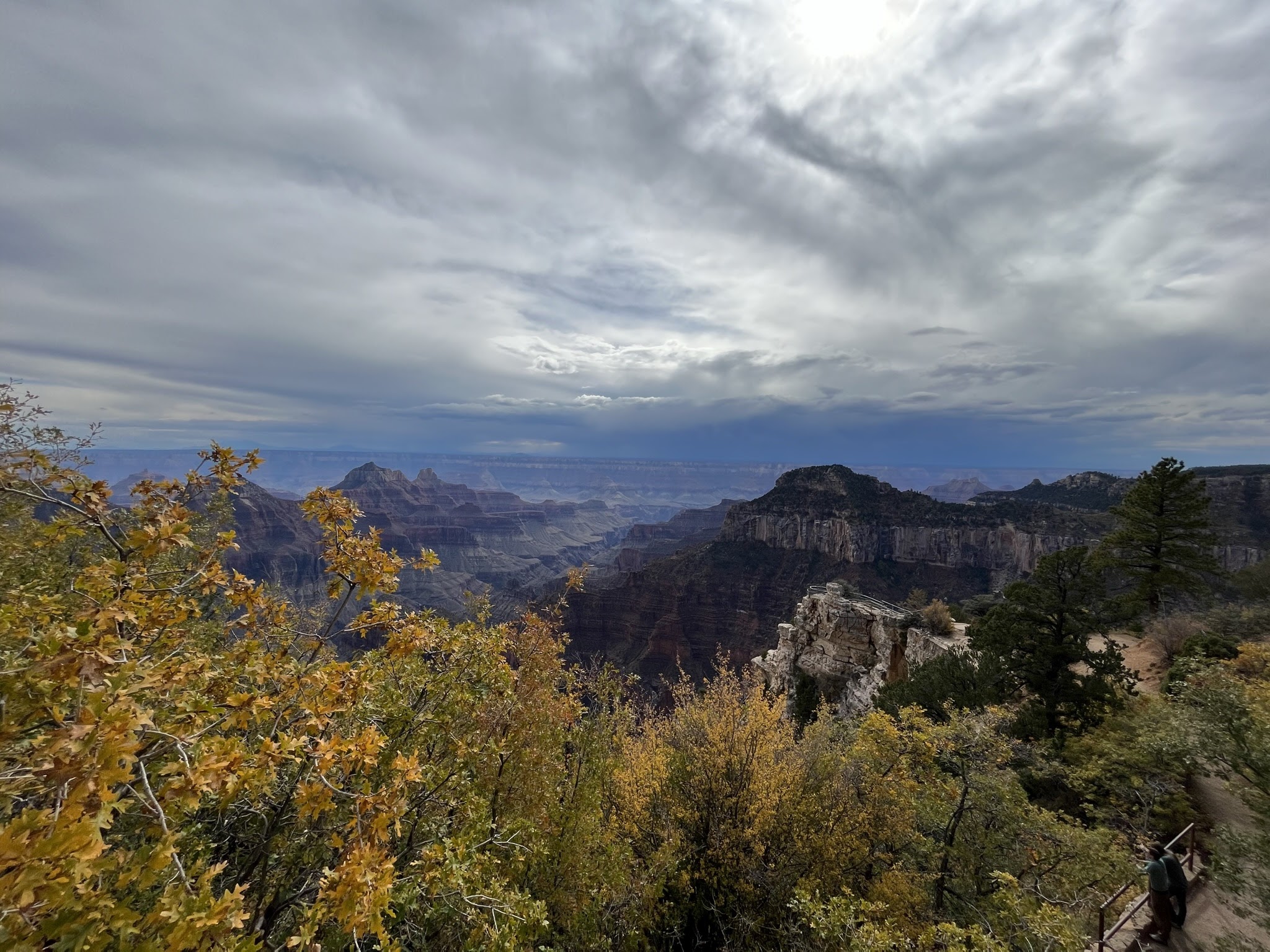
In the afternoon, clouds began moving in and rain was forecast. 
 

 The overcast skies gave a whole different perspective.

Even though it impacted the drama of sunset that night, it was worth it to watch the afternoon scenes.


Park rangers kept advising us to watch for lightning, which is prone to strike quickly in the high elevations. However, I only saw one bolt, off in the distance. It didn't start raining until nighttime and into the morning as we departed.

I asked a park ranger to take a photo of us. He took the one at the top of this post, but had us turn around for this photo. He said it was his favorite pose for families for whom he took photos. I saw him do the same for a family group.

Really, I started the story backwards. The photo below was actually our first look at the Grand Canyon on Friday, October 14, as we arrived from Bryce Canyon. 


Our first stop was Point Imperial, elevation 8,803, the highest viewpoint in the park. 


Roosevelt Point is named for Theodore Roosevelt, who is known for his love of nature. Here's what he had to say after a visit to the Grand Canyon:


Leave it as it is. You cannot improve on it. The ages have been at work on it, and man can only mar it. What you can do is to keep it for your children, your children's children and for all who come after you, as the one great sight which every American should see.
Theodore Roosevelt, 1903

Some 900 years ago, prehistoric Indians known as the Kayenta Anasazi lived along the Walhalla Plateau. In the winter, the cold and snow on the rim forced them to inhabit places like the sandy delta of Unkar Creek, where they could continue to farm. During the summer, some of them moved up to the rim to live in seasonal farming communities, where they grew beans, corn and squash. They also hunted in the forests and gathered native plans for food, clothes and medicine. About 1150 A.D., the people left the Canyon, possibly because of a decline in rainfall. They are believed to be the ancestors of the present day Hopi Indians who live east of Grand Canyon.

Angels Window was a highlight of a scenic hike we took as we reached the end of the Cape Royal road.


This was the view as we later stood on a viewing platform on the top of the window.

We listened to several other visitors talk about hiking into the Grand Canyon and then making the trek to the South Rim. Not surprisingly, that was not on our agenda.