Thursday, May 18, 2023

You Can Take the People Away from the Farm ...


You can take the people away from the farm. But you can't take the farm out of the people.


When we were looking for a place to eat supper in Bowling Green, Chaney's Dairy Barn caught my eye. It seemed to be fairly close to Bowling Green, and it gave us an opportunity to make a "Sunday drive" in the country on a Wednesday evening and get off the interstate. Plus, we'd be eating "local," something we try to do as we travel.

While we waited for our food to arrive, I wandered around the dining room to learn more about their history. Just like our Kansas ancestors, the Chaney family settled in Kentucky through the land grant program. The Chaney Dairy is on land that was granted in 1811 to Asa Kerby, an ancestor that dates back eight generations. A farm house stood on the property from 1850 until 1989, when it was destroyed by fire. 

In 2001, current owners Carl and Debra Chaney had a decision to make. They didn't want to give up the dairy business, which had been part of the farm since 1940. But with labor and economic challenges, they needed to make a change. They pivoted and now supplement their dairy operation with an agritourism attraction and informal restaurant. They've added a children's playground with a jumping pillow and playground. They offer both guided and self-guided farm tours to visitors, who can view the 60 Jersey cows and the robotic milkers which help the family produce milk, cheese, ice cream and other dairy staples. 

I had the Dairy-Aire, a pimento cheese sandwich made with Mema's recipe and fried pickles, another specialty, served with homemade ranch. (I'm always in search of pimento cheese that can rival the recipe made by a Stafford UMC church lady way back when. I'm still a bit bitter she went to her grave with that recipe. It wasn't because people didn't ask her for it!)

After supper, we walked down a dirt lane to the dairy facility to tour their barn. 

The cows are housed in a barn with fans and 24-hour access to food and water.

They use a Lely A4 robotic milking system. 

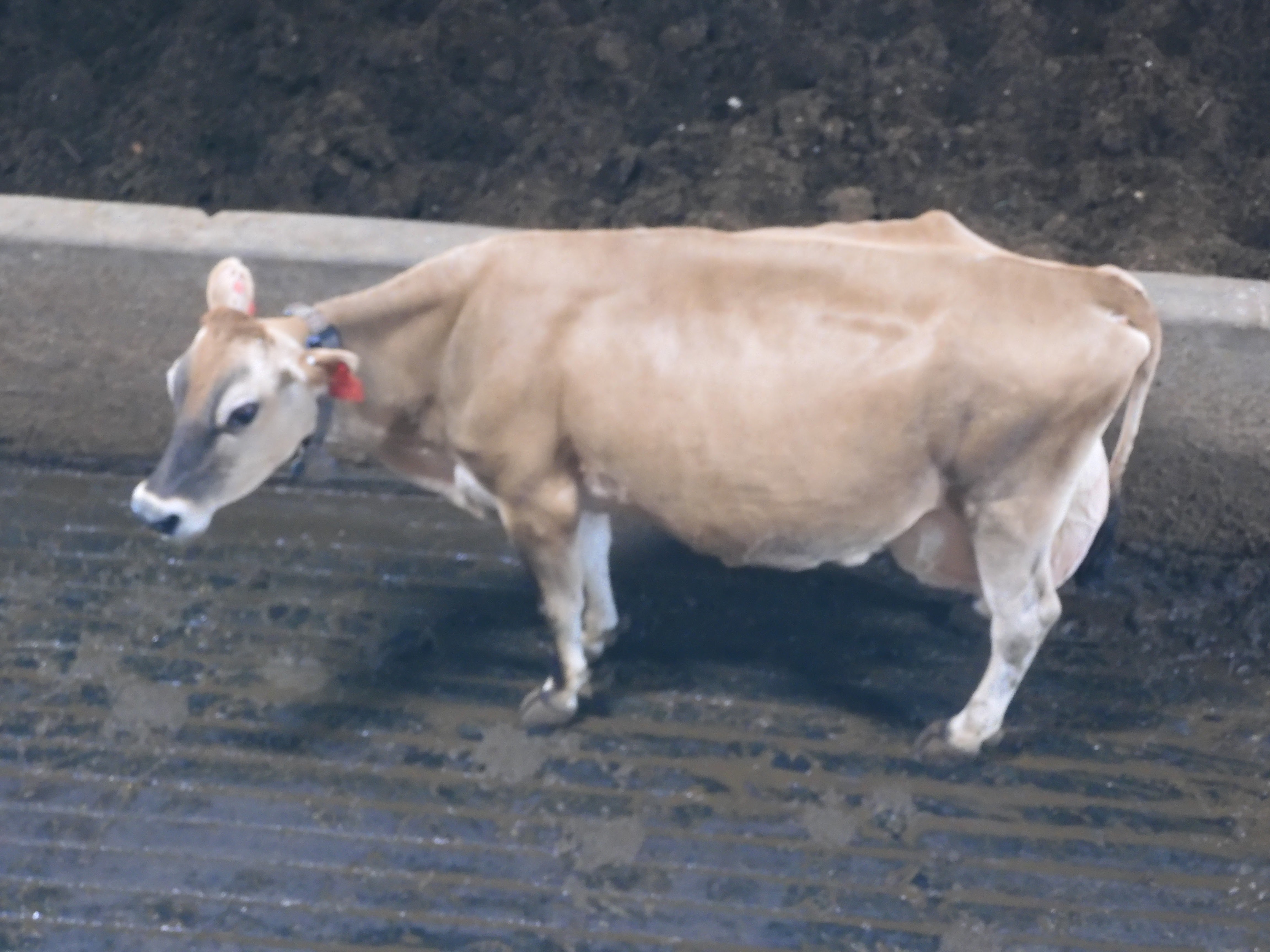
This cow was next in line to be milked. It reminded me of the photos I took of our cows and calves in the lane, waiting to be worked each spring.

Cows choose the time to get in line to be milked.  As full as this cow's udder was, it looked to us that she'd waited plenty long to get in line. But she did join her friends as we were standing there. Most cows go in for milking three times a day and produce 65 to 75 pounds of milk daily.


A robotic arm does everything from clean the cow's udder to hook up the milker. Data on how much milk the cow is producing goes into the computer. 

This cow data was from Abby, No. 1801, whose milking process we watched.

The milk is collected in the milk tank room.

In 2018, the Chaney family added the equipment needed to pasteurize the milk on their farm. 

This led to the Chaney's selling their own fluid milk and dairy products. '


 It's the only place in Kentucky making ice cream that comes from their own milk. 

This photo is blurry, but it shows one of the cows coming out of milker (and more cows in line to be milked in the background.) Another one appears just to be hanging out with her friends.

They even had a robotic manure scrapper.

Like all good farms, they had a barn cat. This one reminded us of a younger version of Big Cat.

The sun was setting, so we left the farmyard to return to the tourist part of Chaney's. 


Our tour gave us enough time for our supper to settle. So, of course, we had to partake in the Chaney's Ice Cream.

We also had Chaney's Ice Cream in a food trailer after our Mammoth Cave tour. Next time, we arrive in Lexington.


Tuesday, May 16, 2023

Well, It Was Mammoth


Mammoth Cave was ... well, Mammoth. But it was probably our least favorite stop on our trip.  And that was a surprise.

Randy, especially, was excited to add a check mark to another National Park after our trip last fall that included six national parks in Colorado, Utah and Arizona. I think both of us were expecting beautiful formations like those found in Carlsbad Caverns, which we visited B.C. (Before Children). Randy also took Jill & Brent to the Caverns when they were on a trip to visit relatives in New Mexico.

But it wasn't like that at all. Honestly, I was more concerned about staying upright on the uneven walkways. Before we ever descended the 200 stairs to get to our tour of the cave's Cleaveland Avenue, the park ranger put the fear of God into us. He cautioned that it would take hours for any rescue crews to respond to a medical emergency or an injury from a fall. Yikes! Way to welcome your guests!

Mammoth Cave National Park includes more than 400 miles of surveyed passages. These days, you have to have reservations to tour the different portions of the cave. Randy chose Cleaveland Avenue, which was rated "moderate" in difficulty. 

I had trouble getting good photos since it was so dimly lit.  And, again, I was trying to stay upright, so I didn't add pulling the camera from my pocket too frequently. (That kind of sounds like my excuses when there were limited photos from gathering and working cattle, doesn't it?)

According to the park, "it shelters a long and complex underground labyrinth.  The mysteries of this amazing natural laboratory have inspired and sustained human discovery for thousands of years."

The caves are karst landscapes, in which water moves rapidly underground by dissolving rock. Mammoth Cave's karst landscape is part of the U.S.'s largest regions of cavernous rocks. Caves and springs commonly occur in karst regions like Kentucky, southern Missouri and Florida. The karst landscape is why the Sky Dome at the National Corvette Museum in nearby Bowling Green collapsed in 2014. (See my earlier blog HERE.)

Karst is key to Mammoth Cave's origin because rock must be readily dissolved by mildly acidic water for cave passageways to form. What Mammoth Cave has that some other karst caves lack is an insoluble sandstone "roof." Sandstone protects the rocks below it. 

Cleaveland Avenue, where we toured, is tube shaped. It was formed as water flowed softly at the water table. Often such tubes are filled with water as they are formed.

A slightly different angle.

Mammoth Cave was formed by water sinking into the ground and flowing through underground streams to the Green River. As the Green River eroded a deeper course, the underground streams abandoned old beds and dissolved new, lower cave passageways.

Mammoth Cave was discovered in 1802. In 1926, Congress passed an Act to accept lands donated to the government to form a brand new national park at Mammoth Cave in Kentucky. At the time, the Mammoth Cave region was full of farmland and homesteads and needed to be prepared for its future park service status. Construction and improvements took place on both the surface and in the cave itself. This included destroying undesirable structures and reducing fire hazards, and building trails, a park amphitheater, as well as many other park structures to support the park’s mission.

The walkways we used were built during the Depression by the Civilian Conservation Corps (CCC). President Franklin Roosevelt created the CCC to put young men, aged 19 to 25, to work during the Depression. During the nine years CCC was in service, more than three million enrollees signed up to live and work in 4,500 camps that stretched across the U.S., including at Mammoth Cave. 

National Park Service photo of CCC workers at Mammoth Cave

For each day that a young man would work, he received $1 dollar. Within a month’s time, he earned $30, five of which he could keep, and the rest was sent to his family to help put food on the table and a keep a roof over their heads. This program addressed two distinct problems facing America; it provided employment for needy young men while also working to solve ecological challenges of conservation. They also planted many of the trees in the Mammoth Cave National Park. 

Four CCC camps were established in Mammoth Cave Park, with each of the camps housing 200 to 250 young men. The CCC often sent workers far from home to work on projects, yet several men from the local communities were part of the Mammoth Cave camps. 

Since those walkways were established some time ago, they are deteriorating and uneven.

Our park ranger asked the question, "Did this rock fall that way or was it placed by human hands?" He didn't really ever answer the question, but rather, told a joke.  
 

Early visitors to the cave often couldn't resist leaving behind a sort of "I was here" mark by writing their names on the cave walls. That will get you arrested these days.

My favorite moment was when the park ranger turned off the lights and the lantern and sang. Obviously, you can't see a thing in this video, but just turn it up and listen:

Thankfully, he turned on the lantern again before we continued on our tour.

Gypsum may also grow outwards in shapes that resemble flowers, like this one:


Flowers, like crusts, form as the gypsum extrudes from the rock (like toothpaste from a tube). In a crust, all the crystal grow at about the same speed, but to form a flower, some of the crystals grow faster than others.

Our tour ended in the Snowball Room. At least, that's what they called it.


They are globular white gypsum balls that cover the ceiling. 

Thankfully, the elevator to the surface worked. All the way through the cave, I had prayed for that outcome. I was not relishing reversing our route and then walking up all 200 steps. 

More from our trip to come.


Thursday, May 11, 2023

No, It's Not Our Corvette


I had an interesting conversation in the bathroom of the National Corvette Museum in Bowling Green, Ky. Before we even got started on our perusal of the museum, we made the prerequisite stop known to all retirement-age people. Yes, the bathroom. As I was washing my hands, a lady said, "Are you the one picking up the new Corvette?"

I almost turned around to see who she was talking to, but since we were the only two at the sinks at that time, I figured it was me.

I smiled. (Didn't I use great restraint not to laugh hysterically?) And I politely responded, "No, it's not us!" 

There was a special place at the museum to pick up custom Corvettes. 

Here's Randy, trying to look sad that the only Corvette he got at the museum was Matchbox-sized. (He also got a golf ball and a new shirt. OK, true confessions: I got a sweatshirt and a Christmas ornament at the Laura Ingalls Wilder Museum.)

We did see a few salesmen leaning over cars on the showroom floor, pointing out the features of a brand new Corvette to potential buyers.

But most of the Corvettes we saw were in the beautifully-designed museum showrooms. 

I took a photo of one below because it had a Kansas tag.


It was a 1963 Corvette with a split window in the back. According to the museum signs, the split window is "one of the most universally beloved Corvette models." At the time when Bill Mitchell was at his creative peak, he sought a uniquely American sports car form. Mitchell's direction to designers was "to put a crease in the pants." This is evident in the fender forms and the crease running the length of the car, still used today. However, the controversial split window disappeared after only one year.

I had to take a photo of the 1988 Corvette because that's the year Brent was born. The 1988 Corvette represented the company's 35th anniversary. (And, ironically, Brent celebrated his 35th birthday yesterday.)

Corvette missed its own 30th anniversary when the 1983 car didn't make it to production in time. So, to mark the 35th anniversary, a special package was added for coupes for an additional $4,795. Only 2,050 35th anniversary edition Corvettes were made. This one had only 380 miles on the odometer.

Speaking of vintage cars, this 1957 version was produced in my birth year. The Corvette Super Sport was designed to "create a vision of what racing cars should be." The SS Racer competed and was capable of "amazing speed," but was rushed through development. The team failed to insulate the driver effectively from the extreme heat of the mechanicals. Despite what engineers called "teething pains," it was hailed as one of the most beautiful racers of the era.

Probably the most fascinating part of the museum for us was a display about the February 12, 2014, sinkhole that swallowed up eight one-of-a-kind Corvettes under the floor of the museum's Skydome. It happened in the early morning hours, so no one was in the museum at the time. When emergency personnel arrived, they discovered a sinkhole 40 feet wide and 25 to 30 feet deep.

Of the eight cars that fell into the hole, the museum owned six and General Motors owned two, including the 1 millionth car to come off the assembly line.

Photo from the National Corvette Museum website

The value of those cars was estimated at $1 million. 

The remaining 20 cars in the Skydome were removed later that day for safekeeping. Two years later, the Skydome reopened and now tells the story of what happened and why. Kentucky is one of the states notable for having karst topography, a landscape formed from the dissolving of rocks such as limestone. (It's not far from Mammoth Cave, which was formed the same way. More on our Mammoth Cave visit is coming up on the blog.) 

While most of the museum featured Corvettes (as you'd expect in a Corvette museum), I couldn't resist a photo by a bright purple 1951 Chevy,

The 1951 Chevy street cruiser was designed by Carl Casper. Casper may have thought it was painted in Purple Passion Candy, but we Wildcat fans know it's K-State purple.


Of course, we had to get a Batmobile photo, too. Casper's designs also attracted Hollywood's attention. Warner Bros. tasked Carl Casper with building three Batmobiles that could be used in promoting the film, "Batman Returns." Casper also designed the Dukes of Hazard General Lee and The A-Team's crime-fighting van. 

Here was his Cosmic Invader. No wonder his cars were popular at car shows throughout the country.

More from Bowling Green next time.

Tuesday, May 9, 2023

Little House on the Prairie


"Once upon a time ..." doesn't just apply to little boys. It also applies to a retirement-aged woman nostalgically recalling her childhood years.

As I wrote last week, we recently returned from a 2,150-mile road trip that took us through parts of four states. Randy was our driver, and I was the navigator. Sometimes, when the traveling duo is on the same stretch of road for an extended period, the navigator may take a break from her directional duties. OK, yes, I was reading. 


But, at just the right time, I happened to look up from my book and saw a glimpse of a billboard. It was advertising the Laura Ingalls Wilder Historic Home and Museum in Mansfield, Mo. A quick search of Google maps showed that the attraction was in a town along our route. 

I didn't even have to campaign to add the stop to our travel itinerary. Randy knows I have wonderful memories of my mom reading the Little House books to us. We three girls would cuddle up on the living room couch and listen to my mom read after supper. Jill read the books while she was in elementary school, and Kinley has read some of them, too.

Laura Ingalls Wilder was born in 1867 near Pepin, Wisconsin. However, her "Little House" books were all written in Mansfield, a small town in the Missouri Ozarks. Laura, her husband Almanzo (Manly) and daughter Rose moved to Missouri from De Smet, South Dakota, leaving the drought-stricken area in a covered wagon on July 17, 1894.  (Drought-stricken definitely sounds familiar right about now!) While at the museum I bought her book, "On the Way Home" about that journey. It was one I hadn't read before and was compiled by daughter Rose from a diary that Laura wrote as they journeyed. 

"Parts of Nebraska and Kansas are well enough, but Missouri is simply glorious. There, Manly interrupted me to say, 'This is beautiful country.' " 
Laura Ingalls Wilder from "On the Way Home"

They arrived in Mansfield on August 30, 1894.  In September, they purchased 40 acres of land, including the site that became Rocky Ridge Farm, where they raised dairy cows, poultry and fruit.

Rose describes the day her parents found the homestead:

My father was glowing, and my mother shining. She never had talked so fast. Just what they wanted, she told Mrs. Cooley, so much, much more than they'd hoped for. A year-round spring of the best water you ever drank, a snug log house, in woods, on a hill, only a mile and a half from town so Rose could walk to school, and, to cap all, just think! 400 young apple trees, heeled in, all ready to set out when the land was cleared. They'd bought it, and as soon as dinner was over, they were going to the bank to sign the papers.
Rose Wilder Lane in "On the Way Home"

The Wilders began building a farm house to replace the log cabin. Almanzo built their farm home, one room at a time. It took him 17 years to finish and it was completed in 1913.

In 1911, Laura started a career as a journalist, writing about rural life in local publications. Their daughter, who was also a journalist, moved back to Missouri in 1928 after living abroad for several years. Rose built what is called the Rock House on the property, a smaller home that she patterned after an English cottage. She thought her parents would appreciate a smaller home to care for and she used proceeds from her writings. She had an architect modify plans from a Sears-Roebuck catalog house.


While with her parents,  Rose encouraged her mom to share her childhood stories. So Laura began writing with a pencil on Big Chief tablets, reliving the stories of her youth.


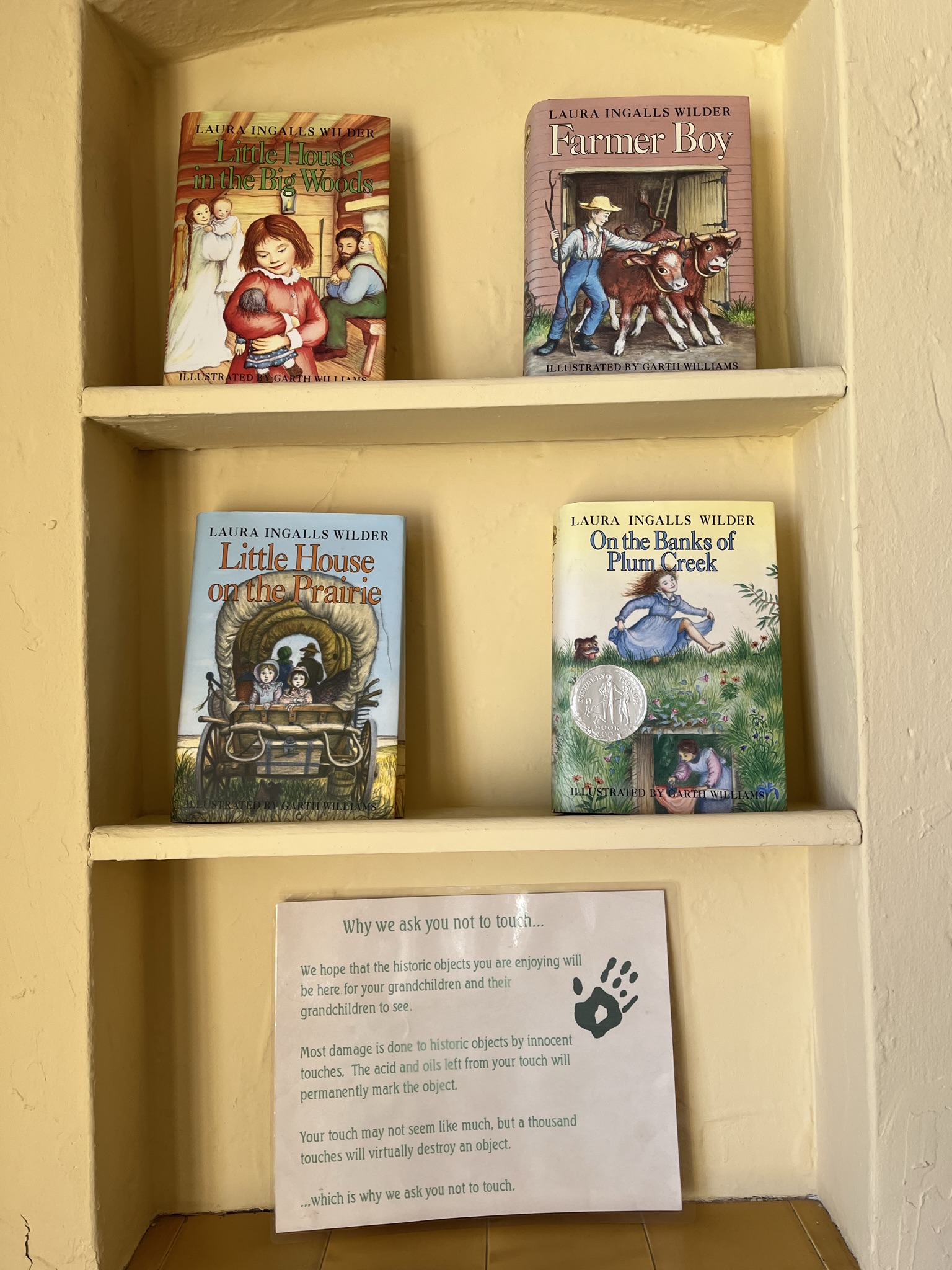
While living at the Rock House, Laura wrote "Little House in the Big Woods," "Farmer Boy," Little House on the Prairie" and "On the Banks of Plum Creek."

The books written by Laura while she lived in the Rock House are displayed in the dining room there.
 

I could picture Laura writing at her dining room table, looking out the windows at the green countryside she'd loved since arriving. Since she wrote "Little House on the Prairie" there, I could almost see Laura remembering her childhood in Kansas. Of course, as a little Kansas farm girl who grew up to be a Kansas farm partner, her "Prairie" book holds a special place in my heart.

During the same time, Rose Wilder Lane wrote, too, including her best-known novel, "Let the Hurricane Roar," which was published as a serial in The Saturday Evening Post in 1932. It became a bestselling book during the Depression. 

By 1936, Rose left Missouri for New York City. Her parents then returned to their original farm home, and the Rock House was sold. However, in 1990, the Wilder Association purchased the property. After restoration, the house was dedicated in 1997 and became part of the museum complex.

Books by Rose Wilder Lane displayed in the Rock House dining room.

After Laura and Almanzo moved back to their original farm house, Laura wrote the other Little House books: "By the Shores of Silver Lake," "The Long Winter," "Little Town on the Prairie," "These Happy Golden Years" and "The First Four Years."

Again, I could picture Laura writing on the table or window seat, while she looked out at the blooming flowers and green grass.

Looking out the window at the Wilders' farm home

Almanzo died at Rocky Ridge in 1949 at the age of 92. Laura lived there until her death at age 90 in 1957. After her death, Rocky Ridge Farm, was turned into a museum that attracts visitors from all over the U.S. - including me!

Laura's Pa called her Half Pint. As an adult, she was less than 5' tall. This was a life-size photo cutout in her farm house kitchen. 


From the dining room, looking back through a pass-through into the kitchen. Almanzo built their farm home, one room at a time. It took him 17 years to finish and it was completed in 1913.

The house is furnished like it was back when the Wilders called it home. 

As you might expect, a library was part of their home.

Almanzo was quite a craftsman. He built Laura many gifts, including this clock, which was mentioned in the Little House books.

After the house tours, we also spent some time in the museum building.


The museum houses hundreds of possessions and artifacts from Laura and her family, including Pa's fiddle which is featured prominently in the Little House books. Visitors can see clothes, photographs, dishes and more.

One of the quotes in the museum said:

As you read my stories of long ago, I hope you will remember that the things that are truly worthwhile and will give you happiness are the same now as they were then. Courage and kindness, loyalty, truth and helpfulness are always the same and always needed. I am beginning to learn that the sweet, simple things of life are the real ones after all.
Laura Ingalls Wilder


No wonder I can relate to Laura!

There are other sites throughout the U.S., located at the sites that Laura's books take place. In fact, one is in Independence, Kansas. I've never been there, but maybe we'll have to add it to the list.

More from our trip next time.