Showing posts with label Class of 2019. Show all posts

Tuesday, April 2, 2019

Class of 2019 Class Photos

This little guy was head and shoulders above the crowd. Literally.

He was one of the "patients" who participated in the three days of annual "well-child" check-ups last week on the County Line. 
He wasn't the only cutie in the waiting room.
Springtime means it's time to "work" baby calves. That may sound like we're sending them off to collect a paycheck. But it really means that we are doing the work by sorting, hauling and doctoring the baby calves.

When Jill and Brent were infants, I took them to well-child checks at the pediatrician. They were different than the last-minute appointments we made for ear infections and other ailments. Well-child checks were designed for the pediatrician to evaluate their health status and give any recommended vaccinations.
Our baby calves undergo a similar process each spring. For this appointment, Randy fulfills the role of "physician's assistant." He certainly doesn't have the education of a Doctor of Veterinary Medicine. We do use a veterinarian for many of our cattle herd's health needs, and we ordered the medication from our vet. But this is a task that Randy does, with help from me and our employee.

The process starts by gathering the mama cows and the calves. The method varies, depending on the location. To work the calves at Peace Creek, we use 4-wheelers to drive the cows and calves a half mile to the corrals and working chute.
 
But, for the other three locations, we gather the cows and calves into a corral and then sort the babies from the mamas. As I've said before, I skip trying to photograph this process. I need my hands free while trying to send mamas back to the corral and keep the babies from following along.

We haul the babies by trailer to the working chute, leaving the mamas behind. 
The babies seem more curious about me than concerned about the fact they are separated from their personal milk machines. The mamas end up with that "first-day-of-kindergarten" feeling being separated from their babies. But, just like at the end of the kindergarten session for we human Mommies, the babies will be back with their mamas soon enough - right after their "doctor's appointments." The babies go, one at at time, down a lane and into a calf cradle - a miniature squeeze chute.
 
The first order of business is giving each calf a number tag and notch in its left ear. This year, the numbers all start with "9" to indicate the baby was born during the 201"9" calving season. Then the baby calf and his friends got Tic-Tac-sized growth implants in their ears. The hormone stimulates the pituitary gland and helps the calf grow. The $1 implant will bring a $3 return. Randy believes it's a matter of using the technology available to more efficiently grow food for consumers. And, yes, we eat the meat that we produce here on the farm and share it with our children and grandchildren.
We give each calf two injections. One is an immunization to prevent blackleg. The other prevents viral diseases in cattle. People often question the reasons for giving immunizations to animals that will eventually enter the food chain. But these injections are like giving immunizations to our own children. It helps keep the calves healthy, and healthy cattle provide a good source of protein in the human diet.

The bull calves also become steers during their time in the chute.
With all the steps done,  the calf joins his fellow "class"mates - none the worse for wear.
After all the calves were through the chute, we loaded them back in the trailer for the short trip back to their mamas. For the Peace Creek group, the babies get a chauffeured ride back to the creek. The mamas follow the trailer the half-mile back to the pasture.
Hopefully, they don't take too many diversions to munch on wheat or grab a drink from a mud puddle.
Once the mamas arrived, they were anxious to find their babies.
I always cue the music in my head, "Reunited and it feels so good..."
We have one more group to work, which will likely happen tomorrow if the lot dries out enough to negotiate it.
The babies and mamas will remain close to the farmstead for the next several weeks until we move them to summer pastures.

Thursday, January 31, 2019

The Fritz Carlton West

The Fritz Carlton is open for business.

Let me pause here to confess that I appropriated my son's name for his house in Manhattan. When he moved back to the Little Apple and bought a house just blocks from the football stadium, his abode became a popular bed-and-breakfast spot for his fraternity brothers. OK, he doesn't usually provide breakfast. He's more likely to provide dinner. It's nearly impossible to get a "reservation" at the Fritz Carlton during K-State's football season (though he's always told us that we can have priority booking).

So, let's just say the Fritz Carlton West has opened for business. The founding members of the Class of 2019 began arriving on Sunday. Two calves were born on that relatively mild day. 
This little guy got the very first ear tag of the year. His number and the rest of his classmates begin with a "9." That signifies he was born in 2019.
This system allows us to know at a glance when the animal was born, especially important if it remains in our herd.
As an example, its mother has a 767 tag, so it was born in 2017. In the case of our newest additions on the County Line so far, all of the mothers have a 7-- tag. 
They are heifers: In other words, they are first-time mothers. They were born in January and February two years ago. They were the 25 females we kept at the end of calving season in 2017 to become the newest mothers in our herd in 2019. We keep the heifers in a corral east of our house so that Randy can check them frequently. First-time moms have the potential for more calving problems than older females, though we try to mitigate that by using bulls that produce lower birth weight progeny.
 
With the first calves born on a fairly warm day, they didn't need a "room in the inn" - or the calving shed, in our case.
Monday was a little chillier. But, since it was early afternoon when this little guy was born and the mom had already licked it off, Randy decided a move to dry straw for the afternoon would give the calf a cozy spot. Those calves are heavy when you're carrying them across a muddy lot. (Not that I would know personally.)
It wasn't long before No. 902 was trying to stand.
And we were there when it took its first steps. (Randy was wishing it had been a little more mobile so he wouldn't have had to carry it!)
The coldest night of the year so far was Tuesday night. This baby was the first guest in Fritz Carlton West, our calving shed. (Learn more about the calving shed here and here.)
After it warmed up out of the wind in the cozy straw, Randy added its eartag and pushed it out the door to rejoin its mom. (Many times, the moms are with them in the shed, but this heifer's mom didn't want a spot in the "motel.")
We were both pushing the calf out to the bigger lot. And then we discovered that we had made a tactical error.
Randy took off across the lot to get a closer look at the other mothers-to-be. And it was like he was the Pied Piper to little No. 903.
Are you my mother? (For the record, the mom and No. 903 have found one another and all is well.)

Two other new babies born Wednesday afternoon and their mamas spent the night in the calving shed last night. Randy also put another three heifers he thought might be close to calving in the shed - just in case.
You know I said that Brent doesn't provide breakfast at his version of the Fritz Carlton. (Most of the time, they're going to a tailgate before the game anyway.) Well, neither do we for the young set, though we provide plenty of hay and feed for their moms.
The Fritz Carlton in Manhattan sometimes provides dinner. We don't have to do that either.

Thursday, October 25, 2018

Replaced by a Drone?

I couldn't resist clicking on a link yesterday that said, "Cargill develops industry-first robotic cattle driver." It probably had something to do with this reminder of our latest cattle adventure:
Though it's a little hard to see, I have a fairly sizable bruise on my arm. It was my own darn fault. I stuck my arm where I shouldn't have. It's one of those things you do and wish you hadn't.

It's not a big deal - a little broken skin and a tender arm is much better than anything broken. And it also points out my abundance of sunspots. Let's call them that rather than age spots, shall we? (Randy heard me say "ouch," but I don't think the other guys even knew anything had happened. I'm quite proud of that.)

With only that minor hiccup, we got our first round of cattle work done this fall Monday during our rain-imposed hiatus from wheat planting and milo harvesting.

Anyway ... I'm thinking one of those robotic cattle drivers would be quite the addition to the old farmstead after reading the article in Farm Journal's Ag Tech:
Improving animal welfare and employee safety—that’s the top two goals driving the creation of the industry’s first robotic cattle mover. Cargill says the robots are designed to move cattle from holding pens to the harvest area at processing plants, reducing stress to the animals by minimizing their proximity to human activity. Employees operate the robots from a catwalk above the holding pens. This also helps improve worker safety.

The machine uses automated arms, blowers and audio recordings to move cattle in a desired direction, and can operate in rain, snow, or mud with no delay in daily operations. Testing was conducted at Cargill’s Wyalusing, Penn., and Schuyler, Neb., beef processing facilities. The robotics are being implemented at Cargill Protein beef plants in the U.S. and Canada.
At any rate, it's not coming to the County Line any time soon, so I guess Randy will have to put up with his clumsy cattle helper instead.
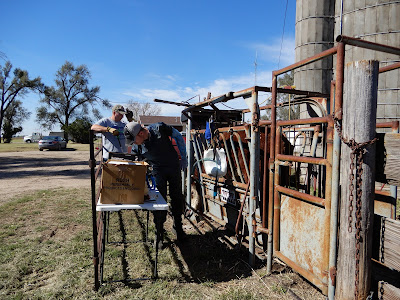
The non-clumsy worker was Dr. Bruce Figger with South Wind Animal Health. He preg-checked 25 heifers, as well as vaccinating and applying a dewormer to the "ladies" and one bull.  

Yes, Dr. Figger got the glamorous job on the "business end" of the heifer. With an internal exam, he determines how far along the young moms are. Bulls arrived in these ladies' pasture in July, so they could be 6 months pregnant by now. Most were in the 5- to 6-month gestation stage. A few were a little "later to the party" and were about 4 months gestation. They will be the first in our County Line maternity ward to deliver the Class of 2019, beginning in late January and February.

The heifers are first-time mothers. Well, 23 of them will be first-time mother come late January. Two of them were "open," in other words, they weren't pregnant.

Now if those "young ladies" were your teenage daughters, that would be good news. As it is, they will become the meat in our freezer next spring.
 
After the exam, Dr. Figger applied a deworming solution to control parasites like worms, lice and liver flukes.
He also gave each pregnant heifer a shot of Virus Shield 6 that prevents leptospiriosis and BVD. Leptospiriosis is an bacterial infection that may cause abortion or stillbirth. BVD stands for Bovine Viral Diarrhea - 'nuff said. The pregnant heifers also got a shot of Scour Bos. The vaccination helps prevent scours (diarrhea) in their babies. Cattlemen want to produce healthy cattle. It's better for the cattle, and it's also better for the bottom line. Just like we gave recommended vaccinations to our children, we believe it's important to give our cattle every medical advantage to have a healthy life.
 
You remember those little pink vaccination books our parents used to keep track of our vaccinations as kids? Dr. Figger also made notes on each heifer, recording her eartag number, her gestation, the medicines she received and a body condition score.

The chute didn't work perfectly during this first round of cattle work, so Shawn did some repair work on it yesterday while Randy planted wheat. However, with 0.80" of rain overnight and this morning, we are AGAIN at a standstill.

True confessions: I had a blog post all ready with beautiful photos of sunrises and fall colors. But I just wasn't feeling it this morning after another round of rain.  We'll save that for a more optimistic day.