

It's not a big deal - a little broken skin and a tender arm is much better than anything broken. And it also points out my abundance of sunspots. Let's call them that rather than age spots, shall we? (Randy heard me say "ouch," but I don't think the other guys even knew anything had happened. I'm quite proud of that.)
With only that minor hiccup, we got our first round of cattle work done this fall Monday during our rain-imposed hiatus from wheat planting and milo harvesting.
Anyway ... I'm thinking one of those robotic cattle drivers would be quite the addition to the old farmstead after reading the article in Farm Journal's Ag Tech:
Improving animal welfare and employee safety—that’s the top two goals driving the creation of the industry’s first robotic cattle mover. Cargill says the robots are designed to move cattle from holding pens to the harvest area at processing plants, reducing stress to the animals by minimizing their proximity to human activity. Employees operate the robots from a catwalk above the holding pens. This also helps improve worker safety.At any rate, it's not coming to the County Line any time soon, so I guess Randy will have to put up with his clumsy cattle helper instead.
The machine uses automated arms, blowers and audio recordings to move cattle in a desired direction, and can operate in rain, snow, or mud with no delay in daily operations. Testing was conducted at Cargill’s Wyalusing, Penn., and Schuyler, Neb., beef processing facilities. The robotics are being implemented at Cargill Protein beef plants in the U.S. and Canada.

Yes, Dr. Figger got the glamorous job on the "business end" of the heifer. With an internal exam, he determines how far along the young moms are. Bulls arrived in these ladies' pasture in July, so they could be 6 months pregnant by now. Most were in the 5- to 6-month gestation stage. A few were a little "later to the party" and were about 4 months gestation. They will be the first in our County Line maternity ward to deliver the Class of 2019, beginning in late January and February.
The heifers are first-time mothers. Well, 23 of them will be first-time mother come late January. Two of them were "open," in other words, they weren't pregnant.
Now if those "young ladies" were your teenage daughters, that would be good news. As it is, they will become the meat in our freezer next spring.


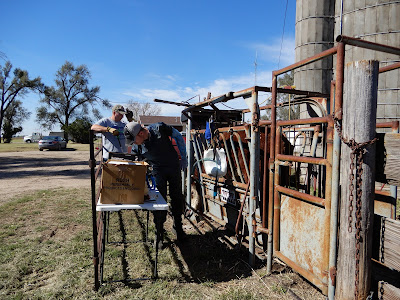
The chute didn't work perfectly during this first round of cattle work, so Shawn did some repair work on it yesterday while Randy planted wheat. However, with 0.80" of rain overnight and this morning, we are AGAIN at a standstill.
True confessions: I had a blog post all ready with beautiful photos of sunrises and fall colors. But I just wasn't feeling it this morning after another round of rain. We'll save that for a more optimistic day.


