Showing posts with label South Dakota travel. Show all posts

Thursday, September 24, 2020

Wonder Book of Nature

 It is an incalculable added pleasure to anyone's sum of happiness if he or she grows to know, even slightly and imperfectly, how to read and enjoy the wonder book of nature. 

President Theodore Roosevelt
Quoted by a park ranger at Mount Rushmore
Evening flag retirement & lighting, September 9, 2020 
 
 
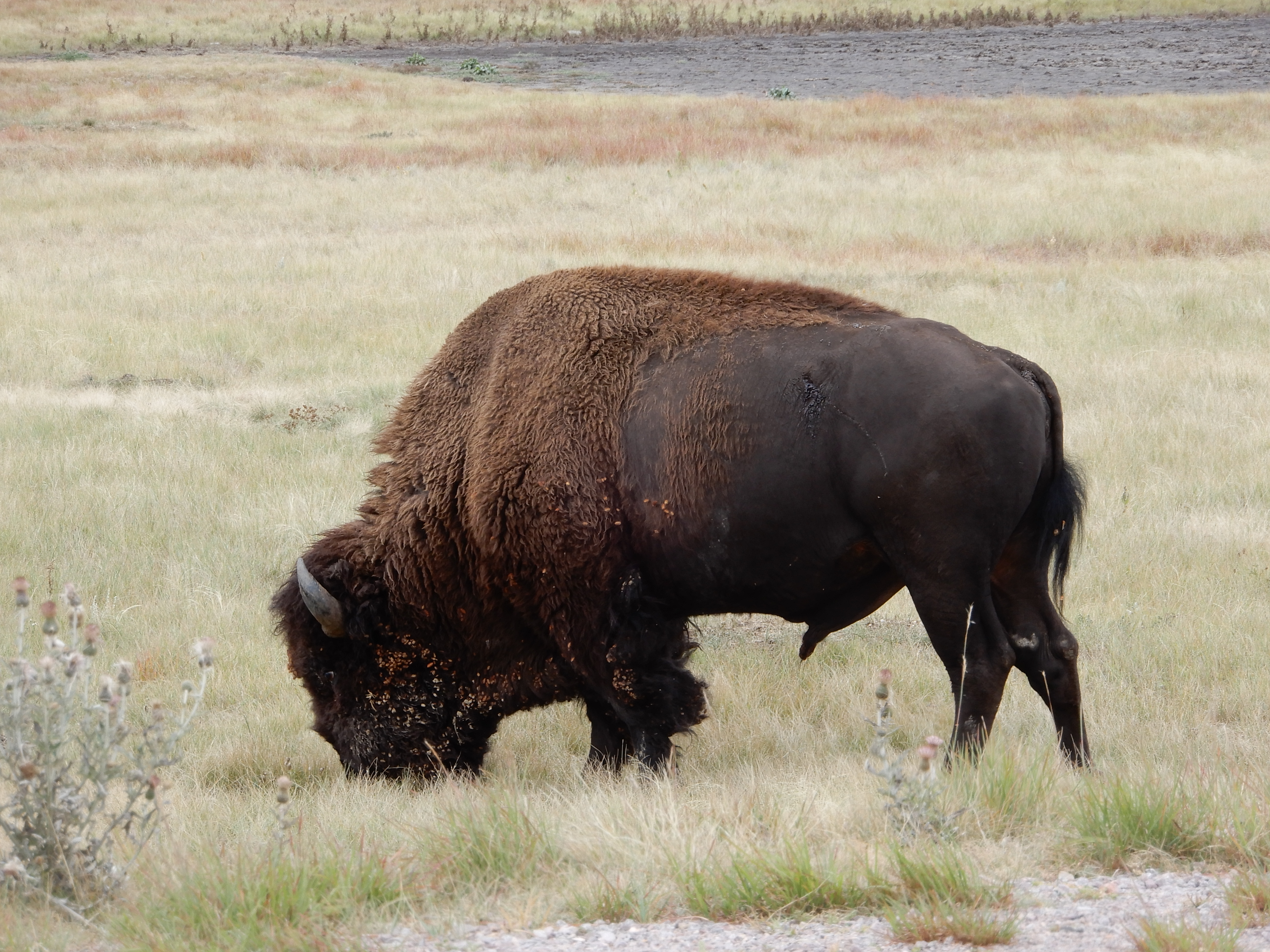
I was picturing a buffalo bull standing majestically on gently rolling hills of South Dakota, with seasonal grasses subtly signaling the transition to fall.
 
Instead, my first glimpse of a buffalo at Custer State Park was next to a picnic area. But it didn't keep me from snapping away with my camera, joining a bunch of other wildlife paparazzi. (I was safely ensconced in my car at the time because I'm a rule follower. Those people over on the bridge must not have seen the signs.)

"Not what I was hoping for," I lamented to my faithful chauffeur as we drove away. 
 
We were nearing the end of the wildlife loop at Custer State Park before we saw any other buffalo or wildlife of any kind.
 
Randy made a new friend.
This young burro seemed to give me the Greta Garbo treatment, "I want to be alone." As you can see, we weren't the only visitors stopped along the roadway. People literally were weaving around them on the road to continue their journey. They reminded me of cattle who sometimes have to be nudged from a feed bunk with the fender of the pickup.

The wild burros (who didn't appear so wild anymore) trace their roots to a herd that once hauled visitors to the top of Harney Peak. At the rate they move these days, it would take awhile.
 
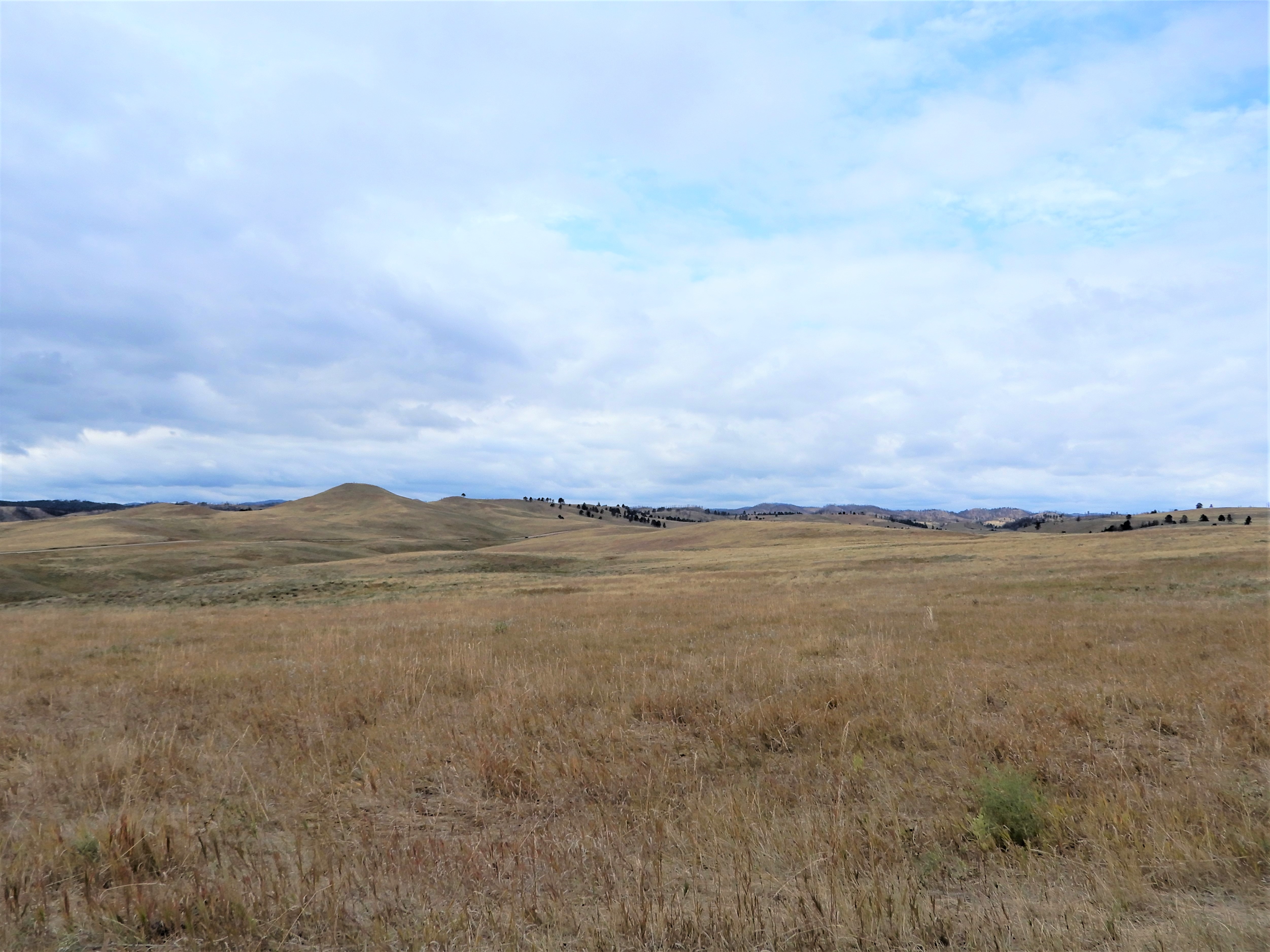
This stretch of road also featured a landscape dotted with buffalo. OK, maybe I have to tell you that's what they are. But I did get the interesting sky and those rolling South Dakota hills I was talking about.

 The buffalo didn't seem too concerned about the traffic jam in their neighborhood.

This coming weekend, September 24-26, Custer State Park will have even more spectators. But they'll get to see the buffalo on the move as cowboys and cowgirls roundup and drive the herd of approximately 1,300 buffalo to corrals for health checks, branding and sorting. It would be a sight to see - as long as you could find a place among some 20,000-plus people expected to gather to watch.

On second thought, I'm just as happy with our more solitary viewing - even if it wasn't particularly dramatic.

Sightseeing wasn't really on the agenda for our trip to South Dakota. However, we did manage to check out some sights during our arrival and departure. And, yes, I was the country bumpkin taking photos of farm things found in downtown Rapid City after supper.

Our trip took us through portions of the Black Hills National Forest ...


One of several one-car tunnels on the twisty road
... and Wind Cave National Park. (Randy was the one who wanted to stand by the signs. Really, I didn't make him!)

We also drove through part of the Badlands on the way to Rapid City. Randy really wanted to use his Senior Pass to the National Parks system.

It's kind of been burning a hole in his pocket, so to speak. (My parents used to say that about birthday money acquired by one of my siblings who shall remain nameless.)


It was an overcast morning, but there was still mysterious beauty in the landscape.

Beauty on the landscape, but just a couple of old Kansans in the foreground. 


 And speaking of Kansas things, I had to take a photo of a sunflower, too. The background didn't look much like home though.

 
The Badlands is another one of those "you've-got-to-see-it-to-believe-it" places. 
 
 
It's also a place where amateur photos just don't capture how beautiful it truly is (kind of like Grand Canyon photos). 


But, of course, that didn't keep me from attempt after attempt. This was our third time to drive through portions of the Badlands. But it's different every time because of the lighting and the season.

Architect Frank Lloyd Wright wrote in 1935: "I've been about the world a lot and pretty much over our own country, but I was totally unprepared for that revelation called the Dakota Badlands. What I saw gave me an indescribable sense of mysterious elsewhere - a distant architecture, ethereal ... and an endless supernatural world more spiritual than earth but created out of it."


It's amazing how much the landscape changes from one overlook to the next - from browns, to reds to yellows and tints in between. The Lakota Indians knew the place as mako sica. Early French trappers called the area les mauvaises terres a traverser. Both mean "bad lands."

They may be "bad lands." But they sure are pretty.


We had a pretty stop at the Valentine (Nebraska) National Wildlife Refuge, too. 

It may not have been a long stop. But we still explored "the wonder book of nature" that Franklin Roosevelt was talking about. Thankfully, we're not far from that bestseller here at home either.


Tuesday, September 22, 2020

Beauty as Bread: Mount Rushmore


A park ranger at Mount Rushmore shared a 1912 quote from naturalist and author John Muir during the evening flag and lighting ceremony at Mount Rushmore National Memorial. I didn't have pen and paper, but I jotted down enough notes on my phone that I could find the quote later:
Everybody needs beauty as well as bread, places to play in and pray in, where nature may heal and give strength to body and soul. 
John Muir, 1912
John Muir believed there was healing and sanctuary in beautiful places. We certainly found that to be true as we experienced the moving Mount Rushmore ceremony at twilight. Randy had spent the day at the hospice with his brother, Lyle. But he wanted to attend the ceremony.

We've been to Mount Rushmore twice before, but this would provide a different glimpse at the monument.  (See photos from those daytime trips here and here.)


There was still snow on the ground from an early-season storm as we nestled under a blanket to wait for the start. The cold and Covid combined to reduce the crowd for the ceremony, which is held beginning in late May through September 30 each year.  That made it easy enough to social distance.

Sunset doesn't occur directly behind the Founding Fathers. But the sunset sky still provided a splash of color as the sun sank below the Black Hills of South Dakota. 

Before it started, the park ranger said that veterans would be invited to come to the stage at the end to retire the flag for the evening. Looking at the small crowd, she was a little concerned, adding that veterans who weren't able to make the trek to the stage could send a representative.

But there was no need to worry. When she asked the veterans to congregate, 34 men and women streamed from the bleachers to the stage.
"The Star Spangled Banner" never sounded so beautiful as it did as our voices drifted upwards toward the lighted Founded Fathers. No, not every voice was in tune. It certainly didn't have the flourishes and frills added by most soloists these days at football stadiums or baseball venues throughout the country.

Instead, strangers from every region of the country sang together with one voice piercing the cold night air. With the giant flag slowly descending, the veterans stood at the feet of the flagpole, hands over their heart. The Founding Fathers seemed to peer wisely onto the scene. Considering the current atmosphere of political contention and intolerance for others, it was a moving moment in time.

Two days later, as we left Rapid City to head toward home, we decided to take a winding road on the outskirts of Custer State Park. It was another overcast day, but as we walked up to the viewing point, a little beam of sun highlighted the mountain. I didn't realize at first that I was looking at Mount Rushmore.
But as I used the Zoom on my camera, good old George, Thomas, Teddy and Abe popped into my viewfinder. It was another reminder of celebrating history and beauty.
 
It would do us all good to remember both.

Tuesday, October 3, 2017

Hills and Valleys

A song has played in an intermittent loop on my mental soundtrack for the past couple of weeks. It momentarily gets bumped to the background by a hymn we sing at church or a song on the actual radio dial.

But, if there's no music playing, it's a song that keeps resurfacing on my internal radio feed. It started on a trip to South Dakota.  Randy had gotten a phone call that his brother, Lyle, was in the hospital in Rapid City, so we hurriedly finished some obligations, then got in the car a couple of days later for the 12-hour trip.

We traveled across our Kansas plains, skirted the Nebraska sand hills and arrived on the plains of South Dakota. But as we got closer to Rapid City, the plains gave way to the Black Hills. It was dark by the time we arrived that first day, but I could still see the faint outline of hills as we drove west. And I first began thinking of Tauren Well's song, "Hills and Valleys," a song that I've heard quite a bit on K-LOVE, a contemporary Christian radio station.

Hills and Valleys
(Find all the lyrics at this link)
Find the story behind the song at this link
Sung by Tauren Wells

On the mountains I will bow my life to the One who set me there
In the valley I will lift my eyes to the One who sees me there
When I'm standing on the mountain I didn't get there on my own
When I'm walking through the valley I know I am not alone
You're God of the hills and valleys, hills and valleys
God of the hills and valleys
And I am not alone

The next few days, we spent most of our time in the hospital ICU, but we also went to Deadwood to retrieve a few things from Lyle's apartment.
  
Painted Lady butterflies danced and swirled in the flower gardens in front of his apartment building, reminding me of their "cousins" I'd left behind in Kansas.
There's beauty everywhere, even when your mind is swirling with other concerns. On the way back from Deadwood, we made a wrong turn and ended up in Wyoming.

But our "wrong" way transported us to the "right" place all along. We saw glimpses of a small stream as we drove. Finally, there was an extra-wide shoulder and we pulled off to explore.
Before I ever reached the clearing, there were more butterflies.
 
And then we stepped into the stillness of the pine trees. It was quiet. Just the rush of water flowing over a small waterfall hidden in the trees marred the silence. The water was enough to mask any sounds from the highway, though it wasn't busy anyway.
The tall pines and their shorter neighbors provided a maze of light and shadows.
Light and shadow ... our little oasis of beauty and pleasure in a sea of illness and shadow and uncertainty. And I remembered more of those lyrics ...
I've walked among the shadows
You wiped my tears away
And I've felt the pain of heartbreak
And I've seen the brighter days

And I've prayed prayers to Heaven
From my lowest place
And I have held Your blessings
God, You give and take away


No matter what I have, Your grace is enough
No matter where I am, I'm standing in Your love

Later, after Lyle was transferred by ambulance to a hospital in Montana, we drove to Mount Rushmore.
It was overcast, and the rain clouds blew in, causing pine needles to pummel us as they fell from the trees surrounding the monument.
And, again, the words from "Hills and Valleys" came to mind:

Father, You give and take away
Every joy and every pain
Through it all, You will remain
Over it all ...

And I will choose to say
Blessed be Your name
And I am not alone


Yesterday, we started planting wheat. My trip to Zenith to get a load of fertilizer was on the flat landscape of our Central Kansas home. There were no literal hills and valleys to traverse. But as tragedy unfolded on television screens and on radio stations yesterday from Las Vegas - and in real life for way too many people - those words again resonated.

And I am not alone.


Thursday, September 28, 2017

Les mauvaises terres a traverser (The Badlands)


The "flowers" bloomed from earth that looked more like gravel than quality soil. The wispy yellow blooms seemed out of place when set against a jagged and unforgiving landscape. It was a little like pinning a boutonniere on a grungy work shirt. It made you look twice to make sure it wasn't a mirage. 
Our unplanned trip to South Dakota wasn't a tourist trek. We had made the 12-hour drive to be with Randy's brother, Lyle, in the hospital. But on our way back to Kansas, we drove through Badlands National Park.
Closeup, the unyielding land seems anything but beautiful or productive. But the sweeping landscapes of peaks, gullies, buttes and prairies help you overlook the unforgiving soil.
It's another one of those "you've-got-to-see-it-to-believe-it" places. It's also a place where amateur photos just don't capture how beautiful it truly is (kind of like Grand Canyon photos).
But, of course, that didn't keep me from attempt after attempt!

In some places, it looks like I imagine the surface of the moon to be - full of craters and crevices.  But instead of the totally "black hole" of space, a blue fall sky provided the backdrop for the stark environment.
In other places, it was almost as if the rocks formed cathedral spires, like architecture from the natural world.
 
In fact, architect Frank Lloyd Wright wrote in 1935: "I've been about the world a lot and pretty much over our own country, but I was totally unprepared for that revelation called the Dakota Badlands. What I saw gave me an indescribable sense of mysterious elsewhere - a distant architecture, ethereal ... and an endless supernatural world more spiritual than earth but created out of it."
It's amazing how much the landscape changes from one overlook to the next - from browns, to reds to yellows and tints in between. The Lakota Indians knew the place as mako sica. Early French trappers called the area les mauvaises terres a traverser. Both mean "bad lands."
By mid-September, children are back in school and families aren't on a summer road trip. But there were still plenty of people exploring the terrain - from those on motorcycles to private cars to buses to campers - all of us in awe of God's creation. 

“The Bad Lands grade all the way from those that are almost rolling in character
 to those that are so fantastically broken in form and so bizarre in color
 as to seem hardly properly to belong to this earth.”
— President Theodore Roosevelt

Authorized as Badlands National Monument on March 4, 1929, President Franklin Roosevelt issued a proclamation on January 25, 1939, that established Badlands National Monument. In the late 1960s, Congress passed legislation adding more than 130,000 acres of Oglala Sioux tribal land (used since World War II as a U.S. Air Force bombing and gunnery range) to the Badlands to be managed by the National Park Service. 
 
An agreement between the Oglala Sioux Tribe and the National Park Service governing the management of these lands was signed in 1976. The new Stronghold and Palmer Creek units added lands having significant scenic, scientific and cultural resources, according to the National Park Service. The park consists of nearly 244,000 acres of sharply eroded buttes, pinnacles and spires blended with the largest, protected mixed grass prairie in the United States.

More than 11,000 years of human history pales to the eons old paleontological resources. Badlands National Park contains the world’s richest Oligocene epoch fossil beds, dating 23 to 35 million years old. The evolution of mammal species such as the horse, sheep, rhinoceros and pig are studied in the Badlands formations by scientists.
The only animals we saw were big horn sheep, some of which grazed near the roadways. Well, I take that back. We also saw prairie dog towns, and several photographers flocked to those areas to play hide-and-seek with the rodents. However, I can see prairie dogs as I drive toward WalMart in Hutchinson, so we skipped that stop.
I also imagined a bird perched on top of the rock when I saw this formation.
And I thought an animal could have been crouched inside this "cave."(On the lefthand side of the shot.)
 
 The Badlands wasn't all massive rock formations. There were also some areas of plains.
But it was time to return to our own home on the Kansas plains. So we left the Badlands behind and hit the road.
Our only tourist stop in Nebraska was a quick gaze from the overlook of the Valentine National Wildlife Refuge. And then we headed the car south to our home near the Quivira National Wildlife Refuge.