Showing posts with label bull sale. Show all posts

Thursday, March 12, 2020

Free Lunch? That's a Bunch of Bull

There's no such thing as a free lunch.

Oh, we didn't shell out any money as we went through the line and picked up our BBQ beef sandwich, chips and cookie at the Poland Angus Farm bull sale. (It was very tasty, by the way.)

And they wouldn't have made us pay if we hadn't purchased a bull at the sale.

But we did. So it was not a free lunch.

In these days of Google, I wondered where the idiom "free lunch" had originated. Who knew TANSTAAFL was an actual acronym.
The concept of TANSTAAFL is thought to have originated in 19th-century American saloons where customers were given free lunches with the purchase of drinks. ... So the saloons purposely offered free lunches with the expectation that they would generate enough revenue in additional drinks to offset the cost of the lunch. 
From www.CulinaryLore.com
I think the concept works out OK for bull sales, too.
 
No. 45 came home with us.

Here's what the sale book said about No. 45:
Another Peyton son that will work on heifers that hits all the numbers.
The verbiage wasn't as effusive as some of the other descriptions, so I guess that's why we didn't pay top dollar. (If our notes are right, the top amount paid that day was $10,000.)
The free lunch wasn't the only fringe benefit. There was an awfully cute greeter as we pulled into the Barber County farmstead.
There were no parking valets, but there was plenty of room in the "parking lot."
When we arrived, we took a sashay through the honored guests.
Based on numbers listed in the sale book, Randy had marked several bulls he was interested in.
He was not alone in his perusal of his sale book or in looking at them in person. It's not just a beauty contest, though looking for correct conformation for each breed is one factor in the decision-making process. While Randy looks for bulls that produce smaller birth weight calves, he's also looking for those whose progeny have higher 205-day weaning weights and yearling weights. He will use this new bull with heifers, so the birth weight is important for first-time mothers.

The weaning weight EPD - or expected progeny difference - on this bull is 72 pounds above the breed's average weight. The yearling weight EPD is 122 pounds above the breed's average weight. So, theoretically, the bull produces offspring that gain well in the first year. He had good milk EPDs, which should make the females he sires good replacement mamas who will make plenty of milk for their calves.

I always take several photos in the bull pens, hoping that I'll end up with a photo of the guy we end up with. But Randy had quite a few marked this time, so my pen photos of No. 45 were not glamour shots, though I did catch his profile in a frame or two.
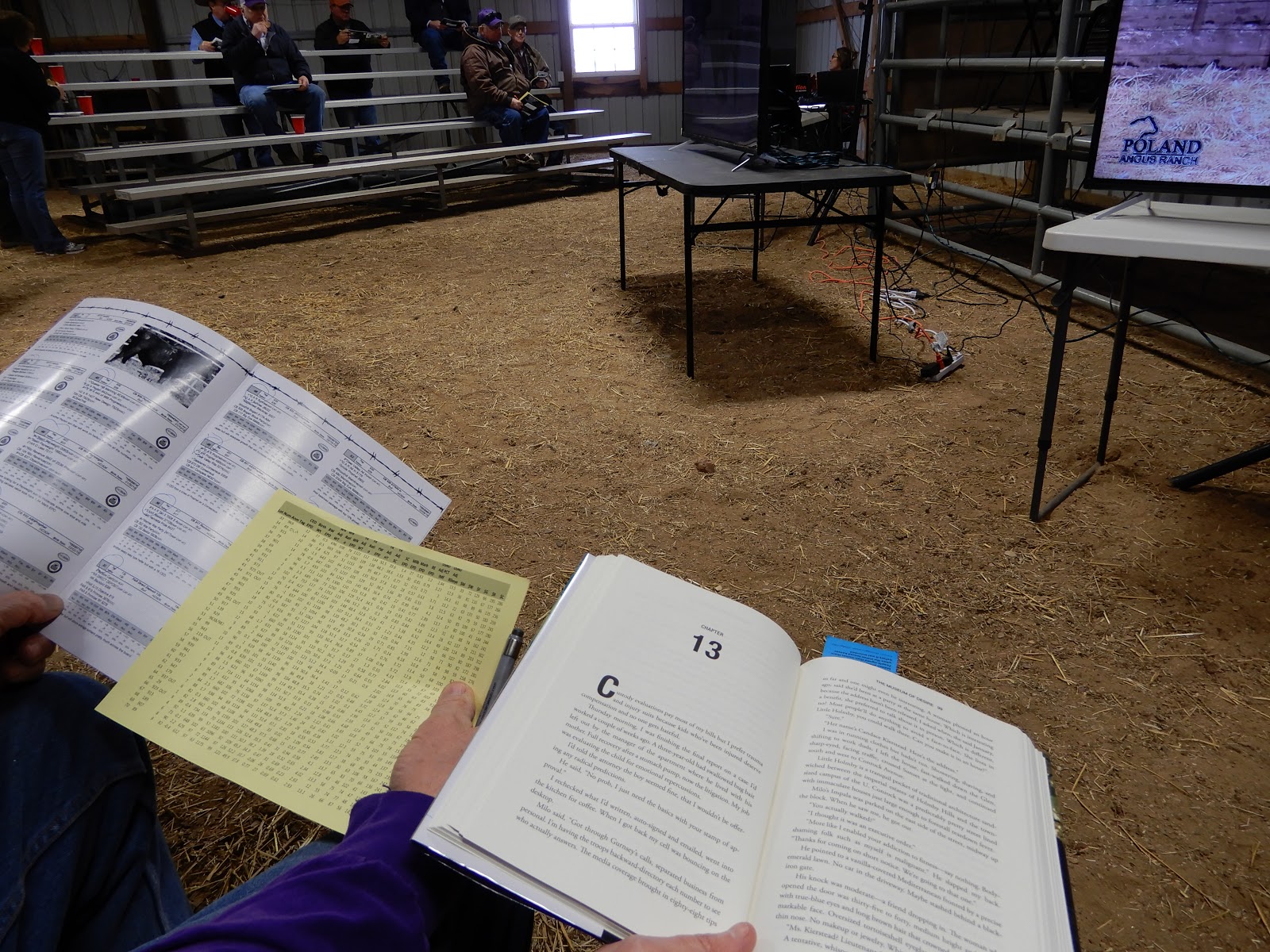
After our "free lunch," Randy continued to look at the updates and read the sales book. I read my mystery.

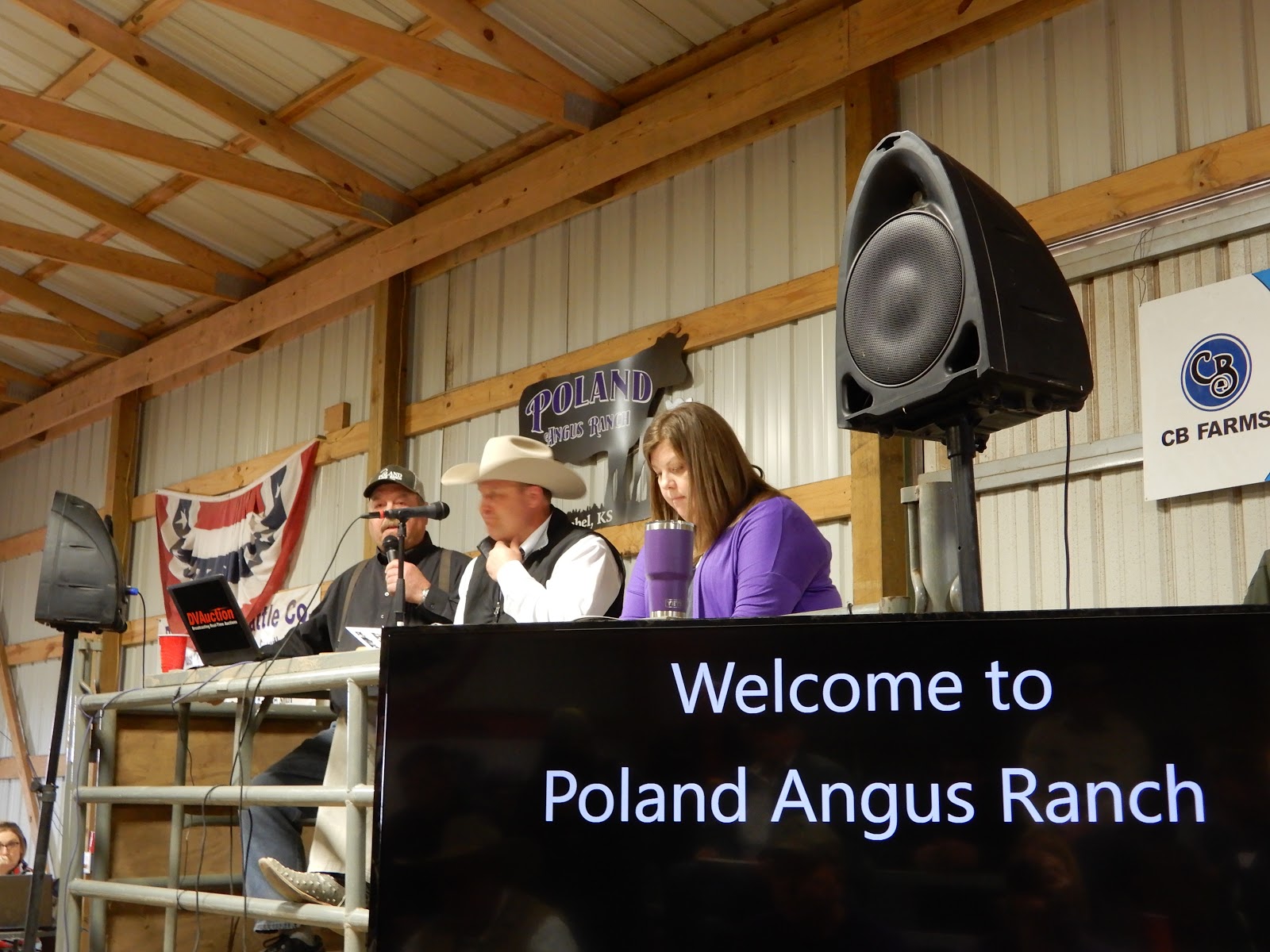
And then it was time. At this sale, the bulls don't come into the arena. Instead, they are shown on a video screen. Three bid takers gave attention to the crowd while the auctioneer chanted his spiel. 
Here was No. 45's brief appearance as a TV star. 
After the auction, we were first in line to retrieve our purchase. If you haul it yourself, there's a small discount. Buyers also got a discount if they were repeat customers. We were.
Once home, the other bulls checked out their new pen mate. Since there are no ladies to impress at the moment, there were no fights - just curiosity.
We don't plan to sell any bulls this year unless they don't pass their "job interview" with Dr. Bruce, our veterinarian, later this spring.

On our way to the bull sale, we made a slight detour and took four heifers who'd lost calves to the Pratt sale barn. 
That required sorting them from the mamas and babies. Randy insists we don't have a Mickey Mouse operation, even though he used stationary that might dispute that. (He knows that I have no memory for numbers, so he makes me a list before we ever start. It keeps everyone happier.)
As we waited to unload, Randy queried, "I wonder if we'll make enough money selling the heifers to pay for the bull?"
I told him there was a flaw in his theory, since we had been raising and feeding those heifers since they were born in the winter of 2018.
We bid $3,750 for the bull, but ended up paying closer to $3,512 after the discounts for hauling and as repeat customers. The heifers ended up bringing $3,585 at the sale barn the next day - $930/head.
Now, if you don't figure pesky things like feed costs, transportation, labor, etc., Randy can feel good. Shhh! Don't burst his bubble.

Tuesday, March 12, 2019

A New Hire at The County Line

Every day across corporate America, business people in pressed suits gather around conference tables for meetings. They gather to make decisions designed to advance their companies, to increase profits, perhaps, even to make a difference in the world.

Some may arrive after a subway ride. Others hopped on a train from a suburb to a towering skyscraper in a sea of tall buildings. Others may have grabbed a taxi or a Lyft or an Uber for their trip from Point A to Point B.
 
The meetings may look a little different in the middle of a Kansas farmstead. While those city commuters may be dodging people and traffic, the country meeting attendee may need to strategically avoid a cow pie or two after stepping out of their transportation for the day - a pickup hooked to a mud-splashed cattle trailer.

But the decisions made in those dirt lots also impact the future of businesses. Choosing a new "employee" requires research and making informed choices - whether in a boardroom or a straw-covered cattle lot.
Randy and I attended the Carcass Plus Bull Sale last Wednesday at Poland Angus Ranch near Isabel. Angus bulls from the Polands as well as CB Farms at Preston were offered for sale. 
Before we arrived, Randy had gone through the sales catalog, circling bulls that fit his criteria. He was looking for an Angus bull he could use for breeding to our heifers, who will be first-time mamas in 2020. So he was looking for a bull who would produce lower birth weight calves and calving ease characteristics.
As we walked through the lots, Randy referred to his sale catalog for the particulars and made notes on some of the animals he was interested in.
Ironically, the first bull I photographed that day was the one who eventually went home with us - Lot 12, aka PAR 613 Product 867.

It was one of those Randy had circled at home, but he wanted to look them over before the sale started. And we had to arrive in time for our dinner date. It was free if you don't count the price of the bull. That counts as free to a farmer - just like "free" caps when you buy a tractor (wink, wink).
Along with my barbecue beef sandwich, I chose a shamrock sugar cookie. A little luck is never a bad thing when it comes to bidding at an auction. 
Neither is bringing a book to pass the time between the lunch and the bidding. Randy read the catalog. I read my book.
This sale was a little different from the last two I've attended. Instead of bringing the bull into a sale ring, each appeared on television screens for bidding.
Here's Lot 12 during his time on the auction block. Here's what it said about him in the catalog:
This deep-sided 613 son has really good Wn (weaning) and Yr (yearling) ratios. Couple that with his top 15% for marbling, it makes him a really good prospect for siring high-marbling calves that will bring you a premium on the rail.
Though the bulls are getting the once over from interested buyers, it's not just a beauty contest, though correct conformation for each breed is one factor in the decision-making process. While Randy looks for bulls that produce smaller birth weight calves, he's also looking for those whose progeny have higher 205-day weaning weights and yearling weights.
Genetics should provide a progressive weaning weight and yearling weight. For Lot 12, the EPD - or expected progeny difference - at weaning is 57 pounds above the average Angus weight. The yearling weight EPD is 103 pounds above the average. Its numbers also ranked above average for meat marbling and ribeye area. He had good milk EPDs, which should make the females he sires good replacement mamas who will make plenty of milk for their calves.

This bull was born on Veteran's Day of 2017, so he's a little more a year old. He now weighs around 1,200 pounds.

For the past several years, we've used a Hereford bull with our heifers. But to add genetic diversity to our cattle herd, Randy opted for an Angus bull for the heifers for this upcoming breeding season. If you want to get all technical, it's a matter of heterosis, "the marked vigor or capacity for growth exhibited by crossbred animals," (according to the dictionary).

We paid $3,500 for him, minus a $50 discount for picking him up and hauling him ourselves on the day of the sale. 
Once we got him home, he strolled the entire perimeter of the lot to check out his new "digs."
Initially, he was by himself in the lot, but after he got out, Randy put another calf in the pen with him to keep him company. We hope that cures his loneliness and keeps him "home" and content until he begins his job this spring.

Tuesday, April 3, 2018

Now That's a Lot of Bull

With terms like "sire" and "dam" and "progeny," I suppose we could be conversing about the Royal Family. But instead of stretch limos and spiffy chauffeurs in suits, these "royal" passengers were transported in trailers by guys and gals in crusty boots.

Some people go on weekend dates to the movies. We went to the Sand Hill Farms production sale on March 24. We were looking for one bull to add to the County Line, bringing our total to 5.

Besides, it was a free dinner! That is every farmer's dream date. (And those Trousdale ladies know how to bake pies, let me tell you!)
 
Randy did his homework ahead of time. When the glossy sale magazine arrived in the mail, he circled the bulls he thought would fit into our herd's needs. Then, once we'd arrived at Sandhill Farms, we looked them over in the lots before the sale began.
It was almost like the guys were judging a beauty pageant for bulls. However, it's not a beauty contest, though looking for correct conformation for a breed is one factor in the decision-making process. While Randy looks for bulls that produce smaller birth weight calves, he's also looking for those whose progeny have higher 205-day weaning weights and yearling weights.
I started getting a little nervous when I heard other people talking about some of the same numbers we were looking for. Even I know what impact supply and demand have on prices!
Randy was looking for a Hereford bull he could use for breeding to our heifers, who will be first-time mamas in 2019.
For several years, we used an Angus bull with our heifers. But to add genetic diversity to our cattle herd, Randy opted for a Hereford bull for the heifers for this breeding season. If you want to get all technical, it's a matter of heterosis, "the marked vigor or capacity for growth exhibited by crossbred animals," (according to the dictionary).
 
During the sale, I took photos (big surprise) and watched two little girls take photos with the new version of a Polaroid camera. (They saw me taking photos and later handed me one in which I was among the crowd). 

But even with the distraction of photos, I'd lean over to Randy when I heard the auctioneer talk about low birth weights and say, "How about that one?"
We ended up with Lot 42 also known as SHF Elsmere Z311 E173. It was not one that Randy had originally marked in the sale catalog, but it fit his criteria. (And since several of the ones he had marked went for more than our budgeted amount, he can thank me for saying, "How about that one?") I always knew he had good taste!

Here's what Kevin Schultz of Sandhill Farms had to say about #42:
This calving ease son of Encore ranks in the top 10 percent of the breed for CED (calving ease direct). We have calved out our first Encore daughters, and I really like the udders and mothering of them. 
Yes, I had to look up CED:
CED is expressed as a difference in percentage of unassisted births, with a higher value indicating greater calving ease in first-calf heifers. It predicts the average difference in ease with which a sire's calves will be born when he is bred to first-calf heifers.
SHF Elsmere's genetics should provide a progressive weaning weight and yearling weight. The EPD - or expected progeny difference - at weaning is 54 pounds above the average Hereford weight. The yearling weight EPD is 91 pounds above the average. Its numbers also ranked above average for meat marbling and ribeye area.  The bull is homozygous polled, meaning its progeny won't have horns, another trait we prefer in our herd.
Once the sale was over, I went to pay and Randy got the trailer in line to take No. 42 home. (If we hauled the bull home ourselves, it was $75 off the sale price.)
We gave him several days to settle into life on the County Line by himself.
But last Thursday, we moved the other bulls back home. Thankfully so far, the welcoming committee composed of bigger bulls has been kind ... no West Side Story Jets and Sharks-type fights. He's a little more than a year old and weighs about 1,200 pounds. The guys in the Welcome Wagon definitely have him outweighed.

We'll see if the camaraderie lasts when some ladies are introduced to the mix later this spring. There may be more aggressive defense of their territory at that point. Ah love ... or lust!