Showing posts with label bulls. Show all posts

Tuesday, April 13, 2021

Candid Camera


I read an article not long ago about new facial recognition technology for cattle. 

On a recent day in the cattle pen, we weren't trying out the latest technical advances from our alma mater, K-State. But the article said that the university is capitalizing on the power of artificial intelligence to build a database for the cattle industry. 

Like humans, each bovine has a set of unique facial features that modern technology can scan and later use to track the animal throughout its lifetime. According to K-State extension beef cattle specialist KC Olson, who helped develop this idea, the technology is based on the geometry of the human face. It uses intricate biometric measurements to put a permanent identification on a person and is capable of nearly 100 percent accuracy.

I couldn't help but think about that as we were testing bulls last week. That day, our veterinarian Dr. Bruce wasn't paying a lot of attention to the facial end of the bull. Most of the attention was focused on the opposite end. 

However, each bull - and cow - has its own personality and characteristics.

This guy, for example, likes to have his head rubbed when Randy feeds a hay bale.


As I was standing there, I couldn't help but notice his white chest, too. He is unmistakably the daddy for No. 012, born in February a year ago. I used this photo on Valentine's Day 2020. 

February 2020

Now, No. 012 is one of the heifers who will calve for us in the winter of 2022. As she comes up to the bunk for feeding, I still recognize the heart shape on her chest. This morning, she and her cohorts will go through the cattle chute for the next step in their journey toward motherhood next winter.

Anyway, the new computer technology came about as Olson and a group of K-State experts in computer engineering, veterinary medicine and animal science began discussing how to apply facial recognition technology to cattle. Then, last fall, the research group made short videos of 1,000 feeder cattle that were restrained in a chute, taking a panoramic view of each calf’s head. From the videos, computer engineers parsed individual images and uploaded it to a neural network.

Once the pictures are loaded, Olson said, the system “teaches itself which of the biometric measurements are critical.” The K-State team recently tested the reliability of the network, also using images of cattle already in the system. Olson said it was accurate 94 percent of the time.

K-State is working with Kansas City-based company Black Hereford Holdings to build a smartphone app called Cattletracs,which will allow producers to submit pictures of their cattle. The app is due to be released soon, though its full capability is not likely to be in place for several months.  

When we unloaded our feeder cattle in Pratt this winter, there was a "be on the lookout" notice for stolen cattle. Maybe this new facial recognition invention will ultimately help with that. 


But, in the meantime, this big guy seemed ready for his close-up, too.

His fellow Angus buddy was a little more camera shy. (He hasn't been around here quite as long. He doesn't have the paparazzi schtick down as well yet.)

But, as I said, their faces weren't the real reason we were there. 

And it wasn't for a lesson on extension cord rolling - though that was a topic of the morning, too. (I've decided it's kind of like folding fitted sheets.)

No, we were there to make sure the four bulls were ready for their "job" this spring and summer. Quality bulls are a big part of the beef business. It's a good management practice to test bulls before you turn them out into the pasture with the heifers and cows each spring. Bulls have no value if they can't perform.

This time, Dr. Bruce brought along his own new portable working chute. In the past few years, our larger bulls have outgrown our home chute. Dr. Bruce's chute is wider, giving more room for the girth of the bigger boys.

Once the chute was set up, the rest of the routine was familiar. 

Dr. Bruce measures the scrotum and checks for defects. The extended period of sub-zero temperatures this winter was a concern for cattle producers - not just for baby calves but also for bulls. So it was especially important to test this year.

The bull is electrically stimulated so that the veterinarian can obtain a sample. 'Nuff said.
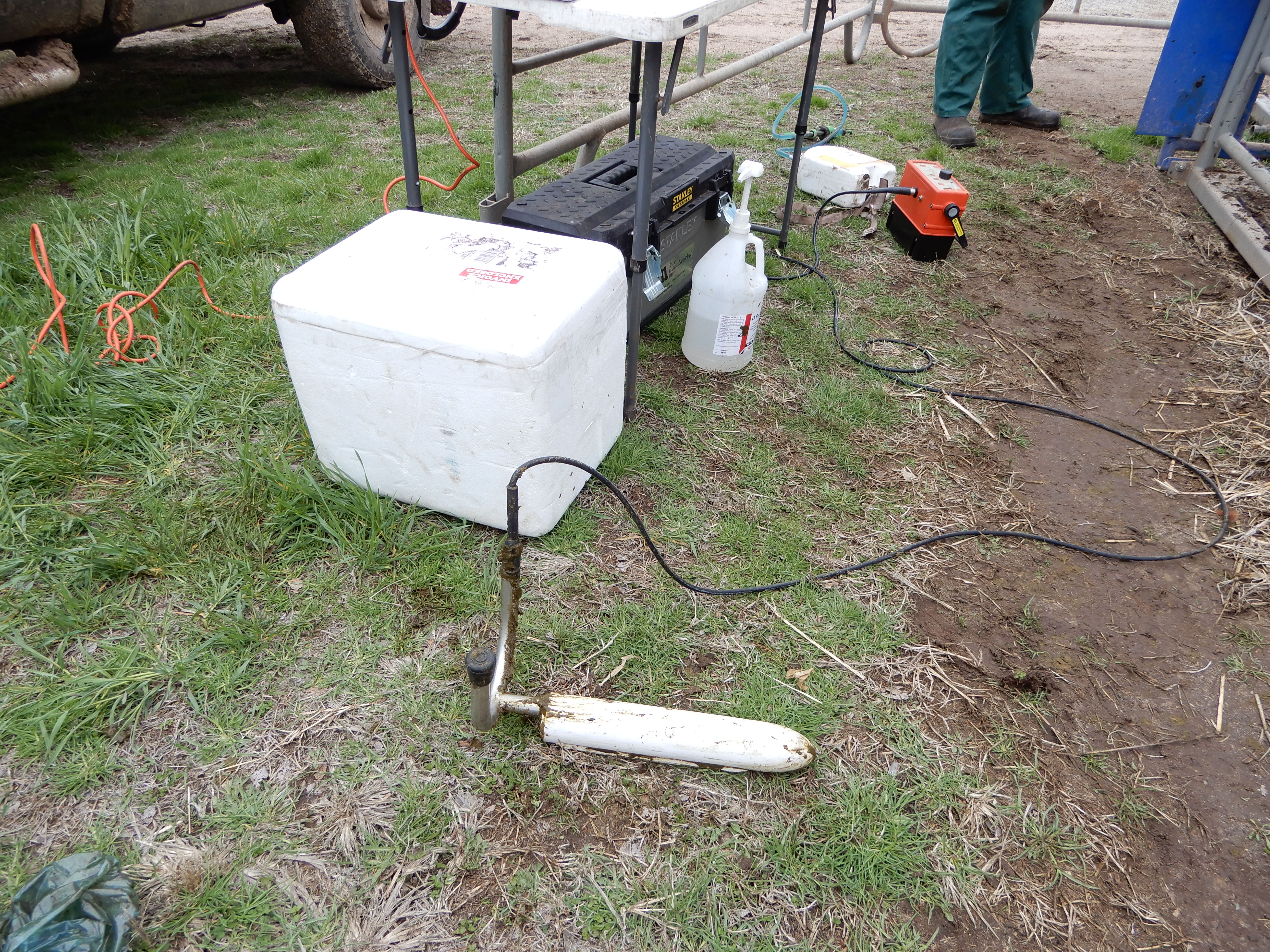
The sample is tested for motility, its "swimming" ability to travel to the cow's egg.


Dr. Bruce then smeared the slide with a dye, which killed the sperm. He could then look at morphology, the shape of the sperm. He was looking for abnormalities in the shape, which could indicate a problem with the ability to breed. 

After the successful tests, Dr. Bruce gave each bull vaccinations to keep them healthy during their summer in the pasture.

It's similar to giving our children vaccinations for their optimal health.

Dr. Bruce also applied a spray-on dewormer.


 All the bulls passed and are ready for action, so to speak. 


After their doctor's appointment, the bulls were hanging out in one of the lots. But after we get done with the heifers this morning,  they'll be heading for greener pastures with their lady friends.
County Line file photo from a different bull's arrival to a pasture, 2013


Tuesday, November 13, 2018

There's No Business Like "Snow" Business

Sing along now:

There's snow business
Like snow business
Like snow business, I know!
This amalgamation of the Irving Berlin tune rattled around in my head like the trailer rattled over snowy roads yesterday morning.
Our earlier rains - 14 inches in a month - and the recent snows have slowed the timing of our annual ritual of moving cattle home from summer pastures. But we moved a group of 25 mamas to the pasture south of our house Monday morning.
Last Friday, we had a brisk morning for a visit from Dr. Figger as he preg-checked and vaccinated the 26 cows. (One was open - or not pregnant - so she had a chauffeur-escorted drive to the sale barn Monday afternoon.)
 Thankfully, we have a little windbreak at the cattle-working chute, and the job didn't take too long.
Hey, 696! Your eartag ruined my perfect line of sparkling snow.
Aw, well! I must remember my priorities!
However,  between running cattle up the lane, I took photos.
It kept my mind off my freezing fingers and toes.
The bulls probably wondered why they were arriving at this snow-covered pasture.  But, never fear: A big bale of hay had already been delivered for their rural Meals on Wheels.
And the surroundings were pretty spectacular.
I guess I wasn't too cold.
 
I wondered around the yard taking more photos after Randy dropped me off both Friday and after we moved the group Monday morning.
Ice on those remaining fall leaves was like icing on a decorated cake.
Even those leaves that had given up their hold on the branches were beautiful underfoot.
You'd think I would have had enough of the cold. But we braved frigid temperatures and an 11 AM start of the K-State vs. KU football game on Saturday.
It took me until we got to Hutchinson (2 hours after our departure) to thaw out! So I guess I really can't complain about the cold this morning as we gather pairs at the Ninnescah Pasture, then sort them and bring them home. Right? I'll try and remember that! It's going to be a long day, I'm afraid!

Tuesday, April 3, 2018

Now That's a Lot of Bull

With terms like "sire" and "dam" and "progeny," I suppose we could be conversing about the Royal Family. But instead of stretch limos and spiffy chauffeurs in suits, these "royal" passengers were transported in trailers by guys and gals in crusty boots.

Some people go on weekend dates to the movies. We went to the Sand Hill Farms production sale on March 24. We were looking for one bull to add to the County Line, bringing our total to 5.

Besides, it was a free dinner! That is every farmer's dream date. (And those Trousdale ladies know how to bake pies, let me tell you!)
 
Randy did his homework ahead of time. When the glossy sale magazine arrived in the mail, he circled the bulls he thought would fit into our herd's needs. Then, once we'd arrived at Sandhill Farms, we looked them over in the lots before the sale began.
It was almost like the guys were judging a beauty pageant for bulls. However, it's not a beauty contest, though looking for correct conformation for a breed is one factor in the decision-making process. While Randy looks for bulls that produce smaller birth weight calves, he's also looking for those whose progeny have higher 205-day weaning weights and yearling weights.
I started getting a little nervous when I heard other people talking about some of the same numbers we were looking for. Even I know what impact supply and demand have on prices!
Randy was looking for a Hereford bull he could use for breeding to our heifers, who will be first-time mamas in 2019.
For several years, we used an Angus bull with our heifers. But to add genetic diversity to our cattle herd, Randy opted for a Hereford bull for the heifers for this breeding season. If you want to get all technical, it's a matter of heterosis, "the marked vigor or capacity for growth exhibited by crossbred animals," (according to the dictionary).
 
During the sale, I took photos (big surprise) and watched two little girls take photos with the new version of a Polaroid camera. (They saw me taking photos and later handed me one in which I was among the crowd). 

But even with the distraction of photos, I'd lean over to Randy when I heard the auctioneer talk about low birth weights and say, "How about that one?"
We ended up with Lot 42 also known as SHF Elsmere Z311 E173. It was not one that Randy had originally marked in the sale catalog, but it fit his criteria. (And since several of the ones he had marked went for more than our budgeted amount, he can thank me for saying, "How about that one?") I always knew he had good taste!

Here's what Kevin Schultz of Sandhill Farms had to say about #42:
This calving ease son of Encore ranks in the top 10 percent of the breed for CED (calving ease direct). We have calved out our first Encore daughters, and I really like the udders and mothering of them. 
Yes, I had to look up CED:
CED is expressed as a difference in percentage of unassisted births, with a higher value indicating greater calving ease in first-calf heifers. It predicts the average difference in ease with which a sire's calves will be born when he is bred to first-calf heifers.
SHF Elsmere's genetics should provide a progressive weaning weight and yearling weight. The EPD - or expected progeny difference - at weaning is 54 pounds above the average Hereford weight. The yearling weight EPD is 91 pounds above the average. Its numbers also ranked above average for meat marbling and ribeye area.  The bull is homozygous polled, meaning its progeny won't have horns, another trait we prefer in our herd.
Once the sale was over, I went to pay and Randy got the trailer in line to take No. 42 home. (If we hauled the bull home ourselves, it was $75 off the sale price.)
We gave him several days to settle into life on the County Line by himself.
But last Thursday, we moved the other bulls back home. Thankfully so far, the welcoming committee composed of bigger bulls has been kind ... no West Side Story Jets and Sharks-type fights. He's a little more than a year old and weighs about 1,200 pounds. The guys in the Welcome Wagon definitely have him outweighed.

We'll see if the camaraderie lasts when some ladies are introduced to the mix later this spring. There may be more aggressive defense of their territory at that point. Ah love ... or lust!