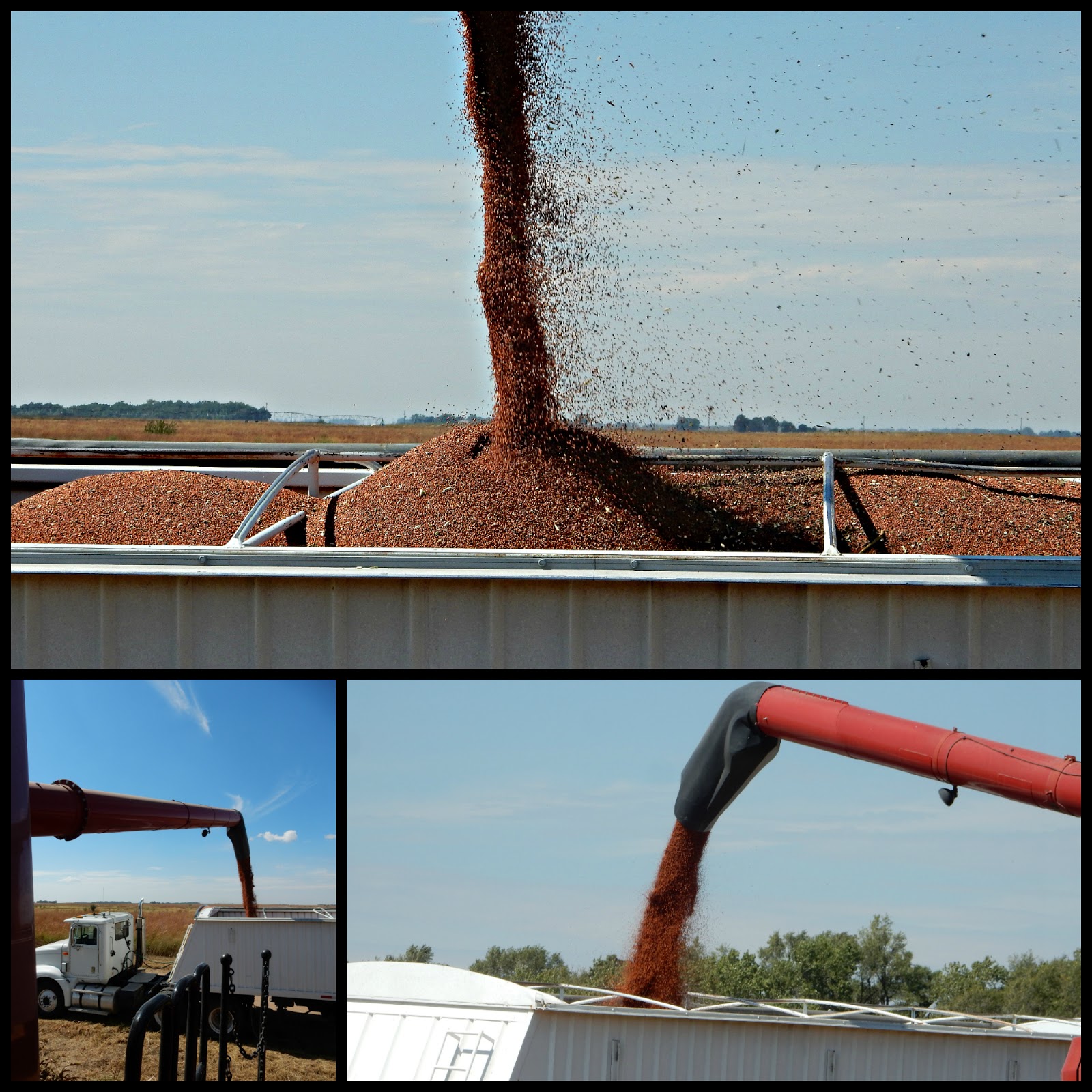
Randy feels good about our decision to retire from active farming in August 2022. But there are times when he misses it, and he gets a little "itchy" - and that itch doesn't have a thing to do with the ever-present harvest dust. Harvest was always Randy's favorite time of the year. Well ... Until he had a breakdown. Or the combine got stuck. Or the employee didn't show up.
So maybe experiencing harvest in the combine's "buddy seat" is OK after all. Let's hope the combine operator was just as happy to have a rider as Randy always was when a kid, grandkid or curious guest showed up.
He was able to ride for a little while as a custom harvester was cutting one of our corn fields. (The ride and the photos were taken September 27.)
Our corn averaged 80 bushels per acre. Todd and Tye Miller, who farm our ground, had some fields that had higher yields at other locations. However, Randy says it was a nice surprise after the field blew so badly after planting this spring because of drought and strong windstorms.
The custom harvester - Frederick Harvesting out of Alden - was trying out an experimental combine, so Randy enjoyed looking at all the bells, whistles and cameras in the combine cab during his excursion.
Tye and Todd still have some our milo to harvest this fall. We'll see if more combine rides are in Randy's future.
Fourth of July gatherings may be few and far between in 2020, thanks to an unwelcome guest named Covid.
But even if you're just celebrating with family, I have an idea for a pasta salad with a little different twist that's sure to create "fireworks" in your mouth. OK, the fireworks will come from flavor - not heat - but you know what I mean!
Jill, Eric, Kinley and Brooke were here last weekend for harvest. I had some excellent help decorating and filling the bags for suppers.
We had a couple of suppertime picnics in the field, but our noon meals were at the dining room table since Randy was in fields close to the house.
When I saw the recipe for Orzo Pasta Salad, I thought it would be a good salad to serve with the Greek Meatballs recipe Jill had shared with me earlier. (By the way, I made extra meatballs and used them for meatball subs for supper in the field last evening: Planned leftovers.)
If your garden is already producing cucumbers, tomatoes and fresh herbs, you're in luck. And if your zucchini is as prolific as Randy's plants, you could add a little zucchini to the veggie mix - just for a new way to use up a little bit of that garden crop that seems to multiply behind your back. Or visit your grocery store produce section or the local farmer's market for your fresh veggies.
Instead of the usual pasta twist or elbow, the base of this salad is orzo pasta. With add-ins like toasted almonds and feta cheese and a tangy olive oil-lemon dressing, it's a satisfying summer salad to add to your table - whether it's 4th of July, a harvest meal or just a regular old day.
The recipe may look complicated, but you can do much of it ahead of time. And we're enjoying the leftovers, too, so if you don't use it in one sitting, that's OK. However, you may need to add a little drizzle of olive oil and another squeeze of lemon since pasta has the tendency to absorb liquid as it sits.
2ears grilled corn, cut off the cob(grilling optional but recommended)
1English cucumber,sliced and cubed
2 cups (1 pint) cherry tomatoes, halved
1 15 oz. cangarbanzo (chickpeas) beans,drained and rinsed
1/2cuppitted Kalamata olives,halved
1/2cupsliced almonds
1/2cupfresh basil, chopped
1/2cupfeta cheese
DRESSING
1/3cupextra-virgin olive oil
2tablespoonsred wine vinegar
1tablespoonlemon juice
1TBS EACHfresh dill parsley and oregano OR 1 tsp EACH dried
1teaspoonsugar
1teaspoonDijon mustard
1/2tsp EACHgarlic powder, salt
1/4teaspoonpepper
Make
dressing, whisking together all the ingredients in a small bowl or by adding to a lidded jar and shaking. Refrigerate until ready to use.
In
a large nonstick skillet, melt butter with olive oil over medium-low
heat. Once melted, increase heat to medium-high and add orzo and onions. Sauté for 3-5 minutes, until onions are soft. Stir
in chicken broth, lemon juice, salt and pepper. Simmer until orzo is al
dente, 8-10 minutes, stirring frequently the last couple minutes of
cooking so it doesn’t burn. Transfer to a large bowl to cool in the refrigerator while you finish
chopping your veggies. Add all of the salad ingredients to the orzo followed by the dressing. Toss to coat. Taste and season with additional lemon juice or salt and pepper to taste. Serve.
Make-Ahead Notes:
Vegetables: Can be chopped 24 hours in advance and stored in separate airtight
containers in the refrigerator or added directly to the orzo pasta
without the dressing.
Orzo: Can be made 48 hours in advance and stored in an airtight container in the refrigerator.
Dressing: Can be made 72 hours in advance and stored in an airtight container in the refrigerator.
If you want to make it ahead, toss all the salad ingredients together with only HALF of the dressing. Cover and refrigerate. When you are ready to serve, toss with desired
amount of remaining dressing.
If you use all of the dressing initially,
your pasta may soak up all the dressing and will taste dry. You can "revive" it with a drizzle of olive oil and a squeeze of lemon juice.
Notes:
My local grocery store doesn't carry many fresh herbs, and we don't grow them in our garden. I substituted a sprinkle of dried basil leaves. (If you use dried, DON'T use 1/2 cup. I really just used a sprinkle. There's a lot of flavor in the other ingredients.) I know the fresh would be better, but this was tasty, too! At this time of year, perhaps you can find some at a farmer's market or ask a generous gardening neighbor.
I also can't get English cucumbers here, and our garden cucumbers aren't ready yet. Since the cucumber I had bought had large seeds, I scraped out the seed portion and chopped up the rest.
I also didn't have corn on the cob, so I just used frozen corn. It didn't caramelize like fresh corn would, but it still added another texture to the finished dish.
I did not use Kalamata olives (or any other olives). I served olives on the side for Randy and Eric. (There aren't many things I don't like, but olives are one of the few.)
If your garden zucchini are as prolific as ours, you could also add some chopped fresh zucchini to the veggies used in the directions.
The original recipe called for sliced almonds. I only had slivered, so we browned them in a little butter until they were toasty. I also served the almonds on the side for the non-nut eaters in the group.
You can use water and some chicken bouillon granules instead of the canned or boxed chicken broth. That's what I usually use.
There are lots of additional recipe notes on Carlsbad Cravings, if you're interested in even more details from the recipe originator: https://carlsbadcravings.com/orzo-pasta-salad/
Here's another pasta salad that we enjoy for harvest: https://kimscountyline.blogspot.com/2011/08/macimum-taste.html (Sorry the photo's not better. This was early in my blogging days.)
It was a picture-postcard-kind of day for the beginning of Wheat Harvest 2020. If the golden wheat set against a cotton-candy sky didn't have you humming "America the Beautiful" under your breath, you just weren't looking.
We began our County Line Wheat Harvest Tuesday, June 16. As I said when I posted a couple of photos on Facebook that day, Wheat Harvest is capitalized around here. It's the largest crop on our dryland farm in Central Kansas.
Randy had done some test cuts the day before, and it was just a little too wet. But by Tuesday afternoon, we were ready to channel our inner Jackie Gleason and say, "And Awaaaay We Go!"
As always, it's interesting to look in the rearview mirror and do a little comparison. I started blogging in 2010, so I have a handy way to research the beginning date for our harvest for the past 11 years:
2010: June 18
2011: June 10
2012: May 26 (an anomaly and the earliest harvest, by far, we've ever had)
2013: June 21
2014: June 17
2015: June 20
2016: June 15
2017: June 12
2018: June 12
2019: June 26
2020: June 16
But we've both been involved in wheat harvest our entire lives - me
growing up on a farm in northern Pratt County and Randy just down the
road from where we were cutting that day.
My Dad had me helping at about age 12, when I began moving
the grain truck in the field. It was my prelude to being ready to drive the truck to the Iuka Co-op once I was legal.
I couldn't find a photo of Randy in a wheat field when he was really little, but I did find one when he was a junior in high school.
This wheat field was part of his FFA project, and the cutline says: "I am pictured here in my wheat field. The wheat has been freeze-burned by recent cold weather."
We've joined a long line of farmers who've been planting winter wheat in Kansas for 179 years. The first harvest of a wheat crop is believed to have been in 1839 near what is now Kansas City and before Kansas was actually a state. Statistics on wheat production in Kansas have been published since 1866, when records indicate that 68,000 acres of wheat were planted. Average yield that year was 19 bushels per acre.
Settlers mostly used varieties they brought from the Eastern U.S. or western Europe. The most successful early imported variety was Turkey Hard Red Winter Wheat. It was brought to Kansas by Mennonite settlers were arrived from the Ukraine in 1874.
My brother posted this video sometime last year, and I showed it to Stafford Elementary 2nd graders when I spoke to their class about farming then and now last fall. It's from Washington state, so the hilly landscape is much different from my part of Kansas. But it's still fascinating to watch. It's dated 1938. It's astounding how many horses and people were needed to accomplish harvest.
By 1880, planted acres in Kansas were up to 2 million, but the yield that year was only 10 bu/acre. By 1930, acres totaled 13.6 million and average yield was 14.2 bu/acre. Wheat production hit its peak in 1937 with 17.1 million, but abandonment of failed acres was huge, with only 13.1 acres harvested and a yield of 12 bu/acre.
Even though the view our ancestors saw out their front doors might be somewhat similar, I wonder what those Kansas farming pioneers would think of our mammoth machines today?
Wheat harvest transforms my resident farmer into a kid waiting for Christmas morning.
It's his favorite time of the year to roll the combine through the field and watch the kernels fall into the bin behind him and the yield monitor calculate beside him.
After last year's abysmal crop, my farmer is cautiously optimist so far. (OK, he's his normal overly-optimistic self and I'm cautiously optimistic.)
Though the puffy clouds from earlier in the day were gone by sunset, it was still a spectacular scene during the so-called "golden hour" ...
... no matter which direction you were looking.
And then it was almost as if Randy were harvesting the sun right along with our golden wheat crop.
It was so pretty out in the field that I turned down a ride. There will be plenty of opportunities for that in the days ahead though.
As I've told some of my farming friends, here's my wish for you this harvest season: May your breakdowns be few and your yields high.
And on that note, I'm off to get a part in Hutchinson at Case this morning!
Say "harvest" in a room of farmers and it could be a little like shouting "Fire!" in a crowded theater. However, milo harvest on our farm this year was anticlimactic. While Kansas grows more sorghum than any other U.S. state, here on
the County Line, we are not contributing much to the total.
In 2014, Kansas ranked first in grain sorghum production in the U.S.
with more than 200 million bushels grown, which equated to more than 40
percent of the country's total production.
The use of sorghum for human consumption is being developed further in
countries where malnutrition and hunger are prevalent. Kansas State University College of Agriculture Ag Report says:
In the Mara Region of Tanzania, one of the most starved areas of the
world, K-State grain scientist Sajid Alavi is part of a research team
working to improve child nutrition and health by providing a
sorghum-soybean porridge blend to children younger than 5. ... While the
results of the five-month study are yet to be finalized, Alavi said the
early indications are that children were more healthy and had average
growth rates.
But milo is getting some additional traction in the U.S., too, as consumers seek gluten-free alternatives. On a Discover Kansas trip with our Kansas Master Farmer Homemaker group a couple of years ago, we toured NuLife Market in Scott City.
NuLife MarketFounder
and President Earl Roemer gave us a tour. Earl’s family has farmed in
the western Kansas for four
generations. For years, his family grew grain
sorghum – also called milo – as a feed grain crop for livestock. But
then Earl began exploring how sorghum could be a human food
source, especially as more and more consumers wanted gluten-free
products. Sorghum has no gluten.
He admits that the
early grain sorghum products
“tasted like cardboard and the texture was like sand.” In 2007, Earl
founded NuLife Market in Scott City to
produce and market sorghum-based products and sell sorghum ingredients
to other food companies.
NuLife uses sorghum grown in the region,
providing value-added opportunities for area farmers. And now NuLife
supplies sorghum and sorghum products for companies like Kashi, Bear
Naked, Go Lean and Annie's Organic, just to name a few. Their sorghum
products can be found in more than a thousand products, such as
gluten-free baked
goods, cereal bars and snacks, represented by some 80 brands. Nu Life
Market is shipping its products coast to coast and beyond.
Our little milo crop just travels a few miles to the Zenith branch of the Kanza Co-op. Some of the milo in our area goes to the ethanol plant near Pratt.
We only had 95 acres of milo, so it only took a couple of afternoons from start to finish.
It was not a bin buster in yield either. The overall average was 40.1 bushels per acre, with a range from 27 to 67 bushels per acre on different fields.
I came home from an afternoon meeting and decided I'd better go ride the combine if I wanted to experience milo harvest at all this year. A parts run took me away from the field the other afternoon.
Compared to wheat, the whole life cycle of milo is much shorter, too. Randy planted the crop in early June.
By June 13, it was up and growing.
June 13, 2019
By August 23, when I took the photo below, the milo was headed out and starting to turn.
And, with that, the sun sets on another harvest of 2019.