Showing posts with label testing bulls. Show all posts

Tuesday, April 13, 2021

Candid Camera


I read an article not long ago about new facial recognition technology for cattle. 

On a recent day in the cattle pen, we weren't trying out the latest technical advances from our alma mater, K-State. But the article said that the university is capitalizing on the power of artificial intelligence to build a database for the cattle industry. 

Like humans, each bovine has a set of unique facial features that modern technology can scan and later use to track the animal throughout its lifetime. According to K-State extension beef cattle specialist KC Olson, who helped develop this idea, the technology is based on the geometry of the human face. It uses intricate biometric measurements to put a permanent identification on a person and is capable of nearly 100 percent accuracy.

I couldn't help but think about that as we were testing bulls last week. That day, our veterinarian Dr. Bruce wasn't paying a lot of attention to the facial end of the bull. Most of the attention was focused on the opposite end. 

However, each bull - and cow - has its own personality and characteristics.

This guy, for example, likes to have his head rubbed when Randy feeds a hay bale.


As I was standing there, I couldn't help but notice his white chest, too. He is unmistakably the daddy for No. 012, born in February a year ago. I used this photo on Valentine's Day 2020. 

February 2020

Now, No. 012 is one of the heifers who will calve for us in the winter of 2022. As she comes up to the bunk for feeding, I still recognize the heart shape on her chest. This morning, she and her cohorts will go through the cattle chute for the next step in their journey toward motherhood next winter.

Anyway, the new computer technology came about as Olson and a group of K-State experts in computer engineering, veterinary medicine and animal science began discussing how to apply facial recognition technology to cattle. Then, last fall, the research group made short videos of 1,000 feeder cattle that were restrained in a chute, taking a panoramic view of each calf’s head. From the videos, computer engineers parsed individual images and uploaded it to a neural network.

Once the pictures are loaded, Olson said, the system “teaches itself which of the biometric measurements are critical.” The K-State team recently tested the reliability of the network, also using images of cattle already in the system. Olson said it was accurate 94 percent of the time.

K-State is working with Kansas City-based company Black Hereford Holdings to build a smartphone app called Cattletracs,which will allow producers to submit pictures of their cattle. The app is due to be released soon, though its full capability is not likely to be in place for several months.  

When we unloaded our feeder cattle in Pratt this winter, there was a "be on the lookout" notice for stolen cattle. Maybe this new facial recognition invention will ultimately help with that. 


But, in the meantime, this big guy seemed ready for his close-up, too.

His fellow Angus buddy was a little more camera shy. (He hasn't been around here quite as long. He doesn't have the paparazzi schtick down as well yet.)

But, as I said, their faces weren't the real reason we were there. 

And it wasn't for a lesson on extension cord rolling - though that was a topic of the morning, too. (I've decided it's kind of like folding fitted sheets.)

No, we were there to make sure the four bulls were ready for their "job" this spring and summer. Quality bulls are a big part of the beef business. It's a good management practice to test bulls before you turn them out into the pasture with the heifers and cows each spring. Bulls have no value if they can't perform.

This time, Dr. Bruce brought along his own new portable working chute. In the past few years, our larger bulls have outgrown our home chute. Dr. Bruce's chute is wider, giving more room for the girth of the bigger boys.

Once the chute was set up, the rest of the routine was familiar. 

Dr. Bruce measures the scrotum and checks for defects. The extended period of sub-zero temperatures this winter was a concern for cattle producers - not just for baby calves but also for bulls. So it was especially important to test this year.

The bull is electrically stimulated so that the veterinarian can obtain a sample. 'Nuff said.
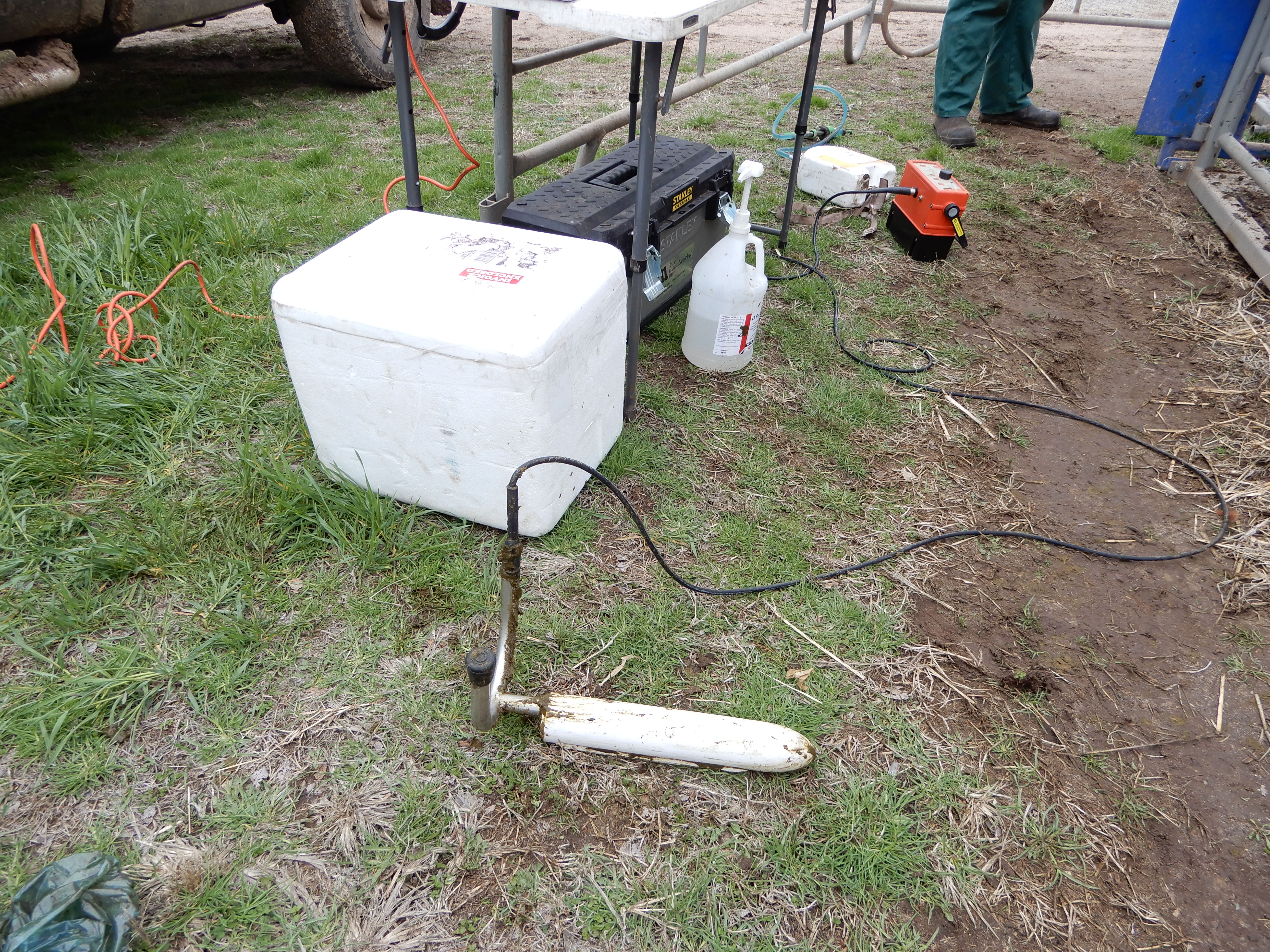
The sample is tested for motility, its "swimming" ability to travel to the cow's egg.


Dr. Bruce then smeared the slide with a dye, which killed the sperm. He could then look at morphology, the shape of the sperm. He was looking for abnormalities in the shape, which could indicate a problem with the ability to breed. 

After the successful tests, Dr. Bruce gave each bull vaccinations to keep them healthy during their summer in the pasture.

It's similar to giving our children vaccinations for their optimal health.

Dr. Bruce also applied a spray-on dewormer.


 All the bulls passed and are ready for action, so to speak. 


After their doctor's appointment, the bulls were hanging out in one of the lots. But after we get done with the heifers this morning,  they'll be heading for greener pastures with their lady friends.
County Line file photo from a different bull's arrival to a pasture, 2013


Tuesday, April 9, 2019

The Birds and the Bees (and Other Sticky Topics)

Randy has a secret to wedded bliss: Instead of expecting me to remember numbers while sorting cows and calves, he prepares a "cheat sheet."

I am notoriously bad at numbers. Give me words any day.
My eyesight is also not the best, even with my ever-present glasses.

But if I have something in black and white that I can hold in my hand, things will go much more smoothly ... for everyone involved. (For the uninitiated, BWF means black white face.)
In a pinch, my hand works, too. (I didn't take the photo of my hand with manure on it. You're welcome.)

But at least my hand wasn't where Randy's was during this particular cattle-working adventure. We needed the list of numbers so that we could sort out four cows that hadn't yet calved and one mama whose baby had died.

Most of our mama cows have already had their calves. So Randy wanted to see if the stragglers were pregnant. After hauling them to the working chute, Randy gloved up with a plastic sleeve and did the exam.
I had to hold the end gate up on the working chute so it didn't inadvertently come down and hit Randy in the head.
All four ended up being pregnant.

We sent them into another pen to await the arrival of their calves. And, in fact, two of them had their calves a couple of days later. The cow whose calf had died was taken to the Pratt sale barn.

For a cow-calf operation, pregnancy is the goal. So the bulls also had a doctor's appointment. This time, Dr. Bruce Figger came to conduct what's euphemistically called a "bull soundness exam (BSE)." In other words, is the bull up for the job that is to come this spring and summer?
 
 "You're going to do what kind of test?" Mr. Bull appeared to be asking.

A BSE has three components:
  • Scrotal circumference is highly correlated with semen output and serving capacity. 
  • A physical exam is performed to simply ensure that a bull is physically up to the challenge of the breeding season. Are his feet and legs structurally correct? Is he free from injury and/or infection?
  • The veterinarian then examines the bull's semen to determine if the sperm cells are normal. After getting a sample, Dr. Figger smeared a sample on a slide and looked through the microscope.
With the first look, he was testing the semen for motility, its "swimming" ability to travel to the cow's egg.
Then he smeared the slide with a dye, which killed the sperm. He could then look at morphology, the shape of the sperm. He was looking for abnormalities in the shape, which could indicate a problem with the ability to breed.
Microscope photo credit to Dr. Bruce Figger
The sperm in the upper left is healthy and correct. The sperm nearer to the light is not healthy. The bulls he tested were all fertile.

After the fertility tests, the bulls were each given vaccinations to keep them healthy during their summer in the pasture. It's similar to giving our children vaccinations for their optimal health. Their vaccinations prevent blackleg and BVD, a respiratory disease in cattle.
He also applied a pour-on de-licer.
The bulls are deemed ready for the job, but it will still be a couple of weeks of  "vacation." Then we'll put them to work for their part in creating the Class of 2020.
I agree with most of the bullet points, though at the County Line, we do "fire" bulls for being obnoxious and destructive - especially if that "insubordination" is directed toward humans.

Thursday, April 26, 2018

The Birds and the Bees: Farm Style

I saw this graphic from Faith, Family and Beef while scrolling Facebook last week. It made me laugh. I agree with most of the bullet points, though at the County Line, we do "fire" bulls for being obnoxious and destructive - especially if that "insubordination" is directed toward humans.

But think about the rest of it: Wouldn't it be a sweet job to have room and board, health care and food provided for only a few months of work?

For all those fringe benefits, we do expect our herd bulls to do their job. That's why four of our bulls again went through a "job interview" last week with Dr. Dayul Dick from Prairie Vista Veterinary Hospital and Supply. (The fifth bull was the one we just purchased at Sandhill Farms production sale, so it had already been tested.)

Quality bulls are a big part of the beef business. It's a good management practice to test bulls before you turn them out into the pasture with the heifers and cows each spring. Bulls have no value if they can't perform. So Dr. Dick came to perform bull breeding soundness examinations.

First, Dr. Dick measured each bull's scrotum and examined it for defects.
He then needed to collect a semen sample using this contraption.
He set up a mobile laboratory on the hood of a pickup, smearing a sample on a slide and looking through the microscope.
With the first look, he was testing the semen for motility, its "swimming" ability to travel to the cow's egg.
Then he smeared the slide with a dye, which killed the sperm. He could then look at morphology, the shape of the sperm. He was looking for abnormalities in the shape, which could indicate a problem with the ability to breed.
After the fertility tests, the bulls were each given vaccinations to keep them healthy during their summer in the pasture. It's similar to giving our children vaccinations for their optimal health.
Vet assistant Liz also applied a pour-on dewormer.
While all the bulls passed the fertility test, there was a slight problem. Only one fit properly in the squeeze chute.
That called for some creative acrobatics by both Liz and Dr. Dick to get the samples they needed, as well as a strategically-placed steel pipe to keep the bull in position.
The bulls aren't the only factor in the "birds and bees" of a Kansas cattleman.

The heifers who will become first-time mothers next winter also have been getting some extra care.
Beginning in March, our 25 yearling heifers had their silage topped with MGA. MGA is melengestrol acetate, which suppresses the ovulation cycle for the heifers. For 14 days, Randy added the MGA to the silage and fed the equivalent of 1/2 a pound per head per day.

This is the first step in getting the heifers to come into estrus (or heat) at the same time. These young ladies were born in early 2017. In 2019, they will become mothers for the first time.
On Monday, we sent the heifers through the working chute for the next phase of their OB-GYN appointments.
There, they each got a shot of Lutalyse, which makes the heifers come into heat.
So why do we try to synchronize the heifers' cycles? We do it to shorten the calving season for the heifers, which saves labor at calving time. (Well, it saves some labor for the humans - not the mama cows.) Because heifers are first-time mamas, we check them frequently in case they are having trouble calving.

Randy also gave each heifer a vaccination to prevent respiratory issues and diarrhea. 
 
Then it was time for the "birds and bees" to happen. The heifers were put in a pen with the bulls.
Some 283 days later, the babies are supposed to arrive. So we will expect to get our first 80-pound bundles of joy next January 28 or so. 

The bulls are ready. The heifers are ready. And if all goes as planned,  the miracle of life begins yet again on the County Line.