Showing posts with label wheat harvest 2016. Show all posts

Tuesday, July 19, 2016

The Good, The Bad & The Ugly: Wheat Harvest 2016 Summary

Wheat Harvest 2016 is now in the rearview mirror.

I don't know that there is ever a harvest without some hitches. But the 2016 version had its moments of "the good, the bad and the ugly" during the almost month-long process.
The good: We had a high yield of 80 bushels per acre in one field. (Randy got 2nd place at the Stafford County Fair market wheat show with some of the KanMark wheat, which tested 64 pounds per bushel.)

The bad: We experienced rain delay after rain delay, dragging harvest out for a month. By the end of harvest, the test weight was down to 56 pounds per bushel.

The ugly: We  had a low yield of 15 bushels per acre on a field that had been hailed on twice and was mired in mud and weeds. By the time we "called it good," the grain was sprouting in the head, and we had a borrowed combine buried in the mud.

Our overall average on 1,559 acres planted to wheat was 48.5 bushels per acre. The last two fields definitely brought down the average.
It had all started so well. We were all smiles when harvest began June 15.
 
We had a new-to-us combine. At a farm auction this spring, we purchased a 2010 7120 Case combine, along with a 2011 35-foot flex header.
   
Randy was loving all the new gadgets. He could hardly keep his eyes off the yield monitor and information screens.
After a quick, first-day repair, the combine was working well.

We were getting binloads of high-quality wheat. Early in harvest, test weights were 62 to 64 pounds per bushel. The benchmark for quality wheat is 60 pounds per bushel. 
The lunch lady was getting good reviews from the boss and from the truck driver.
Philly Cheese Steaks served al fresco on the back of the car trunk!
Our first minor bump in the road was a trouble with a truck tire. But nobody got hurt and we were able to get it fixed relatively quickly. Plus, we were close enough to Zenith that hauling exclusively with the semi didn't pose too much of a problem.
A storm rolled in late June 17. Even though Randy would have preferred spending his Father's Day on the combine, we had a weather delay.
 After 6+ inches of rain during a period from June 17 to July 2, we were starting to see quite a few weeds in the remaining fields.
The final 275 acres had been hailed on twice and had gotten the most rain.
We had a rain-imposed hiatus from July 2 to July 11. Then, a raccoon dining inside the combine created more harvest drama. The raccoon went through the radiator when Randy tried to move the combine to our final two fields. The combine got hauled off to the repair shop.
So we traded red for green, borrowing our neighbor's combine.
The 4-wheel drive came in handy anyway, since Randy was still combating soggy ground and mud. Randy had a breakdown on July 13, which necessitated parts runs to both Hutchinson and Pratt.

The Kanza Co-op locations at both Zenith and Stafford were full, so we started hauling to Stafford County Flour Mills. And there we discovered another problem. The wheat had begun sprouting in the head because of all the rain and because it was down in the field so badly. Thankfully, they accepted the grain, though it was with a 17 percent dock. (It's not the impression you want to make on a mill that produces the best flour in the country: Hudson Cream Flour. We weren't the only ones with sprouted wheat, though, and Stafford County Flour Mills hauled the sprouted grain to another facility, where it will likely be used as livestock feed.)
We ended harvest with Randy watching a bulldozer in the combine's rearview mirror as it got pulled out of the muck and mire of the final field.
At some point, you just have to say "enough is enough" and call it good. It was our final location, and it had hail damage from two separate storms. Weeds were taking over after multiple rains. 
And after the combine got stuck the evening of July 13, we got another 2.20" of rain. The bulldozer we hired had to pull the combine all the way to the road.

A little perspective is in order: In 2015, our wheat crop averaged 50 bushels per acre. Harvest 2014 was not a good year, and we averaged 24.5 bushels per acre. Our best year ever was 2013, when we averaged 52 bushels per acre, despite planting into dust and several late freezes. 

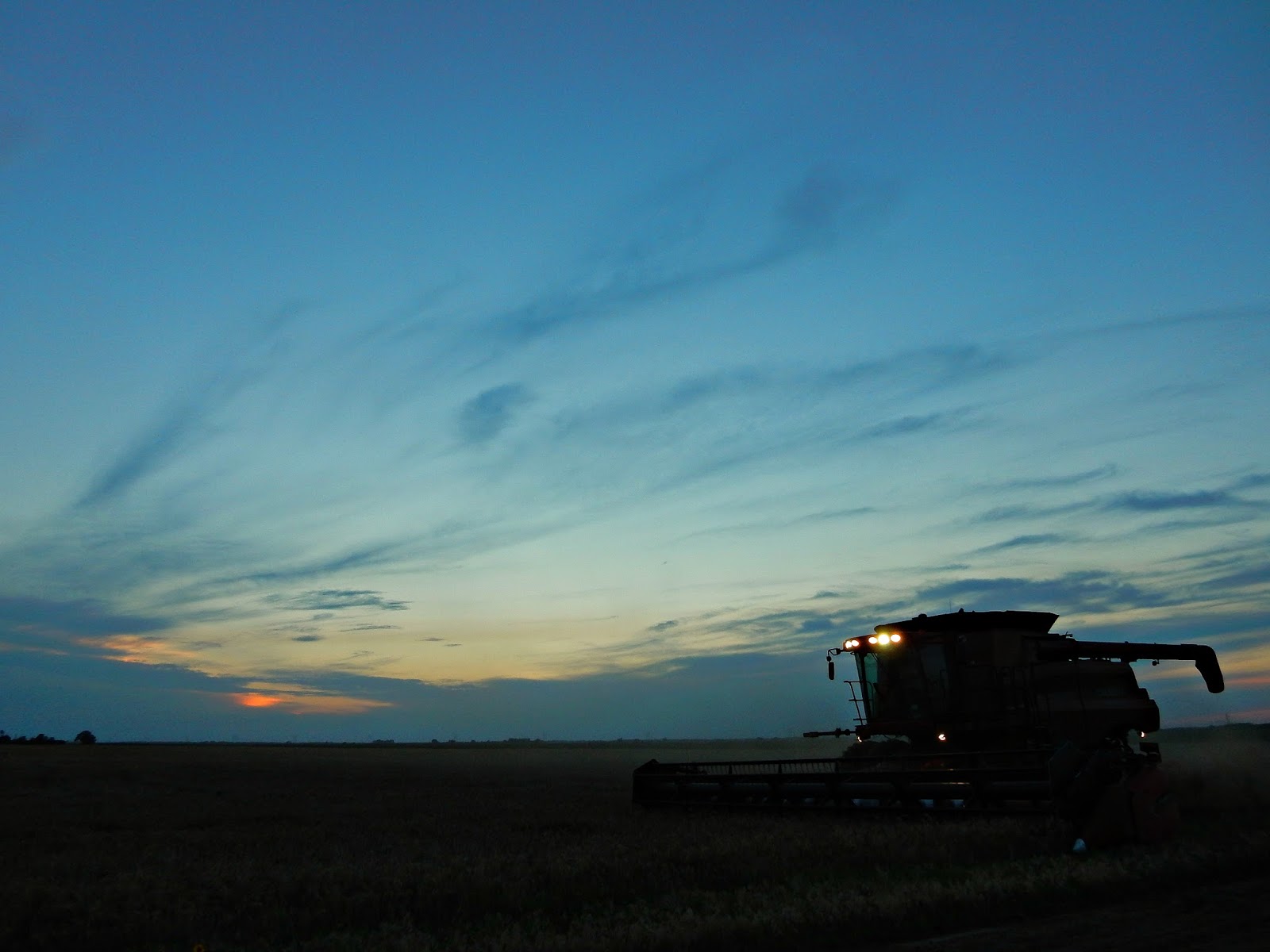
So, the sun has finally set on Wheat Harvest 2016. The dryland corn and milo looks good after all those harvest rains. The guys are working on the second cutting of alfalfa. This harvest has been one to remember. Some of it, we'd probably prefer to forget. But that's part of farming. Kind of like the amnesia that new moms experience following labor, we'll put it behind us. And the journey will begin anew in September and October as we plant the 2017 wheat crop.

Tuesday, July 12, 2016

A Buzzard Circles: Cue the Harvest Saga

A buzzard was circling the combine when I went by yesterday afternoon. It wasn't there for the combine, but it might as well have been.

The buzzard was dining on the big, well-fed raccoon who had been eating an all-you-can-eat wheat buffet inside our combine. When Randy started the combine up to move to our remaining 275 acres of wheat, the coon went through the machine, tearing up the radiator and assorted other parts.

The buzzard didn't come for the combine. But Straub's International did. If you are one of those people who thinks raccoons are cute, you are welcome to pay our repair bill!

It was just another part of the Wheat Harvest 2016 saga. We started June 15. Yes, way back then, it looked so promising. And, the wheat we cut early was well above average. Then it began raining. We think it's rained seven times since June 20. We had a hiatus from July 2 through July 11 because the ground was just too soggy.
Thankfully, our neighbor, Gary, rescued us yet again. He had already planned to help us cut to finish up. Now, his machine will harvest our remaining crop. Randy got a quick lesson in transitioning from red to green, and he's been driving the borrowed combine. It has 4-wheel drive, so it has been helpful on the still muddy ground.
I'm glad I took photos of harvest earlier. The photos of beautiful wheat are long gone. From the road, there are so many weeds coming through that you can hardly tell we're cutting wheat. The straw spreader looks more like a lawn mower tossing mulch as it chews through grass.
Photo taken June 15, 2016
But we are thankful to again be cutting. We got a sprinkle of rain overnight. Now, if the rain can just stay away for a couple of days: Fingers crossed!

Who would have thought I'd have to juggle getting set up for the Stafford County Fair with running meals to the field? As superintendent of 4-H foods and nutrition, I'm setting up this afternoon. Judging begins bright and early Wednesday morning. In our current situation, I'm thankful that our active 4-H days are over and we aren't trying to get livestock and a dozen other projects ready to go while still trying to finish up harvest.

I hope that we'll be able to say we're done with harvest sometime before the fair is over.  If all goes well and the "creek don't rise," we should be done sometime on Wednesday.

"If all goes well ..." I don't think I'll count on that.

We are ready to put Wheat Harvest 2016 in the rearview mirror.

Tuesday, July 5, 2016

Up A Creek: Wheat Harvest 2016

Progress on Wheat Harvest 2016 is up a creek ... so to speak. You know the old saying, "God willing and the creek don't rise." Well, our 4th of July had a rising Peace Creek, so there was no wheat cutting then or for the foreseeable future.
As the clouds moved in again Friday night, we finished up a field near our house. If you look closely (photos below), you can see weeds poking through the wheat. With more than 6 inches of rain since harvest began June 20, we are going to be battling weeds, muddy fields and downed wheat as we try to salvage the rest of the crop.
 
Yesterday, on the 4th of July, we surveyed the 275 acres of wheat we still have to cut north of Stafford. You don't have to look too hard to find the weeds in those fields.
We also don't have to look far to find hail damage. This particular location has gotten hail twice during harvest, so there's quite a bit of wheat on the ground. Some of the corn leaves have also been shredded there.
While the weather hasn't been conducive for wheat farmers, we did find a creature who is really liking the soggy weather.
The guys had to pull a wheat truck out of the field this morning. It's been sitting there since Friday night, since the co-op wasn't open over the holiday weekend. (There was no need. No one could cut wheat.)
Hopefully, the sun hasn't set on Wheat Harvest 2016 quite yet. We'll have to see what this week brings. Until then, it's hurry up and wait.

Thursday, June 30, 2016

Road Trip: Wheat Harvest Version

My first job on the farm was driving a pickup while my dad picked up fence posts. I was in elementary school at the time. Long before I had my driver's license, I moved trucks around in the harvest field. These were the days before my dad had a grain cart to haul the grain from the combine to the truck. So I'd move the truck closer to the wheat so my dad didn't have to go as far to dump the bin load each round.

When I got my farm permit, I drove the wheat trucks to the Iuka Co-op. Our hired man, Ed, was my patient navigator the first year. He taught me the fine points of waiting in line, unrolling the tarp, how to dump the truck and instructions in the fine art of elevator etiquette. But, after that, I made dozens of trips to the elevator during wheat harvest each year.

When Randy and I were first married, I worked at The Hutchinson News, so I didn't drive the truck, except on weekends. After I "retired" from that job and the kids got a little older, I was back in the driver's seat again.

However, I've never driven our semi. This is the second wheat harvest we've had it. I know I could learn. But we've had a hired man available to do it, so my job has transitioned to go-fer and cook.


The other evening, after one of our rain delays during harvest, our hired man wasn't back yet, so Randy asked if I'd like to go with him as he drove the semi with a load of wheat to Zenith.
It's definitely a different perspective, viewing the familiar Zenith Road from a loftier perch.
We arrived at our destination - our favorite prairie skyscraper.
Randy unrolled the tarp.
He pulled the semi onto the scales at the co-op office, where they weigh the loaded truck. With the orange probe, they get a sample of the wheat and test for quality, including weight, moisture, protein and foreign matter.
This was taken in 2015. This trip, I was inside the truck cab.
Through the rearview mirror, we could see that they wanted us to take the truck to location "B" - inside the elevator. 
These elevators were designed long before there were big semi trucks. It's a tight squeeze.
If I were the driver, I would much rather dump at the outside pit, location "C."
Photo from 2015 - the outside dump location
I captured Randy's shadow in the mirror behind us as he waited for the wheat to flow into the elevator pit. After so many harvests, I like finding different images that tell the story.
Photo from 2015, showing co-op guys opening the hatches.
Once the truck is in position, the co-op workers open the hatches underneath the truck. The semi truck is emptied through gravity. (We also have a tandem truck that has a lift to dump the grain. For photos of that, click HERE.)
With the grain unloaded, Randy pulled back onto the scales for an empty weight. We also pick up the ticket which gives a record of how much wheat we delivered that trip and its quality. 
Then, it was back to the field to fill 'er up again.
The farmer or landlord pays a storage fee to the co-op based on the amount of time the grain was stored before being sold. Then, it belongs to the co-op. When the co-op sells it, most is trucked out of the elevator to the buyer. (In the past, rail travel helped move a lot of grain, too, but most of it is trucked these days, at least in this area.)

FYI:  When I pulled up a blog post from last year, I saw that wheat was $5.15 on June 23. Wheat closed at $3.15 on the board at Zenith yesterday. 

Thankfully, we were able to start cutting again yesterday afternoon after our Tuesday rain delay. We had to move to a different location. It is a slow process, since the wheat is down fairly badly and he's still having to battle some mud. But the wheat yields are still above average, though quality has suffered with the rains.

Still, we're glad to be back at it! Every swath puts us a little closer to done.