Wednesday, March 23, 2016

Well-Baby Checks

It was a lovely spring morning for a 4-wheeler ride in the pasture. But we had more in mind than just a farm version of an amusement ride as we bumped over the pasture ruts. It was time to round up the mamas and the babies for the youngster's "well-baby checks."

Just like human moms take their children to regularly-scheduled doctor's appointments, the bovine babies go through a similar process, though we skip the weight and height measurements. And, for this particular visit, Randy serves as the "physician's assistant," without the medical degree.
There are always a few who dawdle. (There are a few in every crowd, right?) We ran the mamas and babies through a series of corrals and then into a pen by the old barn, where we sorted the pairs. I didn't get photos of that process. It's not a Kodak moment to send the mamas out, while trying to keep the babies in the pen. (In other words, I don't have any extra hands for clicking the camera shutter.)
Then, you have to convince someone to become a leader. Here, most of them were turned in the wrong direction. Guys, it works better to go head first into the barn. They eventually figured out what direction they were going. We loaded them into a trailer and hauled them to the working corrals, where each waited for his or her turn.
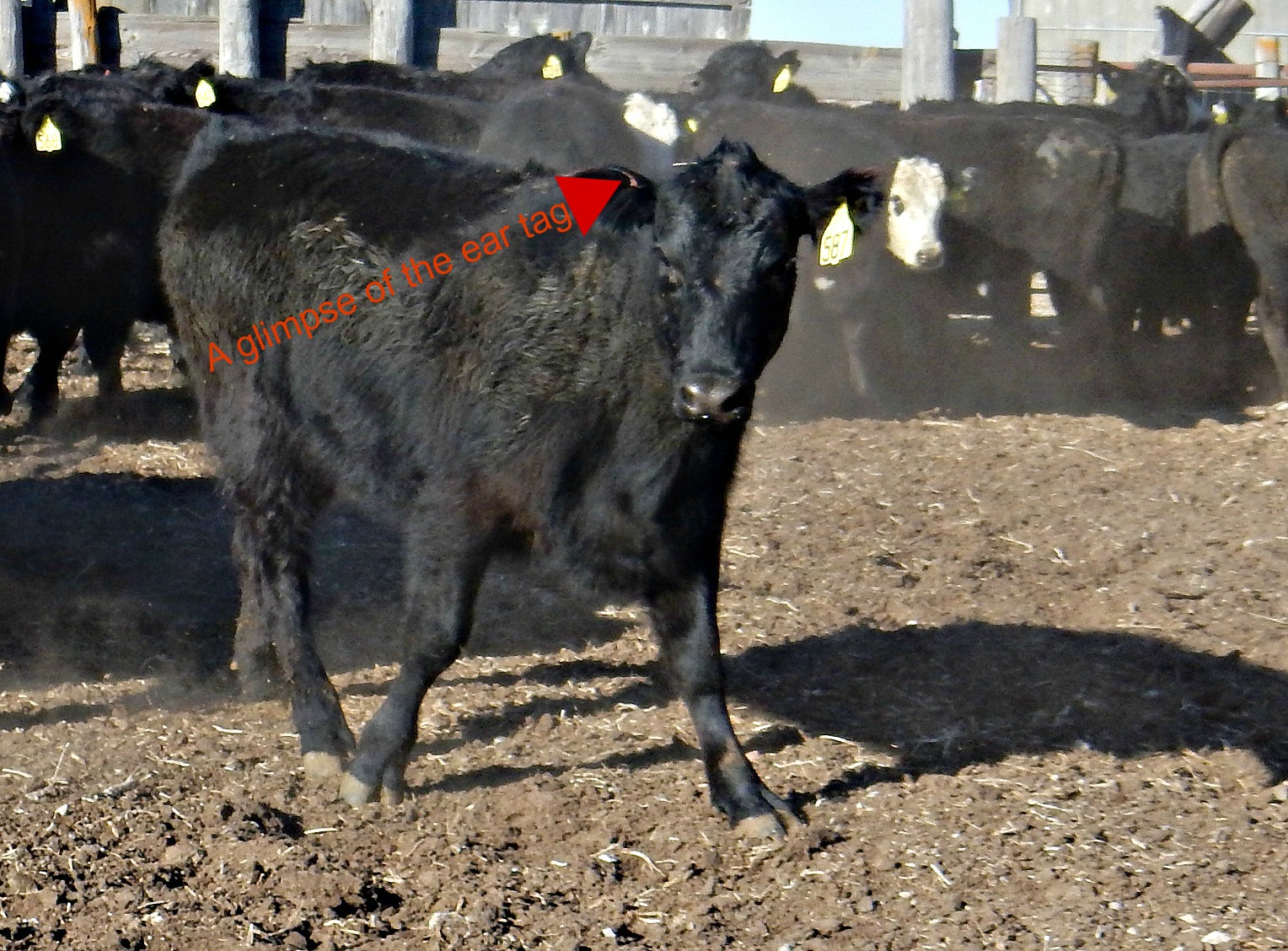
A few already had eartags. They were calves from heifers, which we tag as we go.
Others would get their tags while in the calf cradle, a miniature squeeze chute.
Here on the County Line, the first number on the ear tag signifies the year the calf was born. So, this year's numbers begin with a "6" for 2016.  Last year's calves had a number beginning with 5 and so on. Randy's name and cell phone number are on the back for easier identification.
Each calf's left ear is notched, another form of identification we use on our farm.
 
Then, the baby calf and his friends get Tic-Tac-sized growth implants in their ears. Ralgrow is a hormone that stimulates the pituitary gland and helps the calf grow.
The $1 implant will bring a $3 return. Randy believes it's a matter of using the technology available to more efficiently grow food for consumers. And, yes, we eat the meat that we produce here on the farm and share it with our children and grandchildren.
We give each calf two injections. One is Ultrabac 7, an immunization to prevent blackleg. The other is Bovi-Shield Gold 5, which prevents viral diseases in cattle. People often question the reasons for giving immunizations to animals that will eventually enter the food chain. But these injections are like giving immunizations to our own children. It helps keep the calves healthy, and healthy cattle provide a good source of protein in the human diet

The bull calves, like Number 635, also become steers during their time in the chute. (The next three photos below were taken a different year, but are better than those I took yesterday.)
Randy makes an incision in the sac.
He pulls the testicles through the incision.
And then he cuts the cords. It was time for No. 635 to exit the chute to make room for the next one and to join his buddies.

 Here is the one we were looking for all morning - the last one of the day - the 27th.
The moms were waiting anxiously as we returned to their corral.
Cue the music: "Reunited, and it feels so good!"
It was time for a snack break.
We sent them back to a nearby pasture to await their transport to greener summer pastures in May.
Today on the agenda? Working another group of County Line calves. It's supposed to be windy today, so it may not be the most pleasant of working conditions. 

Monday, March 21, 2016

Family Resemblance

Do you remember the book, Are You My Mother? It was published in 1960 as part of Random House's Beginner Books series.

I remember checking this book out of the Pratt Public Library as a child. When I took Jill and Brent to the library, I loved pulling my favorite childhood books from the shelves and packing them in our book bag.

Are You My Mother? by P.D. Eastman is the story about a mother bird who knows her egg will be in her nest where she left it, so she leaves him alone to go and get something for him to eat. The baby chick hatches. He does not understand where his mother is, so he goes to look for her. In his search, he asks a kitten, a hen, a dog, and a cow if they are his mother. They each say, "No."

Spoiler alert:  He eventually finds his mother.
During a weekend trip to Topeka, I was reminded that there's not a question about who Kinley's mother is. There's plenty of Daddy characteristics, too, as I watched the engineer and meticulous first-born daughter build together at the Discovery Center.
And, as Brooke transforms from toddler into little girl, now 18 months old, there is definitely some family resemblance there, too. (Actually, Brooke wasn't a toddler for long. She's more a "runner." I was reminded of that as Randy and I were chasing her around the Topeka Zoo!)
There might even be a few characteristics that come from an older generation.

It wasn't easy to get everyone standing in one place and looking the same direction.
 
We also see bloodlines reflected on the County Line. There's no question that this little calf and mother are a pair. Even their facial markings are virtually the same. 
While these aren't exactly a matched pair, the splotch on their face makes it easy to see they are related, too. 
We have lots of little all-black babies and mamas running around the pasture.
But when it's time to eat, mother and baby are sure to find one another!
Family resemblance: It's fun to see, whether human or bovine!

***
A note:  I wrote this last week and intended to post it on Thursday or Friday. But I went with Randy to a Kanza Co-op board retreat in Kansas City and was too cheap to pay the $9.95 it took to use the internet in my room. Plus, I spent most of the time in KC in the hotel room sick. I hated missing the group activities. As I told a couple of people, if I missed a dinner theater, you know I didn't feel well. On a positive note, I read three books and watched more NCAA basketball than I figured I'd be able to. See? You can find positives in anything.  And that may be easier, since I'm feeling a whole lot better today.

Tuesday, March 15, 2016

A Story To Tell: 2016 Ag Day

"A picture is worth a thousand words." 

That familiar, probably overused phrase is on a display of space photos at the Cosmosphere. Last summer, while at the national convention of the Master Farm Homemakers Guild in Hutchinson, we acted like tourists in our own backyard. One of my favorite Cosmosphere displays showed photographic images taken from space.
  The display says, in part: 
The best way to judge the role of the camera in space is to try to imagine what it would be like if it had not been taken along. Try to imagine how difficult it would be to visualize the stark beauty of the moon's surface or an Earth-rise over the lunar mountains or the brilliant rays of the rising sun reflecting off a space-walking astronaut as he dangles from his orbiting spacecraft. Imagine what would have been lost to us if we had not experienced the image of our small, fragile, blue Earth floating against the backdrop of the heavens. ... The photographic images are a permanent record that will forever demonstrate the role our few generations have played in the evolution of human history.
Today (March 15) is National Agriculture Day, a day designated each year by the Agriculture Council of America to celebrate the accomplishments of agriculture. This year’s theme is Agriculture: Stewards of a Healthy Planet.
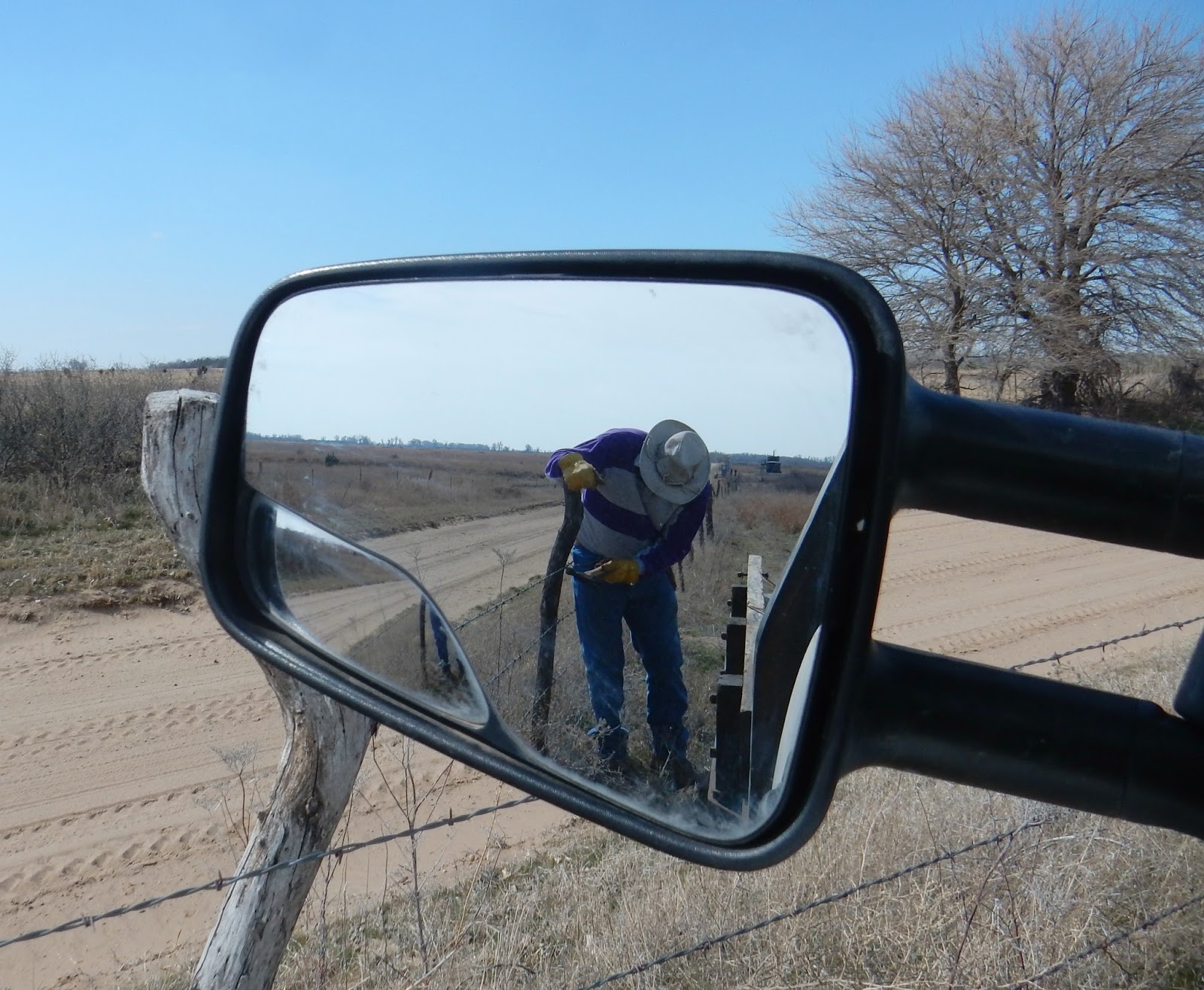
Last week, I was the pickup driver while Randy,  his cousin Don and Don's son, Hans, fixed fence at the Big Pasture. The pasture has been in the family for more than 100 years. The ground was purchased in 1900 for about $4 per acre by August Brinkman, a great-great-great uncle of Randy's. Originally in a tract of 1,040 acres, 560 acres remain in the Fritzemeier family.

A few years ago, this location was designated as a Farm Bureau Century Farm. Randy's Grandpa, Clarence, and two of his brothers owned the pasture together. Now Randy and Don are the owners.
Traditionally, we don't move cattle to the Big Pasture before May 1, but we were working on fence to get it ready for another season during which cattle can graze on the native grasses and drink from the Rattlesnake Creek that runs through it. Though the lushness of spring is several weeks away, there was still beauty in the starkness of the winter landscape, too, especially on a day that hinted of spring to come. 
It wasn't just a trip down memory lane for Randy, who is the fifth generation on his family's farm in Stafford County. I was also remembering that my first job on my parents' Pratt County farm was driving the pickup while my Dad worked on electric fence. I, too, am the fifth generation in my family associated with Kansas farming.
According to the 2012 Agriculture Census, there are 3.2 million farmers and ranchers in the U.S. Last year, American's farmers - who represent only 1 percent of the U.S. population - had 912 million acres in production of food and fiber.
  • The U.S. farmer of today produces enough food and fiber for approximately 160 people. This number was 19 people in 1940, 46 people in 1960, and 115 people in 1980.
  • Farmers receive just under 16¢ of every consumer dollar that is spent on food. The other 84¢ is spent on processing, packaging, marketing, transportation, distribution and retail costs of the food supply.
Yet it seems consumers would much rather get their information about how their food is produced from someone who has never set foot on a farm or a ranch. They let restaurant public relations gurus define what is safe to eat. Yet it is America's farmers and ranchers who devote their daily lives to it. 

Just like those astronauts who carried cameras to outer space, I carry my camera with me as we live and work on the County Line. It's up to us - farmers and ranchers - to tell our story. As I've said before, I don't want to leave it to PETA or HSUS to tell the story of farming today. It's one of the reasons I began my blog, Kim's County Line, six years ago.
For more than 100 years, Randy's family has been fixing fence in that very same pasture. Randy, like his father and grandfather before him, make sure those fence posts are in solid ground. If something isn't solid, he fixes it.
 
Just like other industries, farmers have changed some agricultural techniques through the years in an effort to improve and advance, all the while keeping their livelihoods and their families on solid ground. Just like looking in a rearview mirror, they use the past as a guide, but they also have their eyes firmly fixed on the future.
Information flies toward us, popping up on Facebook feeds. "Tweets" and "Snaps" signal their presence with immediate pings on the phones that are always in our pockets or in our hands. But maybe - just maybe - consumers could ask a  real farmer if they have questions about modern food and fiber production. What might change if they would look at photos or read words from a real Kansas farm and not just let a self-proclaimed "expert" determine their viewpoint?
 
Wouldn't that be a more solid connection with the world of agriculture? March 15 may be National Ag Day and Kansas Ag Day. But you know what? Every day is Ag Day around here, no matter the date on the calendar.
 
As the Cosmosphere photography display said: 
The photographic images are a permanent record that will forever demonstrate the role our few generations have played in the evolution of human history.
It's true for those images from space. But it's also true for we farmers and ranchers of today.

Friday, March 11, 2016

Sale Time: A Year in the Making

The road to the cattle sale isn't covered just in the distance the semi travels as it leaves the farmstead and arrives at the sale barn.

For us, the road to the sale of our feeder cattle started more than a year ago, when the 2015 calf crop was being born on the County Line in February and March. We have been caring for them ever since.
Photo taken in late January 2015
Last week, we sold 72 feeder calves at Pratt Livestock. Ours were among the more than 6,600 head sold last Thursday (March 3).
From cowboy hats to ballcaps, buyers and sellers mingle in seats reminiscent of an old school gym. Cattle buyers are identified by their cell phones pressed close to their ears, as they talked with clients who needed cattle. They were on their phones as much as teenage girls ... really!
Buyers nervously watched the board to see how much each particular pen of cattle brought, as the auctioneer sang his tune about "fussy and fancy heifers" and "green steers."


"You like 'em now," the auctioneer warbled.
 
"Look at the length on them, and their bigger sisters are coming right behind them."
Our steers averaged 808 pounds apiece and sold for an average of $1.58 per pound. Our heifers, which weighed an average of 678, sold for an average of $1.54 a pound. That was way down from last year, when cattle prices were above the $2 per pound mark. Can you think of anything besides farm prices that go down rather than up? Yeah, me neither.

Though they didn't weigh as much as last year, Randy was pleased with the 2-pound-a-day rate of gain since they were weaned from their mothers last November. 
 
We sold 72 head and kept 25 of our 2015 calf crop at home to become our next new mamas. These heifers will give us the first glimpse of our 2017 calf crop next January and February.

It was a long day at the sale. We got to the sale barn just after 10:30 AM. It was 8:30 before our last group of steers were sold.  I had brought a library book, but I finished it mid-afternoon. I ended up buying a paperback in Pratt to pass the time for the rest of the day.
There was one big bonus to leaving after dark. The semis played ring-around-the-rosey in the sale barn parking lot, creating a colorful light show.
The sale ends one chapter on the County Line,  but the next one has already begun with a new crop of 2016 calves.

Wednesday, March 9, 2016

2016: To Market, To Market

The job required quick reflexes and extraordinary vision. Too bad I have neither of those attributes. But, as I tell Randy, you get what you pay for.

Still, my aging reflexes and eyeglass-corrected vision helped get the job done as we sorted feeder calves last week. I ran one of the gates as we sorted the group.

These calves were a little more than a year old. They were the babies born to our cow herd during the 2015 calving season a year ago. They spent last summer at pasture with their mamas, then we sorted off the babies last fall and weaned them after a veterinarian visit. The feeder calves have been in a separate pasture, where we fed them all winter. (Click on the links for more of the calves' journey at the County Line.)

After getting them into the corral,  we sorted them into two groups - steers and heifers. That's where the 20-20 eyesight would have been helpful.
Last fall, the veterinarian inserted a red tag in the right ear of the heifers treated with the bruccellosis vaccine. They are the heifers that potentially could become mamas for us in the future - additions to our cow herd. It's not always easy to see those tags on moving heifers!

Randy planned to keep 25 heifers to breed back for our herd. So, after the initial sorting, Randy again looked through the heifers, and he chose the ones that he thought had the best characteristics that we want to carry on in our herd. He looked for heifers with a straight back, good muscling, a larger frame size, good feet, a smaller head and a feminine look.

Those 25 went into a separate lot. The remaining 72 went back to the pasture until Wednesday morning, when we again brought them up into the corral.

 
That's when the semi came to take them to the sale barn. Though we have two cattle trailers, it would take several trips to get all the cattle to the sale barn, so we hire Darrel Harner Trucking to haul them in a semi.
The cattle go single file up a loading chute and into the semi. The semi is divided into different compartments, which can hold anywhere from six head to 25 head of cattle. Darrel would tell us how many he wanted at a time, and the guys would send that many into the truck.
 
Once they were all loaded, the semi pulled out for the trip to Pratt Livestock.  
 
 We did have to take one trailer load of calves ourselves, so the semi wouldn't be overweight.
Once the semi arrived, the sale barn workers sorted our cattle by sex and size and put them into different pens where they had water and feed until sale time. There are lots of pens throughout the sale barn facility. Each sellers' cattle are kept separate.
They also unloaded our farm trailer and added those cattle to the larger group brought by semi.
And, no, I didn't get photos of those cattle unloading because I didn't want to get in the way.
Randy is always happy when it's sale time!
Coming up: More from the cattle sale!