Thursday, October 10, 2019

Life Lessons from Golf

Note: This was an expedition back at the end of August. I wrote it awhile ago but never posted it. Still, I want it in our blog book, so I'm posting it on this blustery day when the weather does not suggest a leisurely golf game at all. It's my usual sense of impeccable timing.

Jill's and Eric's pastor from back when they lived in Omaha had this to say on his DailyCraig post on Facebook recently:

Golf is a lot like life.
1. It’s best done with others.
2. You get good and bad breaks. Deal with it.
3. You don’t have to win to enjoy it.
4. Your most important shot is the next one.
5. Perfection isn’t possible.

 Craig Finnestad, Water's Edge UMC, Omaha, NE

No. 5 was my sticking point back when I was attempting to learn the sport. I know I'm not going to be perfect at anything, but I really hate being bad at "stuff," including golf. One of the fundamentals of golf seems to be that you have to keep trying until you get better. I obviously wasn't patient enough for that. However, while playing golf is not for me, I do enjoy going along for the ride. (See Rule 1.)
"Painting" setting on my camera
At the end of August, after a rain kept us out of the field, that ride took us to Sand Creek Station in Newton. Randy has golfed there several times before and was anxious to share the unusual course with me.
This time, the "ride" seemed to include a caboose. In reality, we couldn't really ride the rails on this historic train car. But Randy couldn't resist climbing up for a closer look. And he wanted me to send a photo to the kids of him swinging his club from the caboose. I think it also got shown to his in-town breakfast buddies.
While the caboose is firmly ensconced in the parking lot, there are plenty of trains that rumble near the 18-hole course. Newton is a railroad hub, and it's evident with the frequent bump and rattle as trains ambled over the tracks. Don't they know that golfers insist on quiet for their golf swings? (I always roll my eyes a bit about that. As a basketball player (OK, basketball bench sitter), I was always told that you have to tune out crowd noise while shooting a free throw. Since I was lucky if I got into the game with 20 seconds or so to go, I didn't ever have to put that principle to work, so what do I know? But I always find pro golfer's insistence on total silence a little primadona-ish.
To get to Hole 1, you drive under the railroad tracks.
The caboose is visible from a few holes on the course and serves as a colorful backdrop.
While Randy enjoys golfing, I enjoy the scenery and the other "visitors" to the golf course ...
... like this heron ...
... and this cute guy.
But I also appreciate being able to sit in the shade of the golf cart and read my book. With an afternoon away from home, I don't have to feel guilty about reading when I should be writing or cleaning or doing laundry or any other more productive activity.
It's also fun to try and come up with new photo angles and ideas for photography shots, including playing with light and shadow.

One of my favorites that day was the pyramid of practice balls with a train in the background.
I should have taken a picture of the contraption the groundskeeper was using to build the pyramid (but alas, maybe another time).

Randy had a good golf game. I read more of a good book. (Things You Save in a Fire by Katherine Center. I recommend it.) I captured some cool photos. As they used to say on the society pages of the weekly newspapers, "A good time was had by all!"

Tuesday, October 8, 2019

Hay! Here's an Conundrum for You!

 
It's kind of an oxymoron: We raise alfalfa, so you'd think that going to a hay sale to purchase, rather than sell, is counterintuitive.

However, that's just where we found ourselves a couple of weeks ago.  I went with Randy to buy some small bales at the Central Livestock hay auction.
An old sign from 1945 at Central Livestock
Most Tuesdays throughout the summer, the hay auction takes place outside the South Hutchinson sale barn before the sale ring opens for cattle later in the morning.
We got there early to look over the selection brought to the auction by those who had bales to sell. 

So why would we need to buy hay when we raise hay? In fact, we grow alfalfa and sudan, both of which we bind up in big round bales and feed to our cattle. Randy was bidding on small square bales of hay to use as "bait hay." (That's an oxymoron, too: The "square" bales are actually rectangular. Hmmm - That's what they're called anyway.)
 
The small bales come in handy for my role in calling cattle into the corrals to bring them home from summer pastures or to entice them to change locations during the winter. It's a little tough to toss those 1,500-pound big round bales, don't you think? A 60-pound bale works better. (And let's get real: I'm not tossing the whole bale myself either. I end up pulling chunks from the bale for enticement purposes.)
 
Who knew there'd be such a crowd? There were preschoolers there with their Daddies and plaid-shirted farmers. There were cowboy hats and seed company caps. The variety didn't end with the people. There was brome hay. There was alfalfa. There was millet hay. There were small bales, big square bales and a couple of big round bales.
I may sometimes toss some hay into the air for calling the cattle, but I leave the whole bale tossing to my favorite farmer. He's been doing that since junior high days. Growing alfalfa has always been part of the crop rotation for Randy's family.
 
Back when Randy was a child, they used a sickle mower which laid the hay flat. Then, they would rake the hay. Since they didn't own a baler, a neighbor would bale it into square bales. Then, Randy, his brother and dad would pick up the hay from the field. 
These days, he isn't bucking bales in a whole field. As auction bidder No. 835, he raised his hand and purchased two different piles of alfalfa hay, totaling 34 bales. 
Besides looking for quality hay, he chose a couple of piles closest to the driveway for easier loading. Always thinking, my farmer! I'm always thinking, too. I occupied myself with paying for the hay and then taking photos. I could say I forgot my gloves. But, honestly, Randy didn't ask me to help and I didn't volunteer.
Once we got home, he reversed the process and unloaded the hay in a storage shed. A couple of kittens who'd been hiding out in the few remaining bales of hay we purchased a couple of years ago had to be momentarily relocated to the wheelbarrow.
The kittens were returned to their hay "condominium."
 However, the mother didn't like the human interference and moved them.

Our neighbor borrowed a few bales for a homecoming float. And now we're ready for those cattle-gathering expeditions this fall. 

Thursday, October 3, 2019

Bob Dole's Chauffeur

I was Bob Dole's chauffeur on Tuesday.

Before anyone thinks I've suddenly begun Ubering former presidential candidates in my spare time, I should probably confess that the Bob Dole I was carting around was actually 50 bags of Bob Dole seed wheat.
 
I made a couple of trips to Miller Seed Farm on Tuesday. Bob Dole was my first passenger. On the second trip, I picked up 50 bags of Zenda seed wheat.
Randy started planting wheat on September 25.
There are four zones of ideal planting in Kansas. Romulo Lollato, K-State Extension wheat specialist, has done research and concluded that sowing date plays a major role in crop yields. Planting after recommended dates can mean a whopping decrease in yields of up to 3.5 bushels an acre per day.
  • Zone 1: Sept. 10-30
  • Zone 2: Sept. 15 to Oct. 20
  • Zone 3: Sept. 25 to Oct. 20
  • Zone 4: Oct. 5-25
Since we live in Zone 3, our start date falls within the recommendation.
Randy saved two varieties of wheat during our 2019 harvest - Larry and Zenda - and that is the wheat we started drilling this fall.  We binned some of the wheat as we were harvesting this summer in our on-farm storage. Later, we took the retained wheat to Miller Seed Farm for cleaning and seed treatment.
It went back in our home bins until we were ready to plant. It is augered out of the truck into the drill boxes. The wheat we save at harvest can only be used by our farm.
This year, we are planting 1,575 acres to wheat which will be harvested in 2020 (if all goes as planned).

This is the first time we've "invited" Bob Dole to our farm. It's a new wheat variety developed by Kansas State University and released in a public-private partnership between Syngenta and Kansas wheat farmers through the Kansas Wheat Commission and Kansas Wheat Alliance. The hard red winter wheat variety, which is distributed by Agri-Pro, was first introduced in Kansas during the 2018 season.

We always plant seed wheat in fields closer to the on-farm storage bins. Before Randy puts the bagged seed wheat in the drill, he cleans out the other seed. He starts baling it out with an old coffee can and ends up using a shop vacuum to get the rest.
While Randy planted the Bob Dole wheat, I went back to Miller Seed Farm for our other seed wheat variety - Zenda. It was released in 2017 by the Kansas Wheat Alliance.
 New varieties of wheat are developed in efforts to resist disease and improve yields.
About the time Randy got done loading the Zenda into the drill, it began raining.We've gotten about 0.60" in the past couple of days, so wheat planting is shut down for the time being.
The newly-emerging wheat that was put in the ground a week ago is loving this moisture.


Tuesday, October 1, 2019

Air Traffic Control

We need air traffic control on the County Line these days.
A walk through trees stirs up butterflies swooping on air currents while they dodge darting dragon flies. With the wind blowing the past two days, the migrating Monarchs look for a respite in the shelterbelts and tree lines.
At a hay auction last week, I spotted a woolly bear caterpillar. A retired farmer saw me taking photos and told me I could start my own meme. (Who knew he'd know about memes!?) And I asked him, "Aren't they supposed to be a sign that winter is coming?"

He confirmed my recollection of folklore, and a Google search when I got home brought me a little more information. Here’s the legend: The woolly bear caterpillar has 13 distinct segments of either rusty brown or black. The wider the rusty brown sections (or the more brown segments there are), the milder the coming winter will be. The more black there is, the more severe the winter.

It appears we could be in trouble. But since it's been 80-degrees-plus the past two days, winter seems eons away. And who has time to worry about that when another sign of fall is moving through my backyard? With several of my friends posting congregations of Monarchs hanging out in their trees, I know I'm not alone in having an "air bnb" in the backyard.
Monarch butterflies are not cold hardy and cannot survive our freezing winters. However, they are one of very few insect species that can feed on milkweed.
This milkweed bloomed in our pastures this summer.
Milkweed is cold hardy, with milkweed species growing all the way into Canada. The monarch butterflies fly north each year to take advantage of this milkweed food source. But they must migrate back to Mexico each winter.
 
Each spring, the adult butterflies that have overwintered begin flying north and laying eggs on milkweed. These generations of monarchs stairstep their way until some reach Canada.
Butterflies are truly miraculous.

If nothing ever changed, there'd be no butterflies.
- Author Unknown

That's quite a reminder for this change-challenged person. They are the ultimate symbol of transformation. As George Carlin once quipped, "The caterpillar does all the work but the butterfly gets all the publicity."
I'm not sure that's true of monarch butterflies. It sounds like a lot of work to me to travel for two months, across thousands of miles, bucking wind and rain and predators. And it's all to get to a destination they've never visited before.
 
They begin the journey in their summer home in Canada and the northern regions of the U.S. They are headed for a mountain range 70 miles west of Mexico City in central Mexico, where they find the perfect habitat to survive November through March in the Oyamel forests. As many as 300 million spend the winter there. Wouldn't that be a sight to see?
They aren't like ducks and geese which migrate year after year. They will only make this journey one time. So how do they know where to go?
 
It is just another miracle of God's creation. Researchers say that it appears to be a combination of directional aids such as the magnetic pull of the earth, the position of the sun and the availability of milkweed. No matter the reason, they are a beautiful signal of fall.
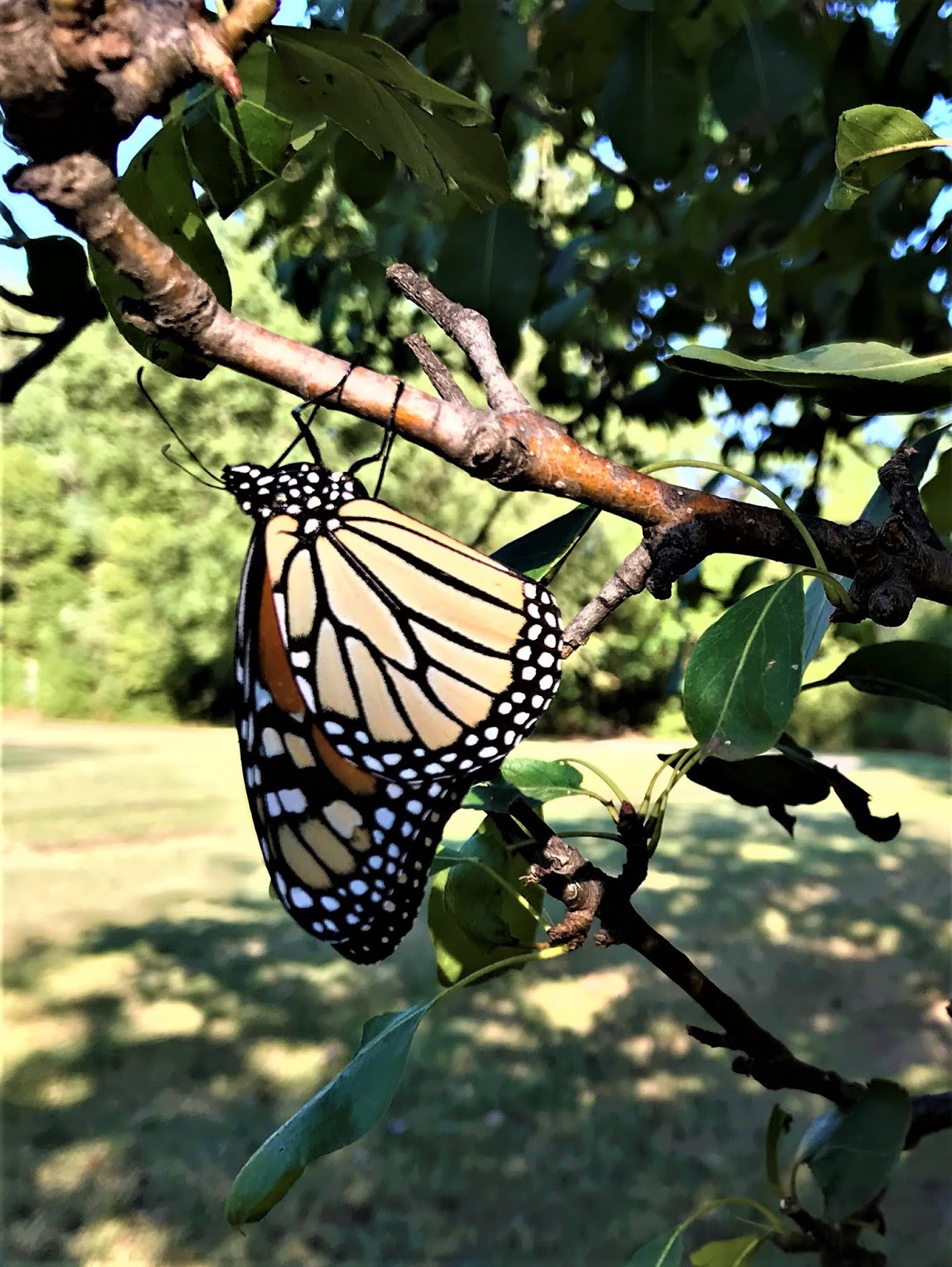
As I was mowing on Friday, I almost had a mid-air collision with this beauty taking a breather in a pear tree.
"I'll just back up and let you hang out," I told my visitor. 
Mowing isn't my favorite job. But it does have its perks during Monarch migration.