Tuesday, March 15, 2016

A Story To Tell: 2016 Ag Day

"A picture is worth a thousand words." 

That familiar, probably overused phrase is on a display of space photos at the Cosmosphere. Last summer, while at the national convention of the Master Farm Homemakers Guild in Hutchinson, we acted like tourists in our own backyard. One of my favorite Cosmosphere displays showed photographic images taken from space.
  The display says, in part: 
The best way to judge the role of the camera in space is to try to imagine what it would be like if it had not been taken along. Try to imagine how difficult it would be to visualize the stark beauty of the moon's surface or an Earth-rise over the lunar mountains or the brilliant rays of the rising sun reflecting off a space-walking astronaut as he dangles from his orbiting spacecraft. Imagine what would have been lost to us if we had not experienced the image of our small, fragile, blue Earth floating against the backdrop of the heavens. ... The photographic images are a permanent record that will forever demonstrate the role our few generations have played in the evolution of human history.
Today (March 15) is National Agriculture Day, a day designated each year by the Agriculture Council of America to celebrate the accomplishments of agriculture. This year’s theme is Agriculture: Stewards of a Healthy Planet.
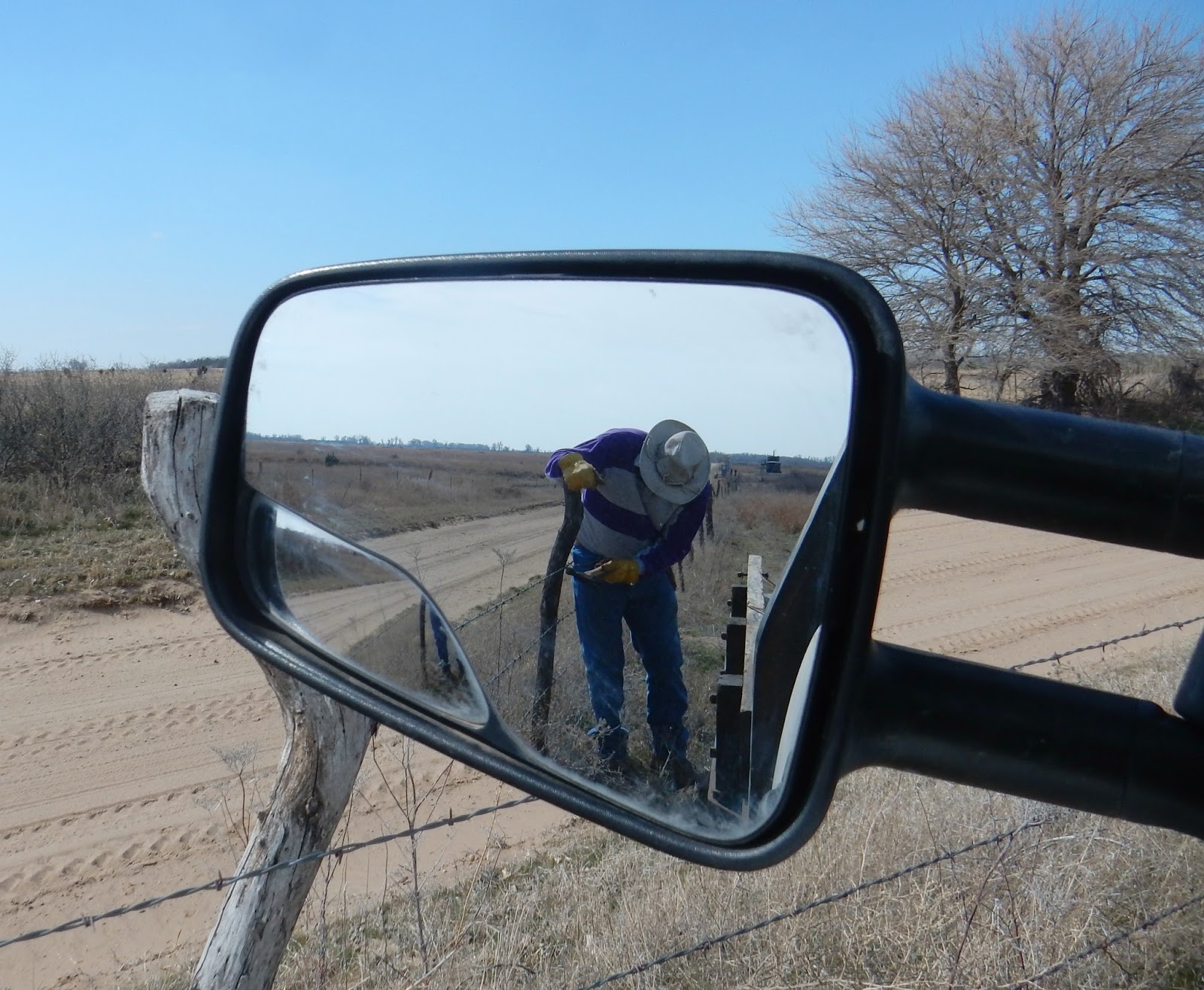
Last week, I was the pickup driver while Randy,  his cousin Don and Don's son, Hans, fixed fence at the Big Pasture. The pasture has been in the family for more than 100 years. The ground was purchased in 1900 for about $4 per acre by August Brinkman, a great-great-great uncle of Randy's. Originally in a tract of 1,040 acres, 560 acres remain in the Fritzemeier family.

A few years ago, this location was designated as a Farm Bureau Century Farm. Randy's Grandpa, Clarence, and two of his brothers owned the pasture together. Now Randy and Don are the owners.
Traditionally, we don't move cattle to the Big Pasture before May 1, but we were working on fence to get it ready for another season during which cattle can graze on the native grasses and drink from the Rattlesnake Creek that runs through it. Though the lushness of spring is several weeks away, there was still beauty in the starkness of the winter landscape, too, especially on a day that hinted of spring to come. 
It wasn't just a trip down memory lane for Randy, who is the fifth generation on his family's farm in Stafford County. I was also remembering that my first job on my parents' Pratt County farm was driving the pickup while my Dad worked on electric fence. I, too, am the fifth generation in my family associated with Kansas farming.
According to the 2012 Agriculture Census, there are 3.2 million farmers and ranchers in the U.S. Last year, American's farmers - who represent only 1 percent of the U.S. population - had 912 million acres in production of food and fiber.
  • The U.S. farmer of today produces enough food and fiber for approximately 160 people. This number was 19 people in 1940, 46 people in 1960, and 115 people in 1980.
  • Farmers receive just under 16¢ of every consumer dollar that is spent on food. The other 84¢ is spent on processing, packaging, marketing, transportation, distribution and retail costs of the food supply.
Yet it seems consumers would much rather get their information about how their food is produced from someone who has never set foot on a farm or a ranch. They let restaurant public relations gurus define what is safe to eat. Yet it is America's farmers and ranchers who devote their daily lives to it. 

Just like those astronauts who carried cameras to outer space, I carry my camera with me as we live and work on the County Line. It's up to us - farmers and ranchers - to tell our story. As I've said before, I don't want to leave it to PETA or HSUS to tell the story of farming today. It's one of the reasons I began my blog, Kim's County Line, six years ago.
For more than 100 years, Randy's family has been fixing fence in that very same pasture. Randy, like his father and grandfather before him, make sure those fence posts are in solid ground. If something isn't solid, he fixes it.
 
Just like other industries, farmers have changed some agricultural techniques through the years in an effort to improve and advance, all the while keeping their livelihoods and their families on solid ground. Just like looking in a rearview mirror, they use the past as a guide, but they also have their eyes firmly fixed on the future.
Information flies toward us, popping up on Facebook feeds. "Tweets" and "Snaps" signal their presence with immediate pings on the phones that are always in our pockets or in our hands. But maybe - just maybe - consumers could ask a  real farmer if they have questions about modern food and fiber production. What might change if they would look at photos or read words from a real Kansas farm and not just let a self-proclaimed "expert" determine their viewpoint?
 
Wouldn't that be a more solid connection with the world of agriculture? March 15 may be National Ag Day and Kansas Ag Day. But you know what? Every day is Ag Day around here, no matter the date on the calendar.
 
As the Cosmosphere photography display said: 
The photographic images are a permanent record that will forever demonstrate the role our few generations have played in the evolution of human history.
It's true for those images from space. But it's also true for we farmers and ranchers of today.

Friday, March 11, 2016

Sale Time: A Year in the Making

The road to the cattle sale isn't covered just in the distance the semi travels as it leaves the farmstead and arrives at the sale barn.

For us, the road to the sale of our feeder cattle started more than a year ago, when the 2015 calf crop was being born on the County Line in February and March. We have been caring for them ever since.
Photo taken in late January 2015
Last week, we sold 72 feeder calves at Pratt Livestock. Ours were among the more than 6,600 head sold last Thursday (March 3).
From cowboy hats to ballcaps, buyers and sellers mingle in seats reminiscent of an old school gym. Cattle buyers are identified by their cell phones pressed close to their ears, as they talked with clients who needed cattle. They were on their phones as much as teenage girls ... really!
Buyers nervously watched the board to see how much each particular pen of cattle brought, as the auctioneer sang his tune about "fussy and fancy heifers" and "green steers."


"You like 'em now," the auctioneer warbled.
 
"Look at the length on them, and their bigger sisters are coming right behind them."
Our steers averaged 808 pounds apiece and sold for an average of $1.58 per pound. Our heifers, which weighed an average of 678, sold for an average of $1.54 a pound. That was way down from last year, when cattle prices were above the $2 per pound mark. Can you think of anything besides farm prices that go down rather than up? Yeah, me neither.

Though they didn't weigh as much as last year, Randy was pleased with the 2-pound-a-day rate of gain since they were weaned from their mothers last November. 
 
We sold 72 head and kept 25 of our 2015 calf crop at home to become our next new mamas. These heifers will give us the first glimpse of our 2017 calf crop next January and February.

It was a long day at the sale. We got to the sale barn just after 10:30 AM. It was 8:30 before our last group of steers were sold.  I had brought a library book, but I finished it mid-afternoon. I ended up buying a paperback in Pratt to pass the time for the rest of the day.
There was one big bonus to leaving after dark. The semis played ring-around-the-rosey in the sale barn parking lot, creating a colorful light show.
The sale ends one chapter on the County Line,  but the next one has already begun with a new crop of 2016 calves.

Wednesday, March 9, 2016

2016: To Market, To Market

The job required quick reflexes and extraordinary vision. Too bad I have neither of those attributes. But, as I tell Randy, you get what you pay for.

Still, my aging reflexes and eyeglass-corrected vision helped get the job done as we sorted feeder calves last week. I ran one of the gates as we sorted the group.

These calves were a little more than a year old. They were the babies born to our cow herd during the 2015 calving season a year ago. They spent last summer at pasture with their mamas, then we sorted off the babies last fall and weaned them after a veterinarian visit. The feeder calves have been in a separate pasture, where we fed them all winter. (Click on the links for more of the calves' journey at the County Line.)

After getting them into the corral,  we sorted them into two groups - steers and heifers. That's where the 20-20 eyesight would have been helpful.
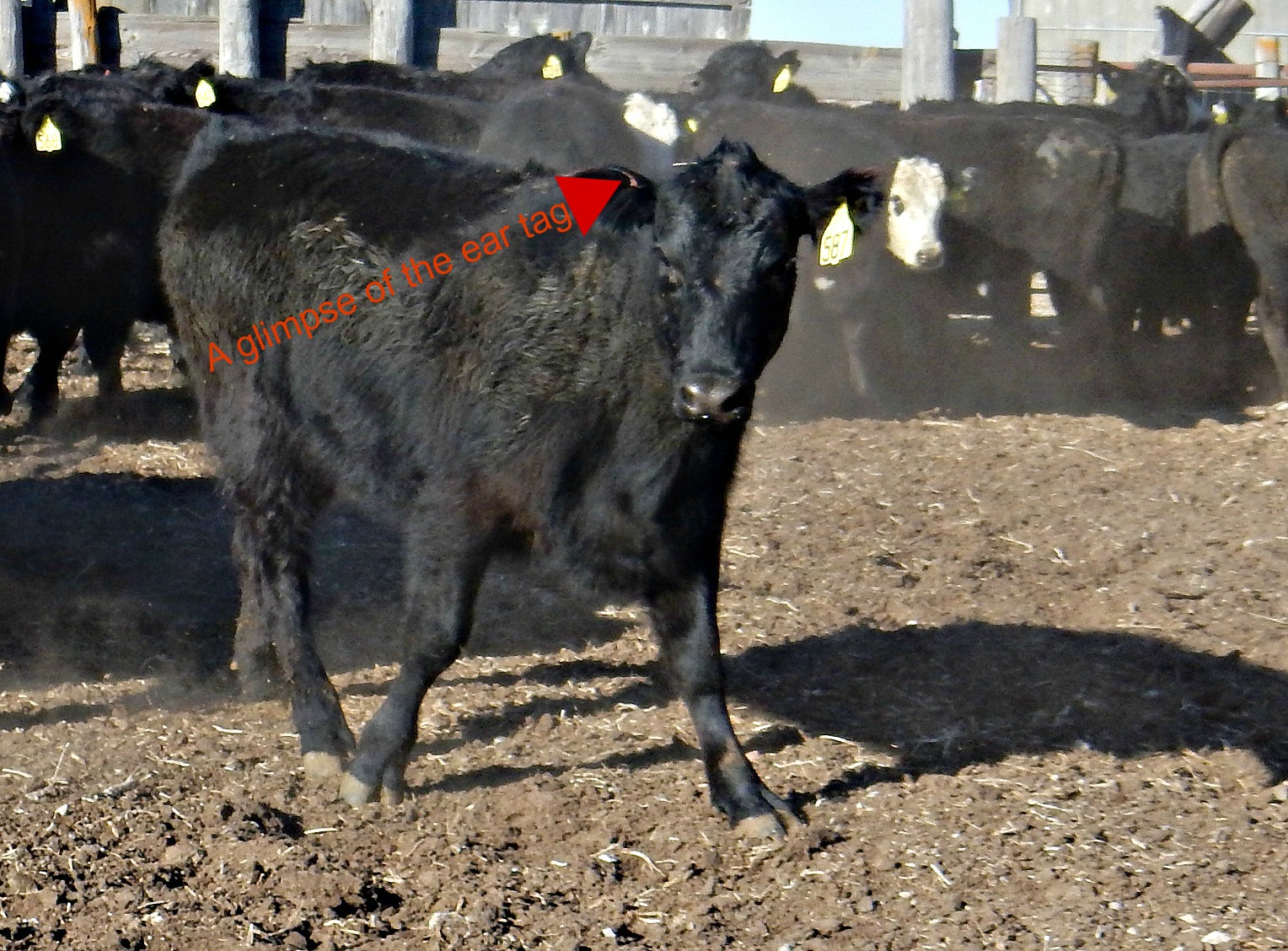
Last fall, the veterinarian inserted a red tag in the right ear of the heifers treated with the bruccellosis vaccine. They are the heifers that potentially could become mamas for us in the future - additions to our cow herd. It's not always easy to see those tags on moving heifers!

Randy planned to keep 25 heifers to breed back for our herd. So, after the initial sorting, Randy again looked through the heifers, and he chose the ones that he thought had the best characteristics that we want to carry on in our herd. He looked for heifers with a straight back, good muscling, a larger frame size, good feet, a smaller head and a feminine look.

Those 25 went into a separate lot. The remaining 72 went back to the pasture until Wednesday morning, when we again brought them up into the corral.

 
That's when the semi came to take them to the sale barn. Though we have two cattle trailers, it would take several trips to get all the cattle to the sale barn, so we hire Darrel Harner Trucking to haul them in a semi.
The cattle go single file up a loading chute and into the semi. The semi is divided into different compartments, which can hold anywhere from six head to 25 head of cattle. Darrel would tell us how many he wanted at a time, and the guys would send that many into the truck.
 
Once they were all loaded, the semi pulled out for the trip to Pratt Livestock.  
 
 We did have to take one trailer load of calves ourselves, so the semi wouldn't be overweight.
Once the semi arrived, the sale barn workers sorted our cattle by sex and size and put them into different pens where they had water and feed until sale time. There are lots of pens throughout the sale barn facility. Each sellers' cattle are kept separate.
They also unloaded our farm trailer and added those cattle to the larger group brought by semi.
And, no, I didn't get photos of those cattle unloading because I didn't want to get in the way.
Randy is always happy when it's sale time!
Coming up: More from the cattle sale!

Monday, March 7, 2016

American As Apple Pie

As a child, I remember going with my parents to vote in the tiny town of Byers, just 3 1/2 miles away from our farm home. I'm not sure I realized the significance as they disappeared behind the red, white and blue canvas curtain of the voting booth with ballot in hand. But when I reached age 18, I, too, wanted to make my vote count.

However, in all those years since, I've never been part of a caucus. Kansas' caucus have traditionally been later in the process. Each party's nominee was pretty much a foregone conclusion, so it didn't seem like it made any difference anyway.

However, this year was different. With the tally for delegates still in flux, it seemed more relevant this year. But, as I saw the line at the Reno County Republican caucus stretch for a hundred yards down the sidewalk outside the Atrium Hotel, I again wished that our house was on the other side of the county line.

According to Facebook, my friends and neighbors in Stafford County were in and out of their caucus in a matter of minutes. But in Hutchinson, cars were circling the hotel lot, trying to find a place to park. We had errands to run, so we decided to do them and come back.
The next time, the line was only a few dozen feet from the front doors. But it was deceptive. Inside, the line snaked and curved through the hotel lobby, doubling back. We were many and varied. Young parents carried babies, pushed empty strollers and tried to entertain squirming toddlers. Teens accompanying their parents on a Saturday morning, shuffled their feet as the line slowly moved, while their fingers raced and dashed over their phones.

Some senior citizens leaned against the lobby chairs and sofas for a brief respite before moving on to the next rest point. Some wore their political leanings on their sleeves with campaign T-shirts, but a lot more promoted their favorite college instead. After all, it was game day for K-State, KU and Wichita State.
It took about 45 minutes to reach the table where we handed over our driver's licenses and our voter registration records were checked. We were handed a sticker and went into a hotel ballroom, where we traded the sticker for a ballot. Once we got there, it took only a few seconds to put a pencil mark by a candidate's name and drop it in the voting box.

Brent says it only took 5 minutes in Riley County. Some caucus goers in Wichita waited 3 hours, so 45 minutes didn't seem so bad after I heard that.
 
Was it a wise use of my time? I doubt it. But at least I was part of the process. And, in a democracy, that should be celebrated.

Our trip to the caucus came as we were driving home the morning after seeing our niece, Madison, in the opera, The Consul, at K-State.
Photo from K-State Theatre
Even though we can get disillusioned by our political system in America, The Consul was a reminder of what living in a police state would be like. The opera is set in a large European city, probably in the 1930s or '40s. A freedom fighter comes home with a bullet in his leg, courtesy of the country's corrupt Secret Police. For his family's survival, he flees to a neighboring democratic country, leaving behind his wife, Magda (Madi's character), his mother and an ill baby boy.
Photo by K-State Theatre
Magda goes to the consulate to try and get exit visas for the rest of the family to join her husband and escape persecution. But the whole process is an exercise in futility and bureaucratic red tape. The show doesn't have a "feel good" happy ending.

Perhaps that glimpse of oppression gave me a little more appreciation for the political process as I stood in line on a beautiful spring morning in Hutchinson, Kansas. Flawed as it is, I can still be part of our political process.

Friday, March 4, 2016

Living Dangerously - Country Style

Living dangerously - country style:  Your husband goes to a farm auction with the checkbook while you're at a meeting.

It just may lead to a farm fleet expansion. Randy bought a new-to-us combine at a Pratt County farm auction on Tuesday. He purchased a 2010 7120 Case combine, along with a 2011 35-foot flex head header and a trailer to pull the header.

And, just so you know, we DID talk about it before he went, so it wasn't a total surprise. He had a price in mind and doubted it would buy the equipment. However, with a depressed farm economy right now, the price for used machinery is down.

He says he got a good deal. My dad and brother concur, so it must be true. (Either that or the farmers are sticking together.)
The new combine is 16 years newer than the combine we'd been using for 14 years. (We bought that one at a farm auction is 2002.)  The combine has 1,500 engine hours, compared to 3,800 on our old combine.
It has many more bells and whistles. It's our first piece of equipment that has GPS, other than our portable Garmin in the car, which loves telling us "recalculating." I don't think that's a feature of this version: Randy hopes not!

At least he didn't get that message on the drive home. It took him 1 1/2 hours at 23 miles an hour on country back roads to get the combine home. Ironically, along the way, he pulled over to let a tractor pass. It turned out to be a neighbor who was taking a similar route, driving a tractor home after getting it repaired at a Pratt dealership. That's our version of a country traffic jam, I guess.
Randy has a lot of reading ahead trying to figure out all the features. One of the sellers was a high school classmate of mine. He generously spent some time showing Randy the ropes.

But still, Randy has a little "light reading" ahead with four new manuals. Randy already loves harvest. I have a feeling he'll be even more excited this year!

Wednesday, March 2, 2016

Miracles in the Making

Too often, we don't look for miracles. Instead, the world seems filled with problems and hatred. The news at the end of last week was marred by a mass shooting in Hesston. Things like this aren't supposed to happen in Small Town, Kansas, America.

It was another sad story in a week of sad stories. A farmer's wife lost her 31-year-old husband unexpectedly. Several friends were asking for prayers for their hospitalized loved ones.  I was struggling to forgive someone for damage done to our property. By the end of the week, the bad news seemed to smother my mood like a heavy, wet blanket.
Sometimes, it seems like we're truly stuck in the hard things.
We may need a helping hand to get us out of our predicament.  (Randy to the rescue!)

Yes, problems may seem to multiply much faster than the solutions. But, even in the midst of struggles, there are miracles to be found.

A small-town police chief saves many others from harm through his quick response to a shooting. A community bands together to honor the living and the dead. Many there have responded with "shalom justice," a way to "choose love over fear." (Click on the link for a wonderful commentary by Michele Hershberger, a professor of Bible and Ministry at Hesston College).

A group of Farmer's Wives from all over North America who know each other only through a Facebook page came together to raise more than $1,100 for one of their own. People gathered on a Saturday afternoon to help a hospitalized church member get things moved into a new home.

These are the miracles in the midst of tragedy. For me, those glimpses of light and love are the way that we are the hands and feet of Jesus in this world.
And one of my personal antidotes to feeling down is as close as the pasture and the corrals. It may not solve every problem, but it sure makes you forget about them for awhile. Watching babies grow is good medicine.
Yes, miracles are in this world. We just have to open our eyes to them. 
Sometimes, we find them in a cattle pasture.
 
Sometimes, we just need to witness a little love. It doesn't solve all the problems. But it sure makes you feel better.


Wobbly baby calf from Kim Fritzemeier on Vimeo.