Showing posts with label Corn Harvest 2019. Show all posts

Tuesday, September 24, 2019

It Is What It Is: Corn Harvest 2019


It is what it is.

It's a philosophy of life I suppose I learned at my parents' dinner table. Both my brother and I seem to use it with some regularity. I believe the phrase has been transcribed on a homemade plaque at the family farmstead.
 
That sums up corn harvest, which we completed last week. It wasn't the worst corn harvest we've ever had. It wasn't the best.

It is what it is.
 
In this case, the overall average was 66.6 bushels per acre. The high was 97 bu/acre and the low was 61 bu/acre. (If 66.6 was the average, you can deduce that there was more in the 60-bushel range than the 90s.) We don't have irrigation, so these are dryland crop totals. From what we hear from neighbors and family, our average is fairly consistent with others in our area for dryland fields.

In all honesty, Randy was a little disappointed with the yield. We had a lot of subsoil moisture at the beginning of the growing season. But I guess we just didn't get the rain and cooler temperatures we needed during grain filling. There were fairly large mudholes where no crop grew. As Randy says, "I guess it's Kansas."

How does Corn Harvest 2019 stack up with previous years' averages?
2019 - 66.6 bu/acre
2018 - 82 bu/acre
2017 - 43.6 bu/acre
2016 - 71 bu/acre
2015 43.88 bu/acre
2014 - 108 bu/acre
2013 - 57 bu/acre (This was the first year we added corn into the crop rotation).

When you reach the end of a season, it's always good to look back to where you've been. To read more about each stage, click on the links:
We started planting corn on April 15, 2019, and finished April 25 or so. Wheat has always been our primary crop. However, the prevented planting of wheat acres due to excessive moisture last fall meant an increase to those we devoted to corn on the County Line. The cost of planting corn is appreciably higher than the cost of planting wheat due to seed costs, fertilizer and herbicide. Because we are a totally dryland farm, wheat typically performs better than corn on our acreage. 

We planted 600 acres of corn. To compare: In 2018, we planted 280 acres of corn.
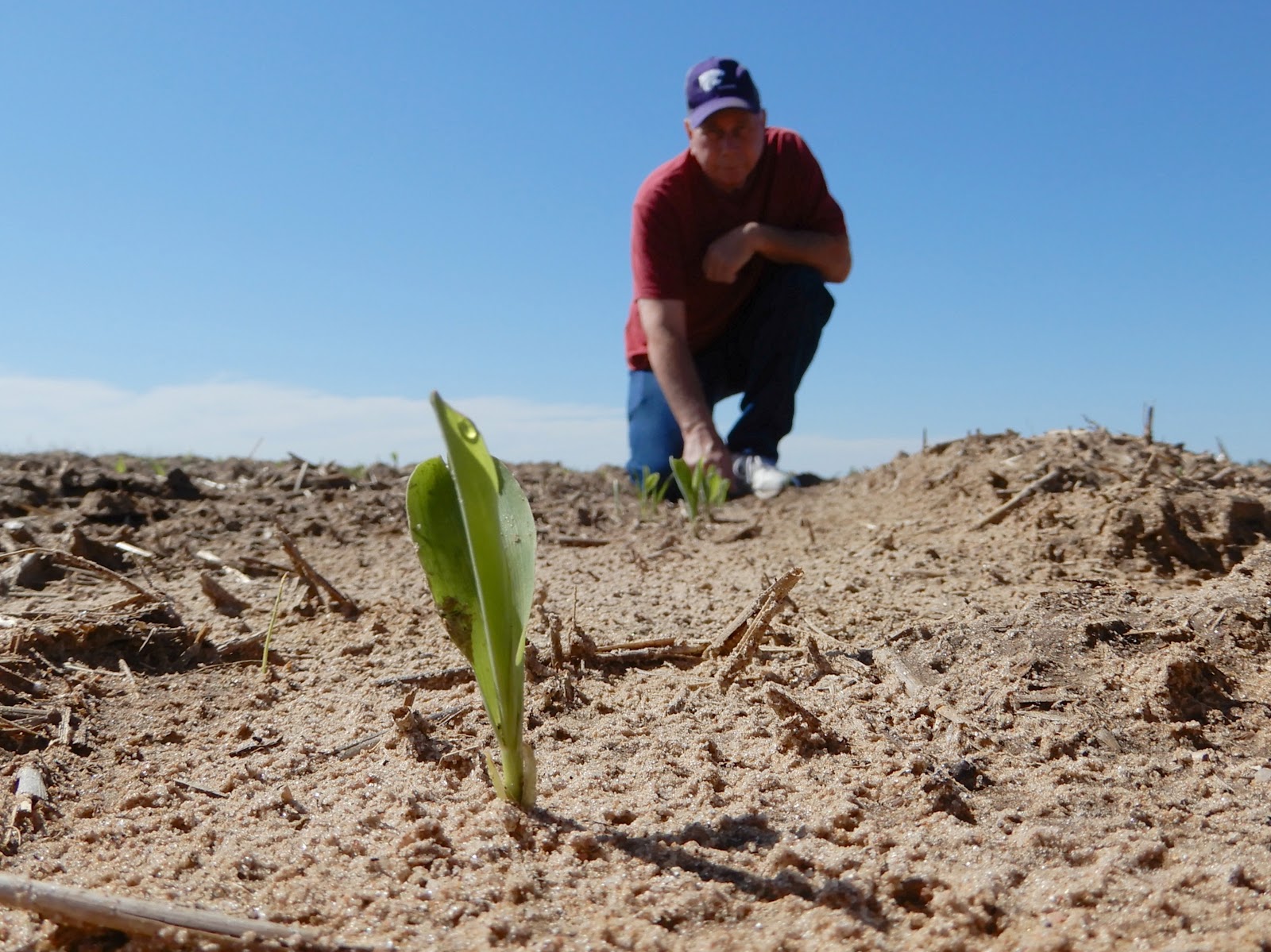
The corn was emerging in early May.
June 21, 2019
By mid-June and the beginning of summer, it was knee high.
As advertised in a song from a musical, the corn was "as high as an elephant's eye" in July
July 8, 2019
At least it was high as a farmer's eye.
 
By the end of August, the corn was starting to dry down. It was too dry to take to the feedlot for high-moisture corn and not quite dry enough to haul to the elevator.
Our corn wasn't a bumper crop. But neither was our wheat this year. This is the first time we have more corn bushels to sell than wheat bushels. (We planted 1,080 acres of wheat vs. the 600 of corn. Part of that is the difference in the size of the kernel. Corn kernels are bigger and heavier than wheat kernels. Corn typically produces more bushels per acre than wheat, and that was definitely true this year when we had the poorest wheat harvest we'd had in the 10 years I've been blogging.)
And so we finish up another task on the County Line. 

It is what it is. 

And, as one of my dad's other signs - and sayings - goes, we'll keep on hoeing.

Thursday, September 19, 2019

God's Handwriting

Sunrise, September 17, 2019 - Happy Birthday, Jill!

A Time to Think

Never lose an opportunity for seeing anything that is beautiful; for beauty is God's handwriting, a wayside sacrament.—Ralph Waldo Emerson

A Time to Act

Open your arms to beautiful moments and they will come to you.

A Time to Pray

Today God, let me shine for You.
From a Guideposts email devotional

I like to bracket my days with beauty on both ends.
From sunrise skies in the east ...
to sunset skies in the west.
Most of the time, I witness these spectacles by myself with cicadas' buzz as a white-noise undertone. But one evening this week, I had some company. When I saw the pretty clouds and setting sun, I drove to a neighbor's windmill, a vantage point I've used before when featuring the western sky.

When I arrived, the cattle were congregated at the windmill, the bovine equivalent to an evening cocktail hour, I suppose.
I was the party crasher. And they were curious. They kept creeping closer ...
... and closer ...
... and closer ...
 
 ... until I had several standing at the gate. I don't know whether they thought I had grain or hay. But I arrived at the party empty-handed (other than my camera, of course), so we just had some polite conversation before I departed.
I made a couple of other stops before going home ...
... watching the day's light dwindle away like a cowboy riding into the distant sunset.
And I was again reminded of Ralph Waldo Emerson's words:

Never lose an opportunity
 for seeing anything that is beautiful; 
for beauty is God's handwriting,
 a wayside sacrament.

Thursday, July 11, 2019

Grinning from Ear to Ear: A Corn Update

The corn is making my wheat farmer grin from ear to ear ... corn pun intended.

While we slog our way through the soggy ground and poor wheat crop toward the end of wheat harvest, Randy can't help but be excited about our dryland corn crop. He has to let his eternal optimist outlook shine somehow!
July 4, 2019
It's not the norm to have a tunnel of corn lining both sides of the road on the trip from our house to the Zenith Road. Corn still is not our primary crop, but prevent planting on wheat acres last fall meant a boost in the corn acres planted this spring.
 
We planted 600 acres of corn last April. That's not much when compared to other farmers, especially those with irrigated acres, but it's significant for us. We also planted 95 acres of milo and 30 acres of silage, doubling our normal row crop acreage.
Because of spring rains, we have our share of mudholes in the corn fields.
But now that the corn is taller, there's the illusion of a mile-long avenue of corn on one side of the road south of our house.

The 1.5 to 2 inches of rain that fell Friday into Saturday arrived at an inopportune time for wheat harvest. But it was an ideal time for corn pollination.
The tassel is the male flower of corn. Each tassel is comprised of a central tassel stalk and lateral branches. As the corn plant tassels, it opens its packets of pollen.
 
At the same time, silky strands become exposed on the lower portion of the plant. The pollen from the top of the plant must reach the silk. In the fields, this is done solely by wind and luck. Once the silk is covered in pollen, each strand will become a kernel of corn, and an ear of corn will start to form.

Corn is monoecious, which means that male and female reproductive structures are present on each plant. However, male and female flowers are in separate locations on the plant. Given the separation of the ear and tassel and considering the vast amounts of pollen transported within a field, it is understandable why corn is primarily cross-pollinated. Less than 5 percent of kernels may be fertilized by pollen from the same plant.
The ear is the female flower of corn. (Randy is pointing an undeveloped ear of corn in the photo above.)
 
Silks develop and elongate from the surface of each ovary on the ear. The silk functions as the stigma and style of the female flower providing a pathway for the male reproductive cells to reach the ovule. Silks begin growing from ovaries at the base of the ear, then progress toward the tip.
Normally, pollination is a continuous process with fertilization occurring gradually along the ear as silks emerge. A mass of long, green silks indicates that pollination has not occurred. Anything that interferes with pollination may reduce fertilization and kernel set.
Successful fertilization does not always result in a harvestable kernel. Even though the corn looks good right now, there's a lot of time until harvest. For several weeks following fertilization, grain quality and quantity can be reduced when photosynthesis is interrupted by cloudy conditions, moisture stress, heat stress and other factors.
But even with those caveats, the crop's current prospects have my farmer happy for the moment.
July 8, 2019
It's good to have something to dream about when it's taking forever to fill a truck with a poor wheat crop and you're backing out of endless mud to avoid getting stuck. 

Thursday, April 25, 2019

Corn Is On the Horizon

In the old-time westerns, the hero rides off into the sunset after overcoming trials and tribulations. The implication is that he has survived to fight another day and will begin anew the next day after a day of rest and renewed spirit.

Is it so different to watch the tractor and planter ambling toward the western horizon? This year, it seems apt. Randy began planting corn on April 15 and is about to finish up. Just like a cowboy in a Wild Wild West film, we've had our share of battles this past year, including 15 inches of rain falling in just one month last fall. The deluge kept us from planting one-third of the acres we'd planned for wheat for 2019.
So, corn it is. And with the longer days of springtime, the hours in the field have increased again, too. It makes for a happier farmer, who says, "I finally feel like I'm getting something done."
The prevented planting of wheat acres means an increase to those we'll devote to corn on the County Line.
Two piles of bagged corn seed are marked for us at the Zenith branch of the Kanza Co-op.
Today, many farmers plant RIB corn (refuge in a bag) - whether it's irrigated or dryland.
The green-colored seeds have a different genetic make-up and are treated with a different insecticide than the purple-colored seeds. The purple seeds are a refuge for several different insects in a field, giving them a habitat to satisfy EPA rules. Before RIB technology was available, farmers had to plant so many acres in a field to a corn that wasn't resistant to the bugs and the rest of the field could be resistant. With RIB technology, farmers can plant it all at the same time, without changing seed and figuring acreage requirements. 
Randy adds a seed talc - or lubricant - to the planter boxes to facilitate the seed's journey from planter to soil.
He is also putting on a starter fertilizer to promote early growth. This comes after the co-op applied 100 pounds of nitrogen per acre earlier this spring. I'm often the delivery driver for the starter fertilizer, going to Zenith when Randy empties the tank.

The make-up of the starter fertilizer was determined after Randy did soil testing before planting. It includes 40 pounds of nitrogen, 5 pounds of sulfur and 1 pound of zinc per acre.
 
The fertilizer is in the tank pulled by the pickup. First stop is pulling up to the scales at the elevator to weigh the empty pickup and fertilizer trailer and tell the scale operator what kind of fertilizer we want. (There's another stop after the tank is filled.)
Then, it's off to the fertilizer shed, where an employee fills the tank with the "recipe" Randy has ordered.
This year, we're picking up the seed as we need it at Zenith, so on some trips, I also get the bagged seed from another building.
Once back to the field, Randy can then use the fertilizer in the trailer to refill the fertilizer tanks on the planter, attaching a hose ...
And then starting a motor to pump the fertilizer to the planter.
It's a little hard to see, but he can watch the levels rise in the yellow tanks.
And then he's off again.
We are planting more corn this year than ever - 600 acres. That's not much when compared to other farmers, especially those with irrigated acres, but it's significant for us. We'll also plant 95 acres of milo and 30 acres of silage, doubling our normal row crop acreage.

Often, the field across the road is filled with an ocean of waving wheat in June. This year, it will be corn instead. I've always thought the lyricist for the musical, "South Pacific," didn't really know that much about Kansas crops, when he claimed, "I'm as corny as Kansas in August" in one of the songs from that show.

But with wheat acreage down and corn planting up, maybe I'll have to re-evaluate!