Showing posts with label corn harvest. Show all posts

Tuesday, October 15, 2024

Corn Harvest from the Jump Seat


Randy feels good about our decision to retire from active farming in August 2022. But there are times when he misses it, and he gets a little "itchy" - and that itch doesn't have a thing to do with the ever-present harvest dust. Harvest was always Randy's favorite time of the year. Well ... Until he had a breakdown. Or the combine got stuck. Or the employee didn't show up.

So maybe experiencing harvest in the combine's "buddy seat" is OK after all. Let's hope the combine operator was just as happy to have a rider as Randy always was when a kid, grandkid or curious guest showed up. 


He was able to ride for a little while as a custom harvester was cutting one of our corn fields. (The ride and the photos were taken September 27.)


Our corn averaged 80 bushels per acre. Todd and Tye Miller, who farm our ground, had some fields that had higher yields at other locations. However, Randy says it was a nice surprise after the field blew so badly after planting this spring because of drought and strong windstorms. 


The custom harvester - Frederick Harvesting out of Alden - was trying out an experimental combine, so Randy enjoyed looking at all the bells, whistles and cameras in the combine cab during his excursion. 

Tye and Todd still have some our milo to harvest this fall. We'll see if more combine rides are in Randy's future. 


Thursday, September 23, 2021

Pretty on the Inside?


I think wheat fields are beautiful at pretty much every stage - from bright green sprout to those iconic "amber waves of grain" waving in the Kansas wind. 

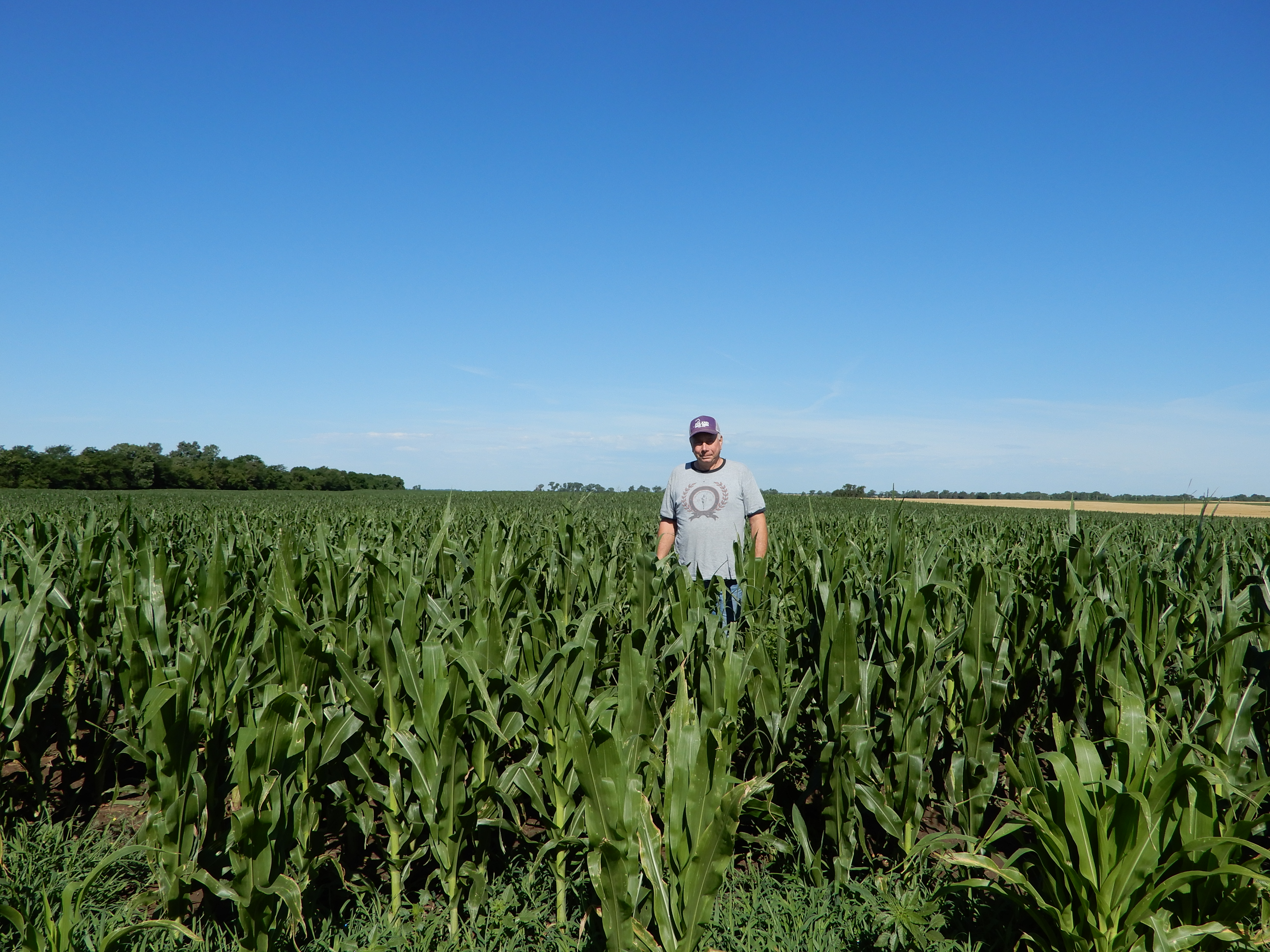
However, to me, corn is not a "looker" at harvest time. But we always hope it will be pretty on the inside. (I wrote about ugly corn syndrome in June. Evidently it didn't get a complex because it did OK in the end.) 

Last Friday, we completed our annual quest to discover the "inner beauty" of the crop.

We are relative newcomers to corn and have only had it in our crop rotation since 2013. (Randy has been producing alfalfa for 50 years and wheat for almost that long.) Our 99 bushels/acre 2021 corn crop was almost identical to the verdict last year:

2021 - 99 bu/acre
2020 - 98 bu/acre
2019 - 66.6 bu/acre
2018 - 82 bu/acre 
2017 - 43.6 bu/acre
2016 - 71 bu/acre
2015 - 43.88 bu/acre
2014 - 108 bu/acre
2013 - 57 bu/acre (This was the first year we added corn into the crop rotation).

We began corn harvest on Thursday, September 2. There was an abrupt pause the next day, when it was foggy and humid. Friday night (September 3), we got 3 inches of rain at our house, which stopped corn harvest in its tracks. While the corn was dry earlier, we couldn't get over the ground with the combine again until Wednesday, September 8. We stayed home from the K-State football home opener September 11 to cut corn. We had to be at the state fair on Tuesday, September 14, for Kansas Master Farmer and Farm Homemaker Day. As presidents of our respective branches of the organization, both of us had parts in the meeting and program. Then it rained that evening. 

However, it was pretty from the grandstand as we watched the storm roll in.

We made it through about 45 minutes of the Logan Mize concert before nearby lightning strikes shut down the music for awhile. (We drove home instead of waiting for Sawyer Brown. Looking at radar, we weren't sure the concert would continue, but it did.)

It took until Friday (September 17) for the ground to dry out out enough again for cutting. And we cut the last load of corn for 2021 that afternoon.

This spring, we planted 294 acres to dryland corn. (See the blog post about planting here. The corn was a lot higher than knee high on the 4th of July. And for photos on how it was looking later in July, click here.)

Our acres don't amount to much in the overall statistics of production for Kansas. 

According to the Kansas Corn Commission, a third of our corn stays in Kansas to feed livestock; a third is made into ethanol and dried distillers grain at Kansas ethanol plants; and a third of our corn leaves Kansas to be used in other states or exported overseas, along with corn products. 

Only five states produced more corn than Kansas in 2020. However, since our primary crop here on the County Line is wheat, we don't contribute much to the state's total. For us, corn is one of the crops used in our rotational program to keep soil quality good and weeds down. For my brother and parents in a neighboring county, corn is a primary crop.

Whether it's wheat, corn or milo, Randy still likes being in the combine seat. And I like to go along for the ride.


I think the dry corn cobs look a little like missiles as they get propelled into the header. The corn ears are pulled off the corn stalk and are dragged into the combine with rollers. Inside the combine, the corn kernels are separated from the husks and cobs.


The cobs and debris are dispersed out the back of the combine. And the corn kernels go into the semi for a trip to the co-op elevator.


Many farmers have a grain cart pulled by a tractor to transfer the corn from the combine to the grain cart to the truck. 


But we unload from the combine directly into the truck.


Here's a little video, but the combine cab window is kind of dusty. It's probably not particularly "pretty on the inside."

It's always good to have the sun set on another harvest season.


Unrelated to corn, we discovered that Randy's wheat entry in the Kansas State Fair wheat show had done well. He got second in one of the classes on his Bob Dole wheat variety. And the cycle continues: He began planting our 2022 crop on September 21, the final day of summer (at least, according to the calendar).


Tuesday, October 6, 2020

And That's A Wrap: Corn Harvest 2020


The sun has set on Corn Harvest 2020. (Actually, it set a long time ago, but I had other things to write about.)

And the numbers are in.


The overall average was 98 bushels per acre. The high was 107 bu/acre and the low was 85 bu/acre. We don't have irrigation, so these are dryland crop totals.

How does Corn Harvest 2020 stack up with previous years' averages?

2020 - 98 bu/acre
2019 - 66.6 bu/acre
2018 - 82 bu/acre
2017 - 43.6 bu/acre
2016 - 71 bu/acre
2015 - 43.88 bu/acre
2014 - 108 bu/acre
2013 - 57 bu/acre (This was the first year we added corn into the crop rotation).

When you reach the end of a season, it's always good to look back to where you've been. To read more about each stage, click on the links:

 
Back in April, we received this "care package" in the mail from some anonymous friends (who didn't end up staying anonymous ... Thanks Bob and Debbie!)

Anyway, at the time, I made the hypothesis that given the Great Pandemic Toilet Paper Shortage of 2020, we might be smarter to bypass the corn itself and move directly to marketing the cobs.
Facebook photo post by Jim Chansler of our local grocery store, Paul's, on March 18
 
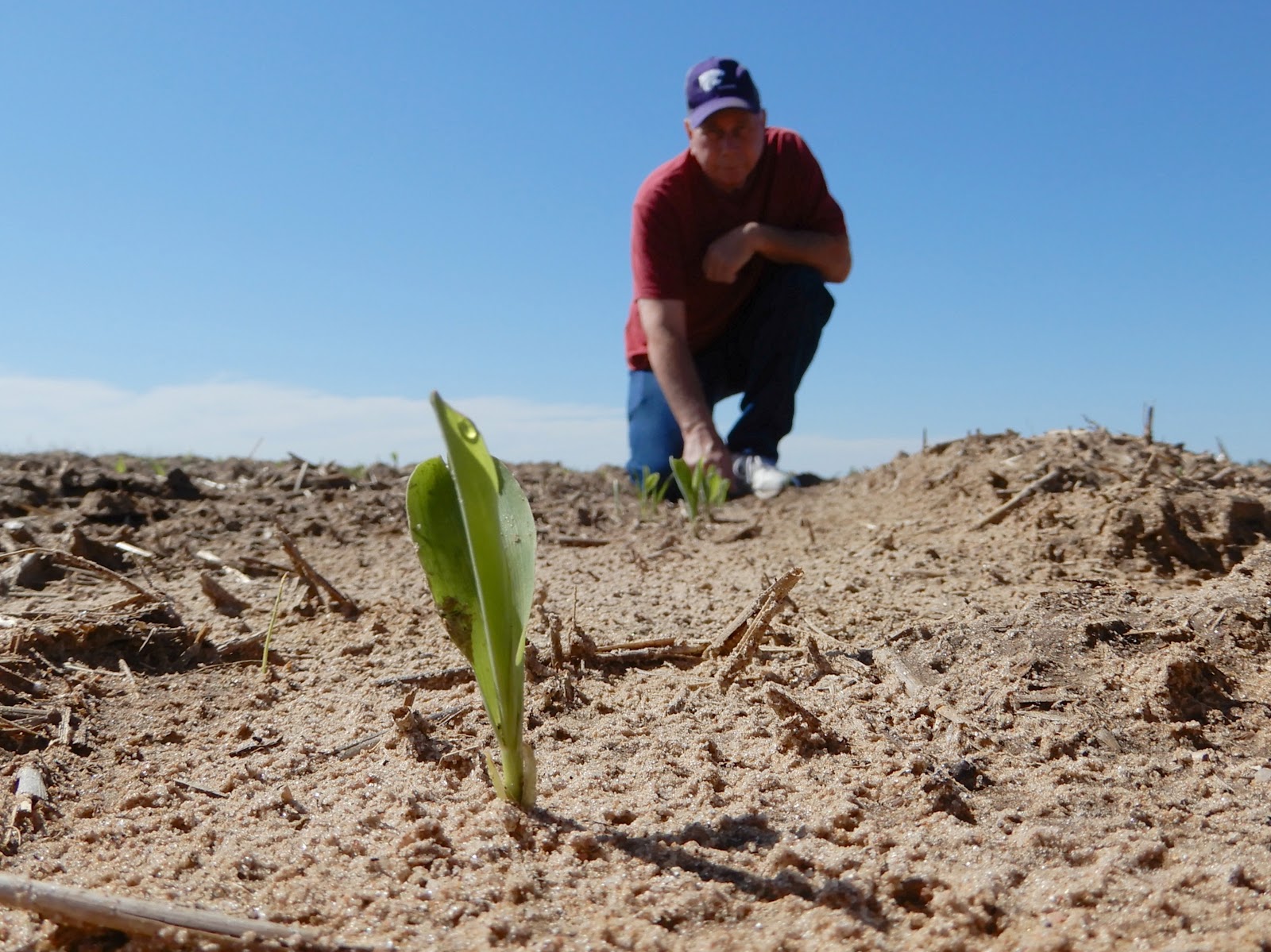
However, my farmer didn't go for that theory, so we planted corn April 20 through April 28, with stops and starts because of rain.  

April 2020

 
Wheat has always been our primary crop, and that was the case again in 2020. Because we are a totally dryland farm, wheat typically performs better than corn on our acreage.  
 
After 2019's increase of corn acreage because of prevented planting of wheat acres, we planted 600 acres of corn in 2019. This year, we were back to just 150 acres of corn planted. Our corn acreage is not going to "break the bunker," so to speak, at our local co-op, but it does play a role in our crop rotation here on The County Line. 

Planting, April 2020

The corn had emerged by May 1.
By the first week in June, it was off to a good start after beneficial spring rains.

The corn crop survived three different wind storms in June and July that demolished trees and made our lean-to "lean" a little more than it needed to.
June 22, 2020
It's amazing to me how quickly corn grows, compared to wheat. Wheat harvest is 9 months in the making. Corn goes from planting to maturity in just a little more than 100-114 days.
July 16, 2020
We were the first to deliver corn to the local elevator, though some of our neighbors had cut and delivered high-moisture corn to a nearby feed lot. I wrote "You Might Be a Farmer ..." when we began cutting.

And that's a wrap ... until next year.  On to milo and silage harvest! We hope to finish up our 2021 wheat planting today. There's always something to do.

Tuesday, September 24, 2019

It Is What It Is: Corn Harvest 2019


It is what it is.

It's a philosophy of life I suppose I learned at my parents' dinner table. Both my brother and I seem to use it with some regularity. I believe the phrase has been transcribed on a homemade plaque at the family farmstead.
 
That sums up corn harvest, which we completed last week. It wasn't the worst corn harvest we've ever had. It wasn't the best.

It is what it is.
 
In this case, the overall average was 66.6 bushels per acre. The high was 97 bu/acre and the low was 61 bu/acre. (If 66.6 was the average, you can deduce that there was more in the 60-bushel range than the 90s.) We don't have irrigation, so these are dryland crop totals. From what we hear from neighbors and family, our average is fairly consistent with others in our area for dryland fields.

In all honesty, Randy was a little disappointed with the yield. We had a lot of subsoil moisture at the beginning of the growing season. But I guess we just didn't get the rain and cooler temperatures we needed during grain filling. There were fairly large mudholes where no crop grew. As Randy says, "I guess it's Kansas."

How does Corn Harvest 2019 stack up with previous years' averages?
2019 - 66.6 bu/acre
2018 - 82 bu/acre
2017 - 43.6 bu/acre
2016 - 71 bu/acre
2015 43.88 bu/acre
2014 - 108 bu/acre
2013 - 57 bu/acre (This was the first year we added corn into the crop rotation).

When you reach the end of a season, it's always good to look back to where you've been. To read more about each stage, click on the links:
We started planting corn on April 15, 2019, and finished April 25 or so. Wheat has always been our primary crop. However, the prevented planting of wheat acres due to excessive moisture last fall meant an increase to those we devoted to corn on the County Line. The cost of planting corn is appreciably higher than the cost of planting wheat due to seed costs, fertilizer and herbicide. Because we are a totally dryland farm, wheat typically performs better than corn on our acreage. 

We planted 600 acres of corn. To compare: In 2018, we planted 280 acres of corn.
The corn was emerging in early May.
June 21, 2019
By mid-June and the beginning of summer, it was knee high.
As advertised in a song from a musical, the corn was "as high as an elephant's eye" in July
July 8, 2019
At least it was high as a farmer's eye.
 
By the end of August, the corn was starting to dry down. It was too dry to take to the feedlot for high-moisture corn and not quite dry enough to haul to the elevator.
Our corn wasn't a bumper crop. But neither was our wheat this year. This is the first time we have more corn bushels to sell than wheat bushels. (We planted 1,080 acres of wheat vs. the 600 of corn. Part of that is the difference in the size of the kernel. Corn kernels are bigger and heavier than wheat kernels. Corn typically produces more bushels per acre than wheat, and that was definitely true this year when we had the poorest wheat harvest we'd had in the 10 years I've been blogging.)
And so we finish up another task on the County Line. 

It is what it is. 

And, as one of my dad's other signs - and sayings - goes, we'll keep on hoeing.

Thursday, September 19, 2019

God's Handwriting

Sunrise, September 17, 2019 - Happy Birthday, Jill!

A Time to Think

Never lose an opportunity for seeing anything that is beautiful; for beauty is God's handwriting, a wayside sacrament.—Ralph Waldo Emerson

A Time to Act

Open your arms to beautiful moments and they will come to you.

A Time to Pray

Today God, let me shine for You.
From a Guideposts email devotional

I like to bracket my days with beauty on both ends.
From sunrise skies in the east ...
to sunset skies in the west.
Most of the time, I witness these spectacles by myself with cicadas' buzz as a white-noise undertone. But one evening this week, I had some company. When I saw the pretty clouds and setting sun, I drove to a neighbor's windmill, a vantage point I've used before when featuring the western sky.

When I arrived, the cattle were congregated at the windmill, the bovine equivalent to an evening cocktail hour, I suppose.
I was the party crasher. And they were curious. They kept creeping closer ...
... and closer ...
... and closer ...
 
 ... until I had several standing at the gate. I don't know whether they thought I had grain or hay. But I arrived at the party empty-handed (other than my camera, of course), so we just had some polite conversation before I departed.
I made a couple of other stops before going home ...
... watching the day's light dwindle away like a cowboy riding into the distant sunset.
And I was again reminded of Ralph Waldo Emerson's words:

Never lose an opportunity
 for seeing anything that is beautiful; 
for beauty is God's handwriting,
 a wayside sacrament.