Showing posts with label Mount Rushmore. Show all posts

Tuesday, September 22, 2020

Beauty as Bread: Mount Rushmore


A park ranger at Mount Rushmore shared a 1912 quote from naturalist and author John Muir during the evening flag and lighting ceremony at Mount Rushmore National Memorial. I didn't have pen and paper, but I jotted down enough notes on my phone that I could find the quote later:
Everybody needs beauty as well as bread, places to play in and pray in, where nature may heal and give strength to body and soul. 
John Muir, 1912
John Muir believed there was healing and sanctuary in beautiful places. We certainly found that to be true as we experienced the moving Mount Rushmore ceremony at twilight. Randy had spent the day at the hospice with his brother, Lyle. But he wanted to attend the ceremony.

We've been to Mount Rushmore twice before, but this would provide a different glimpse at the monument.  (See photos from those daytime trips here and here.)


There was still snow on the ground from an early-season storm as we nestled under a blanket to wait for the start. The cold and Covid combined to reduce the crowd for the ceremony, which is held beginning in late May through September 30 each year.  That made it easy enough to social distance.

Sunset doesn't occur directly behind the Founding Fathers. But the sunset sky still provided a splash of color as the sun sank below the Black Hills of South Dakota. 

Before it started, the park ranger said that veterans would be invited to come to the stage at the end to retire the flag for the evening. Looking at the small crowd, she was a little concerned, adding that veterans who weren't able to make the trek to the stage could send a representative.

But there was no need to worry. When she asked the veterans to congregate, 34 men and women streamed from the bleachers to the stage.
"The Star Spangled Banner" never sounded so beautiful as it did as our voices drifted upwards toward the lighted Founded Fathers. No, not every voice was in tune. It certainly didn't have the flourishes and frills added by most soloists these days at football stadiums or baseball venues throughout the country.

Instead, strangers from every region of the country sang together with one voice piercing the cold night air. With the giant flag slowly descending, the veterans stood at the feet of the flagpole, hands over their heart. The Founding Fathers seemed to peer wisely onto the scene. Considering the current atmosphere of political contention and intolerance for others, it was a moving moment in time.

Two days later, as we left Rapid City to head toward home, we decided to take a winding road on the outskirts of Custer State Park. It was another overcast day, but as we walked up to the viewing point, a little beam of sun highlighted the mountain. I didn't realize at first that I was looking at Mount Rushmore.
But as I used the Zoom on my camera, good old George, Thomas, Teddy and Abe popped into my viewfinder. It was another reminder of celebrating history and beauty.
 
It would do us all good to remember both.

Tuesday, September 26, 2017

Our Mugs Visit Their Mugs


"... let us place there, carved high, as close to heaven as we can, the words of our leaders, their faces, to show posterity what manner of men they were. Then breathe a prayer that these records will endure until the wind and rain alone shall wear them away."
Gutzon Borglum, Mount Rushmore sculptor, 1930


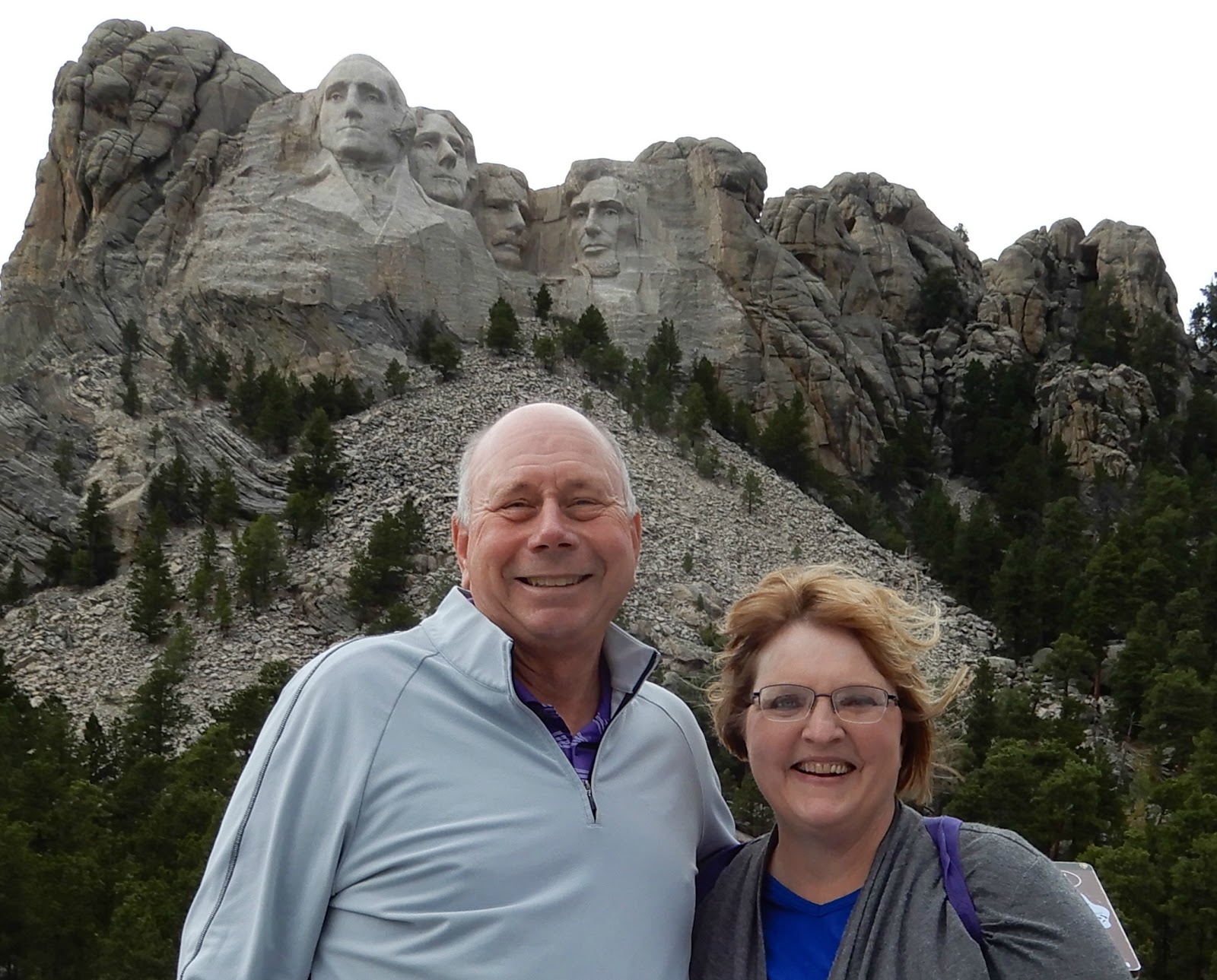
Taken September 19, 2017. Why does my hair always look like the "before" picture?

As a former newspaper Focus editor, I often had to incorporate "mug shots" into the pages I designed. There were people celebrating milestone birthdays, others marking 50 years or more of marriage and young couples just starting on their matrimonial journey.

Mug shots - or the dreaded "grip and grin" shots from a ribbon cutting or awards banquet - weren't the preferred illustration for newspaper editors. We much preferred action shots or unusual angles ... the photos that made the reader stop for a second look. (Of course, those head shots with anniversaries and weddings and such were probably the best read of the section, if I'm honest. People like seeing their friends and family in newsprint.)

But I couldn't resist having a stranger take our "mugs" visiting the "mugs" of a rather famous four guys in American history.  I returned the favor for several fellow tourists.

A trip to Mount Rushmore was not on the docket this September. However, Randy's brother was in the hospital in Rapid City, and Randy wanted to make the trip to South Dakota. After his brother was transferred to Montana for additional rehabilitation, we became tourists for the afternoon.

The day was gray, but the rain held off until after we'd been up and down the steps and trails that gave us different angles to view the monument.
 
As I looked at this monument carved out of the Black Hills of South Dakota, I kept thinking about what a genius sculptor and artist Gutzon Borglum had to have been. He didn't have any computer models. He didn't have modern equipment. He didn't have state-of-the-art blasting tools. He used a protractor ... yes, a protractor ... to figure out the measurements and dimensions.

And I realized that while Borglum didn't have modern contraptions, he had something much more valuable: He had vision. He could "see" through the layers of rock. And he had the skill and determination and intestinal fortitude to make it happen.
More than 450,000 tons of rock were removed from Mount Rushmore to bring out the four presidential faces. Although about 90 percent of the rock was removed with dynamite, the remaining rock was removed by drilling with jackhammers and wedging the rock off the mountain. The final finishing work on the faces was completed using small jackhammers and facing bits.

As with many monumental projects, not everybody was on the same page at first. In 1923, Doane Robinson, the superintendent of the South Dakota State Historical Society, had envisioned a massive mountain memorial carved from stone so large it would put South Dakota on the map and bring tourists by the carload. Robinson was dreaming of Western figures such as Chief Red Cloud, Buffalo Bill Cody, Lewis and Clark and other Western heroes.

 
But Borglum didn't share that vision. The outspoken sculptor told Robinson that his life's work would not be spent immortalizing regional heroes. Instead, he insisted the work demanded a subject national in nature and timeless in its history.

By selecting four presidential figures for the carving, Borglum wanted to create a reminder of the birth, growth, preservation and development of a nation dedicated to democracy and the pursuit of individual liberty.

In these days when the nation seems so divided, those ideals are worth remembering, don't you think? 
While we were in South Dakota, Randy read an article that said peak beauty for fall foliage was still a week or two away. We did find a little bit of fall color decorating our way.

Friday, May 29, 2015

Ghostwriter

Kathy's post to Facebook: The little sister has to ride in the back seat, just like old times!
Miles: 1,725.
Days: 4.
Siblings: 3.
Nieces: 2
Years since the last family vacation: 42
Time together: Priceless (or so I hear)

This week, Randy went on an adventure with his sister, Kathy, to visit their brother, Lyle, in South Dakota. Kathy's girls - Amanda and Emily - went along for the ride. They wanted to know how long it had been since Randy and Kathy had been on a family vacation. After some difficult math calculations, the siblings figured out it would have been 1973. The summer before Randy's senior year in high school, their family went to Ohio to visit family.

This was a last-minute trip. With rain in the forecast for another week, Randy called Kathy on the way home from Topeka on Saturday (May 23) and they left Monday morning (May 25) for Deadwood, South Dakota. He got home at 11:30 last night (May 28).
For the uninitiated, that's a farmer-style vacation. It's a last-minute excursion based totally on the weather. (The last time Randy and I visited Lyle, we left in a drought-stricken August.) Jill says that's how nearly all our family vacations happened, with the exception of some spring break trips. Since I had meetings every day this week and KFRM reports to do, I couldn't go at the last minute.
So, I will be the ghostwriter for this adventure. There is a marked difference when I actually go on the trip. In October 2010, we went to South Dakota (and Nebraska and Wyoming). I took 437 photos, and it took me seven blog posts to tell the tale.

Randy says he often commented to his traveling companions that "Kim would want to stop to take a picture." He did send me 11 photos from his phone - after he figured out how to do it. (I told him that he had three knowledgeable technology consultants in the car with him and just to ask!)
He sent me this photo of the Platte River at Grand Island, Nebraska. He literally took it standing in the parking lot at Arby's. He was well aware that I would have probably searched for a more scenic angle. 

Kathy was a good travel agent and booked a nice hotel, the Grand Mountain Resort Holiday Inn in Deadwood. Randy called and said that it was where Iowa farmer Chris Soules and his entourage from ABC's "The Bachelor" stayed and filmed an episode.

They got a good price since it was the off-season. One guy told Randy that October and May were the "times for newlyweds and nearly deads." I guess the Fritzemeier travel party didn't fit the parameters.
They toured the Broken Boot Gold Mine in Deadwood. Randy says it was probably more tourist trap than gold mine, but they still had fun. He got a stock certificate "which has no voting power and has a par value of plenty of blue sky when traded on the Deadwood Stock Exchange."
 
They also went to the 76 Museum in Deadwood. (FYI; The shirt and the hat were photo props - thank goodness!)

The museum had a basement full of buggies.
One of their favorite side trips was to Mount Rushmore. It was a must-see for Kathy and the girls.
Randy texted us to say that when he turns 62, he can buy a pass to all the national parks for a mere $10. Jill told him that it wasn't all that long.
Amanda, Kathy & Emily
Thankfully, they were able to get a few snapshots in and explore the monument before it started pouring rain, along with some hail.
 
They went through the Badlands on the way back to Kansas yesterday. This is the one photo I got via text. I took dozens from the same area.
Another difference: I probably would have suggested we not make the drive in one day. How can you get 437 photos otherwise?

Tuesday, October 26, 2010

Monumental


"... let us place there, carved high, as close to heaven as we can, the words of our leaders, their faces, to show posterity what manner of men they were. Then breathe a prayer that these records will endure until the wind and rain alone shall wear them away."
Gutzon Borglum, Mount Rushmore sculptor, 1930

I love photos. I'm sure that will come as quite a shock to all of you. But as much as I love photos, they can't always convey the magic of seeing something in person.

I've seen photos of Mount Rushmore. Actually seeing Mount Rushmore was monumental - pun intended.

Mount Rushmore was one of the stops on our vacation last week. As I looked at this monument carved out of the Black Hills of South Dakota, I kept thinking about what a genius sculptor and artist Gutzon Borglum had to have been.

He didn't have any computer models. He didn't have modern equipment. He didn't have state-of-the-art blasting tools. He used a protractor ... yes, a protractor ... to figure out the measurements and dimensions.

I saw a jetstream slice through the clear blue sky while I listened to a park ranger tell the story of Mount Rushmore.

And I realized that while Borglum didn't have modern contraptions, he had something much more valuable: He had vision.

He could "see" through the layers of rock. And he had the skill and determination and intestinal fortitude to make it happen.

As with many monumental projects, not everybody was on the same page at first. In 1923, Doane Robinson, the superintendent of the South Dakota State Historical Society, had envisioned a massive mountain memorial carved from stone so large it would put South Dakota on the map and bring tourists by the carload. Robinson was dreaming of Western figures such as Chief Red Cloud, Buffalo Bill Cody, Lewis and Clark and other Western heroes.

But Borglum didn't share that vision. The outspoken sculptor told Robinson that his life's work would not be spent immortalizing regional heroes. Instead, he insisted the work demanded a subject national in nature and timeless in its history.

By selecting four presidential figures for the carving, Borglum wanted to create a reminder of the birth, growth, preservation and development of a nation dedicated to democracy and the pursuit of individual liberty.

An avenue of state flags frames the walkway toward the memorial.

The selection of the four presidents was not without controversy either. Washington and Lincoln were obvious choices, and they were carved first and second, respectively.

The park ranger leading our tour said he's often asked, "Who are the other two guys?" While I find that a sad commentary on American's grasp of their own history, I guess grade school children aren't celebrating the birthdays of Thomas Jefferson and Teddy Roosevelt by coloring their faces and making paper cherry trees. On the other hand, when I was a grade school student, we did pay homage to Washington and Lincoln when we celebrated their February birthdays (individually - I might add.) Thomas Jefferson, the primary author of the U.S. Declaration of Independence, was another obvious choice for the monument, though his face might not be universally recognized.

Teddy Roosevelt was the most controversial of Borglum's choices. The president was a personal friend of the sculptor, but, as our park ranger said, Roosevelt was a champion of the American west and he - like his compatriots in stone - left the president's office better than he found it.

In 1927, with the help of more than 400 workers and several influential politicians, Borglum began carving a memorial to the history of America. More than 450,000 tons of rock were removed from Mount Rushmore to bring out the four presidential faces. Although nearly 90 percent of the rock was removed with dynamite, the remaining rock was removed by drilling with jackhammers and wedging the rock off the mountain.

The monument was finally completed in 1941. Borglum's son, Lincoln, did the final work on the monument after his father's death in March 1941.

The detail is remarkable. The closer you get to the monument, the more details you see. How did Borglum know what pieces of rock to remove to make the eyes stand out in each president's face? Genius ...

Today Mount Rushmore is visited by some 3 million visitors a year from across the U.S. and the world.

I was glad to visit the monument in the off-season and avoid some of those 3 million visitors.